This article explains public information. It does not determine eligibility or replace an official notice.
What did the Sindh Education Foundation approve in November 2026?
At its 14th Board of Governors meeting, chaired by Chief Minister Syed Murad Ali Shah, the Sindh Education Foundation approved a package that pairs reopening closed schools with higher subsidies and new schools in areas that have none. The meeting also reviewed the foundation's 2026-27 budget proposals and approved extra funding to recruit qualified and trained teachers.
The Chief Minister said education was the Sindh government's top priority and described investment in education as an investment in the province's future. He stressed quality education for children in remote and underserved communities, stronger school infrastructure across Sindh, better learning outcomes, higher enrolment and fewer children out of school. He also praised the foundation's record of expanding access through public-private partnerships and community-based schooling, and he called for effective measures to keep that progress going.
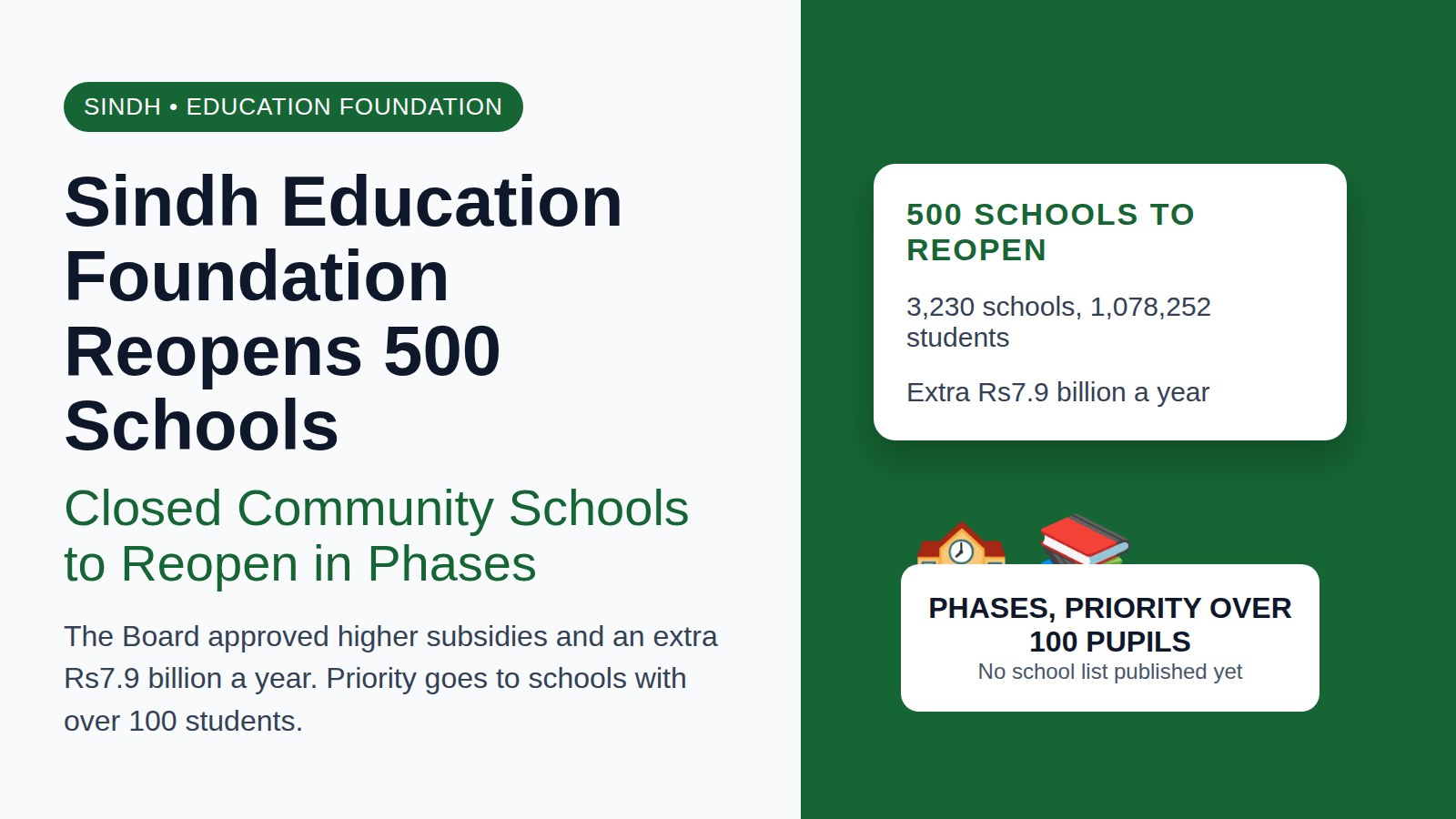
The headline decision is a proposal to reactivate about 500 government community schools in phases, with priority for institutions that have more than 100 students. The Chief Minister also directed officials to reopen closed foundation schools, open new schools where government facilities are unavailable, and fix schools that lack basic infrastructure and essential facilities. The board approved higher subsidies for government community schools and non-formal education programmes, plus a special grant package for institutions in underdeveloped and hard-to-reach areas. Extra funding was also approved to make Public School Tando Adam operational under the Peoples School Model.
How many schools does the Sindh Education Foundation run today?
The foundation now runs 3,230 schools and educational centres across Sindh, serving about 1,078,252 students, according to the figures shared at the board meeting. That scale makes it one of the largest school networks in the province, and it explains why a subsidy change touches so many families at once.
The same meeting was told that more than one million students in foundation-assisted schools will benefit from the revised subsidy rates, and more than 18,000 students at institutions run with The Citizens Foundation will benefit too. For context, the foundation enrolled one million students across the province by February 2026, a milestone the Sindh Education Minister, Syed Sardar Ali Shah, called remarkable at a meeting at the foundation head office in Karachi. The foundation works through public-private partnerships, with partner organisations running schools under its programmes while the foundation pays a per-student subsidy.
Which 500 schools will reopen first?
No published list names the 500 schools yet, and no phase dates have been announced. Parents should treat any list shared on social media or WhatsApp as unverified until the foundation or the School Education and Literacy Department publishes it.
The one selection rule that has been published is enrolment size. The proposal gives priority to institutions with more than 100 students, so larger closed community schools should come first when the phases begin. The Chief Minister also directed that new schools be opened where government facilities are unavailable, which points to remote and underserved areas first. Until the foundation releases district lists and dates, the honest answer is that nobody outside the department can say whether a specific school is in phase one.
What do the revised subsidy rates mean for schools and teachers?
The board approved revised subsidy rates for the first time since 2021-22, and the increase needs an additional Rs7.9 billion every year. The money is meant to improve educational standards, keep school activities running and give students better facilities.
The exact new per-student rates have not been published, so parents should not rely on any figure quoted online. The last published rates, given by Managing Director Gahanwer Ali Laghari in May 2025, were Rs800 to Rs2,000 a month per student from pre-school to Class 10, rising to Rs2,500 for higher secondary classes and up to Rs5,000 for some special initiatives. Those figures predate the November 2026 revision, so they show the old scale, not the new one. In February 2026 the Education Minister directed partner organisations to spend at least 40 per cent of the subsidy on teachers' salaries, a rule meant to lift teaching quality. A separate proposal reviewed in October 2025 would set the average per-child monthly subsidy at Rs2,500 with annual rises linked to inflation, but that proposal covered the foundation's partnership with The Citizens Foundation, not the whole network.
What is a government community school?
A government community school is a public school building run with community involvement under the foundation's model, rather than a school run directly by the School Education and Literacy Department. The foundation supports such schools through subsidies and partner organisations, and the model is designed for areas where a full government school is hard to staff or sustain.
The foundation itself is a semi-autonomous organisation set up under the Sindh Education Foundation Act 1992, with its head office in the NICL Building on Main Korangi Road in Karachi. Its Board of Governors is chaired by the Chief Minister, with the Education Minister as vice chairman. The foundation runs several programme types, including Foundation Assisted Schools, the People's School Programme, non-formal education centres and micro schools, and it works with partners such as The Citizens Foundation under a 2019 to 2029 agreement.
How will parents know when a school near them reopens?
Parents can follow five practical steps once the official information starts to come out. No step needs an agent or a fee, and every step can be checked against an official source.
- Watch for the official list. The foundation or the School Education and Literacy Department must publish district-wise lists of the 500 schools and their phase dates. Check sef.org.pk and the department's notices first.
- Visit the school building. Once a school is listed, parents can visit to confirm that teachers have been posted and classes have started, rather than relying on a reopening announcement alone.
- Ask the school operator. Each reopened school will have a partner organisation or operator managing it. Ask for the operator's name, the class levels offered and the enrolment process.
- Confirm there is no fee trap. Foundation-assisted schooling is meant to be free for enrolled children, so parents should report any demand for admission fees to the foundation.
- Keep documents ready. A child's birth registration or B Form and the parent's CNIC are the usual documents for enrolment in a government-supported school, so keep them ready before the lists come out.
What changed in November 2026?
The table below sums up every decision from the 14th Board of Governors meeting in one place. It is the quickest way to see what was approved and what is still unknown.
| Decision | What was decided | Status on 10 November 2026 |
|---|---|---|
| Reopening | About 500 government community schools to be reactivated in phases | Proposal approved, no school list or phase dates published |
| Subsidy rates | First revision since 2021-22, extra Rs7.9 billion a year | Approved, new per-student rates not published |
| Community and non-formal schooling | Higher subsidies for government community schools and non-formal education programmes | Approved |
| Hard-to-reach areas | Special grant package for institutions in underdeveloped and hard-to-reach areas | Approved |
| Public School Tando Adam | Extra funding to run it under the Peoples School Model | Approved |
| Teachers | Extra funding to recruit qualified and trained teachers | Approved |
| Budget | 2026-27 budget proposals reviewed | Under review |
The table shows the shape of the decision. The approvals are real and the numbers are on the record, but the two details parents want most, the school list and the dates, are still missing. That gap matters more than any other part of the announcement, because a reopening plan without a list cannot be checked school by school.
What should parents check before enrolling a child?
A reopened building is not the same as a working school. Parents should run through this checklist before they enrol a child in any school named in the reopening plan.
- The school's name appears on the official reopening list.
- Teachers are present and classes are running, not just announced.
- The class levels offered match the child's age and grade.
- No admission fee or monthly fee is demanded.
- Books and basic facilities, such as drinking water and washrooms, are in place.
- The operator's name and the foundation's support are confirmed at the school.
If any of these checks fails, parents should wait for the next phase or contact the foundation before enrolling. A school that opens without teachers, books or water does not serve the child, even if its name is on a list.
How does this expansion fit the wider Sindh education plan?
The reopening plan sits inside a larger push to bring out-of-school children back into classrooms. In an earlier board meeting the Chief Minister set the foundation a target of bringing 300,000 out-of-school children back to school by setting up 300 digital micro schools and hiring more than 600 women learning facilitators, with Rs800 million approved for the work. The foundation's Accelerated Digital Learning programme with Teach the World Foundation is part of the same push, and its second phase runs for three years.
Other Sindh schemes run alongside the school plan. The Sindh School Education Scholarship Programme reserves at least 50 per cent of its scholarships for girls, and the People's School Programme, started in 2022, now runs 35 English-medium schools with more than 25,000 students. Digital learning also reaches private school students through the Sindh Virtual STEM School, and families can check related support such as the Sindh Youth Card and Benazir Taleemi Wazaif stipends for school children. In Punjab, the same school-building idea takes a different form through the Nawaz Sharif Schools of Eminence and the Daanish Schools programme, which shows that each province is rebuilding its school network in its own way. Families in farming households can also check the Sindh Hari Card scheme for related provincial support.
The 500-school plan also has a precedent. In 2018 the foundation surveyed 941 closed government schools in Thatta, Badin, Jamshoro, Dadu and Sujawal and drew up a plan to reopen 168 of them, a step that was expected to give more than 35,000 children access to schooling. A 2024 report said only about 100 schools had reportedly been revived by then, which is a reminder that announcements and reopened classrooms are two different things. The November 2026 plan will be judged the same way, by how many of the 500 schools actually open their doors.
Frequently asked questions
When will the 500 closed schools reopen?
No reopening dates have been published. The proposal is to reactivate about 500 government community schools in phases, and the foundation has not announced when the first phase will start. Parents should watch sef.org.pk and the School Education and Literacy Department for the official dates.
Which schools are on the reopening list?
No list of the 500 schools has been published. The only selection rule announced so far is that institutions with more than 100 students get priority. Any list circulating on social media or WhatsApp is unverified until the foundation publishes it.
What is a government community school?
It is a public school building run with community involvement under the Sindh Education Foundation model, with the foundation paying a per-student subsidy to a partner organisation that manages the school. The model is used where a full government-run school is hard to staff or sustain, often in remote or underserved areas.
How much extra money will the subsidy rise cost?
The revised subsidy rates need an additional Rs7.9 billion every year, according to the figures shared at the board meeting. The new per-student rates themselves have not been published, so the extra cost is the only money figure parents can rely on for now.
Will school fees change for parents?
Nothing in the board decisions points to a fee for parents. Foundation-assisted schooling is meant to be free for enrolled children, and the subsidy is paid to the school operator, not charged to families. Parents should report any demand for admission or monthly fees to the foundation.
Who runs the Sindh Education Foundation?
The foundation is a semi-autonomous organisation set up under the Sindh Education Foundation Act 1992, and its Board of Governors is chaired by the Chief Minister, with the Education Minister as vice chairman. The Managing Director, Gahanwer Ali Laghari, runs its day-to-day work from the head office in Karachi.
How can parents check if a school near them will reopen?
Parents should wait for the official district-wise list from the foundation or the School Education and Literacy Department, then visit the school to confirm teachers are posted and classes are running. The school operator can confirm the class levels offered and the enrolment process.
What is the Peoples School Model, and what is Public School Tando Adam?
The Peoples School Model is the foundation's way of running English-medium comprehensive schools under public-private partnership, and the People's School Programme has run 35 such schools since 2022. Extra funding was approved at the November 2026 meeting to make Public School Tando Adam operational under this model.
How is this different from the 500 schools The Citizens Foundation will build by 2029?
They are two separate plans that share the same number by coincidence. The Citizens Foundation partnership, which runs from 2019 to 2029, aims to establish 500 new schools by June 2029, and 98 had been set up by October 2025. The November 2026 plan is about reactivating about 500 existing closed government community schools, not building new ones.
Will teachers be hired for the reopened schools?
Yes, extra funding was approved to recruit qualified and trained teachers and strengthen educational services. In February 2026 the Education Minister also directed partner organisations to spend at least 40 per cent of the subsidy on teachers' salaries. The number of posts and the hiring dates have not been published.
Sources and official links
Check the destination address before entering personal information.
Related guides
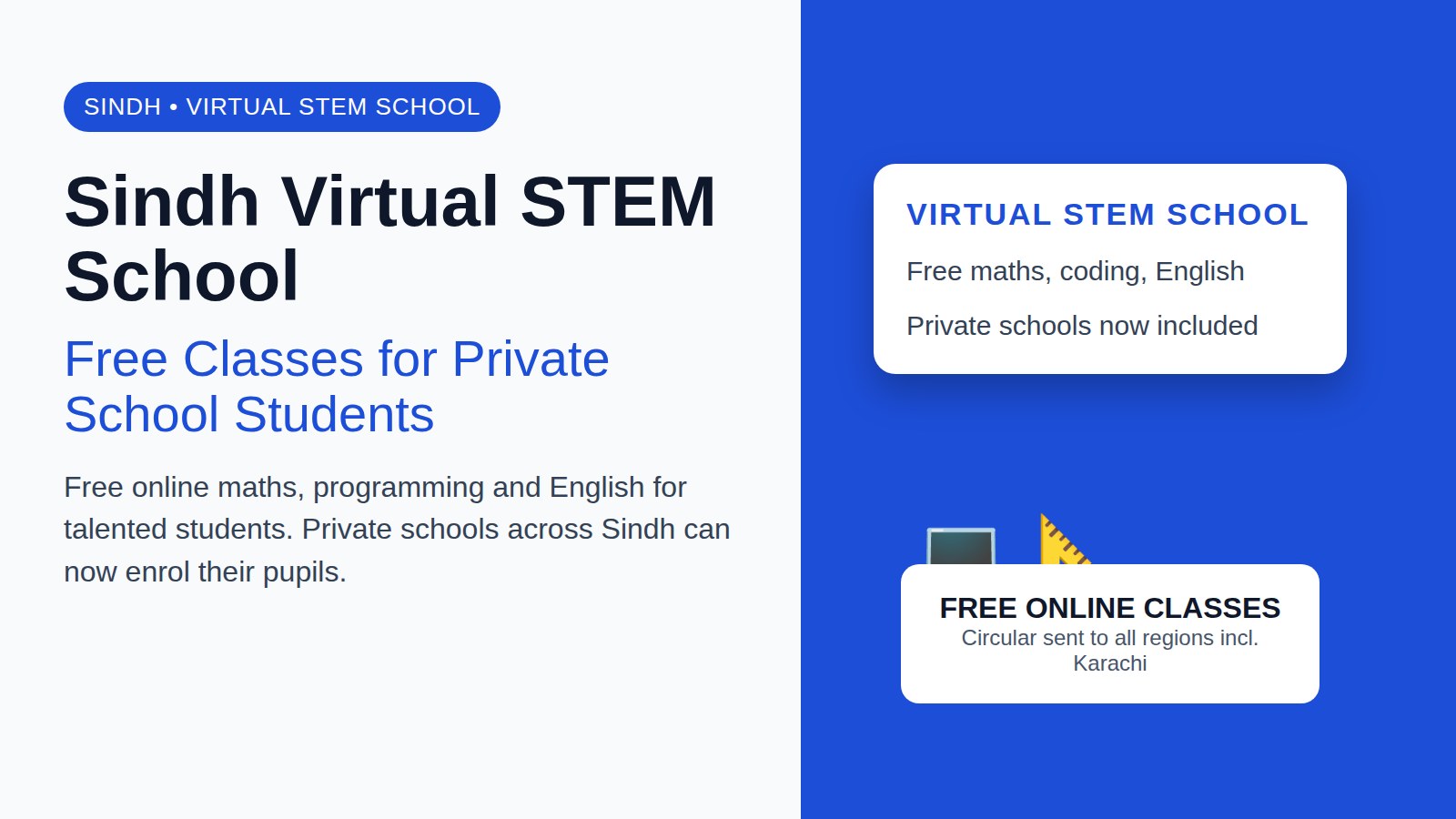
Sindh Virtual STEM School Opens Enrolment to Private School Students
Sindh has opened enrolment in its free Virtual STEM School to talented students from private schools across the province. A circular from the Directorate of Inspection and Registration of Private Institutions Sindh asks schools to register eligible pupils for online training in mathematics, computer programming and English.
Read guide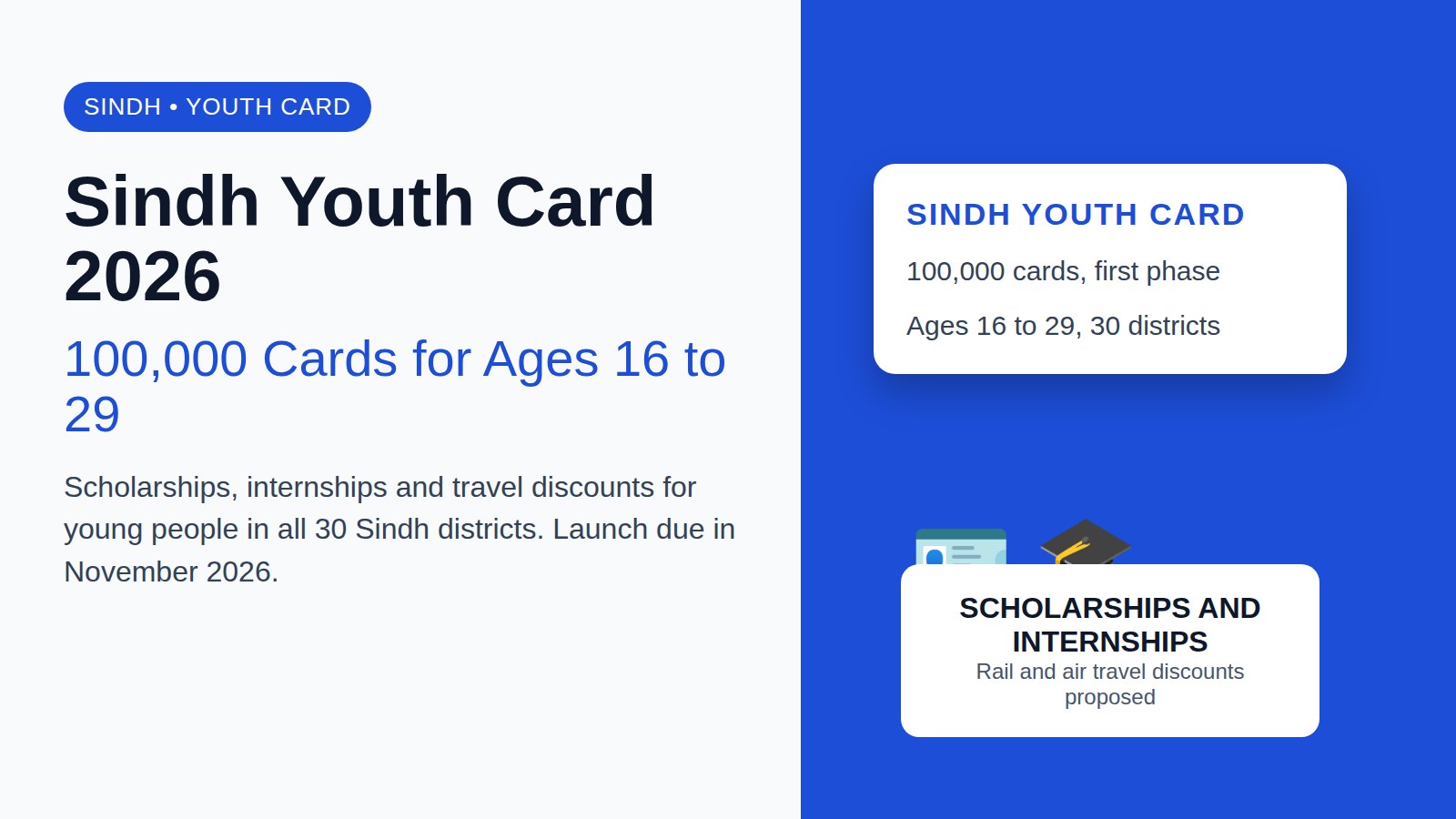
Sindh Youth Card 2026: Launch, Benefits, Eligibility and Registration
The Sindh Youth Card 2026 is a Sindh scheme for young people aged 16 to 29. It will bring scholarships, internships, skills training and services from 13 departments onto one digital platform. As of 8 November 2026 it has not launched yet, and registration will open after Bilawal Bhutto Zardari inaugurates it this month.
Read guide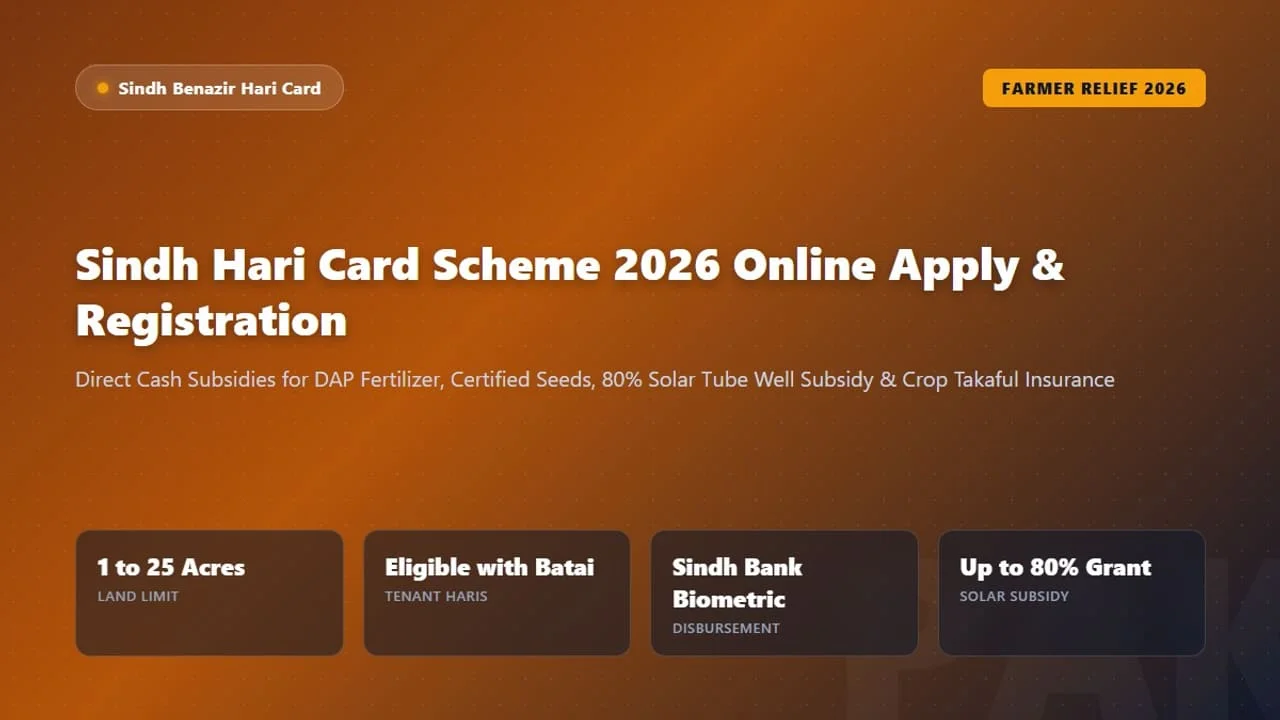
Sindh Hari Card Scheme 2026 Online Apply: Registration, Farmer Subsidies & Eligibility Guide
Apply for Sindh Hari Card 2026. Complete guide to registration, land eligibility criteria, Sindh Bank biometric card, fertilizer subsidies, and cash relief.
Read guide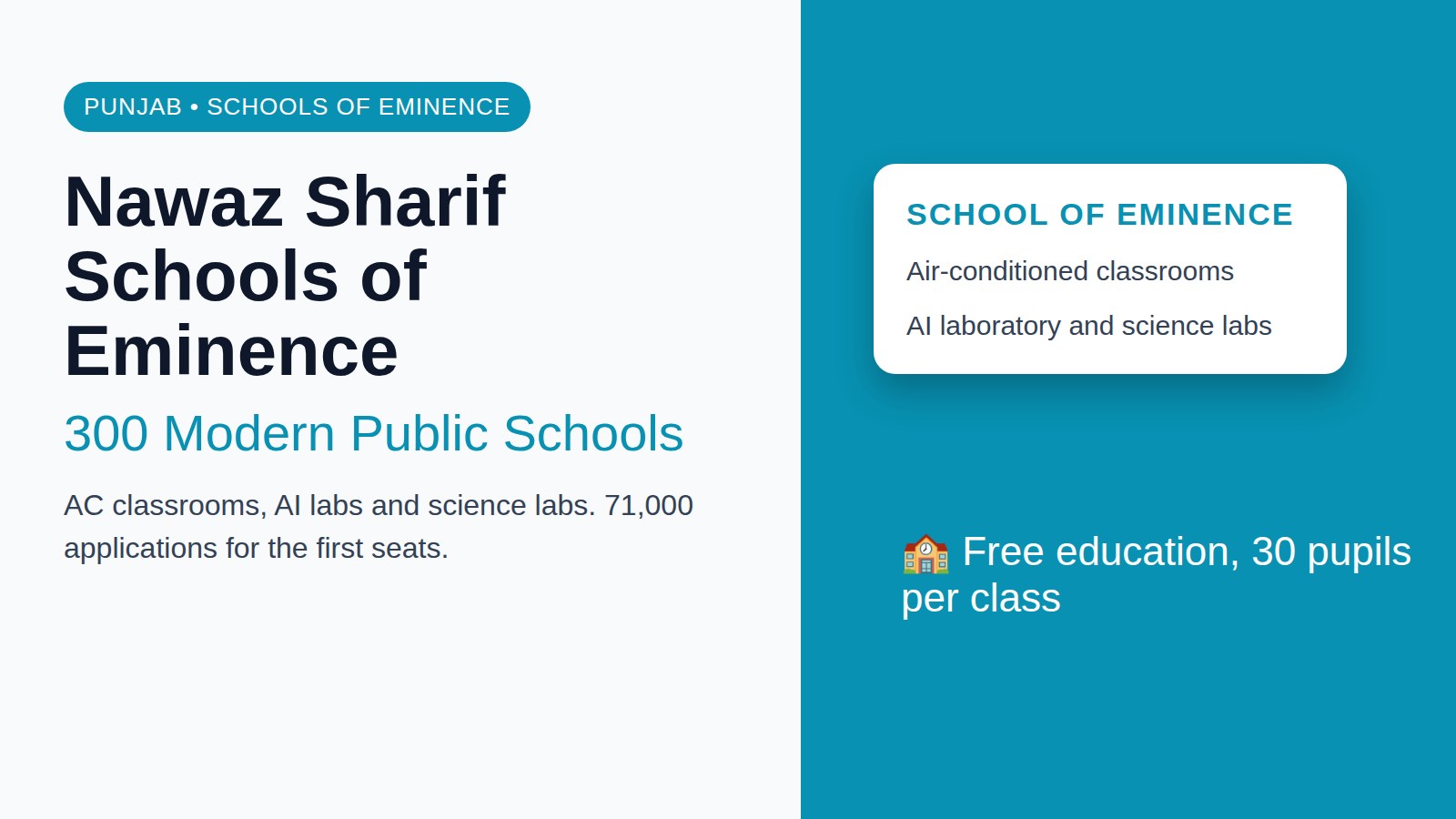
Nawaz Sharif Schools of Eminence Punjab: 300 Modern Public Schools Explained
Nawaz Sharif Schools of Eminence are 300 upgraded public schools being built across Punjab by the Punjab Education Foundation. Each campus has air-conditioned classrooms, AI laboratories and science labs, with classes capped at 30 students. Families earning up to Rs 200,000 a month get free education.
Read guide
Daanish Schools Construction Admission: What Was Ordered and Who Qualifies
On 31 October 2026, Prime Minister Shehbaz Sharif ordered Daanish Schools construction across Pakistan to run around the clock, with no compromise on quality. Admission stays strictly merit-based for children from the poorest and most deserving families. No new admission dates were published in the reports reviewed, so families should wait for an official announcement.
Read guide