This article explains public information. It does not determine eligibility or replace an official notice.
What is the Punjab She Threads programme?
This is an independent information guide. It is not the official website of the Punjab Women Development Department, the Punjab Skills Development Fund or any textile company named here.
Confirm the course, the education rule and seat availability with the centre before travelling, because reports differ by centre and stream.
A programme for rural women entering textile work
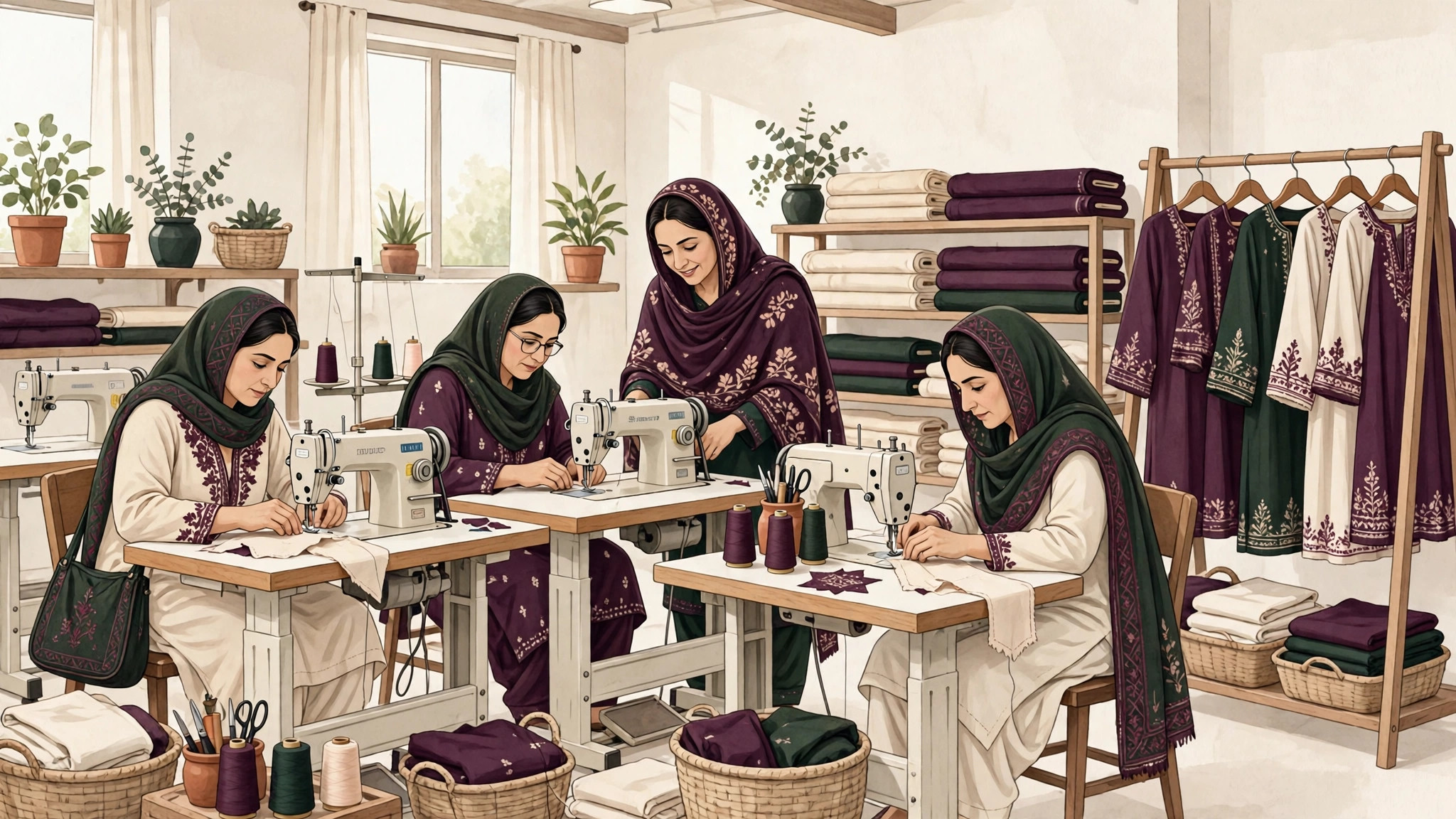
She Threads is a Punjab programme that trains rural women for work in the textile and garment industry. The official Women Development Department page describes its aim as economic empowerment of rural females in the textile sector, and as turning marginalised rural women into a skilled, formal workforce.
Training takes place at partner textile factories, so trainees learn on industrial equipment in a factory setting, not in a general classroom alone.
It is not a cash assistance programme, a university scholarship or a business loan. Its value is the skill, the certificate and the placement support that follow the course, together with the stipend paid during training.
Who runs it, and who funds the training
The Women Development Department of the Government of Punjab sponsors She Threads, and the Punjab Skills Development Fund (PSDF) executes it in collaboration with the department. PSDF is a Punjab skills development fund set up by the Government of Punjab, and it funds demand-driven skills training through partner providers.
The curriculum was developed with the Technical Education and Vocational Training Authority (TEVTA) and the textile industry, according to November 2026 reporting from Faisalabad. Programme reporting names Chief Minister Maryam Nawaz Sharif in connection with the initiative's vision, and Faisalabad reporting says 1,150 women trained in 2025-26, with a target of 2,500 women trained by June 2027.
Who can apply for She Threads registration?
Age, residence and domicile
Applicants must be women aged between 18 and 45 years, from rural or less-developed areas of Punjab, and seeking employment or self-employment. The official department page lists five programme districts: Sialkot, Sheikhupura, Faisalabad, Lahore and Multan.
November 2026 registration reports name centres only in Lahore and Faisalabad, so a woman from another programme district should confirm whether her nearest centre has an open batch before travelling.
Applicants must hold Punjab domicile. November reports from Faisalabad and Lahore both name domicile as a required document, alongside a Computerised National Identity Card (CNIC).
Residence in Punjab alone is not presented as enough; ask the centre if you do not hold Punjab domicile.
Education: why you must check with the centre
Education is the one eligibility point where November sources do not agree. Reporting from Faisalabad and Lahore in November 2026 says applicants need at least a matriculation qualification.
Older programme material and a June 2026 guide say middle level, class 8 pass, is enough. A later programme summary says middle to matriculation depending on the trade stream.
The safest reading is that the required level may differ by centre and by trade. Ask the centre for the education rule for the exact course you want, and take your original academic documents so staff can check them at screening.
Do not treat a middle pass or a matric certificate alone as a guarantee of admission for every course.
Who cannot apply at a particular factory
Shortlisted applicants must sign an affidavit declaring no previous association with the relevant industry partner as a trainee or employee. That rule is centre-specific: it bars a previous association with that factory, not necessarily with every textile employer.
If you have previously trained or worked at the factory where you want to apply, tell staff at the first visit and ask whether that batch is open to you. Seats are also limited, so meeting the age, domicile and education rules does not guarantee a place.
What training and money do trainees receive?
The three-month course mix
Training lasts three months and is free, including training materials. November reporting from Faisalabad says the course is 80 percent practical work and 20 percent classroom instruction, including soft skills.
The official department page adds foundation skills for the modern workplace, including digital financial literacy, communication and teamwork. Start dates, daily timings and course availability follow the factory's batch plan, so the centre, not a central calendar, is the source for the next intake.
Courses named in November reports
November centre reports name industrial stitching machine operation as the main course in Faisalabad, and apparel supervision as a course in Lahore. The wider programme also covers apparel planning and merchandising, pattern drafting, quality assurance and pattern cutting, according to Faisalabad reporting.
The official department page says there are 10 key trades in total, but November reports do not name all 10, so this guide names only the trades corroborated in November centre reporting and does not assume every trade is open at every centre.
Stipend, transport and materials
Trainees receive Rs 15,000 a month during training, and November reporting from Faisalabad says that amount includes a transport allowance. The official department page says trainees receive Rs 15,000 directly each month during training to cover expenses, and training materials are free.
The stipend is a training stipend, not a salary and not a cash assistance payment. No November centre report used here states the payment dates, the payment method or whether a trainee who leaves early keeps any part of the stipend, so ask the centre how and when it is paid before you enrol.
How do you register for She Threads in November 2026?
Registration for the November 2026 Lahore and Faisalabad intakes is described in centre reporting as in person at a participating textile factory. Older guides mention a WomenFirst app and a web page for registration.
Those older routes are not presented here as the November route, because November centre reporting describes on-site registration, screening and an affidavit at the factory. If a centre tells you a different route applies to its batch, follow the centre's instruction for that batch.
- 1. Choose a centre by course, not only by city. Confirm, if possible, that the course you want has seats in the current batch.
- 2. Visit the centre with your original CNIC, your Punjab domicile certificate and your original academic documents.
- 3. Tell registration staff that you want to apply for the Punjab government's She Threads programme, and give the course name you want.
- 4. Complete initial screening, including recording your personal information and previous training experience, a brief interview and verification of eligibility.
- 5. Wait for independent verification of your profile. Only verified candidates are shortlisted, according to Faisalabad reporting.
- 6. If shortlisted, sign the affidavit confirming the accuracy of your information and declaring no previous association with that industry partner as a trainee or employee, then complete formal enrolment.
Before you leave home
Take originals, not only photocopies, and keep copies for your own record. If your CNIC or domicile details do not match your academic documents, ask the centre before the visit whether a correction is needed, because a mismatch at screening can delay enrolment.
At the centre
Ask four questions before you submit anything:
Write down the answers, because that note helps you compare centres without relying on memory if a later announcement changes the course or schedule.
- Which course has seats?
- What education rule applies to that course?
- What the training schedule is?
- How the stipend is paid?
Which centres are taking registrations now?
The table below uses only centres named in November 2026 centre reporting. Centres in Sialkot, Sheikhupura and Multan are on the official programme district list, but no November centre report used here names an open registration desk in those districts, so they are not listed as open here.
Lahore centre
Registration in Lahore has begun under the Women Development Department, according to November 2026 reporting. Training is arranged at Shahkam Industries on Multan Road, and the course combines classroom teaching with practical training.
Information about registration can also be obtained through assistant commissioners, union council secretaries and relevant district offices.
Faisalabad centres
Faisalabad registration is handled through Masood Textile Mills and Alpha Knitting, both offering industrial stitching machine operation. The department has asked the district administration to help inform eligible women in rural areas accessible from Sheikhupura-Faisalabad Road and Jhang Road.
An information point is not a registration desk unless the centre confirms it, so confirm where to submit the application itself.
| Centre | City | Course reported in November 2026 | Address reported | Confirm before travelling |
|---|---|---|---|---|
| Shahkam Industries (Pvt.) Ltd. | Lahore | Apparel Supervisor; industrial stitching also listed in earlier programme information for this site | 1 km Defence Road, 23 km off Multan Road, Lahore | Which course has seats in this batch |
| Masood Textile Mills | Faisalabad | Industrial Stitching Machine Operator | 32 km, Sheikhupura-Faisalabad Road, Faisalabad | Education rule for stitching, and seat availability |
| Alpha Knitting (Pvt.) Ltd. | Faisalabad | Industrial Stitching Machine Operator | 220-RB Pathanwala, Jhang Road, Faisalabad | Education rule for stitching, and seat availability |
What happens after you submit your application?
Screening and independent verification
After you submit an application, staff record your personal information and previous training experience, hold a brief interview and verify eligibility. An independent firm then verifies applicants' profiles, and only verified candidates are shortlisted, according to Faisalabad reporting.
Registration at the factory is therefore not the same as enrolment: the first visit starts the process, and verification decides the shortlist. No November centre report used here gives a fixed verification time, a shortlist date or a waiting-list rule, and no one should be paid to speed up verification.
Affidavit and enrolment
Shortlisted applicants must sign an affidavit confirming the accuracy of their information and declaring no previous association with the relevant industry partner as a trainee or employee. Only applicants who complete all prescribed steps are formally enrolled.
Read the affidavit before signing it, and ask staff to explain any clause you do not understand, especially where it covers previous employment at that factory.
What happens after training ends?
Certification
Successful trainees receive certification from the Punjab Board of Technical Education (PBTE), according to Faisalabad reporting. PBTE certifies technical training, and its certificate is the formal record of the trade you completed, so keep the original and a copy for employers and later training applications.
The official page lists 2,500 certified women trained as a programme outcome, but that is a target and outcome claim, not a promise that every trainee in a batch will pass.
Placement support, not a promised job
The official department page uses the words guaranteed job placement and guaranteed employment after training. Other programme reporting uses softer language: facilitate formal job placements, support in securing jobs, and placement support with participating textile companies.
This guide uses placement support, because a guarantee for every trainee cannot be verified from November centre reporting, and placement depends on trade, assessment result, factory vacancies and location. Ask the centre, before you enrol, which partner employers took trainees from the last batch and in which trades.
How is She Threads different from SEHR and other Punjab programmes?
She Threads versus SEHR
SEHR, or Skill Enhancement Through Home Reach, is a different Women Development Department programme covering digital skills and hospitality tracks, and its registration was reported as stopped on 8 October 2026 while the certification process was updated. She Threads is a textile programme taught in person at factories, with a Rs 15,000 monthly stipend during training.
Do not use SEHR eligibility, courses or registration dates for She Threads. The test is the trade: industrial stitching, apparel supervision or another textile trade at a partner factory is She Threads material; online digital skills or hospitality should be checked as SEHR, and only if its registration is open on the day you apply.
She Threads versus scholarships and loans
She Threads is also different from the Punjab scholarship and loan guides readers often find alongside it on this site. The CM Punjab Honhaar Scholarship programme is a university scholarship, not factory training.
The Prime Minister Youth Loan Scheme is a business loan programme, not a training stipend. The Punjab Rozgar Scheme guide covers a provincial employment and loan scheme, not a textile course.
If you want a loan or a scholarship, use the relevant guide and its own eligibility rules.
Safety: fees, agents and your CNIC
No fee, no agent
Training is free, training materials are free, and no November centre report used here names a registration fee. Never pay a fee, a top-up, an advance or a verification charge to register, to speed up verification or to secure a seat.
A person who asks for money for any of those steps is not acting on behalf of the programme as described in official and centre reporting; report the approach through the centre or district office and keep any message or receipt as evidence.
Share documents only at the centre
Show your original CNIC, domicile certificate and academic documents at the participating factory during screening, as November reporting describes. Do not send copies of your CNIC, your CNIC number, a PIN or a one-time code to a person who contacts you by message, call or social media about She Threads, and do not share those details with this website.
This guide does not collect applications, and no application is made by reading this guide. If a message claims to be from the programme and asks for money or personal codes, treat it as a scam attempt and check with the centre or district office through a number or office you already trust.
Frequently asked questions
Is She Threads registration open now in Punjab?
Yes, in November 2026 registration is reported as open in person at participating textile factories in Lahore and Faisalabad. The official programme covers five districts, but November centre reports name only Lahore and Faisalabad desks, so confirm the position in Sialkot, Sheikhupura or Multan before travelling.
Who is eligible for the Punjab She Threads programme?
Women aged 18 to 45 from rural or less-developed areas of Punjab, with Punjab domicile and seeking employment or self-employment, are the target group. The education rule differs by centre and trade in November reporting, so confirm the exact rule for your chosen course with the centre.
How much is the She Threads monthly stipend?
Trainees receive Rs 15,000 a month during the three-month training period, and November reporting from Faisalabad says that amount includes a transport allowance. The official department page also states Rs 15,000 a month during training, and training materials are free.
Is She Threads training really free?
Yes, training and training materials are free according to the official department page and November centre reporting. No registration fee is named in those reports, and any person asking for a fee to register, verify or secure a seat should be treated as a scam risk.
What courses does She Threads offer?
November centre reports name industrial stitching machine operation in Faisalabad and apparel supervision in Lahore, with apparel planning and merchandising, pattern drafting, quality assurance and pattern cutting also covered by the wider programme. The official page says there are 10 key trades in total, but November reports do not name all 10, so confirm which trade has seats at your centre.
Where do I register for She Threads in Lahore and Faisalabad?
In Lahore, register at Shahkam Industries (Pvt.) Ltd., 1 km Defence Road, 23 km off Multan Road. In Faisalabad, register at Masood Textile Mills, 32 km Sheikhupura-Faisalabad Road, or Alpha Knitting (Pvt.) Ltd., 220-RB Pathanwala, Jhang Road. Take your original CNIC, domicile certificate and academic documents.
What documents do I need for She Threads registration?
You need your original CNIC, your Punjab domicile certificate and your original academic documents for screening. Shortlisted applicants must also sign an affidavit confirming the accuracy of their information and declaring no previous association with that factory as a trainee or employee.
Can I apply if I previously worked at the same factory?
No, for that factory, according to November reporting, because shortlisted applicants must declare no previous association with the relevant industry partner as a trainee or employee. That rule is centre-specific, so ask another centre whether its batch is open to you if you have a previous association with one factory.
What certificate do I get after She Threads training?
Successful trainees receive certification from the Punjab Board of Technical Education (PBTE), according to Faisalabad reporting. The certificate records the trade you completed, so keep the original and a copy for employers and for any later training application.
How is She Threads different from SEHR?
She Threads is in-person textile training at partner factories with a Rs 15,000 monthly stipend, while SEHR is a different Women Development Department programme covering digital skills and hospitality. SEHR registration was reported as stopped on 8 October 2026 while certification was updated, so do not use SEHR dates or courses for a She Threads application.
Sources and official links
Check the destination address before entering personal information.
Related guides

CM Punjab Honhaar Merit Scholarship Program 2026: Online Apply, Eligibility & 100% Tuition Fee Guide
To apply online for the CM Punjab Honhaar Merit Scholarship Program in 2026, register on the official portal at honhaarscholarship.punjabhec.gov.pk using your CNIC/B-Form and academic registration details. The Government of Punjab provides 100% full tuition fee coverage for 30,000 undergraduate students enrolled in 68 priority disciplines across 50 public universities and medical colleges.
Read guide
Prime Minister Youth Loan Scheme 2026: Complete Application, Eligibility & Tiers Guide
The Prime Minister Youth Loan Scheme 2026 provides subsidized business financing up to Rs 7.5 million for Pakistani citizens aged 21 to 45 across three tiers (0%, 5%, and 7% markup). Apply online through the official pmyp.gov.pk portal.
Read guide
Punjab Rozgar Scheme: Subsidized Business Finance
Understand Punjab Rozgar business finance, official terms and the difference between subsidized markup and an interest-free loan.
Read guide
Benazir Hunarmand Programme 2026: Free Skills Training, Eligibility and Registration for BISP Families
Benazir Hunarmand Programme offers free skills training to one member of a BISP family who is aged 18 to 40, has at least Matric, and is registered in the BISP Dynamic Registry. Registration is through the official Hunarmand portal or a BISP Tehsil Office, and registration alone does not guarantee selection for training.
Read guide
Punjab One Million Youth Skills Plan: Mahir, Global Rozgar, Advance Tech and Language Learning Explained
Punjab plans to train one million young people in technical and vocational skills over three years. The target was announced on 1 November 2026, and it covers industrial training, business process outsourcing, emerging technology, agriculture, and language learning. It is a target, not an open application form.
Read guide