This article explains public information. It does not determine eligibility or replace an official notice.
What does "ever-married condition removed" actually mean?
BISP has reported that the ever-married condition for Benazir Kafaalat is removed, so marital history alone should no longer decide who receives payment. BISP has not yet published the start date, new wording, or update process, so an unmarried woman should confirm her record at a tehsil office before expecting payment.
Independent note: PakBenefits is not BISP and is not affiliated with the Government of Pakistan. It does not register you or collect your CNIC. Check your record only on the official 8171 portal, by SMS to 8171, or at a BISP tehsil office.
The old payee rule, in plain terms
Under the old rule, the payee in an eligible household had to be an ever-married woman with a valid CNIC. Ever-married means a woman who is married now, or who has been married before, including a widow or a divorced woman. That rule decided who received the money, even when the household itself had already passed the poverty survey, so a poor household with no married woman in it could be left without a payee.
The new position, as reported on 29 October 2026
On 29 October 2026, BISP briefed First Lady Bibi Asifa Bhutto Zardari at BISP headquarters in Islamabad, led by Chairperson Senator Rubina Khalid and Secretary Amer Ali Ahmad. The removal of the ever-married condition was highlighted as a step to reach women who were previously excluded. That is a reported direction, not a published rule: no start date, new wording, or update process was given.
What has BISP confirmed, and what has it not published yet?
Confirmed in the 29 October briefing
The briefing confirmed the direction of travel, and it gave two payment-system figures. Secretary Amer Ali Ahmad told the meeting that 9.7 million Benazir SIMs had been activated under the Social Protection Wallet, and that 9.3 million beneficiaries had transacted through CNIC-linked digital wallets.
It also noted more than 50,000 registrations for the Benazir Hunarmand Programme. Those items are context, not proof that a particular household has been updated.
Not yet confirmed
Three questions remain open, and a careful guide should name them rather than fill them in: the date the condition was removed, whether unmarried women already in surveyed households will be added automatically or must visit an office, and whether the change applies only to Benazir Kafaalat or also to Benazir Taleemi Wazaif and Benazir Nashonuma. As of 31 October 2026, reporting noted that bisp.gov.pk did not yet carry the change. Check bisp.gov.pk again before publishing, and update this section if BISP has since published the rule.
| Question | Status as of 4 November 2026 |
|---|---|
| Is the ever-married condition removed? | Reported in the 29 October 2026 briefing, not yet published as a rule in the 31 October check |
| When did it take effect? | Not published |
| How are existing households updated? | Not published |
| Does it cover Taleemi Wazaif and Nashonuma? | Not published |
| Does the poverty test change? | No change announced |
| Does the quarterly amount change? | No change announced in that briefing |
Who may gain from the change?
Households with no married woman as payee
The households most likely to gain are those where no woman meets the old ever-married test, such as a household headed by an unmarried adult daughter, an unmarried sister, or another unmarried woman who manages the home. If the household passes the poverty survey, the change suggests that such a woman could now be named as the payee, instead of the household being left out for marital status alone. This does not mean every unmarried woman qualifies: the household must still pass the survey, and she must hold a valid CNIC.
Households that were already surveyed
A second group needs a different answer, and BISP has not yet given it: households already surveyed, where an unmarried woman was not recorded as the payee because of the old rule. It is not yet known whether BISP will update those records automatically, or whether the woman must ask for a survey update at a tehsil office. Until that process is published, ask in person and keep a record of the answer, rather than assume a record has changed.
What still decides whether a household gets Kafaalat?
The poverty survey and the PMT cut-off
Benazir Kafaalat is decided by the National Socio-Economic Registry, known as NSER. A household survey produces a Proxy Means Test score, known as a PMT score, on a scale from 0 to 100, where a lower score means a poorer household.
A household generally needs a PMT score of 32 or below to qualify, or below 37 where a household member has a disability. The 29 October briefing announced no change to that cut-off.
Full rules: BISP eligibility criteria guide
A valid CNIC and a matching household record
The payee must hold a valid Computerised National Identity Card, known as a CNIC, issued by the National Database and Registration Authority, known as NADRA. Her CNIC, household members, and survey record must match NADRA records.
A mismatch, or an expired CNIC, can still block payment. Correction happens in person, through NADRA or a BISP desk, because the portal cannot correct a record or change a PMT score.
Other exclusion checks that have not changed
BISP also applies exclusion checks that screen out better-off households, and the 29 October briefing announced no change to them. Competitors report that a government job, a car or commercial property, frequent foreign travel, and high utility bills can lead to exclusion, and a biometric mismatch can delay payment. Confirm the exact filters with BISP in individual cases.
How do you check your 8171 result?
Check by portal or SMS
The 8171 check is a status check, not a registration. It reads the household record that BISP already holds, and it does not create a new record or change a payee. Use only the official channels, and do not enter your CNIC on a copycat site, a social media form, or a site that asks for a PIN, a one-time code, or a fee.
Full check guide: Check BISP status by CNIC online
- 1. Open the official portal yourself by typing 8171.bisp.gov.pk, or send your 13-digit CNIC number, without dashes, by SMS to 8171.
- 2. On the portal, enter the 13-digit CNIC of the beneficiary woman and the picture code shown on the screen, then submit.
- 3. Read the reply carefully, and keep a note of the exact wording and the date you checked.
- 4. Wait for a message from 8171 before travelling to collect money, because an eligible result does not by itself mean that a payment for the current cycle has been released.
How to read the result after the payee change
An eligible result means the household meets the survey test, but it does not answer the payee question by itself. If it still names a different payee, or shows no record, ask at a tehsil office. Not-eligible usually points to the PMT score, no-record usually means no survey or a mistyped CNIC, and under-verification means a mismatch still needs resolving in person.
What should an unmarried woman do at a tehsil office?
Questions to ask, in order
Take this checklist to the office, and ask the questions in this order, so that you leave with a clear answer rather than a general reassurance. This checklist is the original element in this guide: competitors gave general visit steps, but none gave a payee-specific question script tied to the three unpublished details.
If no instructions have arrived, ask what to do in the meantime, whether a note can be added to the file, and check again after BISP publishes the rule. Do not pay anyone who offers to speed up the process.
- 1. Has your office received written instructions about removing the ever-married condition for Kafaalat?
- 2. Can an unmarried woman in my household now be recorded as the payee, and if so, what form or survey update is needed?
- 3. Does my household need a new survey, a roster update, or no visit at all, and what is the next step in my case?
- 4. Will the change be applied automatically to households already surveyed, or must I request it?
- 5. Does the change also apply to Taleemi Wazaif or Nashonuma for my household, or only to Kafaalat?
- 6. What should I check on 8171 after this visit, and after how many days should I check again?
What to take and what to write down
Take your original CNIC, adult family members' CNICs, and children's B-Forms, plus any document showing a family change, and your mobile phone. Do not hand your phone, SIM, PIN, or one-time code to anyone else.
Write down the date, the officer's name if given, any token number, and each answer, for comparison with the published rule. General survey steps: Benazir Kafaalat registration and CNIC check guide
Why do older guides still say only ever-married women qualify?
The old wording is still in circulation
Older BISP leaflets, survey sheets, and many online guides still state the old rule: only an ever-married woman with a valid CNIC can be declared a beneficiary in an eligible household. That wording has not been withdrawn in a published notice, and offices may still use old forms. A briefing and its written implementation are at different stages, which explains the confusion.
The age claims you should not rely on
Some guides add an age threshold the 29 October briefing did not mention: one claims never-married women above 40 were considered, another claims unmarried women above 35 have been approved. Neither appears in the briefing coverage. Do not plan around 35 or 40 unless BISP publishes it.
What scams and mistakes should you avoid?
No fee, no agent, no PIN
BISP registration, surveys, and 8171 checks are free. No one may charge you for registration, a survey update, a SIM, wallet activation, or recording a payee.
Treat anyone asking for money, a PIN, a one-time code, or your phone as a fraud. BISP messages come only from 8171.
Do not share your CNIC with this site or a stranger
This site does not need your CNIC and does not check your status for you. Enter it only on 8171.bisp.gov.pk or by SMS to 8171.
A genuine officer does not need your phone or PIN to answer a payee question. Check again after a survey update, after BISP publishes the rule, and at each new payment cycle.
Frequently asked questions
Has BISP removed the ever-married condition?
Yes, as a reported briefing point, but not yet as a published rule. BISP highlighted the removal in its briefing to First Lady Bibi Asifa Bhutto Zardari on 29 October 2026. As of the 31 October check reported at the time, bisp.gov.pk had not yet published the rule change, so the implementation details remain open.
Can an unmarried woman now get BISP Kafaalat?
She may be able to be the payee, but only if her household passes the poverty survey and her record is correctly updated. The change suggests that marital history alone should no longer block her, but it does not guarantee payment. She should confirm her household record at a tehsil office and check her 8171 result before expecting money.
Does the removal change the PMT score cut-off?
No change to the PMT cut-off was announced in the 29 October briefing. A household generally still needs a PMT score of 32 or below, or below 37 where a household member has a disability. If the score is above the cut-off, the payee change alone does not make the household eligible.
Does the payment amount change because of this rule change?
No amount change was announced in the 29 October briefing. The quarterly Benazir Kafaalat amount is reported at Rs 14,500 for the October to December 2026 quarter. A rise to Rs 18,000 from January 2027 has been reported as planned, but it had not been paid as of the November 2026 reporting, and it should not be treated as current November income.
Does the change also apply to Taleemi Wazaif and Nashonuma?
That has not been confirmed. The 29 October briefing coverage discussed the ever-married condition in the context of Kafaalat, and it did not state whether Taleemi Wazaif or Nashonuma, which are paid to the mother, are covered. Ask at a tehsil office, and do not assume that a Kafaalat change automatically changes those programmes.
Do I need to be 35 or 40 years old to qualify as an unmarried woman?
No age threshold of 35 or 40 was given in the 29 October briefing coverage, so this guide does not use one. Older guides have claimed different age thresholds, but those claims are not the new rule and should not be relied on. Wait for BISP to publish the new wording, and ask the tehsil office what age rule, if any, it is currently applying.
Can I register as an unmarried woman online through 8171?
No, the 8171 portal and SMS service only check status, they do not register a household or change a payee. Registration and survey updates happen in person at a BISP tehsil office or registration desk, or through a BISP mobile registration van where available. Any site offering online BISP registration for a fee is not official.
What documents should I take to a tehsil office?
Take your own original CNIC, the CNICs of adult family members who live in the house, and the B-Forms of children in the house. Take any document that shows a relevant family change, and take your mobile phone so you can receive a message from 8171. Do not hand your phone, SIM, PIN, or one-time code to anyone else during the visit.
What should I do if the tehsil office still applies the old rule?
Ask politely whether written instructions about the removal have arrived, and ask what update, if any, is needed in your case. Write down the date, the answer, and any token or slip number, and check again after BISP publishes the rule. If anyone asks for a fee, refuse, keep a note of the details, and report it on the BISP helpline on 0800-26477.
Is there any fee to add an unmarried woman as a payee?
No, BISP surveys and registration are free, and no fee is charged for a survey update or for recording a payee. Anyone who asks for money, a PIN, or a one-time code to register you, update you, or speed up your payment is running a scam. Report the attempt to BISP, and do not share your CNIC or wallet details with that person.
Sources and official links
Check the destination address before entering personal information.
Related guides
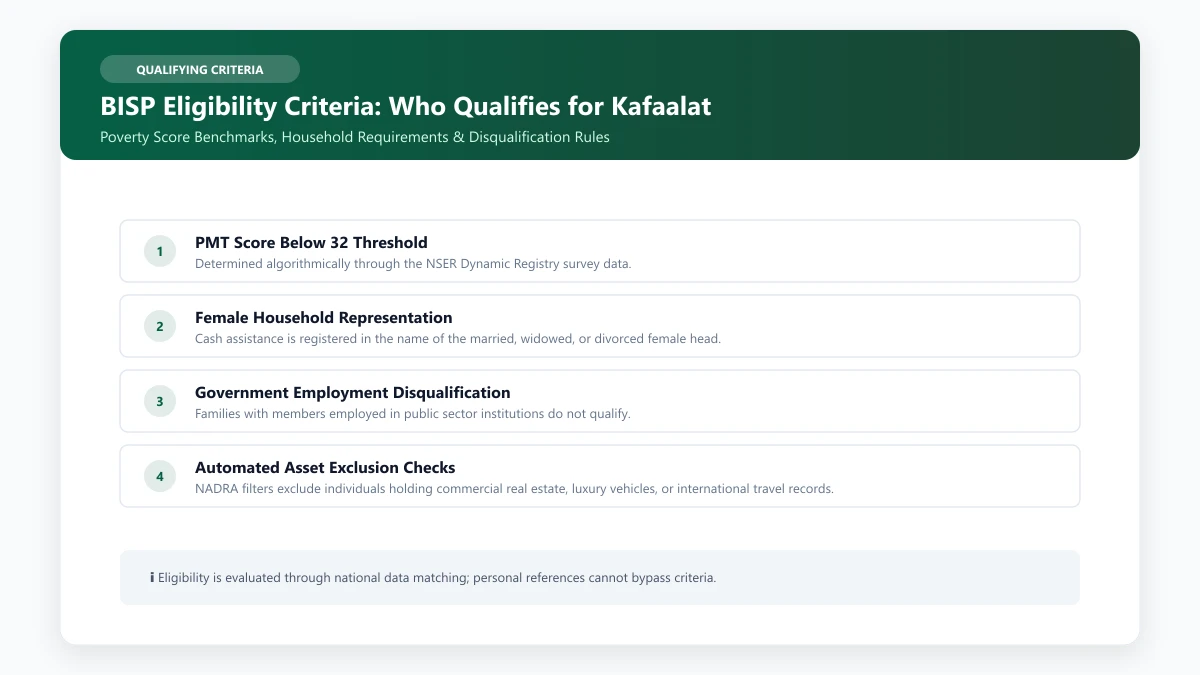
BISP Eligibility Criteria: Who Actually Qualifies for Benazir Kafaalat
BISP eligibility runs on a household's PMT score from the NSER survey, not a fixed income figure — the approved cutoff is 32, relaxed to 37 for households with a differently-abled member.
Read guide
BISP Benazir Kafaalat 2026: 8171 Online CNIC Check & Complete Eligibility Guide
Complete 2026 step-by-step guide to check BISP Benazir Kafaalat payment status online by CNIC via the 8171 web portal. Learn PMT score cutoffs, NSER dynamic survey registration, the Rs 14,500 quarterly stipend from 10 March 2026, and digital wallet payment methods.
Read guide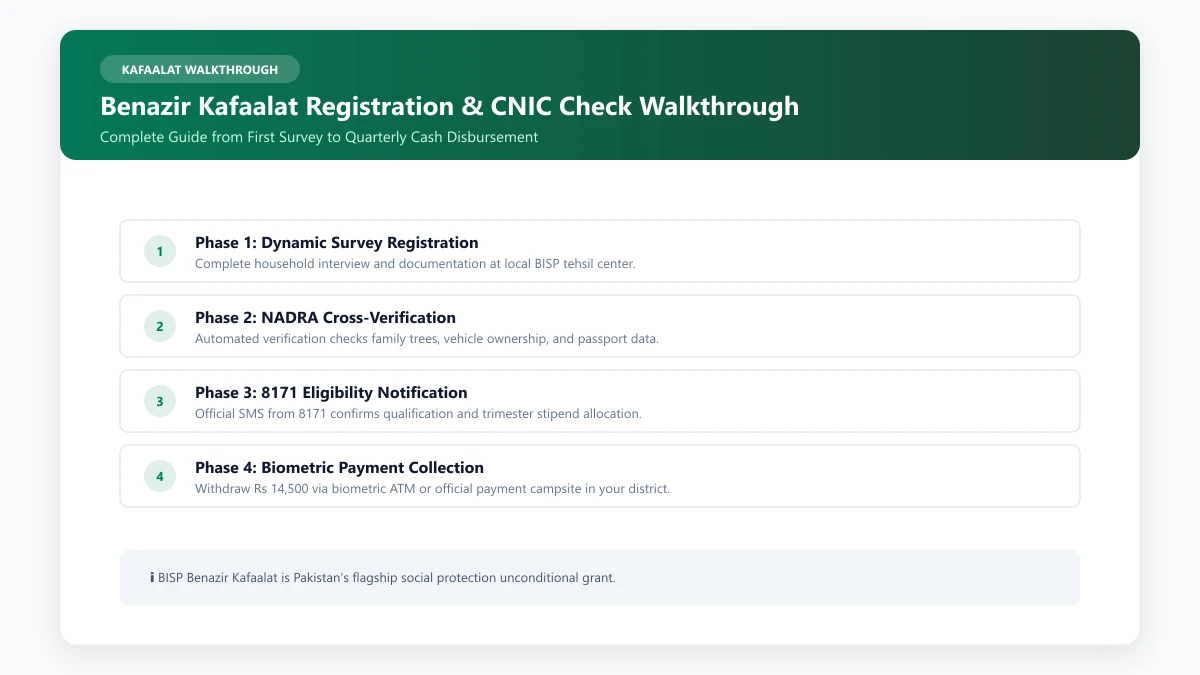
Benazir Kafaalat Registration & CNIC Check: A Complete Walkthrough
How Kafaalat differs from general BISP registration, how the CNIC check works, and what a positive result means next.
Read guide
Benazir Hunarmand Programme 2026: Free Skills Training, Eligibility and Registration for BISP Families
Benazir Hunarmand Programme offers free skills training to one member of a BISP family who is aged 18 to 40, has at least Matric, and is registered in the BISP Dynamic Registry. Registration is through the official Hunarmand portal or a BISP Tehsil Office, and registration alone does not guarantee selection for training.
Read guide
BISP Social Protection Wallet in November 2026: Withdraw From Any Partner Bank, the Rs 280 Cash Charge, and the 31 December Deadline
Yes. As of November 2026, a BISP Social Protection Wallet payment can be withdrawn from an authorised retailer of a partner bank in any city, not only from the bank or district that issued it. Cash withdrawal from the wallet carries a fixed Rs 280 service charge, while online and RAAST transfers are reported free.
Read guide