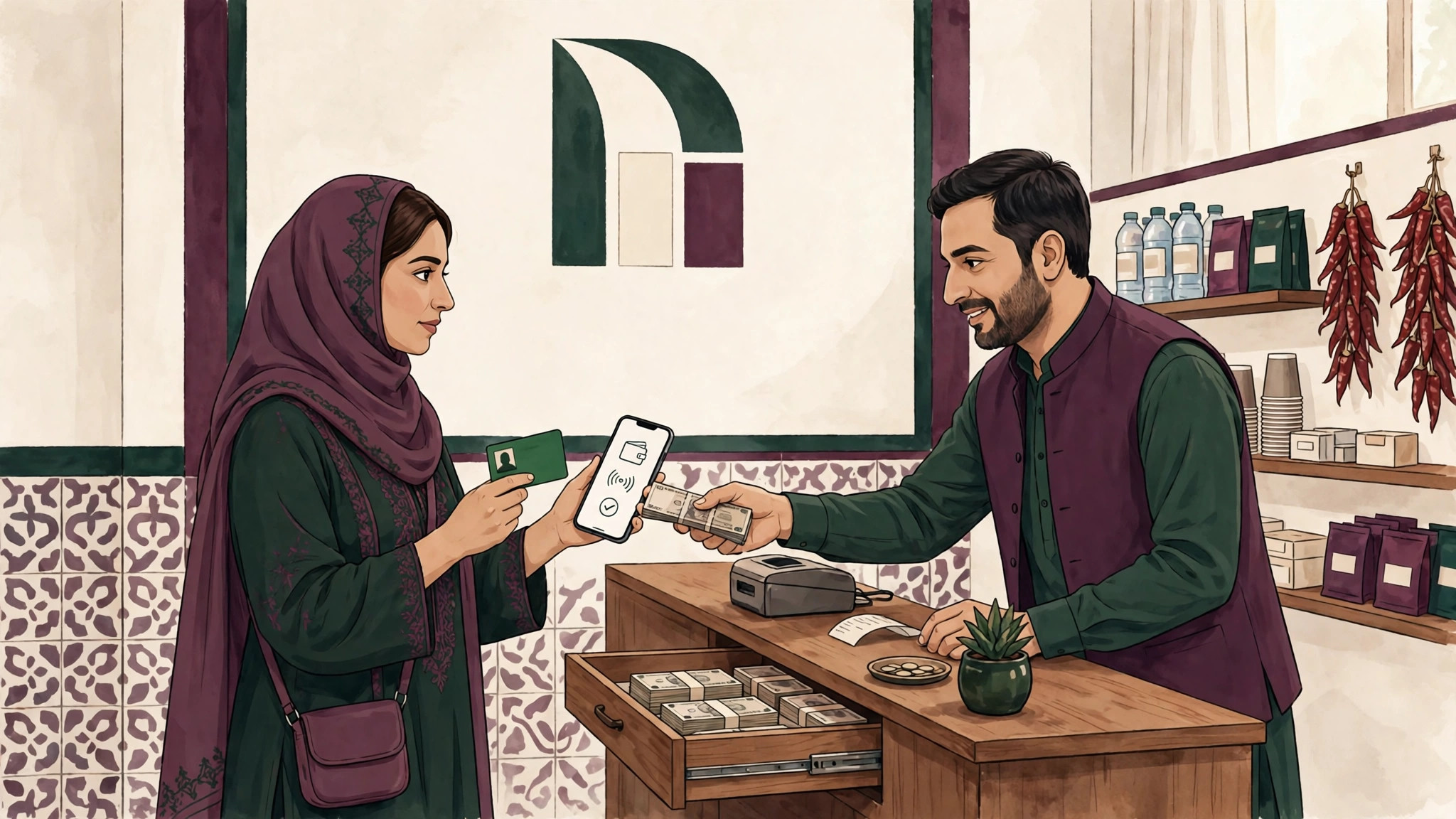
This article explains public information. It does not determine eligibility or replace an official notice.
What is the BISP Social Protection Wallet?
This guide is independent. It is not affiliated with the Benazir Income Support Programme (BISP), and it is not an official BISP page. Do not share your Computerised National Identity Card (CNIC) number, phone, PIN, or any code with this site or with anyone who contacts you claiming to be from BISP. Check your own status only through the official 8171 SMS service, the official 8171 web portal, a BISP tehsil office, or the BISP helpline on 0800-26477.
The Social Protection Wallet is the digital wallet that BISP uses to pay Benazir Kafaalat money. BISP is the federal cash transfer programme that pays a quarterly amount to a woman in each eligible poor household.
Eligibility itself is decided by the National Socio-Economic Registry survey and the resulting Proxy Means Test score, not by the wallet. The wallet is linked to a free Benazir SIM that BISP issues, and BISP staff activate the wallet when the SIM is issued.
The wallet replaced the older pattern in which a woman often had to return to a fixed payment point in her home district. Under the wallet system, the payment stays in the wallet until the woman chooses to withdraw it or transfer it.
That point matters in November 2026, because it means a payment does not have to be collected on the first day it arrives, and it does not have to be collected in one place only.
BISP reported in August 2026 that digital wallet accounts had been opened for 90 percent of women beneficiaries. A later briefing on 29 October 2026 reported 9.7 million Benazir SIMs activated and 9.3 million beneficiaries who had transacted through CNIC-linked digital wallets. Those two figures are not the same measure, so they should not be added together or treated as a single total.
Can I really withdraw from any partner bank?
Yes, according to the interoperability announcement reported on 20 October 2026. Interoperability means that the wallet is not locked to one bank's retailer network.
A woman can go to an authorised retailer of a partner bank in any city, on any day, and withdraw her wallet payment, even if she is away from her home district.
The change does not remove the checks at the counter. The retailer must be authorised, the woman must present her original CNIC, and she must complete biometric verification.
A retailer in a private house, a shop that is not authorised, or a person who asks to hold her phone is not part of this system, even if that person claims otherwise.
Which six banks are reported?
Secondary reporting of the 20 October 2026 E-Kacheri names six partner banks: HBL, Habib Microfinance, Bank Alfalah, Telenor Microfinance Bank, the Bank of Punjab, and Mobilink/Jazz Bank.
That list is reported, not a list this draft could confirm in a BISP press release text available for this research. A separate competitor review of BISP press releases No. 56, 66, 57, 70, 71, and 76 notes that those releases did not name the six banks.
A different list appears in an earlier signing report. The June 2026 signing was attended by the State Bank of Pakistan, 1LINK, Habib Bank Limited, Bank Alfalah, the Bank of Punjab, HBL Microfinance Bank, Easypaisa, and JazzCash, with the World Bank also present.
That is an attendance list for a signing, not the same as the six-bank retailer list reported in October. The draft therefore names the October list as reported, and flags the bank list for a final check at a BISP office before publishing, rather than presenting it as fully confirmed by BISP itself.
What has changed from the old payment points?
Before the wallet system, many women collected payments after a fingerprint check at HBL or Bank Alfalah points of sale, with the bank often depending on the province. The wallet system moves the payment into a digital account first, and the withdrawal point second.
The practical result is that location matters less, but identity checks matter just as much.
The wallet also changes the timing question. BISP says the money stays safely in the wallet, so a woman does not need to withdraw it at once.
That helps when a district phase is still releasing, when travel is difficult, or when a retailer is crowded on the first day. It does not change eligibility, and it does not make a payment arrive earlier.
See BISP payment methods for other payment routes.
How do I withdraw from a wallet retailer, step by step?
The steps below follow BISP's own guidance as reported in its July and August 2026 press releases and in the October 2026 interoperability reporting. Follow them in order, and stop if any step asks for money beyond the charge explained in the next section, or for your phone, PIN, or code.
- 1. Wait for the payment SMS. BISP and the partner bank send a message when the payment reaches the wallet. Keep that message, because it is your proof of how much was paid.
- 2. Go to an authorised retailer of a partner bank. Choose a retailer in any city that is convenient. Do not go to a private house or an unauthorised shop.
- 3. Take your original CNIC and your own phone. BISP requires the original CNIC, not a copy, and the registered mobile number linked to the wallet.
- 4. Complete biometric verification. Give your thumbprint at the counter. If the machine cannot read it, do not hand over your phone or pay someone to fix it. See the troubleshooting section below.
- 5. Count the money before you leave. Check the amount against the payment SMS, and keep the second SMS that arrives after withdrawal. That second message shows the amount paid out and helps prove the transaction.
What to take, and what not to give
Take only the original CNIC, the registered phone, and your own presence for biometric verification. Do not give the phone to the retailer, do not share a PIN or a code from any SMS, and do not pay a fee for SIM collection or wallet activation.
Both of those are free, according to BISP. The only fixed charge reported for this route is the Rs 280 cash withdrawal charge, explained below.
What the two SMS messages prove
The first SMS proves that a payment reached the wallet. The second SMS, sent after withdrawal, proves how much was paid out. Together, they let a woman compare what BISP paid with what she was handed.
If the two do not match, the messages are the evidence to show at a BISP tehsil office or to quote on the helpline. Do not delete them before the money has been counted and checked.
To check the amount again, see check your payment balance.
What does a wallet withdrawal cost?
A wallet cash withdrawal carries a fixed service charge of Rs 280. That figure comes from BISP's August 2026 guidance and from a State Bank of Pakistan briefing to a National Assembly committee reported in July 2026.
The charge applies to cash withdrawal from the wallet. It is not a registration fee, an eligibility fee, or a fee for SIM collection, and it is not a reason for an agent to take more.
If an agent takes more than Rs 280 from a wallet cash withdrawal, that extra amount is not part of the fixed charge. Ask for the full amount shown in the SMS, note the shop name, the date, and the amount deducted, and report it to the BISP helpline on 0800-26477 or at the nearest BISP tehsil office.
Do not accept a larger cut because the agent claims it is a service fee.
The Rs 280 cash charge, explained
The Rs 280 charge is reported as a service charge for converting wallet funds into cash at a retailer. It is different from a deduction, which is an unlawful cut taken by an agent.
The distinction matters because a woman who expects Rs 280 to be charged may still be cheated if an agent takes Rs 280 plus another amount, or takes a round figure such as Rs 500 or Rs 1,000 and calls it a charge.
BISP guidance does not, in the sources checked for this draft, clearly state whether the Rs 280 is taken from the payment itself or paid separately to the agent. That gap is flagged in the coverage report.
The draft therefore does not tell readers how the charge is collected, only that the fixed amount reported is Rs 280, and that anything above it should be challenged and reported.
When is a transfer free? RAAST and online transfers
Online transfers and RAAST transfers are reported free. RAAST is Pakistan's instant payment system, operated by the State Bank of Pakistan.
It allows real-time, account-to-account transfers, and BISP reporting presents it as a free route for moving wallet money digitally instead of taking cash.
That free route is useful only if the woman can receive money digitally and does not need cash at once. If she needs cash, the Rs 280 wallet cash charge applies.
The choice is therefore practical, not only about cost: digital transfer avoids the cash charge, while cash withdrawal is the route for women who need notes in hand.
Cash, ATM, and agent: a comparison
The ATM row is included because readers will ask about it, and because a competitor guide lists biometric ATM withdrawals as free. This draft does not present that row as an official BISP promise.
Confirm the ATM route and its cost at a BISP office or with the partner bank before relying on it, because BISP's own wallet guidance in the sources checked focuses on retailer withdrawals and digital transfers.
See ATM withdrawal steps for the ATM route.
| Route | What you need | Reported cost |
|---|---|---|
| Wallet retailer, any partner bank, any city | Original CNIC, registered mobile number, biometric verification | Rs 280 cash withdrawal charge |
| Online or RAAST transfer | A wallet or bank account that can receive the transfer | Reported free |
| Biometric ATM, as reported by a competitor guide | Original CNIC, fingerprint match | Reported free by that competitor guide, not confirmed as an official BISP statement in this research |
Which dates actually matter in November and December 2026?
Three different dates are often mixed together in forwarded messages and in secondary guides. They are not the same date, and they do not do the same thing.
The table below keeps them separate, and the sections below it explain each one.
20 October 2026: the interoperability announcement
On 20 October 2026, BISP Chairperson Senator Rubina Khalid held a live E-Kacheri at BISP Headquarters and, according to Sabah News and 99 News reporting of that session, said that wallet holders could withdraw from authorised retailers of six partner banks in any city, on any day, at any time.
That is the date for the any-bank withdrawal change, and it is the most recent wallet change in this draft.
The announcement does not set a single national payment date. BISP payments for the October to December 2026 quarter are released district by district, in phases.
A woman should therefore wait for her own payment SMS, rather than travelling because another district has started.
30 September 2026: the SIM date, and why it is confusing
Secondary sources report that BISP set 30 September 2026 as a deadline for free SIM collection, after an earlier warning that missing a 10 September 2026 cutoff could suspend the quarterly payment.
The same secondary sources also report that issuance had not closed and that a final collection chance was still running. Those two statements cannot both be treated as a simple closed door.
This draft therefore does not tell readers that SIM collection is closed, and it does not tell them that the 30 September date is irrelevant.
The safe action is to ask at a BISP tehsil office whether SIM issuance is still open in that district, and to keep the SIM collection step separate from the wallet withdrawal step.
A full Benazir SIM guide already exists on pakbenefits.com, and this post links to it rather than repeating its steps.
31 December 2026: the digitisation target, not a proven SIM cutoff
The 31 December 2026 date that can be traced in this research comes from a State Bank of Pakistan briefing to a National Assembly committee, reported in July 2026. That briefing said complete digitalisation and mandatory online functionality of BISP beneficiary accounts was scheduled for 31 December 2026.
It also said transaction charges of Rs 280 would apply only to cash withdrawals, while online transfers and RAAST transfers would remain free.
A separate December 31 date appears in older BISP rollout reporting from November 2025, when SIM distribution began in 41 districts and women were advised to collect SIMs by 31 December.
That older date belongs to the 2025 rollout, not to a confirmed 2026 SIM cutoff. Quoting it as a 2026 SIM deadline would conflate two different years and two different actions.
The title of this draft uses 31 December as the digitisation target date, and this section is the correction that prevents that title from being read as a SIM cutoff.
| Date | What it is | What it does not mean |
|---|---|---|
| 20 October 2026 | Interoperability announcement reported at a BISP E-Kacheri | It does not change eligibility, and it does not set a payment date for every district |
| 30 September 2026 | A SIM collection date reported by secondary sources, after an earlier 10 September 2026 warning | It is not, on its own, proof that SIM issuance has closed, because secondary sources also report issuance still running |
| 31 December 2026 | Full digitalisation and mandatory online functionality target reported from a State Bank of Pakistan briefing in July 2026 | It is not, in the sources checked, a confirmed BISP SIM collection cutoff for 2026, and it should not be quoted as one without a BISP office check |
What if the retailer, fingerprint, or SMS does not work?
Problems at a wallet retailer are common enough that BISP guidance covers them directly. The first rule in every case is the same: do not pay extra to fix the problem, and do not hand over your phone.
If an agent says he cannot pay you
Go to an authorised retailer of another partner bank. BISP says this explicitly, and it is the practical benefit of interoperability.
If the second retailer also cannot pay, note the shop names and the date, keep both SMS messages, and report the problem at a BISP tehsil office or on the helpline.
Do not accept a partial payment as a favour, and do not let an agent keep part of the money as a fee.
If your fingerprint does not work
Try another finger or another machine first, with clean, dry hands, in daylight at a branch-attached point where possible.
If the fingerprint keeps failing, BISP advises getting a facial recognition certificate from a National Database and Registration Authority (NADRA) office, and using it at the agent.
A full biometric verification failed guide already exists on pakbenefits.com, and this post links to it rather than repeating its full procedure.
If the payment is short, or an extra amount is taken
Count the money at the counter, compare it with the payment SMS, and ask for the full amount before leaving.
If the agent refuses, keep the SMS messages, note the shop name, date, and amount deducted, and report it at once to the nearest BISP office, to BISP staff, or on the helpline 0800-26477.
Illegal cuts at payment points are not new, and the SMS record makes a short payment much easier to prove than a verbal claim alone.
How do I stay safe from wallet fraud?
BISP sends official messages only from 8171, apart from the partner bank's payment SMS. A call or message from any other number that asks for a fee, a PIN, a code, or your SIM is fraud.
BISP never asks for personal information over the phone, never charges for registration, and never charges a commission through an agent for eligibility or payment release, apart from the fixed Rs 280 wallet cash charge explained above.
Withdraw only from a bank's authorised retailer outlet, never from a private house. Never hand your phone to a retailer or agent, because the phone holds the payment SMS messages that prove the transaction.
Trust only BISP's verified pages, the 8171 number, the official portal, and your BISP tehsil office for news about payments.
If a message promises early release, a higher amount, or a new registration for a fee, delete it and check your own status through 8171 instead.
A final safety point is about the SIM itself. The wallet works only with a SIM issued at a BISP office or designated site. A SIM bought from a shop, a house, or an agent will not receive the payment, even if someone tells you it is the BISP SIM.
If you already took a SIM from another source, go to a BISP office with your original CNIC and your own phone for the official one.
Frequently asked questions
Can I withdraw my BISP wallet payment from any bank?
Yes. As of November 2026, you can withdraw from an authorised retailer of a partner bank in any city, not only from the bank or district that issued your payment. You still need your original CNIC and biometric verification, and the retailer must be authorised. A private house or an unauthorised shop is not part of this system.
Which banks are part of the BISP wallet system?
Secondary reporting of the 20 October 2026 E-Kacheri names HBL, Habib Microfinance, Bank Alfalah, Telenor Microfinance Bank, the Bank of Punjab, and Mobilink/Jazz Bank. That list is reported, not confirmed in the BISP press release texts checked for this draft. Confirm the current partner list at a BISP tehsil office before travelling to a specific bank's retailer.
What does it cost to withdraw cash from a BISP wallet?
A wallet cash withdrawal carries a fixed service charge of Rs 280, according to BISP guidance and a State Bank of Pakistan briefing. Online transfers and RAAST transfers are reported free. Any deduction above Rs 280 from a wallet cash withdrawal should be challenged and reported, because it is not part of the fixed charge.
Is the Benazir SIM free, and where do I get it?
Yes. The Benazir SIM and wallet activation are free, and the SIM must be collected only from a BISP office or designated site. Take your original CNIC and your own phone, and let BISP staff insert the SIM and activate the wallet. A SIM bought from a shop will not receive BISP payments.
Do I have to withdraw the money on the day it arrives?
No. BISP says the money stays safely in the wallet until you choose to withdraw it, and withdrawals are possible on any day, including weekends. That does not change eligibility, and it does not make a payment arrive earlier. Wait for your own payment SMS before travelling to a retailer.
What is the 31 December 2026 deadline in this guide?
The 31 December 2026 date traced in this research is the target for complete digitalisation and mandatory online functionality of BISP beneficiary accounts, reported from a State Bank of Pakistan briefing in July 2026. It is not, in the sources checked, a confirmed BISP SIM collection cutoff for 2026. Do not quote it as a SIM deadline without a BISP office check.
What happened on 30 September 2026 for BISP SIM collection?
Secondary sources report 30 September 2026 as a SIM collection date, after an earlier 10 September 2026 warning. The same sources also report that issuance had not closed and that collection was still running. Ask at a BISP tehsil office whether SIM issuance is still open in your district, rather than assuming the date closed the process.
What should I do if my fingerprint fails at the retailer?
Try another finger or another machine first, with clean, dry hands. If it keeps failing, BISP advises getting a facial recognition certificate from a NADRA office and using it at the agent. Do not pay anyone to fix a fingerprint problem, and do not hand over your phone while the problem is being checked.
What should I do if an agent pays less than the SMS shows?
Count the money at the counter, ask for the full amount, and show the payment SMS. If the agent refuses, keep both SMS messages, note the shop name, date, and amount deducted, and report it at once to the nearest BISP office or on the helpline 0800-26477. The SMS record is the evidence that makes a short payment easier to prove.
Can I use RAAST to avoid the Rs 280 cash charge?
Yes, if you can receive money digitally. Online transfers and RAAST transfers from the wallet are reported free, while cash withdrawal carries the fixed Rs 280 charge. RAAST is Pakistan's instant payment system, operated by the State Bank of Pakistan. If you need cash in hand, the cash charge applies, even if a digital transfer would have been free.
Sources and official links
Check the destination address before entering personal information.
Related guides
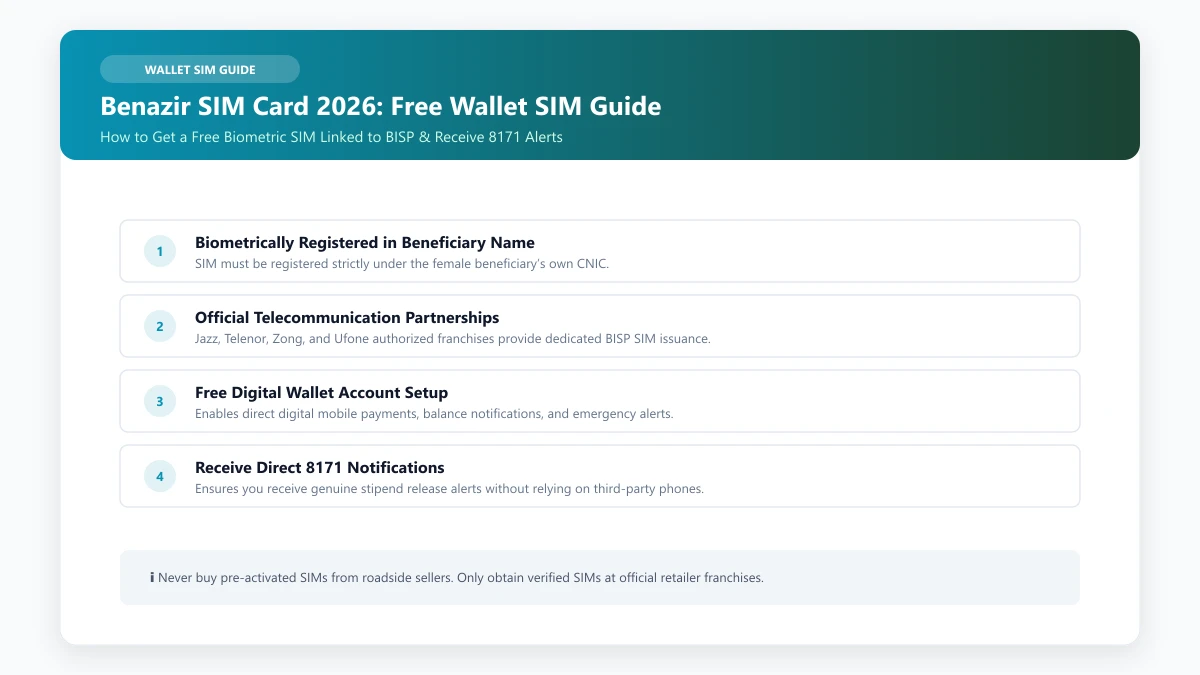
Benazir SIM Card 2026: Free Wallet SIM Guide
The "Benazir SIM card" isn't a special product — it's a free Jazz or Telenor SIM registered to your CNIC that unlocks the BISP mobile wallet.
Read guide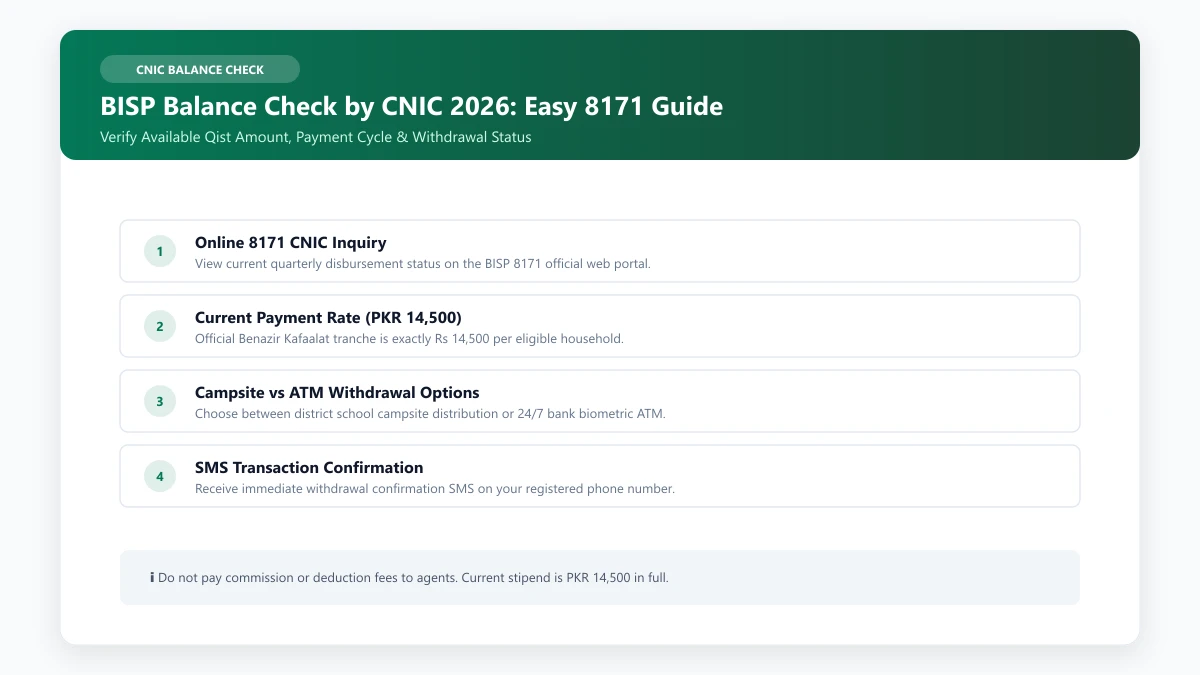
BISP Payment Check 2026: Balance, Payment Date and Withdrawal
To check your BISP payment and balance online, visit the official 8171 web portal (8171.bisp.gov.pk), enter your 13-digit CNIC, and submit the security captcha. Beneficiaries receive quarterly cash installments of Rs. 14,500 via biometric ATMs or authorized HBL and Bank Alfalah payment centers.
Read guide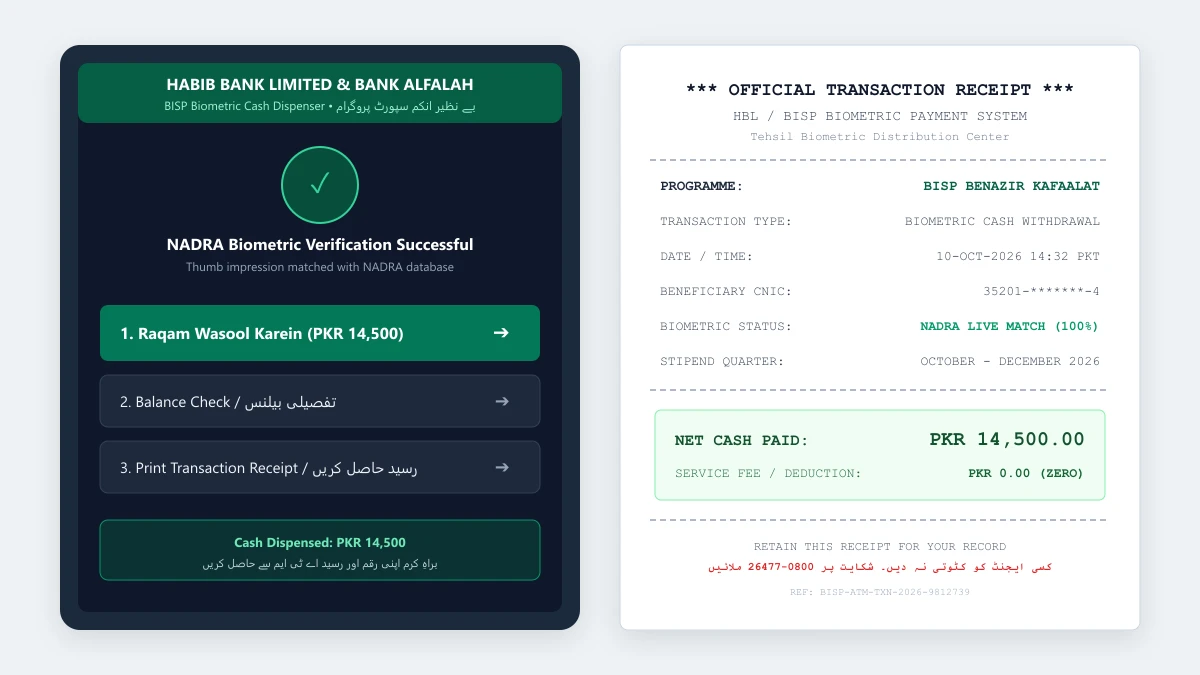
BISP Payment Method 2026: Complete Safe Guide
BISP now pays out through several channels — bank agents, digital wallets, and cash camps. Here's how each one works and how to collect safely.
Read guide
BISP ATM Se Paise Nikalwane Ka Tarika: HBL Konnect Aur Bank Alfalah Biometric ATM Cash Withdrawal (2026)
BISP ATM se paise nikalne ke liye kisi bhi qareebi HBL ya Bank Alfalah biometric ATM par jayen, touch screen par 'Urdu' aur 'BISP/Ehsaas Cash' muntakhib karein, apna 13-hinson ka CNIC number enter karein, biometric scanner par angootha laga kar tasdeeq karein, aur bina kisi agent kataoti ke apni poori Rs. 14,500 qist wasool karein.
Read guide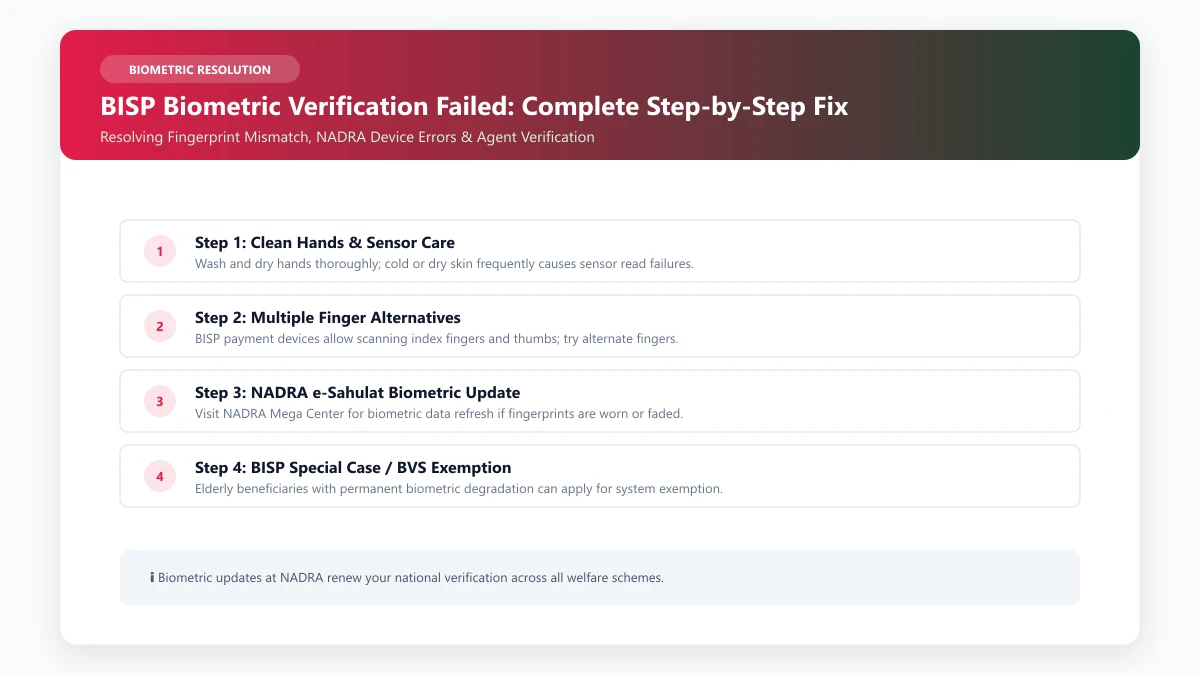
BISP Biometric Verification Failed: Complete Step-by-Step Fix (2026)
If your BISP biometric verification failed, learn how to fix fingerprint errors at the payment terminal, update records at NADRA, use facial recognition, or obtain a Non-BVS form.
Read guide
BISP Ever-Married Condition Removed: What It Means for Unmarried Women and Your 8171 Check
BISP has reported that the ever-married condition for Benazir Kafaalat is removed, so marital history alone should no longer decide who receives payment. BISP has not yet published the start date, new wording, or update process, so an unmarried woman should confirm her record at a tehsil office before expecting payment.
Read guide
Benazir Hunarmand Programme 2026: Free Skills Training, Eligibility and Registration for BISP Families
Benazir Hunarmand Programme offers free skills training to one member of a BISP family who is aged 18 to 40, has at least Matric, and is registered in the BISP Dynamic Registry. Registration is through the official Hunarmand portal or a BISP Tehsil Office, and registration alone does not guarantee selection for training.
Read guide