This article explains public information. It does not determine eligibility or replace an official notice.
What is Punjab one million youth skills training?
Disclaimer: This is an independent information guide. It is not affiliated with the Government of Punjab, the Chief Minister's Office, the Skills Development and Entrepreneurship Department, the Technical Education and Vocational Training Authority (TEVTA), or the Punjab Skills Development Fund (PSDF). Always confirm admission, eligibility, and deadlines on an official government website or at an official training institute before you apply or pay anyone. This guide never asks you to share your CNIC, phone number, or any personal document with this website.
Punjab one million youth skills training is a three-year target for technical and vocational training across Punjab. The plan aims to improve employment, support self-employment, and prepare young people for work in Pakistan and abroad. It is not a single course, a single institute, or a guaranteed job scheme.
The target was set by Punjab Chief Minister Maryam Nawaz Sharif at a special meeting in Lahore on 1 November 2026. Maryam Nawaz Sharif has served as the 19th Chief Minister of Punjab since 26 February 2024. At that meeting, officials briefed her on work already done and on new programmes that would expand training. The announcement therefore has two parts that readers should keep separate: results already reported, and new targets that still need detailed admission notices.
The one million target in plain terms
The one million figure is a training target over three years, not a promise that one million people will be admitted at once. Training will be spread across different trades, institutes, and programmes, and different programmes will open at different times. A reader who sees the headline number should ask which programme, which trade, and which institute is actually open.
The plan also stresses quality and employer relevance, not only headcount. The November 2026 briefing linked training to local industry, self-employment, and international work. That link matters, because a certificate alone does not create a job. The useful question for any applicant is whether the chosen trade has employers, a recognised certificate, and a clear next step after training.
Who announced it, and when
The announcement came from the Government of Punjab, through a special meeting chaired by Chief Minister Maryam Nawaz Sharif in Lahore. News reports dated 1 and 2 November 2026 describe the same meeting, the same headline target, and the same new programmes. That agreement across reports is useful, but it does not replace an official admission notice.
As of 4 November 2026, no single application portal for the whole one million youth skills plan was confirmed in the announcement reports. Readers should therefore treat any social media post that claims a single form, a single deadline, or a guaranteed seat for the whole plan as unverified. Check the programme name first, then look for that programme's own official notice.
Which programmes are inside the plan?
The plan is a group of programmes, not one uniform course. Each programme has a different audience, a different type of training, and a different target number. The table below gives the announced figures exactly as reported, so readers can compare them without mixing them up.
These figures are announced targets. They are not admission numbers for a single intake, and they do not mean that every programme is open now.
Mahir: industrial training in five cities
Mahir is the industrial training part of the plan, with a target of 25,000 young people. The named industrial hubs are Lahore, Faisalabad, Sialkot, Gujranwala, and Multan. That city list matters, because industrial training is most useful where factories and workshops can offer practical work.
The November announcement did not publish Mahir's age limit, education requirement, trade list, or application dates. Readers should not assume that an older PSDF Mahir skills programme, which used the same name in earlier years, has the same rules as this new target. Use the name as a starting point, then wait for, or ask an official institute for, the current notice for this round.
Global Rozgar: training for BPO work
Global Rozgar targets 25,000 young people for work in the business process outsourcing (BPO) sector. BPO work covers customer support, digital services, and IT-enabled operations for clients, often in other countries. The attraction is clear: BPO employers need English communication, computer skills, and customer handling, and those skills can be taught in a short, job-focused course.
Global Rozgar must not be confused with a job guarantee. Employer-led shortlisting is a feature of the existing PSDF BPO programme, and the November plan announcement does not say that every trainee will be hired. A realistic reading is that training improves a candidate's chance in an employer selection process, while the employer still makes the hiring decision.
Advance Tech, Haryali, and language learning
Advance Tech targets 7,500 participants for international certifications in emerging technologies. The word international matters here, because a certificate that employers abroad recognise is different from a local attendance certificate. The announcement did not list which technologies, which certifying bodies, or which courses qualify, so those details still need an official notice.
Haryali is a separate agriculture and green environment programme, with Rs 2.6 billion allocated and a target of 20,000 young people. It sits alongside, but is not the same as, general agriculture training. The CM Language Learning Programme, with courses in 13 languages, is also separate. It is described as a first for Punjab, and its value will depend on which languages are offered, at what level, and whether the courses are linked to jobs or study abroad.
| Programme | Announced target | Focus |
|---|---|---|
| Mahir programme | 25,000 trainees | Industrial training in Lahore, Faisalabad, Sialkot, Gujranwala, and Multan |
| Global Rozgar | 25,000 trainees | Business process outsourcing (BPO) work |
| Advance Tech | 7,500 participants | International certifications in emerging technologies |
| Haryali programme | 20,000 trainees, Rs 2.6 billion allocated | Agriculture and green environment work |
| CM Language Learning Programme | Courses in 13 languages | Language learning, described as a first for Punjab |
| TEVTA institutions | 45,700 trainees per year across 69 institutions | Training aligned with the European Qualifications Framework |
What do the past results actually show?
The November briefing also reported past results, and those results help a reader judge the plan. About 400,000 young people had already completed skills training in Punjab, and more than 45 percent had secured employment, according to the briefing. Under the Skills Development and Entrepreneurship Department, nearly 175,000 trained people had obtained jobs, including more than 38,000 who secured employment abroad.
Those two statements describe different groups, so they should not be added together or treated as the same total. The first figure covers training completed across Punjab. The second covers jobs reported under one department. Keeping that distinction prevents the most common misreading of the announcement, which is to present every reported job as a direct result of the new plan.
Sector results reported in the briefing
The briefing gave sector-by-sector training and employment figures. Manufacturing and information technology had the largest numbers, while agriculture, construction, energy, and hospitality had smaller but still substantial totals.
These figures are briefing figures reported in November 2026 news coverage, not audited placement records published by this guide. They are useful for comparing sectors, but they do not prove that a new applicant in the same sector will get the same result.
| Sector | Completed training | Reported jobs |
|---|---|---|
| Manufacturing | 113,333 | More than 50,000 |
| Information technology | 111,607 | 49,588 |
| Agriculture and livestock | 23,269 | 10,033 |
| Construction | 27,069 | 12,026 |
| Energy | 35,227 | 15,651 |
| Hospitality and tourism | 15,319 | 6,807 |
What the employment figures do and do not prove
A high number of past trainees does not guarantee a future job, and a job figure does not show job quality, salary, or how long the job lasted. The briefing also said that some trainees chose further education instead of work, which is a valid outcome but is not employment. A careful reader should therefore ask for three things that the headline figures do not give: the trade, the certificate, and the employer link.
The briefing also reported inclusion work that is easy to miss in a headline. About 3,000 women in rural areas were earning from home after the Empowering Women through Information Technology programme. The Pahchaan and Umeed programmes had trained 2,474 transgender individuals, and Umeed aims to extend training to 10,000 persons with disabilities. Those programmes show that the skills system is not only for factory and office work, but the announcement did not give their new admission details either.
How can a young person check the right route safely?
There is no single safe shortcut for the whole plan, because there is no single confirmed portal for the whole plan. The safe route is to identify one programme, find its official notice, and check that notice before sharing personal details or paying a fee. The steps below are a checking process, not an application form.
- 1. Write down your goal in one sentence: industrial work, BPO work, emerging technology, agriculture, language learning, or a trade certificate.
- 2. Match that goal to one programme name from the table above, and do not let an agent rename a different course to fit the headline.
- 3. Search for that programme name on the official website of the relevant body, such as TEVTA or PSDF, or ask at a named government institute in your city.
- 4. Check four facts in the official notice: who is eligible, what documents are required, where training will take place, and what certificate you will receive.
- 5. If any of those four facts is missing, wait for the notice instead of paying an agent to fill the gap.
- 6. Keep a copy of the notice, the institute name, and the contact details, so you can check your application status later.
Decide by goal, not by headline
A young person who wants factory work should start with Mahir and with TEVTA institutes in an industrial city. A young person who wants BPO work should start with Global Rozgar and with the existing PSDF BPO programme, while remembering that employer shortlisting still applies. A young person who wants agriculture work should start with Haryali and with agriculture and heavy machinery certification, rather than a general skills headline.
Language learning needs the same discipline. A language course is useful only if the level, the language, and the purpose are clear. A beginner course in a language you do not need for work or study is not a better choice than a trade course with a local employer, even if the language programme sounds new.
Check before you apply: a scam and fee checklist
Government skills training programmes in Punjab are normally free for selected candidates, and official messages do not ask for a payment to unlock a seat. Treat any message that asks for a registration fee, a seat-confirmation payment, or a PIN as a scam warning, and do not share your CNIC number, bank details, or phone OTP with that sender.
Check the sender, the website address, and the programme name before you act. A genuine notice will name the institute, the trade, and the certificate, and it will be consistent with the official website. A fake notice often uses urgency, a countdown, a guaranteed job, and a payment link, and it avoids naming a real institute that you can visit or call.
Who is this plan for, and who should wait?
The plan is aimed at young people in Punjab who need practical skills for work, self-employment, or work abroad. That is a broad audience, and the November announcement did not publish a single age limit or education rule for the whole plan. That gap is important, because different programmes will have different rules.
Readers who are still in school, who already have a trade certificate, or who want a loan or scholarship should not assume this plan covers them. The plan is about skills training. Loans, scholarships, and laptop distribution are separate programmes, and this guide links to those separate guides instead of repeating them here.
What is confirmed, and what is not confirmed
If a post or agent gives you a firm date, age limit, or fee for the whole plan, ask for the official notice that states it. If that notice cannot be shown, treat the claim as unconfirmed.
| Question | Status as of 4 November 2026 |
|---|---|
| One million training target over three years | Announced on 1 November 2026 |
| Mahir, Global Rozgar, Advance Tech, Haryali, and language learning targets | Announced, with the figures in the table above |
| A single portal, age limit, or education rule for the whole plan | Not confirmed in the announcement reports |
| Mahir trade list and application dates for this round | Not confirmed in the announcement reports |
| Advance Tech technologies and certifying bodies | Not confirmed in the announcement reports |
| Which languages the language programme will offer | Not confirmed in the announcement reports |
Existing routes that already have published criteria
One existing route does have published criteria, and it should not be confused with the new plan as a whole. The PSDF Youth Employability Program for BPOs, also called Global Rozgar in PSDF material, lists Punjab domicile, age 16 to 35 years, and minimum matriculation, with employer-led screening and training in customer support, digital communication, and related skills. That programme is useful background for BPO applicants, but its criteria are for that PSDF programme, not a confirmed rule for Mahir, Advance Tech, Haryali, or language learning.
TEVTA is the other existing route to check. TEVTA is the Technical Education and Vocational Training Authority for Punjab, and its official website is tevta.gop.pk. The November plan says 69 TEVTA institutions will train 45,700 young people per year in line with the European Qualifications Framework. That framework link is about recognition of qualifications, not a promise of a job abroad, and readers should check the institute and course before assuming international recognition.
What could go wrong, and what to watch?
Misleading offers and trade choice
The biggest risk is not a difficult course, but a misleading advertisement. Headline numbers attract agents who sell forms, seats, and certificates that do not exist. The second risk is choosing a trade with no local employer, which can leave a trainee with a certificate and no income. The third risk is waiting for a single portal that never opens, while a real institute admission in the same city closes.
New facilities, and one competition result
New facilities and inclusion programmes also need watching. The plan includes Punjab's first modern Woodworking Centre of Excellence, centres for electrical work, vehicle technology, and digital marketing, and a first Cleaning and Cleaner Academy for cleaning support, healthcare, hospitality, and domestic services. Upgraded laboratories include 220 computer laboratories, 100 industrial stitching laboratories, 70 solar laboratories, and 27 healthcare laboratories, plus virtual reality welding and electric vehicle laboratories, and 15,065 teachers and staff received industry-related training. Those upgrades support quality, but they do not by themselves guarantee a seat, a stipend, or a job.
A trainee electrician from a Punjab technical college secured fourth position at the 48th WorldSkills competition in Shanghai, according to the briefing. That result shows what the system can produce at its best, but it is one competitor's result, not a typical outcome. Use it as evidence that standards matter, not as a promise for every trainee.
Frequently asked questions
What is Punjab one million youth skills training?
It is a three-year target announced on 1 November 2026 to train one million young people in technical and vocational skills across Punjab. It covers industrial training, BPO work, emerging technology, agriculture, and language learning. It is a target, not a single course or a guaranteed job.
When was the Punjab one million youth skills plan announced?
It was announced on 1 November 2026, when Punjab Chief Minister Maryam Nawaz Sharif chaired a special meeting in Lahore on skills development. News reports dated 1 and 2 November 2026 describe the same meeting and target. No single portal for the whole plan was confirmed in those reports.
What is the Mahir programme in the Punjab skills plan?
Mahir is the industrial training part of the plan, with a target of 25,000 young people in Lahore, Faisalabad, Sialkot, Gujranwala, and Multan. It is aimed at industrial work, but the November announcement did not publish its trade list, age limit, or application dates for this round. Check an official institute notice before applying.
What is Global Rozgar in the Punjab skills plan?
Global Rozgar targets 25,000 young people for business process outsourcing work, including customer support and digital services. It is not a job guarantee, because BPO employers still shortlist candidates. The existing PSDF BPO programme lists Punjab domicile, age 16 to 35, and minimum matriculation, but those are that programme's criteria, not a confirmed rule for the whole plan.
What is Advance Tech in the Punjab skills plan?
Advance Tech targets 7,500 participants for international certifications in emerging technologies. The announcement did not list which technologies or certifying bodies qualify. Readers should wait for an official notice that names the technology, the certificate, and the institute before choosing this route.
What is the Haryali programme in the Punjab skills plan?
Haryali is an agriculture and green environment programme with Rs 2.6 billion allocated and a target of 20,000 young people. It is separate from general agriculture training and from the agriculture and heavy machinery operator certification also approved in the same meeting. Its trade list and application dates were not confirmed in the announcement reports.
What is the CM Language Learning Programme?
It is a language learning programme approved in the same meeting, offering courses in 13 languages and described as a first for Punjab. The announcement did not list which 13 languages, what levels will be offered, or how to apply. Choose a language only when its level and purpose match your work or study goal.
How do I apply for Punjab one million youth skills training?
There is no confirmed single application form for the whole plan as of 4 November 2026. Pick one programme, find its official notice on a government website or at a named institute, and check eligibility, documents, training place, and certificate in that notice. Do not pay an agent for a seat, and do not share your CNIC or OTP with an unverified sender.
Is Punjab skills training free?
Government skills programmes in Punjab are normally free for selected candidates, and official messages do not ask for a payment to unlock a seat. A fee demand, a guaranteed job claim, or a request for your PIN is a scam warning. Always confirm fees, if any, in the official notice for the specific programme and institute.
Does the Punjab skills plan guarantee a job abroad?
No, it does not guarantee a job in Pakistan or abroad. Past briefing figures show about 400,000 young people completed training and more than 45 percent secured employment, with more than 38,000 jobs abroad reported under one department. Those are past results, not a promise for a new applicant, and employment still depends on trade, certificate, and employer selection.
Sources and official links
Check the destination address before entering personal information.
Related guides
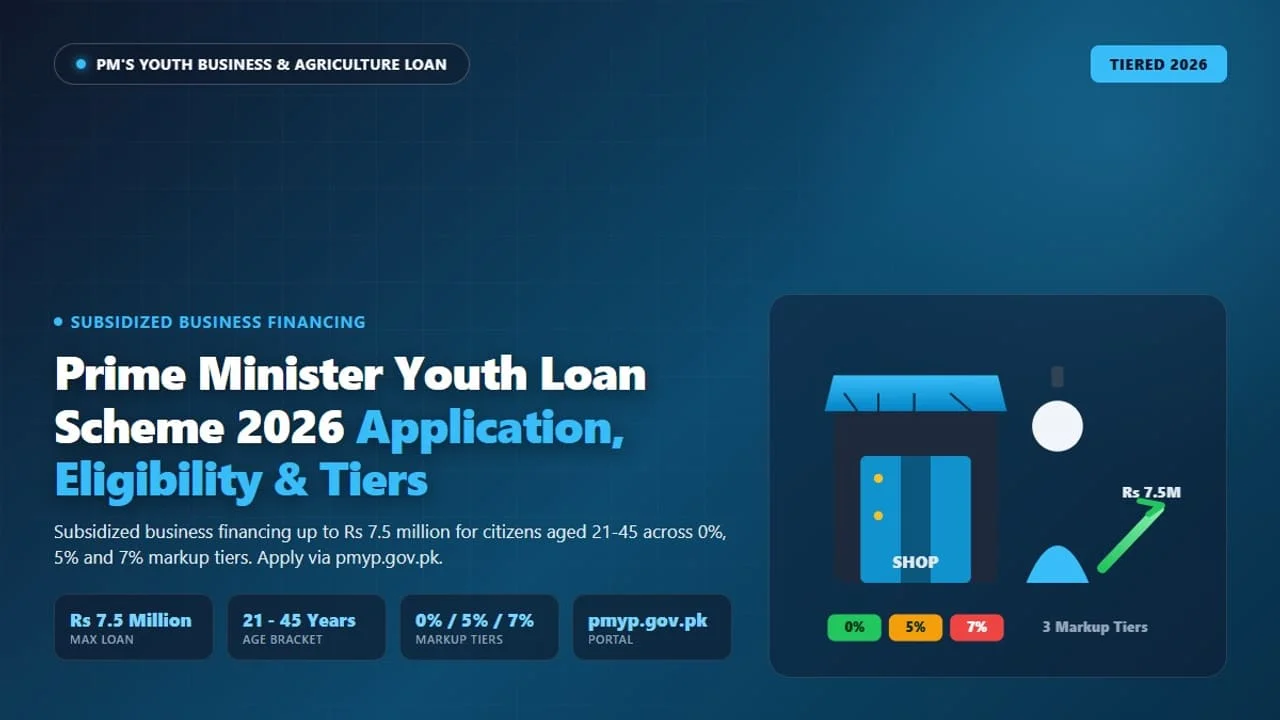
Prime Minister Youth Loan Scheme 2026: Complete Application, Eligibility & Tiers Guide
The Prime Minister Youth Loan Scheme 2026 provides subsidized business financing up to Rs 7.5 million for Pakistani citizens aged 21 to 45 across three tiers (0%, 5%, and 7% markup). Apply online through the official pmyp.gov.pk portal.
Read guide
CM Punjab Honhaar Merit Scholarship Program 2026: Online Apply, Eligibility & 100% Tuition Fee Guide
To apply online for the CM Punjab Honhaar Merit Scholarship Program in 2026, register on the official portal at honhaarscholarship.punjabhec.gov.pk using your CNIC/B-Form and academic registration details. The Government of Punjab provides 100% full tuition fee coverage for 30,000 undergraduate students enrolled in 68 priority disciplines across 50 public universities and medical colleges.
Read guide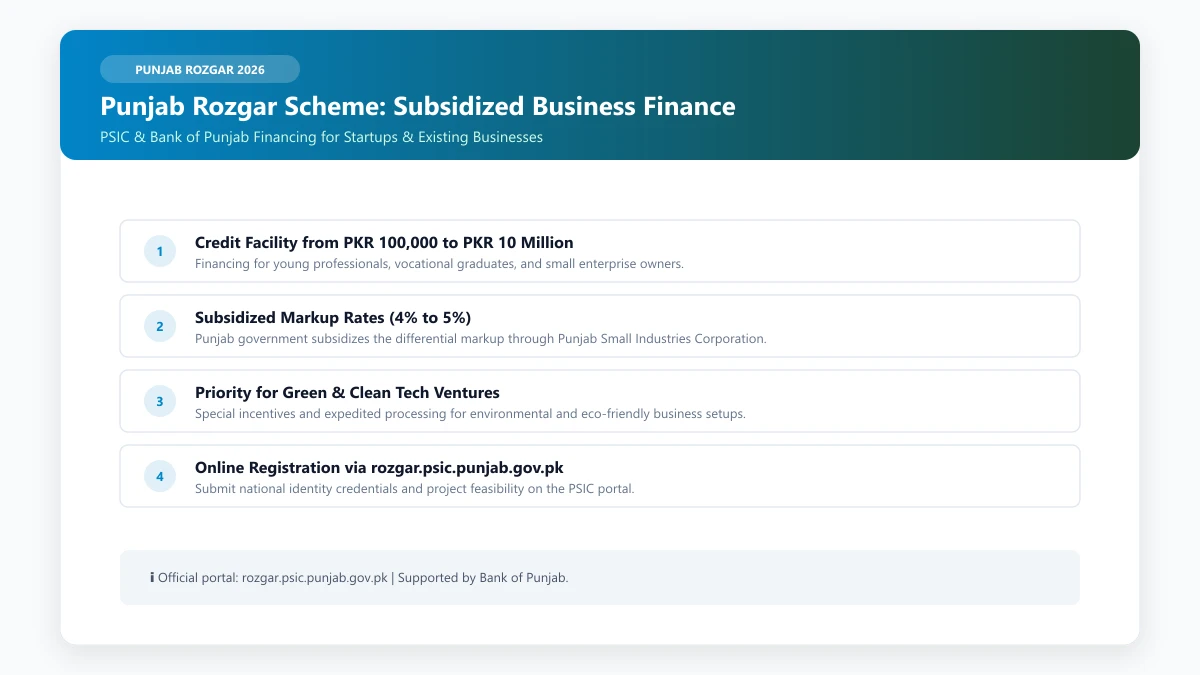
Punjab Rozgar Scheme: Subsidized Business Finance
Understand Punjab Rozgar business finance, official terms and the difference between subsidized markup and an interest-free loan.
Read guide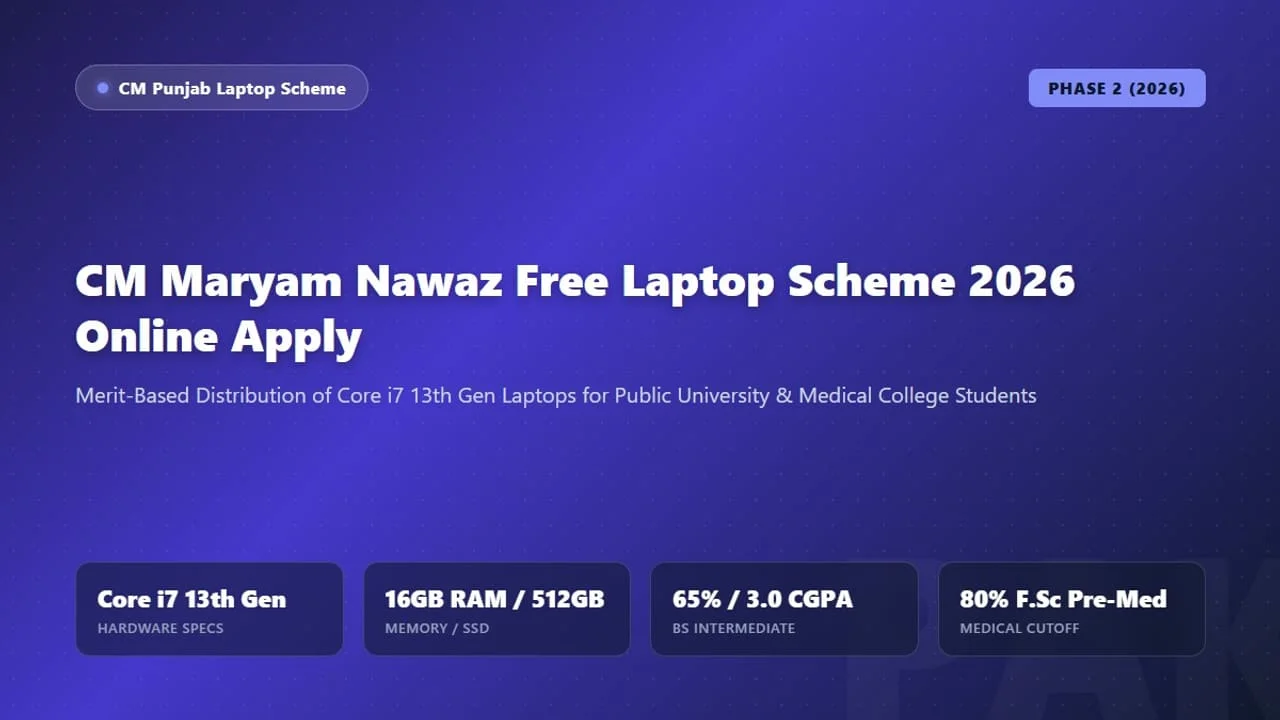
CM Punjab Free Laptop Scheme 2026 Online Apply: Maryam Nawaz Portal, Eligibility & Merit List Guide
Apply online for CM Maryam Nawaz Free Laptop Scheme 2026 at laptop.punjab.gov.pk. Check eligibility, merit CGPA, documents, and 110,000 laptop distribution.
Read guide
Benazir Hunarmand Programme 2026: Free Skills Training, Eligibility and Registration for BISP Families
Benazir Hunarmand Programme offers free skills training to one member of a BISP family who is aged 18 to 40, has at least Matric, and is registered in the BISP Dynamic Registry. Registration is through the official Hunarmand portal or a BISP Tehsil Office, and registration alone does not guarantee selection for training.
Read guide
Punjab She Threads Programme 2026: Rs 15,000 Monthly Stipend, Textile Training and Registration for Rural Women
Punjab She Threads registration is open in person at textile factories in Lahore and Faisalabad in November 2026. Rural women aged 18 to 45 with Punjab domicile can apply for three months of free textile training, free materials and Rs 15,000 a month, including a transport allowance.
Read guide