This article explains public information. It does not determine eligibility or replace an official notice.
What is the Sindh Virtual STEM School?
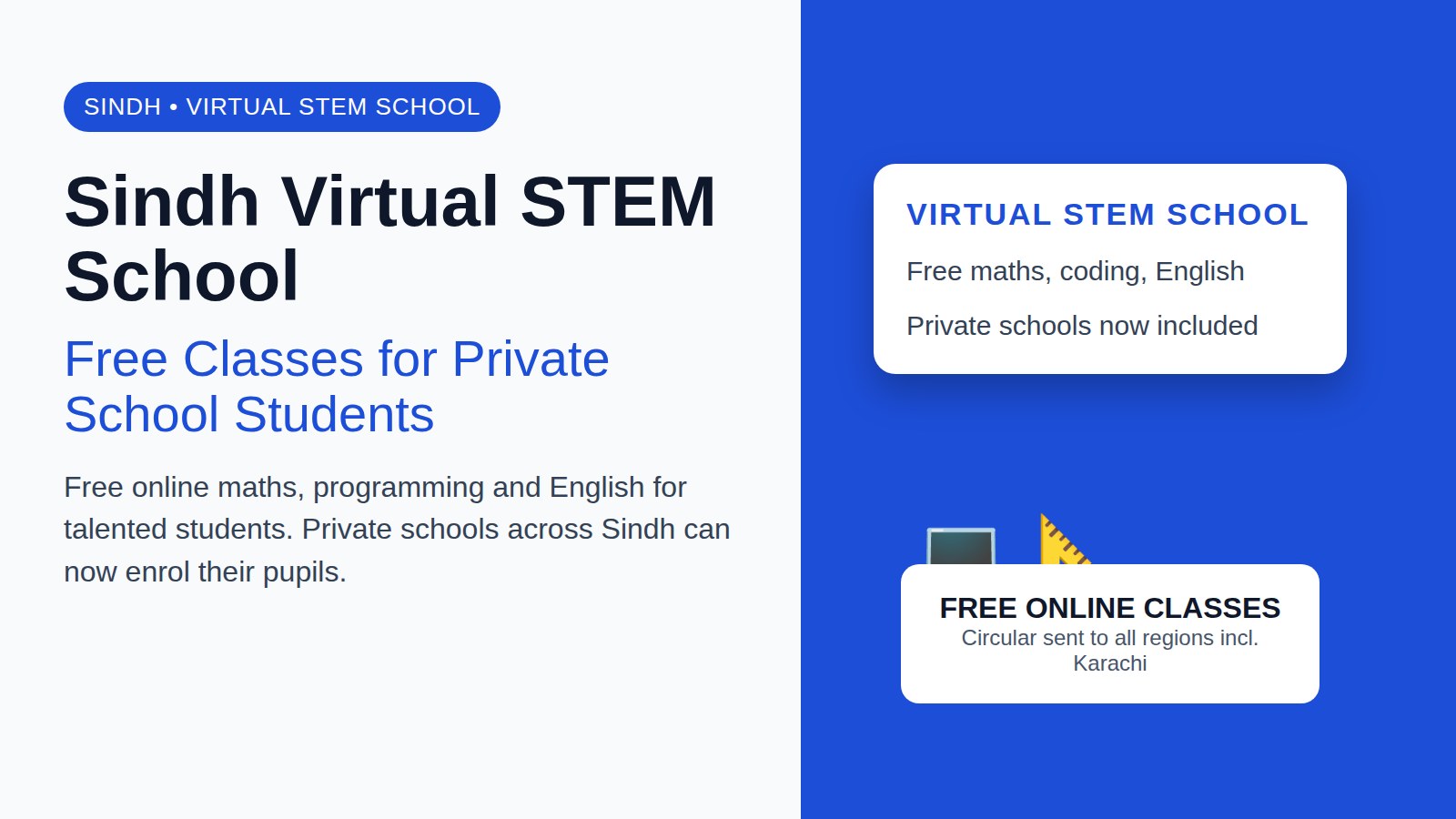
The Sindh Virtual STEM School is a free online programme that trains talented school students in mathematics, computer programming and English. It runs under the Sundar STEM initiative, and its online arm is called the Virtual SundarSTEM School, often shortened to VSS. The programme is supplementary, which means it runs alongside a child's normal schoolwork rather than replacing school. Its aim is to build the kind of advanced problem solving skill that school curricula alone rarely develop, and to prepare strong students for competitions and for further study in science and technology.
The Sindh government runs the provincial expansion of the programme through the Sindh School Education Department. The wider SundarSTEM programme is based in Lahore, where its boarding campus, the SundarSTEM School, offers places to exceptional performers from the virtual programme. That link matters because it shows the virtual school is not a short course with no next step. It is the entry point to a longer path, and the strongest students can move from online training to a full time specialist school.
The official SundarSTEM website describes the Virtual STEM School as a free online programme for students in Grades 4, 5, 6 and 7, with training in Mathematics, Computer Science and English. That description is the most authoritative statement of the programme's scope that this guide could find, and it is the reason this guide treats the official site as the reference point whenever news reports disagree with it. One such disagreement is covered in the eligibility section below, because it affects which children can join. The programme also aims to prepare students to compete in international science Olympiads and for technical university entrance, which explains why its teaching goes beyond the school syllabus.
What changed in November 2026?
As of 9 November 2026, the change is simple and it is significant. Sindh Virtual STEM School enrolment is now open to private school students. Until this expansion, the platform was offered through government institutions only, so a talented child in a private school had no route in. The Sindh government has now expanded its Sundar STEM initiative province-wide and invited private schools to enrol their talented students.
The change was set in motion by a circular from the Directorate of Inspection and Registration of Private Institutions Sindh. The circular went to all regions, including Karachi, and it asked the administrations and principals of private schools to register eligible students. Bloom Pakistan reported the move on 3 November 2026, and CW Pakistan reported it on 4 November 2026. Both reports describe the same sequence: a letter from the Directorate, sent to regional offices, asking private schools to identify talented students and enrol them.
The table below sets out what changed, so a reader can see the old position and the new position side by side.
| Before November 2026 | From November 2026 | |
|---|---|---|
| Who could join | Students reached through government institutions | Students from government institutions and private schools |
| How a school joined | Through the government school system | Private schools register pupils through the circular route |
| Who sent the instruction | Not applicable to private schools | Directorate of Inspection and Registration of Private Institutions Sindh |
| Regions covered | Hyderabad region first phase | All regions, including Karachi |
| Cost | Free | Free, unchanged |
| Subjects | Mathematics, computer programming, English | Mathematics, computer programming, English, unchanged |
The expansion also fits a wider trend. CW Pakistan notes that Khyber Pakhtunkhwa has registered 331 government schools with the Global Virtual School for science, mathematics, English and computer science, and has started a pilot of artificial intelligence supported learning under the E-Basta project. Sindh's decision to open its own virtual STEM platform to private schools shows the same idea spreading across provinces.
Parents should also note what has not changed. There is no published deadline in the reports seen for this guide, and no published list of documents a school must attach. The circular itself has not been published on an official Sindh government website that this guide could find. Those gaps are normal for a fast moving announcement, but they mean families should treat the details below as the best available picture on 9 November 2026, not as a final rulebook.
Who can enrol in the Sindh Virtual STEM School?
The short answer is that talented students from private schools across Sindh can now enrol, through their schools. The longer answer needs care, because the sources disagree on one point, and this guide will not hide that disagreement.
The circular asks private school administrations and principals to identify talented students and register them. That makes the school the route in, not the parent. A parent who wants a child to join should speak to the school principal or administration first, because the school is the body the Directorate has asked to act. The reports describe the target group as talented students and high performing students, which means selection is based on ability, not on first come first served. A child who is strong in mathematics is the natural candidate, since the programme's entry screening tests mathematical ability.
Here is the conflict this guide must flag. The result.pk report says eligible students are in Grades 5, 6 and 7. The official SundarSTEM website says the Virtual STEM School is designed for students in Grades 4, 5, 6 and 7. Those two statements cannot both be the rule for the Sindh expansion, and no official Sindh source found for this guide resolves the difference. As of 9 November 2026, the safest reading is that the programme is aimed at middle school pupils, most likely Grades 5 to 7, with Grade 4 possible under the official programme description. A school should confirm the exact grades with the focal person before it submits names, and a parent should not assume a Grade 4 child is either in or out until that confirmation exists.
Use this quick self-check before you approach a school. It takes a minute, and it stops wasted effort.
- Is the child enrolled in a recognised private school in Sindh? If the school is not registered with the Directorate, the circular route may not apply to it.
- Is the child in Grade 4, 5, 6 or 7? If the child is outside that range, this programme is not the right fit.
- Is the child strong in mathematics? The screening tests mathematical ability, so a child who struggles with maths is unlikely to pass.
- Can the child attend live online classes and practise between sessions? The programme needs regular time, a device and internet access.
- Has the school received the circular? If the principal has not seen it, ask the school to contact the focal person named below.
Screening is part of the process. The result.pk report says students complete baseline mathematical assessments after their school submits their names, and that these assessments confirm eligibility. That detail comes from one secondary source only, so this guide presents it as reported rather than confirmed. Even so, it fits the programme's design, since a selective programme needs a fair way to choose among nominees. Families should expect some form of test or assessment, and should not treat nomination by a school as a guarantee of a place.
There is no confirmed age limit in any source found for this guide, and no confirmed rule about which subjects a child must already be studying. The reports do not mention a fee, a quota per school, or a limit on how many pupils one school may nominate. If a school or an agent quotes a fee, a quota or a guaranteed place, treat that claim with suspicion and check it with the focal person.
What will students learn?
Students receive free online training in three subjects: mathematics, computer programming and English language skills. The three subjects are taught together on purpose, and each one serves a different part of the programme's goal.
Mathematics
Mathematics is the core of the programme, and it is taught at a level above the normal school syllabus. The result.pk report describes the mathematics as Olympiad-standard mathematics, which means it prepares students for mathematics competitions rather than only for school exams. The official SundarSTEM website refers to Mathematics (AoPS), which points to the Art of Problem Solving approach, a well known method for teaching advanced problem solving to school students. Together, those two details paint a clear picture. This is not revision of school maths. It is harder material, built around problems that need creative thinking, not just memorised methods.
Computer programming
Computer programming is the second subject, and it covers the coding skills that underpin computer science. The result.pk report names Python and C++ as the languages used for competitive programming, which is a form of coding where students solve problems against the clock. Python is widely used as a first language because its syntax is clear, while C++ is the standard language in many programming competitions because it runs fast. Teaching both gives students a practical start and a competition ready tool.
English language skills
English language skills are the third subject, and the reports describe the focus as critical English communication skills. That phrasing matters. The programme is not teaching basic English grammar to beginners. It is building the communication skill a student needs to study and compete at a higher level, where English is the main language of higher education and of the global technology industry. A talented mathematician who cannot explain a solution clearly will struggle in competitions and interviews, so English sits alongside the technical subjects for a practical reason.
How do private schools register their students?
Registration runs through the school, not through an open application form for parents. That is the single most important practical fact in this guide, and it shapes everything a family should do next.
The process described in the reports has four steps. These steps come mainly from the result.pk report, so they are presented here as the reported process, not as an officially confirmed procedure. The first step in that report is to access the official provincial education registration desk or VSS web portal. The first two facts, that the Directorate issued a circular and that the Director of School Education (Secondary) Hyderabad is the focal person, are confirmed by both CW Pakistan and Bloom Pakistan.
- The school administration reads the circular from the Directorate of Inspection and Registration of Private Institutions Sindh, which was sent to all regions including Karachi.
- The principal and teachers identify talented students, with a focus on strong mathematical ability, and check that each nominee is in an eligible grade.
- The school completes an institutional nomination form for each student, with verified academic credentials and contact details.
- The school submits the student profiles through the Director of School Education (Secondary) Hyderabad, who acts as the focal desk for official screening.
The Director of School Education (Secondary) Hyderabad has been appointed as the focal person for the initiative, which gives school administrations a single point of contact for questions about registration, eligibility and participation. That appointment is confirmed by CW Pakistan and Bloom Pakistan, and it is the most useful fact in this guide for a school that needs help. A principal who is unsure about grades, documents or timing should contact the focal person rather than guess.
One detail needs a clear warning. The result.pk report gives a web address for registration, virtual.sundarstem.edu.pk/signup, and says applicants can register through the official SundarSTEM portal. This guide could not confirm from an official Sindh source that this portal is the route for the Sindh private school expansion, and neither CW Pakistan nor Bloom Pakistan mentions it. The domain belongs to the real SundarSTEM programme, but that alone does not prove it is the correct route for this circular. Schools should use the focal person and the circular itself as their guide, and should not treat a web address found in a secondary report as an official instruction. If the portal is the right route, the focal person will be able to confirm it in one conversation.
There is also no confirmed deadline in any source found for this guide. No report gives a last date for registration, and no report says when classes for the new intake will start. That absence is itself useful information, because it tells schools to act promptly rather than wait for a deadline that may be announced later. A school that delays risks missing a short window, and a parent who waits for a deadline may find the intake has already closed.
What does the first phase in Hyderabad show?
The first phase of the programme ran in the Hyderabad region, and its results are the reason the expansion is being reported as a success story rather than just a plan. Talented students from nine districts of the Hyderabad region have already enrolled on the Sundar STEM platform, according to both CW Pakistan and Bloom Pakistan. That is a concrete number, not a vague claim, and it shows the programme can reach beyond a single city.
The second result cited in the circular is that students from Hyderabad performed well at the National Mathematics Contest held in Lahore. Both CW Pakistan and Bloom Pakistan report this, and CW Pakistan presents it as evidence that online training can produce strong performance among students who live outside the largest cities. That claim is worth reading carefully. It does not say every Hyderabad student won a prize, and it does not give scores or rankings. It says the region's students performed well, which is a broad statement from the circular rather than a detailed result.
What does the programme cost, and what support do students get?
The programme is free. Every report found for this guide agrees on that point, and the official SundarSTEM website also describes the Virtual STEM School as a free online programme. There are no tuition fees, and no report mentions any charge for registration, materials or classes. That is the clearest fact in the whole story, and families should treat any request for payment with suspicion. If someone asks a parent or a school to pay for a place in this programme, that request does not match the official description, and it should be checked with the focal person before any money changes hands.
Beyond the free tuition, the reports differ, and this guide marks the difference clearly. The result.pk report says enrolled participants receive live online instruction and course materials, that deserving learners receive merit-based laptops and Chromebooks, and that graduates who complete the full programme of three semesters earn a digitally verifiable completion certificate bearing the Virtual SundarSTEM seal. Those are attractive benefits, but they come from one secondary source only. Neither CW Pakistan nor Bloom Pakistan mentions laptops, Chromebooks, certificates or a three semester structure, and the official SundarSTEM page fetched for this guide does not mention them either. As of 9 November 2026, this guide treats the free tuition as confirmed, and the laptops, Chromebooks, certificate and three semester structure as unconfirmed reports that need official confirmation.
That distinction matters, because a family that enrols a child because of a promised laptop may be disappointed if no laptop arrives, and that disappointment can damage trust in a genuinely good programme. Readers who want to compare device support across schemes can read our guides to the PM Chromebook scheme and the CM Punjab Free Laptop Scheme, which cover programmes where device support is documented in detail.
The question of what a graduate receives is also worth a careful answer. The official SundarSTEM website says exceptional performers are offered admission to the SundarSTEM School boarding campus in Lahore. That is confirmed by the programme's own site, and it is a more significant reward than a certificate, because it offers a place at a specialist school. Families should weigh that opportunity alongside the free training itself, since it gives the strongest students a clear goal to aim for. For older students planning the next step after school, our guides to the CM Punjab Honhaar Scholarship, the Ehsaas Undergraduate Scholarship and Scotland Pakistan Scholarships for young women and girls cover the main scholarship routes.
What should parents and schools check before they apply?
A new government programme attracts attention, and attention attracts wrong information. The checks below take little time, and they protect families from the most common problems.
First, confirm the circular reached the school. The Directorate sent its circular to all regions including Karachi, so a registered private school should have received it or should be able to obtain it through its regional office. If a school says it has not heard of the programme, that does not mean the programme is fake. It may mean the circular has not yet reached that school, and the principal should contact the focal person, the Director of School Education (Secondary) Hyderabad, for guidance.
Second, do not pay anyone for a place. The programme is free, and no report mentions a fee at any stage. Anyone who asks for payment, whether for registration, a nomination form, a test or a guaranteed place, is not following the programme as described. Report such a request to the school administration and to the focal person.
Third, do not trust a deadline, a grade rule or a web link that comes from a single social media post. The grade conflict in this guide, Grades 5 to 7 in one report and Grades 4 to 7 on the official site, shows how easily a detail can differ between sources. Check the grade rule, the deadline and the registration route with the focal person, and treat anything else as unconfirmed until then.
Fourth, remember that this guide is independent. PakBenefits is not the Sindh government, not the Sindh School Education Department, and not the SundarSTEM programme. This guide explains what the reports say and where they disagree, but it cannot enrol a child, confirm a place, or answer a question about a specific school. For those answers, the school principal and the focal person are the right contacts.
Finally, keep the opportunity in proportion. This is a selective programme for talented students, not a general entitlement, and not every child who applies will be selected. That is not a reason to avoid applying. It is a reason to apply honestly, to prepare for a screening test in mathematics, and to keep the child's normal schoolwork going whatever the outcome.
Frequently asked questions
Is the Sindh Virtual STEM School free?
Yes, the programme is free. Every report found for this guide, and the official SundarSTEM website, describe the Virtual STEM School as a free online programme with no tuition fees. No report mentions any charge for registration, materials or classes, so any request for payment should be checked with the focal person.
Who can enrol in the Sindh Virtual STEM School?
Talented students from private schools across Sindh can now enrol, through their schools. The programme was previously offered through government institutions only, and the November 2026 expansion opens it to private school pupils. Selection is based on ability, with a focus on strong mathematical skill.
Which grades can join the Virtual STEM School?
The sources disagree on this point, and the disagreement is not yet resolved. The result.pk report says Grades 5, 6 and 7, while the official SundarSTEM website says the programme is designed for Grades 4, 5, 6 and 7. As of 9 November 2026, schools should confirm the exact grades with the focal person before they submit names.
Can a parent apply directly for their child?
No, registration runs through the school, not through a direct parent application. The circular asks private school administrations and principals to identify talented students and register them. A parent should speak to the child's school principal or administration first.
How does a private school register a student?
The school identifies talented students, completes an institutional nomination form with verified academic credentials and contact details, and submits the profiles through the Director of School Education (Secondary) Hyderabad, who is the focal person. The steps above come mainly from one secondary report, so the school should confirm the exact process with the focal person.
What subjects are taught in the Virtual STEM School?
Students learn mathematics, computer programming and English language skills. The mathematics is taught at an advanced, Olympiad standard level, the programming covers Python and C++ for competitive programming, and the English teaching focuses on communication skills for study and competition.
Is there a last date to register for the Virtual STEM School?
As of 9 November 2026, no deadline has been published in any source found for this guide. No report gives a last date for registration or a start date for classes. Schools should act promptly and confirm timing with the focal person rather than wait for a deadline to be announced.
What is the Sundar STEM initiative?
The Sundar STEM initiative is the wider programme behind the Virtual STEM School, run in Sindh by the Sindh government through the Sindh School Education Department. Its online arm, the Virtual SundarSTEM School, offers free training to talented school students, and exceptional performers can be offered a place at the SundarSTEM School boarding campus in Lahore.
Does the programme give students a laptop or a certificate?
This is unconfirmed. One secondary report says deserving learners receive merit-based laptops and Chromebooks, and that graduates of the programme of three semesters earn a digitally verifiable completion certificate. Neither CW Pakistan, Bloom Pakistan nor the official SundarSTEM page confirms those benefits, so families should not rely on them until an official source confirms them.
Where can I confirm the details officially?
Check with the child's school principal, who should have received the circular from the Directorate of Inspection and Registration of Private Institutions Sindh, and with the focal person, the Director of School Education (Secondary) Hyderabad. The official SundarSTEM website at sundarstem.edu.pk also describes the Virtual STEM School programme. This PakBenefits guide is independent and cannot confirm places or enrol a child.
Sources and official links
Check the destination address before entering personal information.
Related guides

CM Punjab Honhaar Merit Scholarship Program 2026: Online Apply, Eligibility & 100% Tuition Fee Guide
To apply online for the CM Punjab Honhaar Merit Scholarship Program in 2026, register on the official portal at honhaarscholarship.punjabhec.gov.pk using your CNIC/B-Form and academic registration details. The Government of Punjab provides 100% full tuition fee coverage for 30,000 undergraduate students enrolled in 68 priority disciplines across 50 public universities and medical colleges.
Read guide
Ehsaas Undergraduate Scholarship 2026 Online Apply: HEC Portal Check, 100% Tuition Fee & Rs 4,000 Stipend Guide
Apply online for HEC Ehsaas Undergraduate Scholarship 2026 on ehsaas.hec.gov.pk. Learn how to secure 100% full tuition fee coverage, Rs 4,000 monthly stipend, prepare university FAO documents, and clear the ISAC interview.
Read guide
Scotland Pakistan Scholarships for Young Women and Girls: Complete Eligibility, Benefits, and Application Guide
The Scotland Pakistan Scholarships for Young Women and Girls is a fully funded financial aid program funded by the Scottish Government and administered by the British Council Pakistan. It covers university tuition, hostel accommodation, and travel for eligible female Pakistani students pursuing undergraduate or master's degrees at HEC-recognized universities inside Pakistan.
Read guide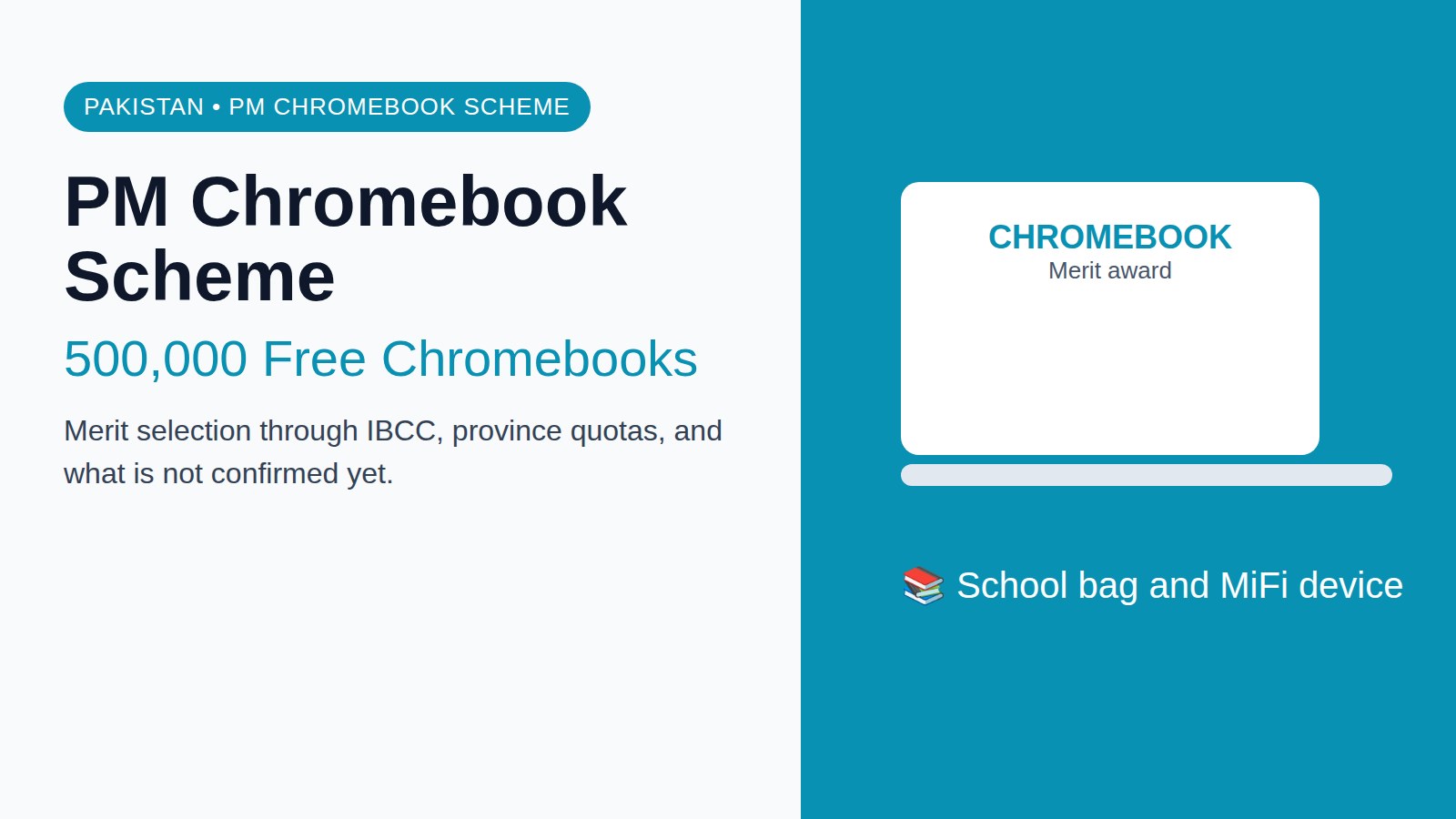
PM Chromebook Scheme: 500,000 Free Chromebooks for Top Government School Students
The PM Chromebook Scheme 500000 Students gives 500,000 Chromebooks, plus a bag and a MiFi internet device, to top performing students of government schools across Pakistan. Prime Minister Shehbaz Sharif launched it in Islamabad on 25 October 2026. Selection is merit based, uses board results verified through IBCC, and registration runs through the IBCC portal.
Read guide
CM Punjab Free Laptop Scheme 2026 Online Apply: Maryam Nawaz Portal, Eligibility & Merit List Guide
Apply online for CM Maryam Nawaz Free Laptop Scheme 2026 at laptop.punjab.gov.pk. Check eligibility, merit CGPA, documents, and 110,000 laptop distribution.
Read guide