This article explains public information. It does not determine eligibility or replace an official notice.
What is the PM Chromebook Scheme?
What the launch announced
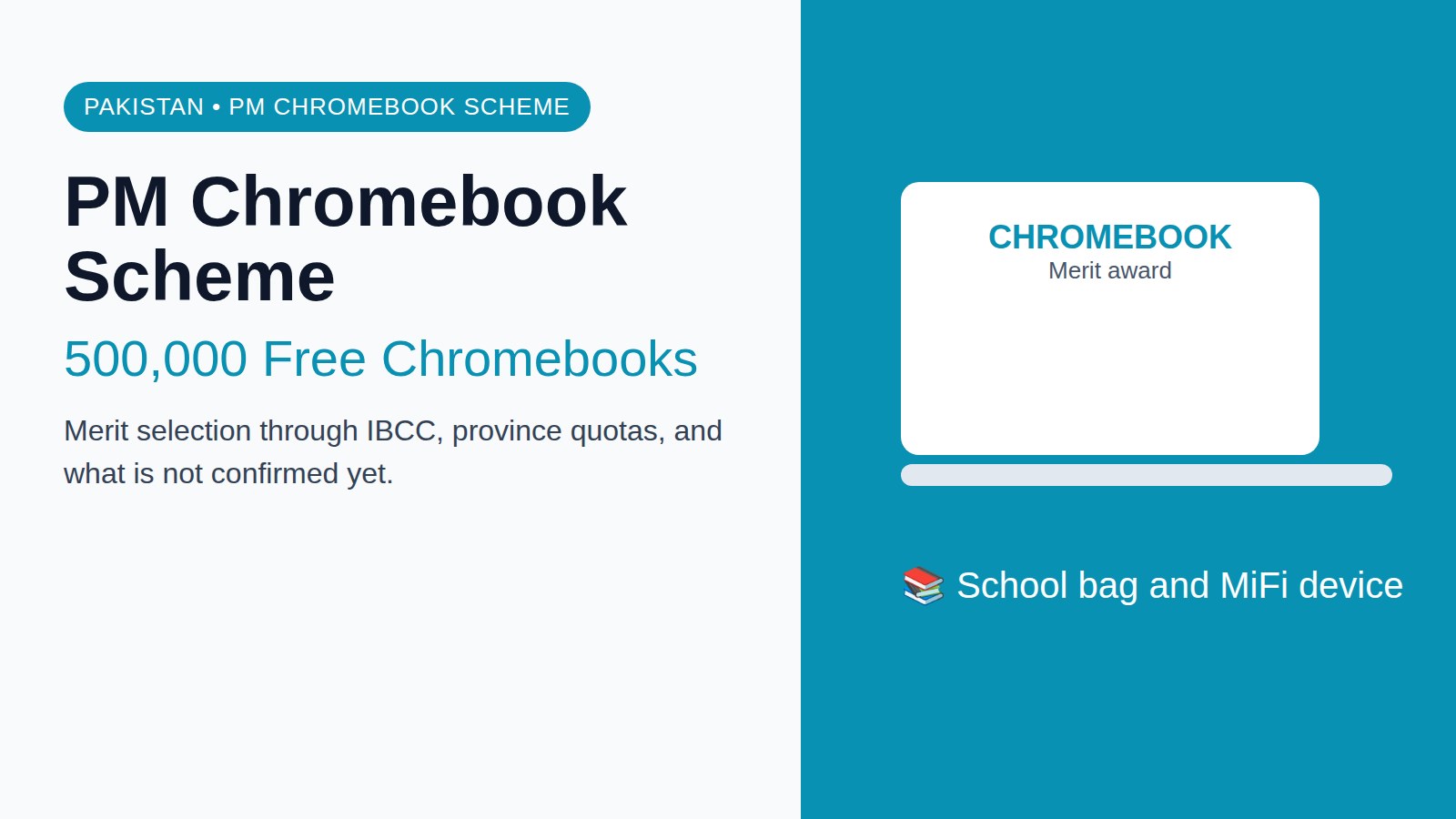
Prime Minister Shehbaz Sharif launched the Prime Minister's Youth Chromebook Scheme at a ceremony at the Convention Centre in Islamabad on 25 October 2026. Launch reports describe a national plan to give 500,000 Chromebooks to talented students over two years, with devices handed on stage to high performing Grade 9 students and students of seminaries. The prime minister said selection would rest on merit alone, so family income would not decide who gets a device.
Who runs the scheme
The Ministry of Federal Education and Professional Training runs the scheme together with the Prime Minister's Youth Programme, in coordination with the provinces. The Inter Boards Coordination Commission (IBCC) verifies board results and runs the official registration portal. The Tokyo Technology Care Foundation is reported as the partner that committed to supply devices under a letter of understanding.
Who is eligible for a Chromebook?
Which classes qualify in each region
In Punjab, Sindh, Khyber Pakhtunkhwa and Balochistan, the scheme covers high achieving Grade 9 students, known as SSC-I students, from the 2026 annual examinations. In Islamabad, Azad Jammu and Kashmir and Gilgit-Baltistan, it covers high achieving Grade 9 and Grade 10 students, known as SSC-I and SSC-II students.
Reports differ on one detail. Several guides quote a minimum of 50 percent marks in SSC-I, but one portal check says no fixed percentage is printed.
Which schools qualify
The scheme is for students of government or public schools. Regular private school students are not eligible, according to the portal guidance reported by several guides. Students at private schools funded through provincial education foundations are reported as eligible by some guides, and registered madaris students are covered through a separate share.
How merit ranking works
Selection is merit based within each province or region, board and stream. Your board sends its list of results to IBCC, IBCC verifies that list, and students are ranked until the regional quota runs out. Ranking is local to your board and stream.
How many Chromebooks does each province get?
The full province quota table
The reported quotas add up to exactly 500,000 devices.
| Region | Chromebooks | Share of the total |
|---|---|---|
| Punjab | 181,090 | 36.2 percent |
| Islamabad Capital Territory | 100,000 | 20.0 percent |
| Sindh | 85,925 | 17.2 percent |
| Khyber Pakhtunkhwa | 51,170 | 10.2 percent |
| Balochistan | 31,815 | 6.4 percent |
| Azad Jammu and Kashmir | 25,000 | 5.0 percent |
| Gilgit-Baltistan | 25,000 | 5.0 percent |
| Total | 500,000 | 100.0 percent |
What the 80/20 and 70/30 splits mean
Within each region's share, 80 percent of devices go to school students and 20 percent go to madaris students. Across the whole scheme, that means 400,000 devices for school students and 100,000 for madaris students. Among school students, 70 percent of devices go to the science stream and 30 percent go to the arts stream.
Do you apply yourself, or does your school or board select you?
The short answer: both, in different steps
You apply personally, but you cannot apply yourself into the scheme from outside your board's list. Your board selects the pool by sending verified results to IBCC, and you then complete your own registration on the official IBCC portal at pmychromebooks.ibcc.edu.pk. The portal matches your details against the board list, and you upload your documents and submit the form.
What to do if your record is missing
If the portal cannot find your record, do not pay an agent and do not submit a second form with guessed details. Contact your school first, then your education board, and ask them to confirm that your details were forwarded to IBCC. Boards send their lists in stages, so a missing record may mean your board has not sent its list yet.
Sindh students face a special timing issue. The portal guidance says Sindh registration opens on the same portal after all Sindh boards announce their Class 9 annual examination 2026 results. One update dated 4 November 2026 reports that the boards for Karachi and Larkana were then listed as open, with other Sindh boards marked as coming soon. Check the portal's board menu for your own board.
How to register on the IBCC portal
Registration steps
Follow these steps in order, and use only the official portal address. Do not use a link from a social media post or a WhatsApp forward without checking that it matches the official address exactly.
- Open the official portal at pmychromebooks.ibcc.edu.pk.
- Select your education board from the list shown on the portal.
- Enter your B-Form or CNIC number and your date of birth, plus your roll or registration number where the form asks for it.
- Check the record the portal shows for your name, school and marks against your own mark sheet.
- Upload the four documents listed below, each file under 300 KB.
- Review every field, then submit the form once.
Reports say you can apply only once and cannot edit the form after submission, so wrong information can cancel an allocation. If a detail on the portal record is wrong, fix it through your school or board first, because the portal record comes from the board list and not from what you type.
Documents you need
Keep scanned copies ready before you start, so you do not lose a session halfway through the form. Each file must be under 300 KB, according to the guides that checked the portal.
- A recent colour photograph with a plain background.
- Your SSC-I or SSC-II mark sheet.
- An attested copy of your B-Form or CNIC.
- An attested copy of your father or guardian's CNIC.
Deadlines you must watch
No nationwide deadline has been confirmed in the reports found for this guide. Deadlines differ from board to board, so your board's notice matters more than any national date you see online. Some board notices set a date in October 2026 for their listed candidates, which shows how quickly a board window can close.
What you get, and what happens after you apply
The device package
Each recipient gets a Chromebook, a bag and a MiFi internet device. The MiFi device lets a student get online at home without depending on a shared family phone. Launch reports say the internet feature could extend the benefit to family members, with the prime minister estimating a reach of 2.5 million people when families are counted.
Some guides report refurbished devices, citing officials through Geo News, but main launch reports do not confirm this. Models, data allowance and connectivity duration are also not confirmed.
Delivery, tracking and complaints
Reports say each Chromebook will be linked to its recipient by serial number and checked against merit, enrolment and delivery details. Devices will go directly to verified students by courier, with a central system tracking every dispatch and delivery. Repair and maintenance are reported to come through a contracted firm after the first year.
Problems, scams and checks before you trust a claim
Common problems and how to handle them
The most common problem is a missing portal record, and the fix sits with the board, as explained above. The second common problem is a document file over the 300 KB limit, which you can fix by compressing the scan before you upload it. The third is a wrong stream or school name on the portal record, which only your school or board can correct at source.
Scam warnings
Apply only through the official IBCC portal, and ignore unofficial websites or agents who ask for money to register you. A genuine scheme does not charge a registration fee, does not ask for payment through a mobile wallet, and does not promise a guaranteed device to anyone who pays.
PakBenefits is an independent guide, not the government, and it does not run this scheme. PakBenefits does not collect CNIC numbers, B-Form numbers, mark sheets or any other student data, and it cannot add a student to a board list or change a merit ranking. Use this guide to understand the scheme, then complete your application only on the official IBCC portal.
How this scheme differs from other student schemes
A school device, not a university laptop
This scheme gives Chromebooks to school students in Grade 9, and in Grade 9 and Grade 10 in Islamabad, Azad Jammu and Kashmir and Gilgit-Baltistan. That is different from the CM Punjab Free Laptop Scheme, which is a separate Punjab programme with its own rules and portal. Do not mix the two portals, and do not assume eligibility for one scheme means eligibility for the other.
Scholarships and skills routes are separate
A Chromebook is a device, not a scholarship and not a training place. If you need fee support for higher education, read the CM Punjab Honhaar Scholarship Program 2026 and the Ehsaas Undergraduate Scholarship guides, which cover different eligibility rules. Young women looking for study support should also check the Scotland Pakistan Scholarships for Young Women and Girls. If you want skills training rather than a device, the Punjab One Million Youth Skills Training programme is a separate route with its own intake.
Check before you apply: confirmed, reported and not confirmed
A quick readiness checklist
Use this checklist before you start the form, so you do not discover a blocker after you have begun. It is the original element in this guide: most competitor guides list the rules, but few separate what is confirmed from what is only reported or still unconfirmed.
| Check | Status in the reports found |
|---|---|
| Launch date, venue and 500,000 total | Confirmed in multiple launch reports |
| Ministry, youth programme and IBCC roles | Confirmed in multiple guides |
| Province quotas and the 80/20 split | Reported consistently across guides |
| Grade 9 focus, plus Grade 10 in Islamabad, AJK and GB | Reported consistently across guides |
| 50 percent minimum mark | Reported by several guides, but one portal check says no fixed percentage is printed |
| Two year rollout | Stated at launch; one guide reports three years instead |
| Refurbished devices | Reported through Geo News, not in main launch reports |
| Nationwide deadline | Not confirmed; deadlines vary by board |
| Data allowance, connectivity duration and Chromebook models | Not confirmed in the reports found |
If a claim is marked reported or not confirmed, check your board notice or the portal before quoting it.
Frequently asked questions
Is the PM Chromebook Scheme real?
Yes. Prime Minister Shehbaz Sharif launched the Prime Minister's Youth Chromebook Scheme in Islamabad on 25 October 2026, and multiple national news outlets reported the launch on the same day. The scheme plans 500,000 Chromebooks for top performing government school students over two years.
Who can apply for the PM Chromebook Scheme?
Top performing students of government or public schools can apply, based on their board results for the 2026 annual examinations. In Punjab, Sindh, Khyber Pakhtunkhwa and Balochistan, only Grade 9 students qualify, while in Islamabad, Azad Jammu and Kashmir and Gilgit-Baltistan, Grade 9 and Grade 10 students qualify.
Do I apply myself, or does my school apply for me?
You apply yourself on the official IBCC portal, but only if your board has already sent your verified result to IBCC. Your school and board supply the verified list, and you complete the personal registration, document uploads and submission. If your record is not on the portal, contact your school or board first.
What is the official portal for the PM Chromebook Scheme?
The official portal is pmychromebooks.ibcc.edu.pk, run by the Inter Boards Coordination Commission. Use only that address, and avoid links from social media posts, WhatsApp forwards or agents. PakBenefits does not collect student data and cannot register you.
How many Chromebooks will Punjab get?
Punjab will get 181,090 Chromebooks, which is 36.2 percent of the 500,000 total and the largest regional share. Within Punjab, 80 percent of devices go to school students and 20 percent go to madaris students.
How many Chromebooks will Azad Jammu and Kashmir and Gilgit-Baltistan get?
Azad Jammu and Kashmir will get 25,000 Chromebooks, and Gilgit-Baltistan will get 25,000 Chromebooks, which is 5.0 percent of the total each. Both regions cover Grade 9 and Grade 10 students, unlike the four provinces, which cover Grade 9 only. Check the portal for your board, since timing can differ by board.
Is there a minimum marks requirement?
Several guides quote a minimum of 50 percent marks in SSC-I, but one guide that checked the portal directly says the portal does not print a fixed percentage and works from each board's list. Meeting a minimum mark does not guarantee a device, since ranking continues only until the quota for your province, board and stream is filled.
What documents do I need to upload?
You need a recent colour photograph with a plain background, your SSC-I or SSC-II mark sheet, an attested copy of your B-Form or CNIC, and an attested copy of your father or guardian's CNIC. Each scanned file must be under 300 KB, according to the guides that checked the portal. Prepare all four scans before you start.
Is there a last date to apply?
No nationwide last date has been confirmed in the reports found for this guide, and deadlines differ from board to board. Some board notices set dates in October 2026 for their listed candidates, so a board window can close while other boards are still open. Check your own board's notice and the portal regularly.
Are the Chromebooks free, and do I need to pay anyone?
The Chromebooks are free for selected students, and no genuine application asks for a registration fee or a payment to an agent. Each device comes with a bag and a MiFi internet device, according to the launch reports. If anyone asks you for money to register you or to guarantee a device, treat that as a scam.
Sources and official links
Check the destination address before entering personal information.
Related guides
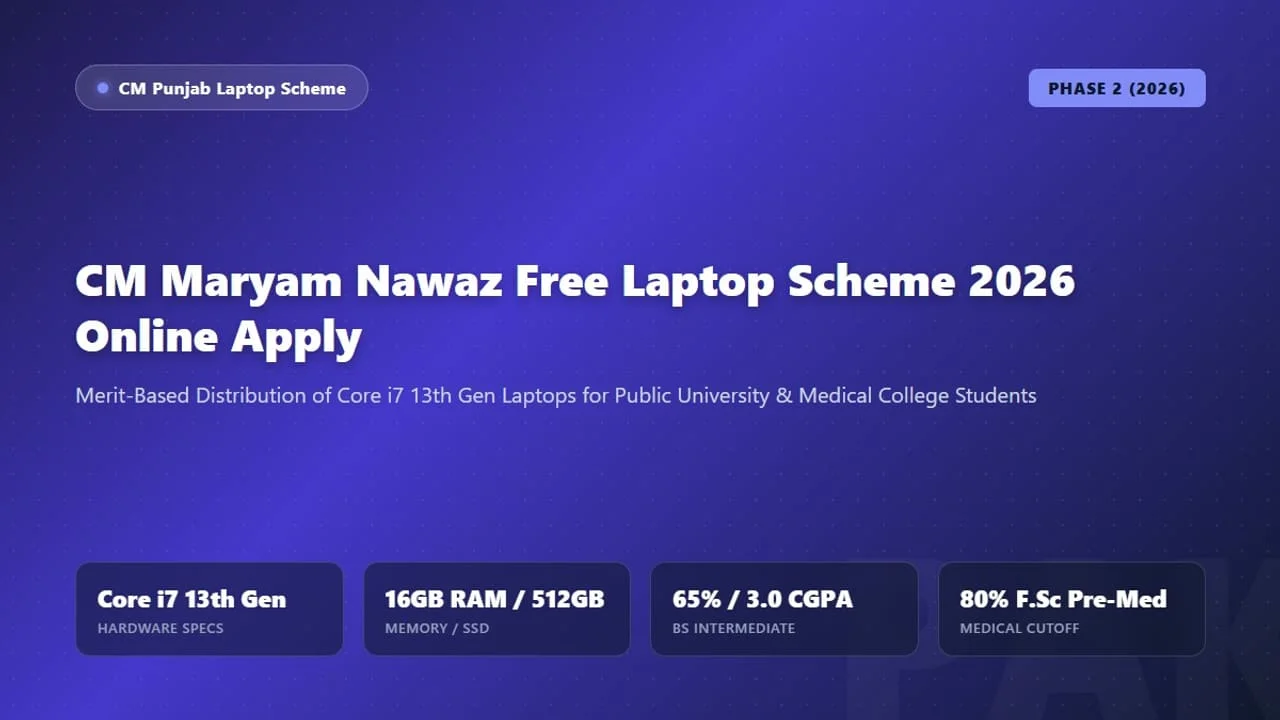
CM Punjab Free Laptop Scheme 2026 Online Apply: Maryam Nawaz Portal, Eligibility & Merit List Guide
Apply online for CM Maryam Nawaz Free Laptop Scheme 2026 at laptop.punjab.gov.pk. Check eligibility, merit CGPA, documents, and 110,000 laptop distribution.
Read guide
CM Punjab Honhaar Merit Scholarship Program 2026: Online Apply, Eligibility & 100% Tuition Fee Guide
To apply online for the CM Punjab Honhaar Merit Scholarship Program in 2026, register on the official portal at honhaarscholarship.punjabhec.gov.pk using your CNIC/B-Form and academic registration details. The Government of Punjab provides 100% full tuition fee coverage for 30,000 undergraduate students enrolled in 68 priority disciplines across 50 public universities and medical colleges.
Read guide
Ehsaas Undergraduate Scholarship 2026 Online Apply: HEC Portal Check, 100% Tuition Fee & Rs 4,000 Stipend Guide
Apply online for HEC Ehsaas Undergraduate Scholarship 2026 on ehsaas.hec.gov.pk. Learn how to secure 100% full tuition fee coverage, Rs 4,000 monthly stipend, prepare university FAO documents, and clear the ISAC interview.
Read guide
Scotland Pakistan Scholarships for Young Women and Girls: Complete Eligibility, Benefits, and Application Guide
The Scotland Pakistan Scholarships for Young Women and Girls is a fully funded financial aid program funded by the Scottish Government and administered by the British Council Pakistan. It covers university tuition, hostel accommodation, and travel for eligible female Pakistani students pursuing undergraduate or master's degrees at HEC-recognized universities inside Pakistan.
Read guide
Punjab One Million Youth Skills Plan: Mahir, Global Rozgar, Advance Tech and Language Learning Explained
Punjab plans to train one million young people in technical and vocational skills over three years. The target was announced on 1 November 2026, and it covers industrial training, business process outsourcing, emerging technology, agriculture, and language learning. It is a target, not an open application form.
Read guide
Daanish Schools Construction Admission: What Was Ordered and Who Qualifies
On 31 October 2026, Prime Minister Shehbaz Sharif ordered Daanish Schools construction across Pakistan to run around the clock, with no compromise on quality. Admission stays strictly merit-based for children from the poorest and most deserving families. No new admission dates were published in the reports reviewed, so families should wait for an official announcement.
Read guide