This article explains public information. It does not determine eligibility or replace an official notice.
What Are Nawaz Sharif Schools of Eminence?
Nawaz Sharif Schools of Eminence, or NSSE, are a Punjab government programme that upgrades public schools into modern campuses with private-sector management. The Punjab Education Foundation runs the programme under a public-private partnership, so the schools stay public and free for most families while licensed partners handle day to day operations. Maryam Nawaz Sharif launched it to match private school facilities, starting with underdeveloped regions.
A Public-Private Partnership Run by PEF
The Punjab Education Foundation, known as PEF, is the body behind the programme. PEF already works with more than 18,200 partner schools and provides free education to over 3.7 million students across Punjab, according to a report published on 9 January 2026. Under NSSE, PEF licenses individuals, entrepreneur groups, educational chains, Ed-Tech firms and NGOs to establish and run the new schools. PEF Chairman Shoaib Awan has led this expansion.
The Flagship Campus in Jalalpur Pirwala
The first School of Eminence opened in Jalalpur Pirwala, in Multan district. The campus spans more than 400 kanals and serves over 2,100 students, which makes it one of the largest public-sector schools in the region. It was launched on 5 May 2025 through a memorandum of understanding signed by Commissioner Multan Amir Karim Khan and PEF Managing Director Shahid Farid, under the supervision of Punjab Education Minister Rana Sikandar Hayat.
What Facilities Will Each School of Eminence Offer?
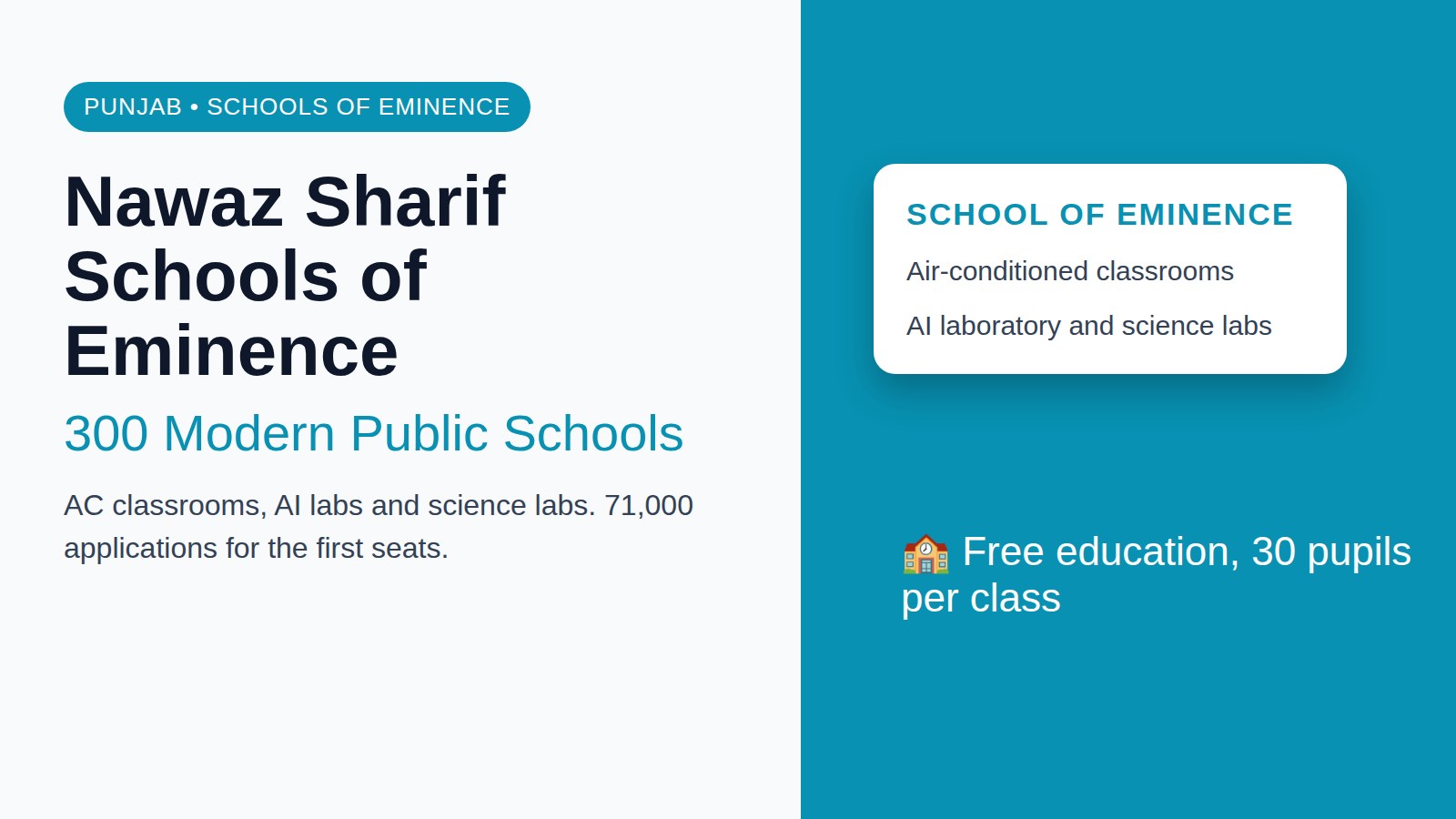
Each School of Eminence is designed as a full modern campus. The standard list includes air-conditioned classrooms, AI laboratories, science labs, smart classrooms, computer labs, STEAM labs, digital libraries and sports facilities. The Chief Minister confirmed the core facilities again on 3 November 2026 at a laptop and Honhaar Scholarship distribution ceremony at COMSATS University Attock, where she said the 300 schools would have air-conditioned classrooms, artificial intelligence laboratories and science labs.
Air-Conditioned Classrooms and Smart Learning
Air-conditioned classrooms are the most talked about feature, and they matter in Punjab summers. The classrooms are also fitted as smart classrooms with digital learning systems, so lessons can use screens, recorded content and interactive material instead of chalk and talk alone. The programme guide notes extra incentives for schools with air-conditioned classrooms. Learning management systems track each student's progress.
AI Labs, Science Labs and STEAM Learning
AI laboratories are the flagship feature of the programme. Punjab's first artificial intelligence laboratories are being set up in public schools under this initiative, alongside science, technology, mathematics, computer and information technology laboratories. Students get hands-on time in science labs, IT labs and robotics facilities, and the curriculum adds STEAM learning, which combines science, technology, engineering, arts and mathematics in practical projects.
Digital Libraries, Sports and Early Childhood Classrooms
The campuses also include digital libraries, sports complexes and Early Childhood Care and Education classrooms, known as ECCE classrooms. Digital libraries let students read beyond their textbooks, while sports complexes and trained physical trainers support co-curricular activity. The guide also requires playgrounds, toilets, CCTV and safety infrastructure. Parent teacher meetings and school advisory councils keep families involved.
How Many Schools of Eminence Are Being Built in Punjab?
The target is 300 Nawaz Sharif Schools of Eminence across Punjab, in every division, district and tehsil. The Chief Minister has repeated that number at several events, most recently on 3 November 2026 at COMSATS University Attock, where she said 300 schools were being established across the province.
The 300-School Target and the 14 August Milestone
In July 2026, the Chief Minister directed officials to make 114 Schools of Eminence operational by 14 August and set a target of completing 300 schools across Punjab by September. That direction was reported on 12 July 2026. Ten campuses were inaugurated in Arifwala around the same time. Note the dates: the 300 by September figure was a target set in July 2026, and the 3 November 2026 statement described the 300 schools as still being established. No official completion figure had been published as of 6 November 2026.
Where the Schools Will Open
PEF plans to open two Schools of Eminence in every tehsil, one for boys and one for girls. The published allocation gives Lahore 12 schools, while Gujranwala, Faisalabad, Rawalpindi, Sargodha, Multan and Bahawalpur get four each. No school-by-school list of all 300 campuses had been published as of 6 November 2026.
| City or area | Schools planned |
|---|---|
| Lahore | 12 |
| Gujranwala | 4 |
| Faisalabad | 4 |
| Rawalpindi | 4 |
| Sargodha | 4 |
| Multan | 4 |
| Bahawalpur | 4 |
| Every other tehsil | 2 (one boys, one girls) |
Who Can Study at a School of Eminence?
The schools are open to all backgrounds, and rich and poor children study together. Students from families earning up to Rs 200,000 a month receive free education. At the same time, the government reserves 10 percent of seats for students whose families can pay the full tuition fee.
Free Education for Families Earning up to Rs 200,000 a Month
Free education is the core promise for parents. If your family earns up to Rs 200,000 a month, your child can study at a School of Eminence without paying tuition fees. That threshold covers most low and middle income households in Punjab.
Why Seats Are So Competitive
Demand for the schools has been very high. More than 71,000 applications were received across Punjab, according to a report published on 12 July 2026. The Chief Minister said parents were placing their trust in public schools again. A separate report put the competition even more sharply: nearly 5,000 applicants competed for every 1,000 available seats. Admission without a NADRA-issued B-Form is prohibited, so parents should keep it ready.
How Do Admissions Work?
This is the question most parents ask, and it is also the one with the least public information. More than 71,000 applications were reported in July 2026. But no public, step-by-step student admission process has been published as of 6 November 2026. No official admission form, test date or merit list process was found. Several websites mix up two different processes: one admits students, and the other licenses operators to run the schools. Only the operator process has a public portal and published rules.
What Parents Know So Far
What is confirmed is that students applied in large numbers and that seats are limited. Each campus must enrol 800 to 1,000 students in year one. Each classroom is limited to 30 students, and a NADRA B-Form is required for admission. Parents should watch for announcements from the Punjab Education Foundation and the district education office. If a form asks for payment to secure a seat, check it against the PEF helpline, 042-111-003-004, before paying anything.
The Operator Portal Is Not a Student Admission Portal
The website nsse.pefsis.edu.pk is the portal for NSSE Phase 2, but it is for operators, not students. PEF uses it for licence applications from individuals, entrepreneur groups, educational chains, Ed-Tech firms and NGOs. Applicants must show 16 years of education, years of experience, and working capital of Rs 7.5 million for an owned building or Rs 10 million for a rented one. A processing fee of Rs 100,000 applies to operator applicants, and the announced deadline was 15 June 2026. That deadline has now passed.
What Will It Cost Parents?
For most families, the answer is nothing in tuition fees. Students from families earning up to Rs 200,000 a month study free, and the government funds the schools through a per-student subsidy paid to the licensed operator. The 10 percent of seats reserved for full-fee families is the only confirmed fee-paying route, and no fee amount for those seats had been published as of 6 November 2026. Parents should not pay any admission fee to an agent or a middleman.
Free Places and the 10 Percent Full-Fee Seats
The free places cover the large majority of seats. The 10 percent reservation for families who can pay full fees means the schools are not restricted to one income group, and it gives the campuses a mixed student body. No official fee figure for those full-fee seats has been published, so this article does not state one. Free education covers tuition. Transport, uniforms and books are not covered by any published statement, so parents should ask the campus directly.
How PEF Pays the Schools
PEF pays the licensed operator a monthly subsidy for each enrolled student. The published rates are Rs 3,500 per student from Nursery to Class 2, Rs 4,000 for Class 3 to Class 5, Rs 4,500 for Class 6 to Class 8, Rs 5,000 for Class 9 to Class 10 in Arts, and Rs 5,500 for Class 9 to Class 10 in Science. The subsidy is linked to verified enrolment, academic performance and operational compliance. Separately, the Punjab government allocated Rs 40 billion to improve public schools with new classrooms, furniture, clean drinking water, washrooms and fans. That covers upgrades across the province, not only Schools of Eminence.
Who Runs the Schools and How Is Quality Checked?
PEF runs the programme under a modern governance framework and holds the licensed operators to account. Each operator takes full responsibility for school establishment, infrastructure, academic management, financial administration, teacher recruitment and community integration, under a five-year renewable licence. PEF monitors performance through quarterly audits, annual evaluations, financial inspections and real-time dashboards.
Teacher Standards and Training
Qualified teachers are a stated requirement of the programme. Teachers must hold at least 16 years of education with professional educational qualifications, and schools must provide regular teacher training, including more than 40 hours of continuing professional development each year. Schools must also hire physical trainers, STEAM trainers and co-curricular specialists.
Tests, Targets and Monitoring
PEF monitors each school through key performance indicators and continuous assessment. The headline academic target is an 85 percent pass rate in Board of Intermediate and Secondary Education (BISE) examinations. PEF also runs an annual Quality Assurance Test, under which 75 percent of students must score at least 40 percent marks.
What Changed in 2026?
The programme moved from a single flagship campus to a province-wide rollout during 2026. The table below puts the key dates in order, so readers can see what was announced and when.
| Date | What happened |
|---|---|
| 5 May 2025 | MoU signed for Jalalpur Pirwala flagship campus |
| 9 May 2026 | Third-party NSSE guide on operator licensing published |
| 15 June 2026 | NSSE Phase 2 operator deadline (now passed) |
| 12 July 2026 | 71,000+ applications reported; 114 schools to open by 14 August; 300 targeted by September |
| 15 July 2026 | Rs 40 billion announced for public school upgrades at Arifwala |
| 29 July 2026 | Opinion piece covers STEM labs, smart classrooms and PPP model |
| 3 Nov 2026 | Chief Minister restates 300-school plan at COMSATS Attock |
| 5 Nov 2026 | Attock ceremony report published from the official handout |
What We Know and What Is Not Public Yet
Confirmed: 300 schools are planned; the Jalalpur Pirwala flagship campus is running with over 2,100 students; classes are capped at 30; families earning up to Rs 200,000 a month get free education; 10 percent of seats are for full-fee families; and over 71,000 applications were received. Not public yet: the student admission process, the full-fee amount, and a school-by-school list. Note: Indian Punjab runs a separate "Schools of Eminence" programme with 117 schools. Its figures belong to a different country and should not be mixed with this PEF programme.
Frequently asked questions
What is a Nawaz Sharif School of Eminence?
It is a modern public school in Punjab, upgraded under the Punjab Education Foundation with air-conditioned classrooms, AI laboratories and science labs. The schools run under a public-private partnership, so a licensed partner operates the campus while it stays public.
How many Schools of Eminence will open in Punjab?
The target is 300 schools across Punjab, in every division, district and tehsil. The Chief Minister directed that 114 schools be operational by 14 August and set a target of 300 by September, and she restated the 300-school plan on 3 November 2026.
Is education free at Schools of Eminence?
Yes, for families earning up to Rs 200,000 a month. Students from those families study without paying tuition fees. The government also reserves 10 percent of seats for students whose families can pay the full tuition fee, though no fee amount has been published.
How can my child get admission to a School of Eminence?
No public student admission process had been published as of 6 November 2026. More than 71,000 applications were reported in July 2026, but no official form, test date or merit list process was available.
What is nsse.pefsis.edu.pk?
It is the online portal for NSSE Phase 2 operator applications, not a student admission portal. PEF uses it for individuals, entrepreneur groups, educational chains, Ed-Tech firms and NGOs that want a licence to run a school. Parents should not use it to apply for a child's admission.
What facilities do Schools of Eminence have?
Each campus is designed with air-conditioned classrooms, AI laboratories, science labs, smart classrooms, computer labs, STEAM labs, digital libraries, sports complexes and Early Childhood Care and Education classrooms. Schools also have CCTV systems, biometric attendance and playgrounds.
Where is the first School of Eminence?
The flagship campus is in Jalalpur Pirwala, in Multan district. It covers more than 400 kanals, serves over 2,100 students, and was launched on 5 May 2025 through an agreement between the Multan Commissioner and the PEF Managing Director.
What is the class size at a School of Eminence?
Each classroom is limited to 30 students. That cap is part of the programme's standard for modern learning facilities, and it is one reason seats are so competitive, with nearly 5,000 applicants for every 1,000 available seats.
Who runs the Schools of Eminence?
The Punjab Education Foundation runs the programme under a public-private partnership model. PEF licenses operators to establish and manage each campus for five years, renewable on performance, and monitors them through audits, annual evaluations and a Quality Assurance Test.
When will all 300 schools be ready?
No completion date has been confirmed. The Chief Minister set a target of 300 schools by September in July 2026, and on 3 November 2026 she said the 300 schools were being established. No official statement had confirmed all 300 were complete.
Sources and official links
Check the destination address before entering personal information.
Related guides
PM Chromebook Scheme: 500,000 Free Chromebooks for Top Government School Students
The PM Chromebook Scheme 500000 Students gives 500,000 Chromebooks, plus a bag and a MiFi internet device, to top performing students of government schools across Pakistan. Prime Minister Shehbaz Sharif launched it in Islamabad on 25 October 2026. Selection is merit based, uses board results verified through IBCC, and registration runs through the IBCC portal.
Read guide
Daanish Schools Construction Admission: What Was Ordered and Who Qualifies
On 31 October 2026, Prime Minister Shehbaz Sharif ordered Daanish Schools construction across Pakistan to run around the clock, with no compromise on quality. Admission stays strictly merit-based for children from the poorest and most deserving families. No new admission dates were published in the reports reviewed, so families should wait for an official announcement.
Read guide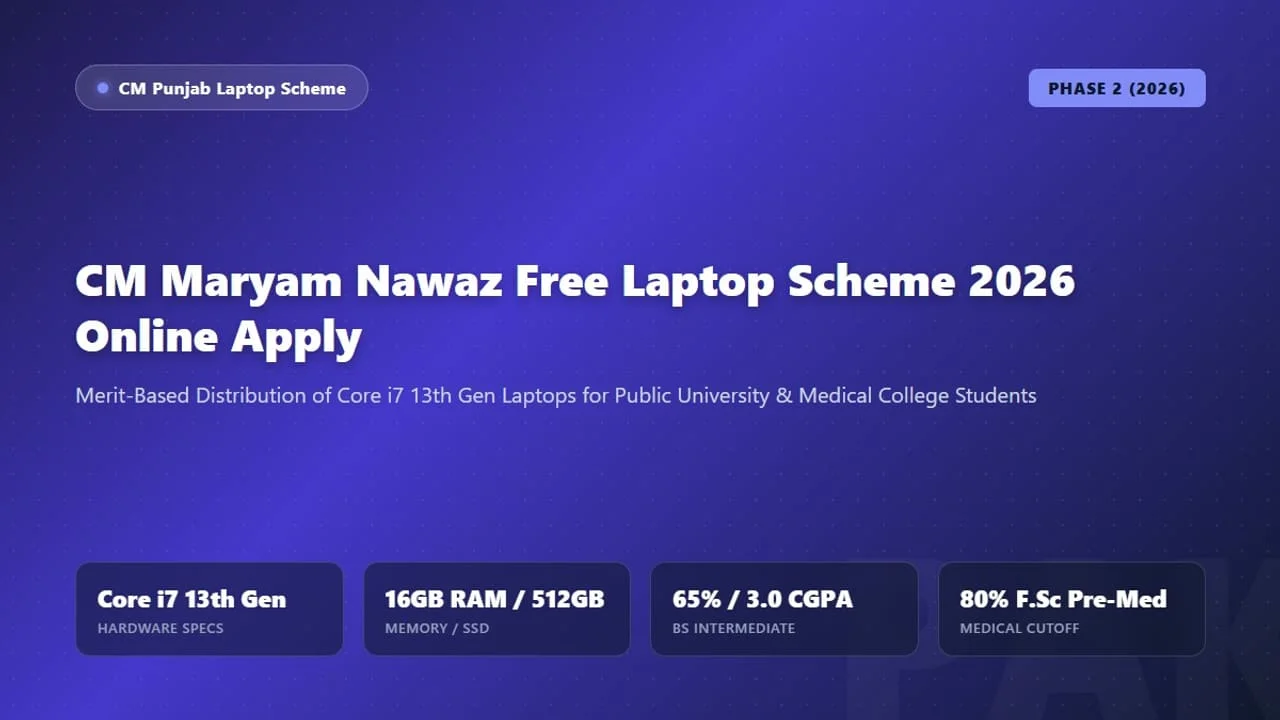
CM Punjab Free Laptop Scheme 2026 Online Apply: Maryam Nawaz Portal, Eligibility & Merit List Guide
Apply online for CM Maryam Nawaz Free Laptop Scheme 2026 at laptop.punjab.gov.pk. Check eligibility, merit CGPA, documents, and 110,000 laptop distribution.
Read guide
CM Punjab Honhaar Merit Scholarship Program 2026: Online Apply, Eligibility & 100% Tuition Fee Guide
To apply online for the CM Punjab Honhaar Merit Scholarship Program in 2026, register on the official portal at honhaarscholarship.punjabhec.gov.pk using your CNIC/B-Form and academic registration details. The Government of Punjab provides 100% full tuition fee coverage for 30,000 undergraduate students enrolled in 68 priority disciplines across 50 public universities and medical colleges.
Read guide
Punjab One Million Youth Skills Plan: Mahir, Global Rozgar, Advance Tech and Language Learning Explained
Punjab plans to train one million young people in technical and vocational skills over three years. The target was announced on 1 November 2026, and it covers industrial training, business process outsourcing, emerging technology, agriculture, and language learning. It is a target, not an open application form.
Read guide