This article explains public information. It does not determine eligibility or replace an official notice.
What Is BISP? The Statutory Foundation (2008–Present)
The Benazir Income Support Programme was established in July 2008 as Pakistan's premier national social safety net, formally codified into law through the BISP Act of 2010. Passed unanimously by Parliament, this legislation established BISP as an autonomous federal authority governed by an independent Board and managed under the Ministry of Poverty Alleviation and Social Safety (PASS).
BISP's primary constitutional mandate is to provide unconditional cash transfers (UCT) directly to female heads of vulnerable households, establishing financial inclusion and shielding families from extreme poverty, hyperinflation, and food insecurity. To identify eligible families objectively, BISP partnered with the National Database and Registration Authority (NADRA) to create the National Socio-Economic Registry (NSER). Using a data-driven Poverty Means Test (PMT) score calculated on a scale from 0 to 100, BISP established a scientific threshold to determine who receives state financial assistance.
- Permanent Legal Cover: Protected by federal statute, insulating its core funding and operations from arbitrary executive dissolution.
- Women-Centric Financial Architecture: Stipends are disbursed exclusively to female family representatives holding valid computerized national identity cards (CNIC).
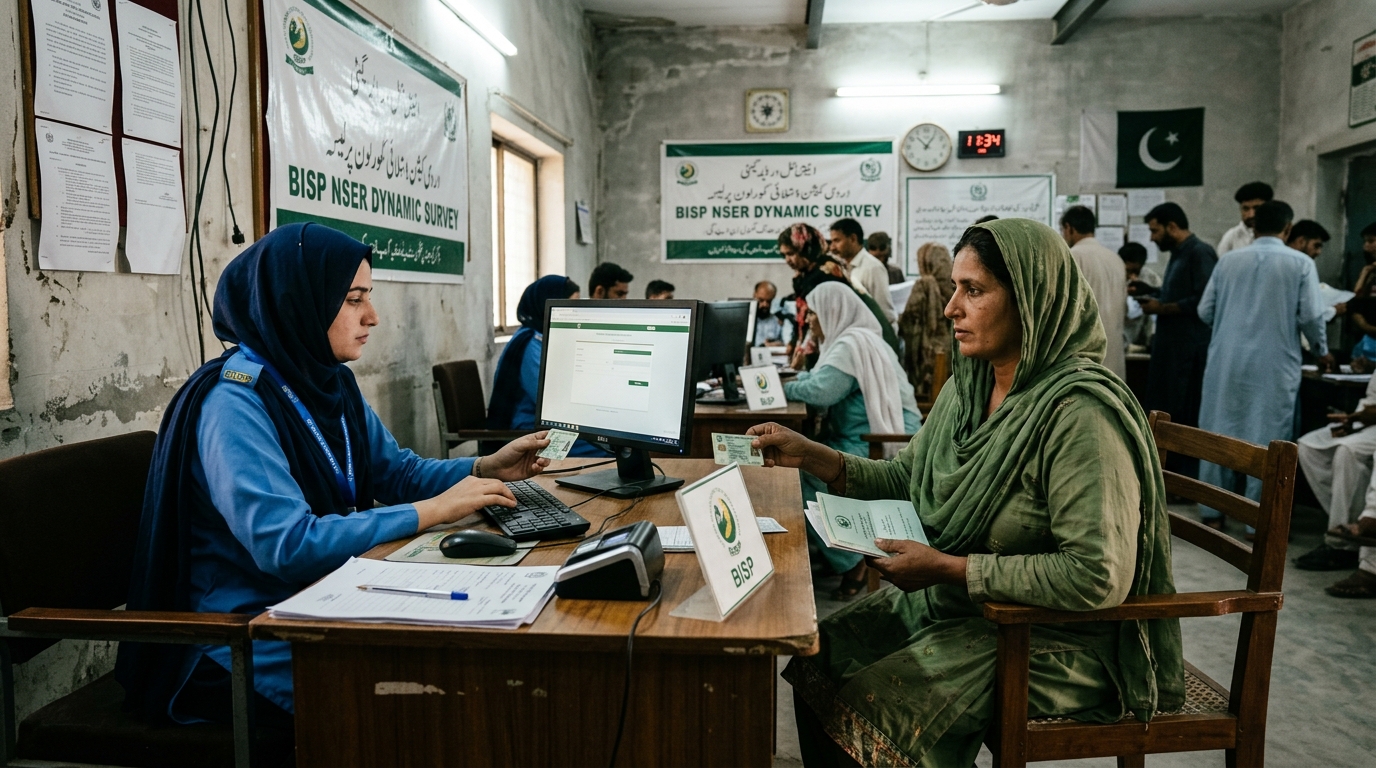
- Extensive Field Infrastructure: Operating over 600 Tehsil Registration Desks across all four provinces, Azad Jammu & Kashmir, and Gilgit-Baltistan.
- Dynamic Registry System: Continuously updating household socio-economic indicators through walk-in NADRA verification counters.
What Was the Ehsaas Programme? The Umbrella Framework (2019–2022)
In March 2019, the federal government introduced the Ehsaas Programme not as a replacement body, but as an expansive umbrella welfare strategy. Designed to combat inequality, invest in human capital development, and lift marginalized communities through multi-sectoral safety nets, Ehsaas spanned over 130 policy initiatives across 34 federal and provincial departments.
Rather than dismantling BISP's physical infrastructure, the Ehsaas policy framework utilized BISP as its primary operational vehicle. Under this framework, BISP's flagship quarterly cash transfer was branded as Ehsaas Kafaalat, the school stipend program (Waseela-e-Taleem) was expanded into Ehsaas Taleemi Wazaif, and the maternal nutrition initiative was launched as Ehsaas Nashonuma.
In addition to BISP-administered initiatives, Ehsaas introduced specialized emergency interventions. Most notably, the Ehsaas Emergency Cash program mobilized over Rs. 200 billion during the 2020 global pandemic to provide one-time Rs. 12,000 cash grants to daily-wage workers who were not previously enrolled in social welfare rosters. Other parallel initiatives included Ehsaas Rashan Riayat, Ehsaas Amdan, and Ehsaas Undergraduate Scholarships.
Core Differences: Institutional Structure, Legal Status, and Mandate
To clear public confusion, it is essential to understand the operational, legal, and functional distinctions between BISP and Ehsaas. While BISP operates as an enduring statutory institution with legal permanence, Ehsaas was an overarching executive policy framework designed to coordinate multiple poverty-reduction pillars simultaneously.
| Feature | Benazir Income Support Programme (BISP) | Ehsaas Programme (Framework) |
|---|---|---|
| Legal Standing | Autonomous statutory body created by an Act of Parliament (BISP Act 2010) | Executive policy framework & multi-agency strategic umbrella |
| Launch Year | July 2008 (statutory act passed in 2010) | March 2019 |
| Primary Focus | Unconditional quarterly cash transfers (Kafaalat) & conditional stipends (education & nutrition) | Multi-sectoral poverty alleviation covering health, housing, microfinance, and emergency cash |
| Target Population | Poorest women meeting the PMT eligibility cutoff (score 0 to 32) | Broader vulnerable segments, daily wagers, students, and low-income families |
| Administrative Body | BISP Board & Federal Executive Management under Ministry of PASS | Poverty Alleviation and Social Safety Division (PASSD) coordinating across 34 bodies |
| Operational Database | National Socio-Economic Registry (NSER) powered by NADRA | Utilized BISP's NSER infrastructure and NADRA biometric verification |
| Current Status (2026) | Fully active, expanded, and the official operational brand for all federal cash stipends | Retired as an operational umbrella; core programs transitioned back under BISP |
Program-by-Program Mapping: How Names Changed Across Eras
Because different government administrations applied different names to the same welfare services, millions of citizens remain uncertain about what their entitlements are called today. The underlying financial support mechanisms have remained consistent, but the program titles were updated across distinct political tenures.
| Core Welfare Service | Initial BISP Era (2008–2018) | Ehsaas Era (2019–2022) | Current BISP Identity (2026) |
|---|---|---|---|
| Quarterly Women Cash Stipend | BISP Basic Cash Transfer (UCT) | Ehsaas Kafaalat | Benazir Kafaalat Programme |
| Children School Stipends | Waseela-e-Taleem (CCT) | Ehsaas Taleemi Wazaif | Benazir Taleemi Wazaif |
| Maternal & Stunting Nutrition | Pilot Specialized Nutrition | Ehsaas Nashonuma | Benazir Nashonuma Programme |
| Household Poverty Database | BISP NSER Household Survey | Ehsaas National Socio-Economic Registry | BISP Dynamic Registry (NSER) |
| Higher Education University Grants | BISP Merit Grants | Ehsaas Undergraduate Scholarship | HEC Need-Based & Regional Grants |
| Interest-Free Micro Loans | BISP Waseela-e-Haq / Rozgar | Ehsaas Interest-Free Loans | PPAF / National Poverty Graduation |
| Official Online Status Portal | bisp.gov.pk | 8171.pass.gov.pk (archived) | https://8171.bisp.gov.pk/ |
The Unified 8171 Gateway: Why It Works for Both
A major source of confusion is the short code 8171. Beneficiaries frequently ask whether 8171 belongs to Ehsaas or BISP. In reality, the short code 8171 is the official, state-owned SMS gateway and web portal service for all federal social safety programs in Pakistan. It was deployed to serve as a single, tamper-proof communication bridge between the state and beneficiaries.
During the 2019–2022 period, the portal was widely known as the '8171 Ehsaas Tracking Portal.' Today, the service is officially designated as the 8171 BISP Web Portal (8171.bisp.gov.pk). Regardless of when an applicant enrolled, all application tracking, payment approvals, installment announcements, and survey appointment notices are dispatched exclusively from the 4-digit sender ID 8171.
Beneficiaries must note that any SMS claiming to represent BISP or Ehsaas originating from standard 11-digit mobile numbers (such as 0300, 0312, 0345) is an unauthorized scam attempting to steal personal data or demand upfront commission fees.
Do You Need Separate Registrations for BISP and Ehsaas?
The short answer is no. You do not need to register separately for BISP and Ehsaas. Because both initiatives utilize the exact same National Socio-Economic Registry (NSER) administered by NADRA, a family that completed the survey under the Ehsaas dynamic registry is automatically recorded within BISP's central database.
Eligibility is governed purely by your household's Poverty Means Test (PMT) score. If your household PMT score is at or below the official cutoff threshold (currently 32 for the Benazir Kafaalat quarterly grant), your family automatically qualifies for disbursements.
Furthermore, there is no such thing as an 'Ehsaas Card' distinct from a 'BISP Card.' Both refer to the biometric ATM cards or branchless digital banking accounts issued through partner banks (such as Bank Alfalah and Habib Bank Limited) to collect approved financial assistance.
- Single Database: Your NSER registration covers all federal cash assistance and subsidy programs.
- Dynamic Updates: Report changes in income, family size, or marital status at any BISP Tehsil Registration Desk.
- Zero Fee: Registration and PMT evaluation are 100% free; beware of agents demanding survey application charges.
How to Verify Your Official Welfare Status Today (2026)
To check whether your family is currently active in the national social protection roster, follow these verified steps:
First, open your web browser and navigate directly to https://8171.bisp.gov.pk/. Never enter your credentials on unverified third-party blogs or social media landing pages. Second, enter your 13-digit CNIC number without dashes, followed by the 4-digit numeric security code displayed on the screen.
Review the returned status message carefully. If the portal states 'Aap Benazir Kafaalat k liye ahal hain', your quarterly installment has been approved for withdrawal. If it displays 'Aap ka gharana janch partal mein hai', your NSER data is undergoing standard verification. If instructed to visit a BISP office, take your original CNIC and child B-forms to your local Tehsil center.
Frequently asked questions
What is the main difference between BISP and Ehsaas?
BISP is a permanent statutory social welfare institution established by law in 2010, whereas Ehsaas was an overarching federal policy framework introduced in 2019 that temporarily coordinated and expanded BISP under a single umbrella.
Is the Ehsaas program still active in 2026?
The specific brand name 'Ehsaas' has been phased out for operational cash programs, but all of its core welfare initiatives—including quarterly stipends and student grants—remain fully active under the Benazir Income Support Programme (BISP).
Is the 8171 SMS service for BISP or Ehsaas?
The 8171 SMS gateway and web portal serve as the official communication channel for BISP, having previously served both programs under the unified federal poverty alleviation framework.
Do I need to re-apply if I registered during the Ehsaas survey?
No, you do not need to re-apply because your survey data is securely stored in NADRA's central National Socio-Economic Registry (NSER), which BISP uses to evaluate eligibility.
Why do some people still call it the Ehsaas Kafaalat program?
Beneficiaries frequently use 'Ehsaas Kafaalat' and 'Benazir Kafaalat' interchangeably because the program was publicized under the Ehsaas name between 2019 and 2022 before returning to its statutory BISP title.
What happened to the Ehsaas Emergency Cash program?
Ehsaas Emergency Cash was a temporary, time-bound relief initiative launched during the 2020 pandemic lockdowns, whereas Benazir Kafaalat continues as a permanent quarterly financial stipend.
How can I check if my household qualifies for BISP or Ehsaas stipends?
You can verify your household's eligibility by entering your 13-digit CNIC into the official government portal at 8171.bisp.gov.pk or by sending your CNIC via SMS to 8171.
Are there separate BISP offices and Ehsaas offices in each Tehsil?
No, there are no separate offices; all social welfare registrations, biometric verifications, and complaint handlings take place at unified BISP Tehsil Registration Centers located across the country.
What is the current quarterly amount disbursed to beneficiaries in 2026?
Eligible female beneficiaries enrolled in the Benazir Kafaalat program receive regular quarterly financial assistance of Rs. 10,500, with specialized seasonal tranches expanding up to Rs. 13,500.
Can I apply for BISP or Ehsaas online through a mobile app?
No, official registration cannot be completed via a mobile app or online form; all valid registrations require an in-person biometric dynamic survey at an official BISP Tehsil desk with original NADRA CNICs and child B-forms.
Sources and official links
Check the destination address before entering personal information.
Muhammad Salman specializes in Pakistani public sector financing, youth entrepreneurship schemes, and government subsidy programmes, cross-referencing all data against official SBP circulars and ministry directives.
Related guides
CM Balochistan Youth Skills Scheme 2026 Online Apply & Registration Guide
Apply online for CM Balochistan Youth Skills Scheme 2026. Complete guide to B-TEVTA online registration, courses, monthly stipends, and 30,000 overseas jobs.
Read guide
Fake 8171 SMS Check, Complaint & BISP Lottery Fraud Alert Guide
Spot fake 8171 SMS scams and report BISP lottery fraud. Step-by-step guide to reporting scammers on PTA 9000, BISP Helpline 0800-26477, Police 15, and FIA Cybercrime.
Read guide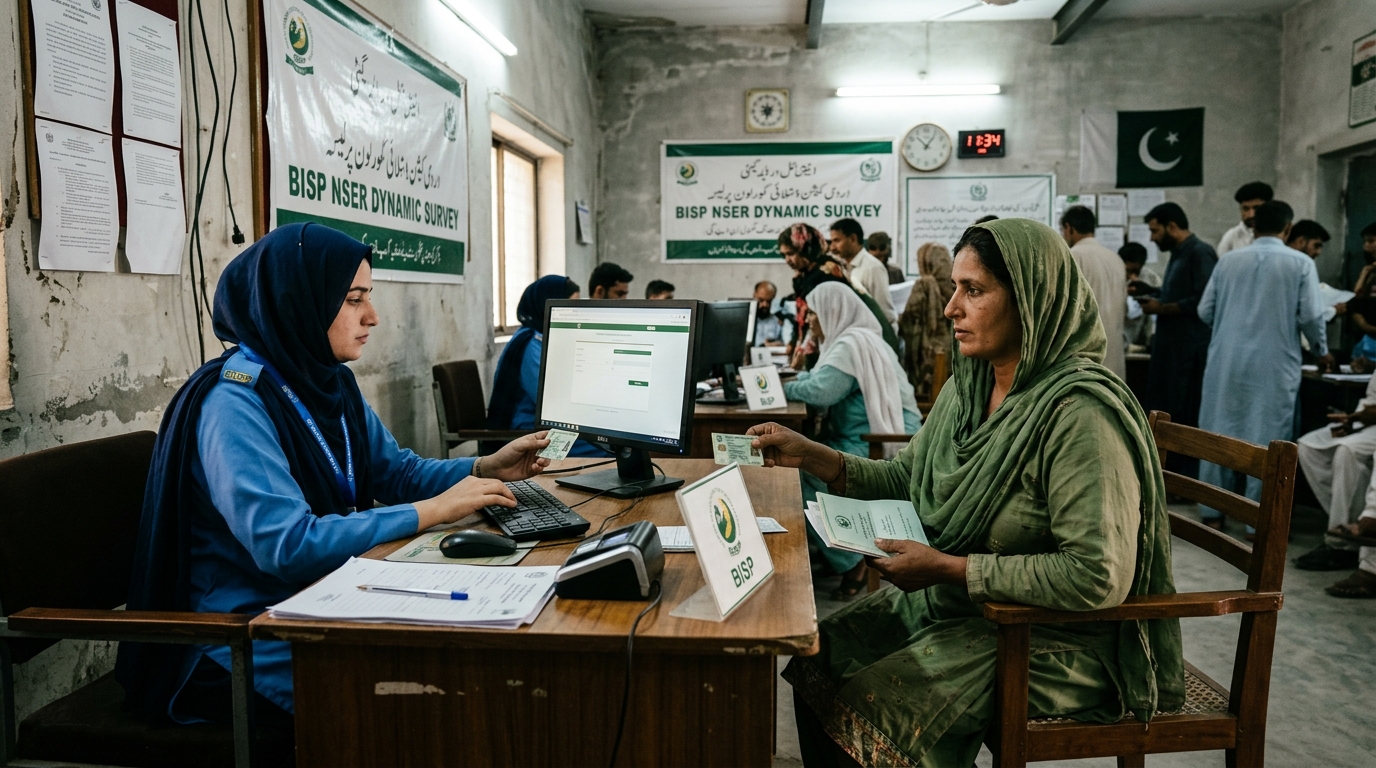
PMT Score Above 32 BISP Re-Survey Guide: Official Procedure to Challenge Poverty Score and Re-Register (2026)
If your BISP PMT score is above 32, your household is classified as financially ineligible for Benazir Kafaalat cash transfers. While you cannot manually edit the score number online, you can legally trigger an NSER dynamic re-survey at your local BISP Tehsil Office if your financial circumstances worsened or your household survey is over two years old.
Read guide