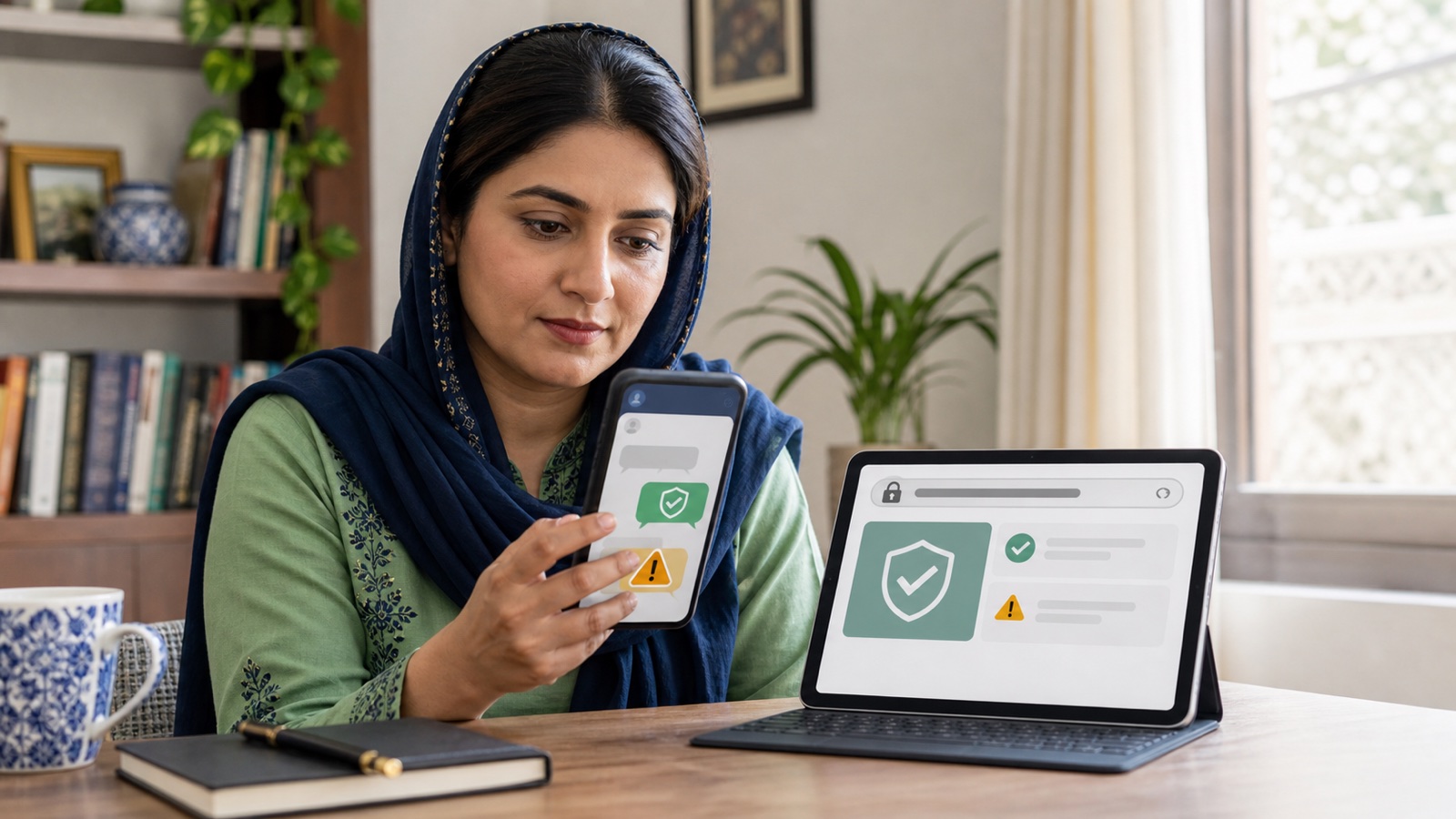
This article explains public information. It does not determine eligibility or replace an official notice.
What the PMT Score Actually Measures
If you've been told your household "failed" a PMT score check, it helps to know exactly what that number is before worrying about what it means. PMT stands for Proxy Means Test, and it isn't a credit score or a bank rating — it's a poverty assessment tool built by the Government of Pakistan to estimate a household's financial condition without asking every family to prove income directly. The score comes from data already sitting in the National Socio-Economic Registry, or NSER, the same welfare-programme database that BISP and Ehsaas both draw from as part of Pakistan's wider social safety net.
In plain terms, the PMT score is the government's way of turning a household survey into one comparable number, so an eligibility assessment can happen at scale across millions of applicants rather than case by case. It's a scoring system, not a judgment — a low score simply signals more financial need than a high one.
How the PMT Score Is Calculated
The second thing people usually want to know is what actually feeds into the number, and the honest answer is: more than most applicants expect. Household income and monthly income are the obvious inputs, but the formula also weighs family size, the number of dependents, housing conditions and housing type, utility consumption including electricity bills, property ownership, and whether the household has vehicles or land on record. Education levels and employment status of working members are factored in too, alongside recorded assets and any relevant special circumstances such as widowhood or disability.
None of this is published as a simple checklist you can total up yourself — the exact formula is treated as an internal government process, not a public calculator. That's a deliberate choice rather than an oversight: a fully public formula would make it easier for people to game the survey answers rather than report their situation honestly.
PMT Score Eligibility Categories
Once the number is calculated, it's compared against bands that decide what, if anything, a household qualifies for. Guidance repeated across several sources places a score of 0 to 32 as fully eligible for cash support and Ehsaas Rashan subsidies, a score of 33 to 40 as partially eligible, generally limited to Utility Store subsidies rather than cash, and 41 and above as not eligible for either. The underlying rule is simple even if the exact cutoffs deserve independent confirmation: a lower PMT score means a higher chance of eligibility, while higher scores reduce approval chances.
Treat these specific numbers as a strong general guide rather than gospel — they show up consistently across independent sources, but BISP hasn't published them as a fixed public chart, so don't assume a household one point either side of a band will always be treated identically.
Why Your PMT Score Might Be Higher Than Expected
A surprisingly high score doesn't always mean the survey was wrong on purpose — most of the time it traces back to information that's simply out of date. Outdated employment records are the most common culprit, followed by registered property the family no longer actually owns, sold assets that were never removed from the file, and unreported income changes after someone lost a job or a business closed. A deceased family member still linked to the household, old survey data that predates a real change in circumstances, shared meter readings that overstate one household's actual electricity use, and an inactive business still listed as active can all quietly push a score up.
Incorrectly included family income — for instance, counting a relative's earnings that don't actually support the household — shows up often too, alongside high electricity bills and registered vehicles that have since been sold. None of these are permanent; they're data problems, and data problems get fixed through an official record update rather than by disputing the score itself.
Common Misunderstandings About the PMT Score
Does a lower score always mean approval? No — and this is genuinely the biggest misunderstanding among applicants. The PMT score is one part of eligibility assessment, not the whole decision; other verification steps still apply even to a household with a strong score. It's also worth being clear that there's no official method to manually increase or decrease your own score from home, and no legitimate way to speed it up through a middleman.
Any agent claiming they can perform manual score manipulation on your behalf is making a promise the system doesn't allow anyone to keep. It's also worth knowing that the permanence of scores is a myth in the other direction too — BISP doesn't show you the exact score as a number online; what you actually see when you check is an eligibility status only, not a raw figure to compare against your neighbor's.
PMT Score vs. NSER: What's the Difference
These two terms get used almost interchangeably, but they're not the same thing. NSER — the National Socio-Economic Registry — is the underlying database that holds your household record details: the raw answers collected when a survey gathers information about your income, assets, and living situation. The PMT score is what comes out of that data — an assessment outcome calculated from the NSER record, not the record itself.
Put simply: NSER is the filing cabinet, and the PMT score is the number someone calculates after reading your file. Updating your NSER entry is what changes your PMT score — you can't change one without touching the other.
Can Your PMT Score Change Over Time
Yes, and this cuts both ways — a score isn't locked in forever the moment it's first calculated. Household composition changes are the most common trigger: a new dependent, a family member's job loss, someone becoming newly widowed, or a new disability in the household can all justify a fresh look. Beyond individual circumstances, updated surveys, a formal re-verification, or a general NSER update rolled out across a district can shift scores even without anything changing on your end specifically.
If your circumstances have genuinely changed, the practical route is requesting a dynamic survey through your local BISP office rather than assuming the system will notice on its own. It's worth building a habit of checking your status periodically after any major life change, rather than only when a payment feels overdue.
Why You Should Never Trust an Agent Who Offers to "Fix" Your Score
Because the PMT score genuinely can't be manually adjusted by an individual, anyone offering to do exactly that is describing a service that doesn't exist. Be especially wary of unofficial PMT score websites that ask you to enter your CNIC before showing a result — sharing your CNIC with a site that isn't the official portal is the actual risk, not the score itself. Paying agents who claim score-modification abilities, whether in person or through WhatsApp groups, is a documented scam pattern, because no private website has authority over an official government calculation.
The safe habit is simple: refuse any fee payments tied to your score, and use official BISP channels only — the 8171 portal and its SMS shortcode — for anything involving your actual result.
Frequently asked questions
Can I lower my PMT score to qualify for the Ehsaas Program?
Yes, but only by correcting genuinely inaccurate NSER information through your local BISP office — not by any shortcut. Scores are recalculated after your updated record is verified, so this is a data-correction process, not a manual score edit.
How long does a PMT score update or verification take?
Some guides report a window of roughly 15 to 30 working days after you submit an update request, though this isn't an officially guaranteed timeframe — treat it as a rough expectation rather than a fixed deadline.
What documents do I need to request a PMT score correction?
Typically your original CNIC, recent utility bills, an income affidavit if your employment status changed, B-Forms for children in the household, and any relevant certificate for special circumstances like widowhood or disability.
Can I calculate my own PMT score myself?
No. The exact calculation formula isn't published, so there's no public calculator or checklist that will produce an accurate number — the only reliable output is the eligibility status shown after an official check.
Can an agent increase my PMT score for a fee?
No individual or private website has the authority to modify an official PMT score. Anyone claiming otherwise, in person or through WhatsApp, is running a scam — report it rather than paying.
Does every applicant receive an individually calculated score?
Yes. Each household gets its own assessment based on its own survey data, so two families in similar circumstances can still end up with different scores depending on what's actually on file for each.
Will my PMT score stay the same forever?
No. It can change whenever your household's underlying NSER data changes, whether through a life event you report or a broader survey update in your area.
Can I see my exact PMT score as a number?
No — official checks show your eligibility status (such as eligible or not eligible), not a raw numeric score to compare against anyone else's.
Does utility or mobile usage affect my PMT score?
Indirectly, yes. High and consistent utility bills can be read as a sign of financial stability, which is one of several factors that can push a score upward.
Is the PMT score used for BISP only, or other programs too?
The same NSER-based scoring system supports eligibility decisions across several Ehsaas-linked initiatives, not just core BISP cash assistance, though each programme applies its own thresholds.
What happens if my score falls in the partially eligible band?
A score in that middle range generally limits you to specific support like Utility Store subsidies rather than direct cash assistance — confirm your exact entitlement through the official portal rather than assuming full benefits apply.
Can I apply again after being rejected due to a high PMT score?
Yes. You can request a fresh survey once your circumstances or records have genuinely changed, and your case will be reassessed rather than permanently closed.
Sources and official links
Check the destination address before entering personal information.
Saad has covered BISP, Ehsaas, and provincial welfare schemes for Live Govt Schemes & Ehsaas Programs since 2024, cross-checking every guide against the current official portal before publication.
Ayesha reviews programme-eligibility and payment content for accuracy against BISP, NADRA NSER, and provincial notices, and flags any guide that needs an update after an official policy change.
Related guides
BISP Biometric Failed? Guaranteed Rs 13,500 Fix
POS machine ya ATM par fingerprints match na hone ki surat mein 13,500 Rs ki payment Form B aur NADRA verification ke zariye hasil karne ka mukammal tariqa.
Read guide
Verified BISP Tehsil Offices KPK & Peshawar List
Peshawar aur KPK ke tamam major districts ke BISP offices ke exact addresses, contact details aur timings ki mukammal master list.
Read guide
Fake 8171 SMS Check, Complaint & BISP Lottery Fraud Alert Guide
Spot fake 8171 SMS scams and report BISP lottery fraud. Step-by-step guide to reporting scammers on PTA 9000, BISP Helpline 0800-26477, Police 15, and FIA Cybercrime.
Read guide