This article explains public information. It does not determine eligibility or replace an official notice.
What Is the Punjab PIVOT Plan 2026-29?
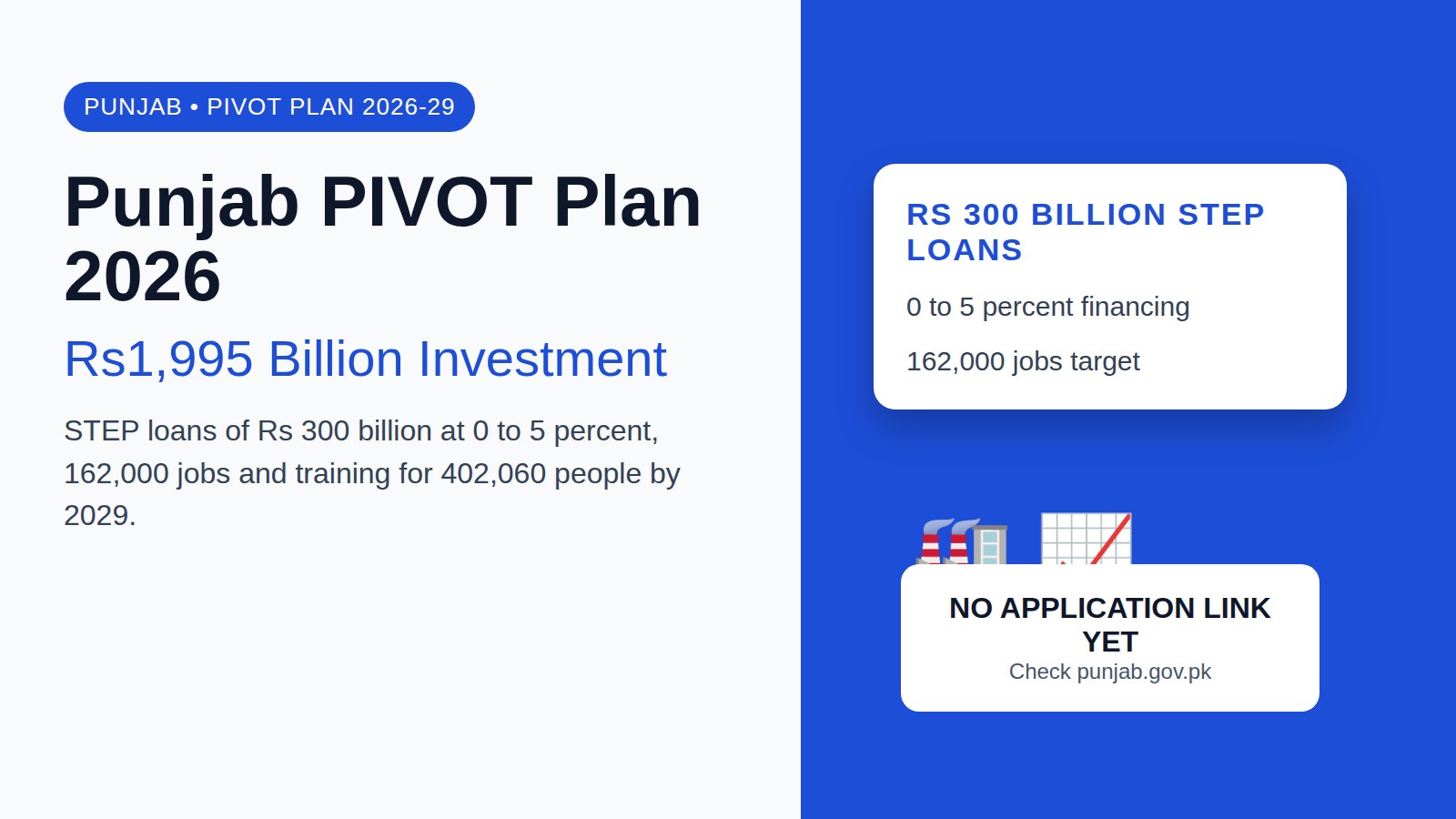
The Punjab PIVOT Plan 2026-29 is a three-year economic development programme run by the Government of Punjab. Its full name is Punjab Innovation for Value, Opportunity and Transformation. The plan aims to grow industry, raise exports, attract private investment and create jobs and skills.
PIVOT is not a cash assistance scheme. It does not pay a monthly amount to households, and it is not a list of open government jobs. It is a plan for businesses, industry, farms, skills and exports, funded by a mix of public investment and private investment the government hopes to attract.
When Was PIVOT Approved and Launched?
The Punjab cabinet approved the main features of PIVOT on 19 October 2026, at the 37th meeting of the provincial cabinet, chaired by Chief Minister Maryam Nawaz Sharif. Senior Minister Marriyum Aurangzeb presented the programme to the cabinet.
The formal launch followed on 30 October 2026 in Lahore. Chief Minister Maryam Nawaz Sharif unveiled the plan at a ceremony attended by State Bank Governor Jameel Ahmad, members of the Pakistan Business Council and business leaders.
One naming point needs care. Some reports after the 19 October cabinet meeting called the programme PIYUT. The launch reports on 30 October used PIVOT. The government has not published a separate note to explain the difference. This article uses PIVOT because that is the name used at the launch.
How Much Investment Does PIVOT Plan?
PIVOT sets an investment framework of about Rs1,995 billion over three years, often written as Rs1,995.3 billion in launch reports. It is a target framework, not money already spent. The total has two parts: public investment of about Rs1,089 billion from the Punjab government, and private investment of about Rs906 billion that the government expects from businesses and investors.
Private money is the larger risk in the plan: it depends on firms choosing to invest in Punjab, and no published account lists signed commitments behind the full Rs906 billion figure. The largest single share goes to industry: Rs753.7 billion for industrial development, manufacturing, value addition and export competitiveness, as part of the Rs1,995 billion total.
Two measures sit inside the industrial share: Rs50 billion for solar installations and battery energy storage systems for industry, and another Rs50 billion to reimburse import duty on machinery and equipment. PIVOT also aims to add $6.8 billion in exports over three years, an additional target, not an increase already achieved.
What Is STEP and How Does the Rs300 Billion Financing Work?
STEP stands for Strategic Trade Enhancement Programme. It is the main financing part of PIVOT: a framework of Rs300 billion in concessional financing for eligible commercial categories. Concessional financing means the interest rate is lower than the normal commercial rate. It is not a grant, and a business that takes STEP financing will still need to repay it.
The announced interest rate is 0 to 5 percent, subject to programme terms. STEP is described as a programme for trade and export related businesses. No full list of eligible commercial categories has been published yet.
A digital portal for STEP was introduced at the launch on 30 October 2026, meant to help businesses reach the programme without long queues. But no verified public link for the portal has been published that a business can use to apply today.
Several key details have not been announced yet: which businesses can apply, the minimum and maximum loan amounts, the banks that will provide the financing, the documents required, the repayment period and the last date to apply. Until the government publishes these details, it is not possible to apply for STEP financing. The Rs300 billion figure is the size of the announced framework, not money already given to businesses.
Who Can Benefit from PIVOT and STEP?
PIVOT is mainly for businesses, investors and young people who want skills or work in industry. The groups that may benefit are exporters, manufacturers, small and medium enterprises, young graduates, skilled workers, farmers and agriculture related businesses.
Existing exporters and manufacturers can use the plan to improve quality, cut costs and raise exports. Small and medium enterprises in manufacturing, food processing, textiles, leather and sports goods may get support to grow and add value. Young people can benefit from skills training, IT internships and start-up incubation. Farmers can benefit from agro-processing parks, aquaculture and shrimp farming.
The exact eligibility rules for each part have not been announced. That is the honest position as of 14 November 2026. People should wait for official announcements before they submit personal information or pay anyone for registration. Most benefits link to business activity, employment or training, not to direct payments.
Can You Apply for STEP Loans Now?
No. It is not possible to apply for STEP financing today. There is no verified application link, no official application form, no published eligibility list and no announced deadline. The government introduced a digital portal for STEP at the launch ceremony, but it has not yet published a verified public link that businesses can use to apply.
This is the most important fact in this article for any business owner who wants a loan. Do not fill any form, do not pay any fee, and do not share your CNIC, bank details or passwords with anyone who claims to offer PIVOT or STEP registration. No official process is open yet.
When the official process is announced, check the eligibility criteria, loan limits, participating banks, required documents, repayment terms and last date. Until then, wait for an official announcement from the Punjab government. Do not use guessed website addresses or unofficial registration forms.
How Many Jobs and Skills Training Places Will PIVOT Create?
PIVOT sets a target of 162,000 direct jobs in three years. Direct jobs are jobs created directly by the programme's investment and industrial projects. The programme also aims to support more than one million livelihoods. That does not mean one million people will get government jobs. It means the programme's activities are expected to support the income and work of more than one million people.
The skills training target is 402,060 people in three years, covering digital skills, IT internships, start-up incubation and business skills, industrial skills and agriculture and aquaculture training. The training is meant to help young people and workers gain skills that industry and the digital economy need.
The training institutions, course details and application process have not been announced yet. No one should pay any person or agent for a PIVOT training place. The jobs and training figures are targets for 2029, not jobs already created or places already filled.
Which Sectors and Industries Does PIVOT Cover?
PIVOT covers five broad focus areas. They are industrial development and manufacturing, business investment and export growth, agriculture and agro-processing, employment and skills development, and technology and tourism. Each area has named sectors and measures.
Industry and Manufacturing
The industrial share of Rs753.7 billion supports value addition in existing industries, machinery upgrades, new industrial projects and help to meet international quality standards. The plan names textiles and garments, sports goods, leather and footwear, surgical instruments, pharmaceuticals, fans, cutlery, steel and ceramics as priority sectors. It also promises modern testing laboratories, certification facilities and plug and play industrial infrastructure.
Business reform is part of the same push. PIVOT aims to digitise 300 public administrative services through the E-Biz initiative, and to bring 2,000 businesses onto e-commerce platforms. Other measures include labour law modernisation, public-private partnership reforms and schemes for leasing state land.
Agriculture and Agro-Processing
Agriculture gets a value addition push rather than a raw commodity push. Four specialised agro-processing parks are planned in Sargodha, Khanewal, Okara and Bhakkar. The parks are meant to process farm products, cut post-harvest losses and connect growers to higher value supply chains. The products linked to the parks in published reports are citrus in Sargodha, mangoes in Khanewal, milk products in Okara and sesame seeds in Bhakkar.
The parks are planned, not completed. The government has announced the locations and the products, but it has not shared construction dates, the investment for each park or the businesses that will run them. The plan also includes export financing for horticulture and floriculture, Horticulture Authorities in 20 districts, and work on livestock, dairy, aquaculture and halal meat value chains.
Technology, Skills and Tourism
Technology runs through the plan in two ways. Skills training covers digital skills, IT internships, internationally recognised certifications and start-up incubation. The plan also backs e-commerce, digital services and technology oriented industries. The aim is to match young people to domestic industry and to overseas labour markets.
Tourism is a smaller but named part of the plan. Investment opportunities are planned around historical and religious sites, Lahore's night-time economy, the Potohar region and Cholistan. No investment figure for tourism alone has been published.
How Will PIVOT Be Run and Checked?
PIVOT has a delivery structure that was announced at the launch. A PIVOT Board will oversee implementation, chaired by Senior Minister Marriyum Aurangzeb, who acts on behalf of the Chief Minister. A dedicated PIVOT Secretariat will work inside the Planning and Development Department. A separate PIVOT cell will work in the Chief Secretary's Office. Deputy Commissioners will serve as district level focal persons.
Progress will be tracked through a central PIVOT Dashboard and an Industry Scorecard, using defined milestones to check implementation and find bottlenecks. Chief Secretary Zahid Akhtar Zaman said the programme would be operationalised within six months, the clearest timetable the government has given so far.
The structure shows the plan is managed at a high level. But a board and a dashboard do not prove delivery. The test will be the first published updates on money released, parks started and STEP applications accepted.
What PIVOT Is and What It Is Not
This table is the key check in this article. It sets the announced plan against claims already spreading about it.
| Claim | What is true as of 14 November 2026 |
|---|---|
| PIVOT is a cash assistance scheme | No. It is an economic development plan for industry, exports, jobs and skills |
| PIVOT pays money to households | No. Benefits link to business activity, employment or training |
| PIVOT is a government jobs advertisement | No. The 162,000 figure is a three-year target, not open posts |
| Rs1,995 billion has been spent | No. It is an announced framework, with Rs906 billion expected from private investors |
| $6.8 billion in extra exports is done | No. It is an additional export target for 2029 |
| STEP loans are open now | No. No verified application link, eligibility list or deadline has been published |
| STEP is a grant | No. It is concessional financing at 0 to 5 percent, and it must be repaid |
| Training places are open now | No. Institutions, courses and the application process have not been announced |
| Agro-processing parks are built | No. Four parks are planned in Sargodha, Khanewal, Okara and Bhakkar |
| PIVOT covers the farmer initiatives of 28 October 2026 | No. Those are separate announcements, not part of PIVOT |
How to Stay Safe from Fake PIVOT Links
PIVOT is new and widely searched, which makes it a target for fake links and agents. Do not pay any fee to any agent for PIVOT registration. Do not share your CNIC number, bank details, passwords or OTP codes with anyone. Do not trust WhatsApp links, Facebook posts or YouTube videos that claim to offer PIVOT registration. Do not fill any form that asks for money or sensitive personal information.
Wait for the official announcement from the Punjab government. PakBenefits shares information only. It does not collect applications or CNIC numbers, and it does not offer registration for any scheme.
Frequently asked questions
What is the Punjab PIVOT Plan 2026?
The Punjab PIVOT Plan 2026 is a three-year economic development programme for Punjab. Its full name is Punjab Innovation for Value, Opportunity and Transformation, and it aims to grow industry, raise exports, attract investment and create jobs and skills from 2026 to 2029.
When was the PIVOT Plan approved and launched?
The Punjab cabinet approved the main features on 19 October 2026 at its 37th meeting. Chief Minister Maryam Nawaz Sharif formally launched the plan in Lahore on 30 October 2026.
How much investment is planned under PIVOT?
The plan sets an investment framework of about Rs1,995 billion over three years: about Rs1,089 billion in public investment and about Rs906 billion in expected private investment. The figures are announced targets, not money already spent.
What is STEP under the PIVOT Plan?
STEP stands for Strategic Trade Enhancement Programme. It is the financing part of PIVOT, with a framework of Rs300 billion in concessional financing at 0 to 5 percent interest for eligible commercial categories, subject to programme terms. It is a loan framework, not a grant.
Can I apply for STEP loans now?
No. It is not possible to apply for STEP financing today. The government has not yet published a verified application link, eligible categories, loan limits, participating banks, required documents or a last date.
How many jobs will PIVOT create?
The target is 162,000 direct jobs in three years, plus support for more than one million livelihoods. These are targets for 2029, not jobs already created. PIVOT is not a general job advertisement.
How many people will get skills training under PIVOT?
The target is 402,060 people in three years. Training will cover digital skills, IT internships, start-up incubation, industrial skills and agriculture. The institutions, courses and application process have not been announced yet.
Is PIVOT a cash assistance scheme like BISP?
No. PIVOT is an economic development plan, not a cash assistance scheme. It does not pay a monthly amount to households. Its benefits link to business activity, employment and training.
What is the full form of PIVOT?
PIVOT stands for Punjab Innovation for Value, Opportunity and Transformation. Some reports after the 19 October cabinet meeting used the spelling PIYUT, but the launch reports used PIVOT.
When will the PIVOT Plan start working?
Chief Secretary Zahid Akhtar Zaman said the programme will become operational within six months of the launch. The full plan document and year by year schedules have not been published yet.
Sources and official links
Check the destination address before entering personal information.
Related guides
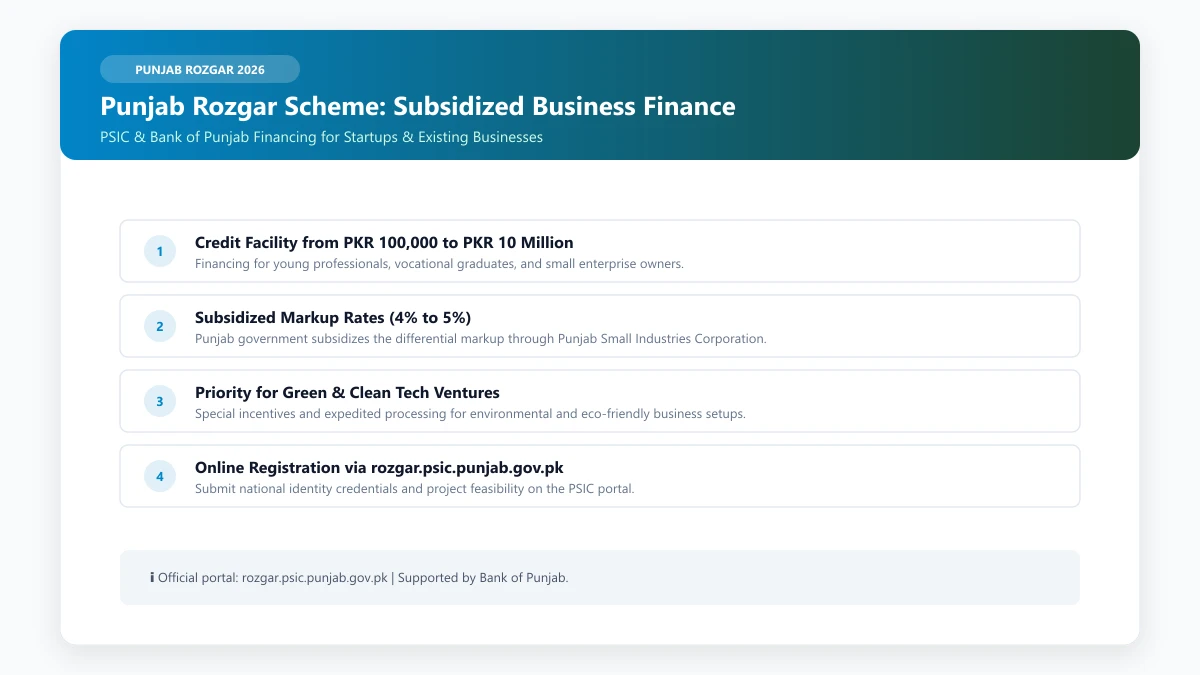
Punjab Rozgar Scheme: Subsidized Business Finance
Understand Punjab Rozgar business finance, official terms and the difference between subsidized markup and an interest-free loan.
Read guide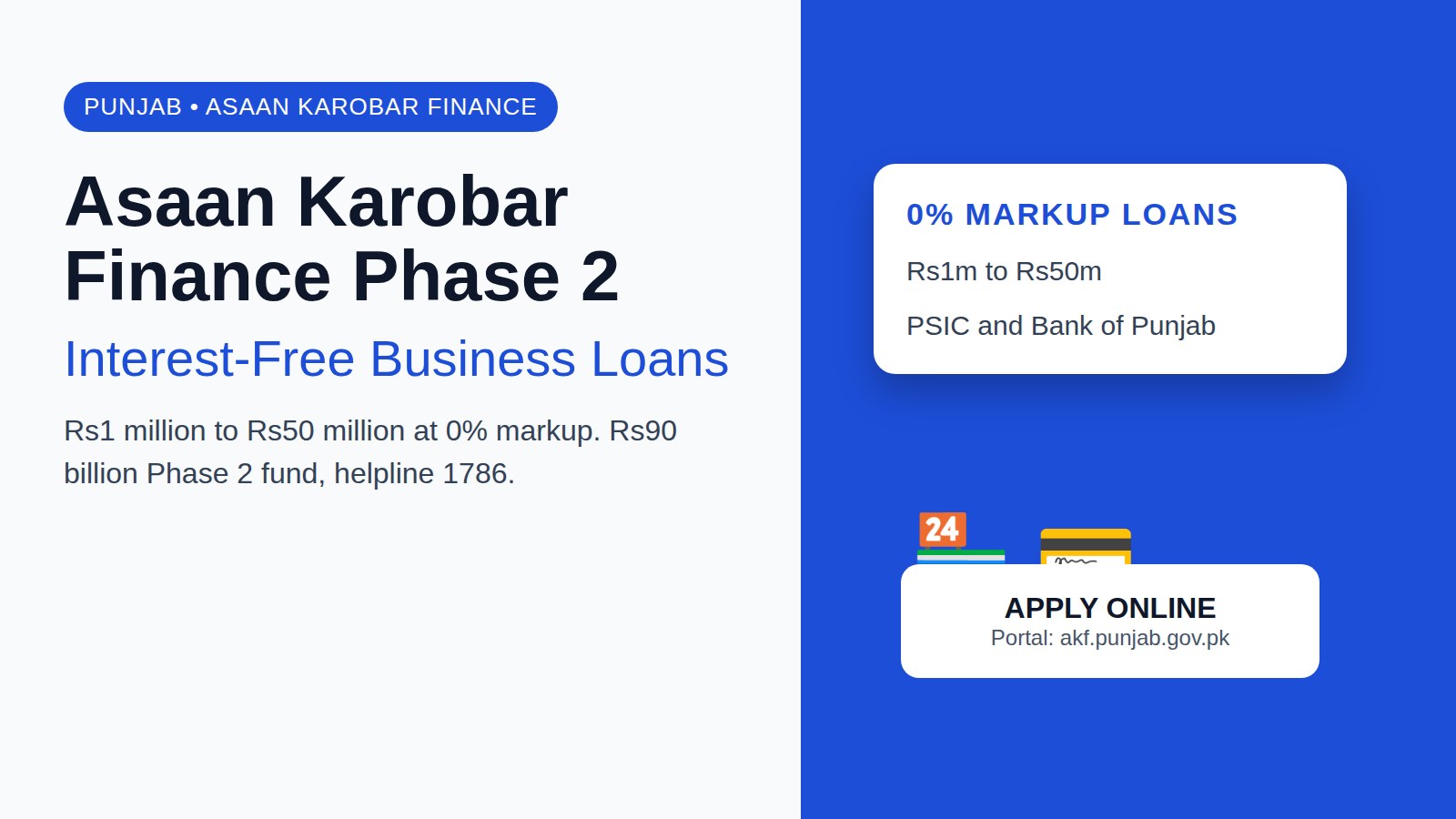
Asaan Karobar Finance Phase 2: Interest-Free Business Loans in Punjab
Asaan Karobar Finance Phase 2 is the second phase of Punjab's interest-free business loan scheme. It offers Rs 30 million to Rs 50 million through four special schemes, plus the original loans of Rs 1 million to Rs 30 million. Borrowers pay 0% markup because the government pays it to the Bank of Punjab.
Read guide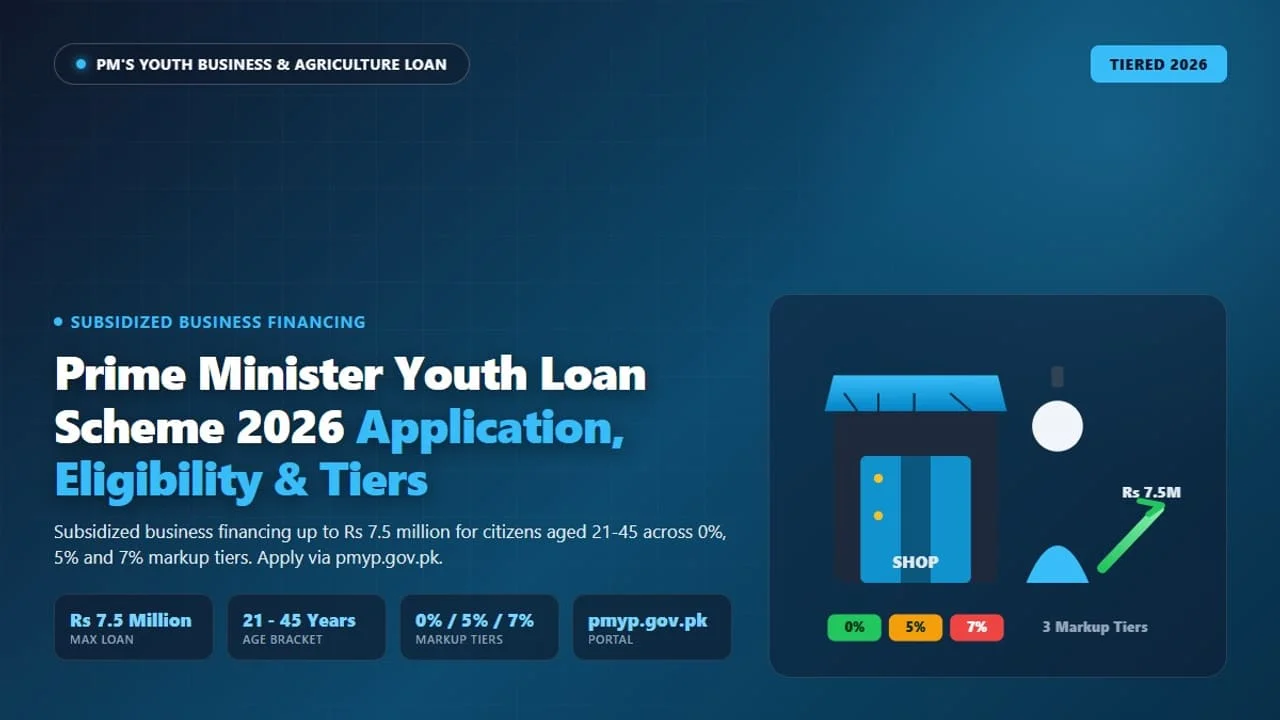
Prime Minister Youth Loan Scheme 2026: Complete Application, Eligibility & Tiers Guide
The Prime Minister Youth Loan Scheme 2026 provides subsidized business financing up to Rs 7.5 million for Pakistani citizens aged 21 to 45 across three tiers (0%, 5%, and 7% markup). Apply online through the official pmyp.gov.pk portal.
Read guide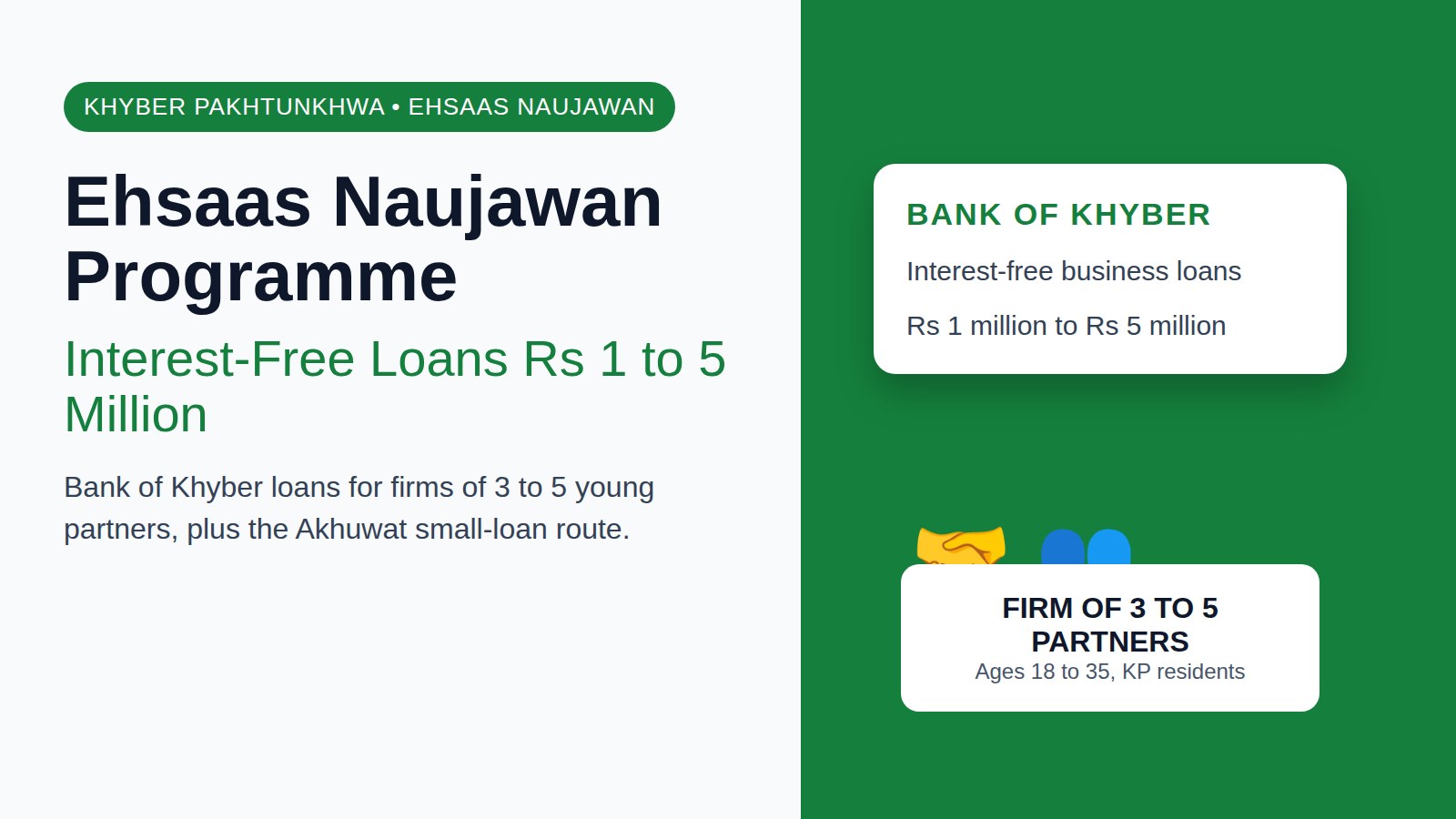
Ehsaas Naujawan Programme: Interest-Free Youth Business Loans in KP
The Ehsaas Naujawan Programme gives interest-free business loans to young people in Khyber Pakhtunkhwa. The Bank of Khyber lends Rs 1 million to Rs 5 million to a registered firm of 3 to 5 partners aged 18 to 35, with no mark-up and up to 8 years to repay.
Read guide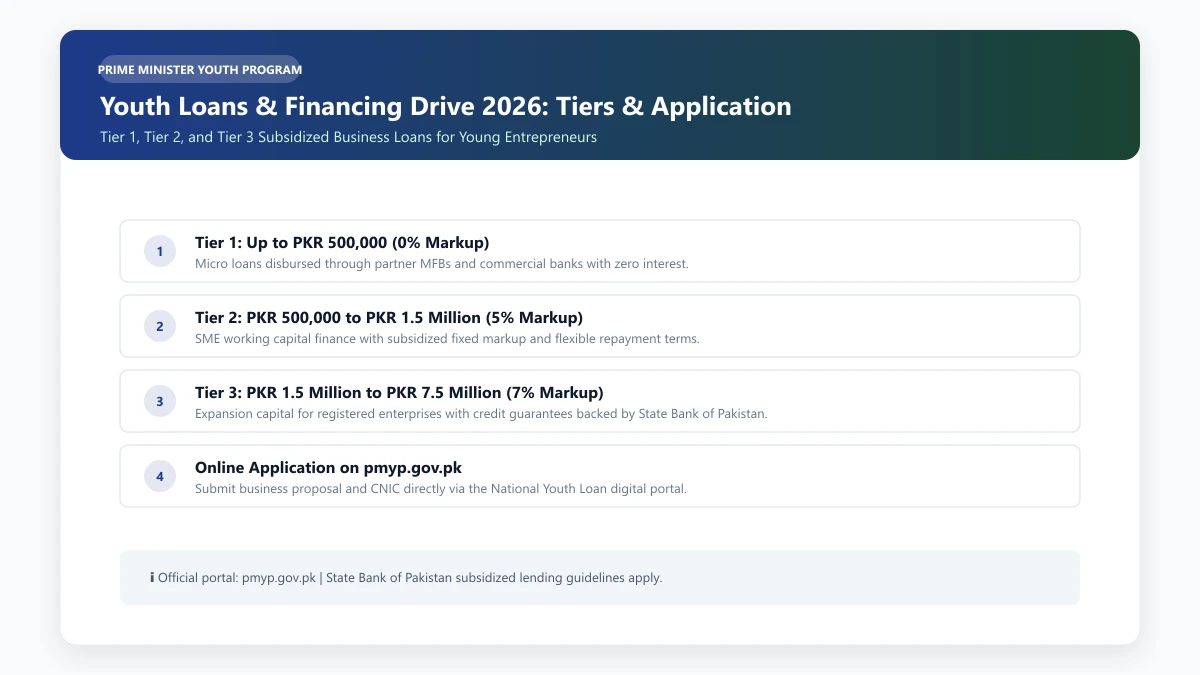
Youth Loans & Financing Drive 2026: How to Apply, Eligibility & Loan Tiers
Master the Youth Loans & Financing Drive 2026 (PMYB&ALS). Learn Tier 1–3 loan limits (up to Rs 7.5M), 0% to 7% markup rates, NADRA CNIC portal steps, and eligibility rules.
Read guide