This article explains public information. It does not determine eligibility or replace an official notice.
What Is Raast?
Raast is Pakistan's national instant payment system. The State Bank of Pakistan describes it as an end to end digital payment system that lets individuals, businesses and government entities pay each other in real time. It is built for low value retail payments, with instant settlement, strong security and broad interoperability across banks and wallets.
Raast is operated by Raast Payments Pakistan (Private) Limited, a wholly owned subsidiary of the State Bank of Pakistan. It sits alongside the Real Time Gross Settlement system, which handles large value payments, while Raast is purpose built for everyday retail payments. Raast launched on 11 January 2021, and its first phase covered bulk payments.
For a reader, the practical point is simple. Raast is the rails, not an app you download. You use it through your bank app or wallet when you send money to an account, a Raast ID linked to a mobile number, or a merchant QR code.
What Are Asaan Assignment Accounts?
Asaan Assignment Accounts, known as AAA, are government assignment accounts used for official government payments. Departments use them to pay vendors, suppliers and other official dues, and salaries routed through assignment accounts also pass through them. They are government accounts, not citizen benefit accounts.
That distinction matters more than any other fact in this article. An assignment account belongs to a government department or office. A Drawing and Disbursing Officer, known as a DDO, is the officer who authorises and releases money from that account. When the news says cheque payments under AAA end, it means the government's own payment channel changes. It does not mean that every citizen must open a new account, register for Raast, or visit an office.
Some reports translate AAA as Easy Assignment Accounts. This article uses Asaan Assignment Accounts, the Finance Division form, throughout.
What Exactly Changes on 16 November 2026?
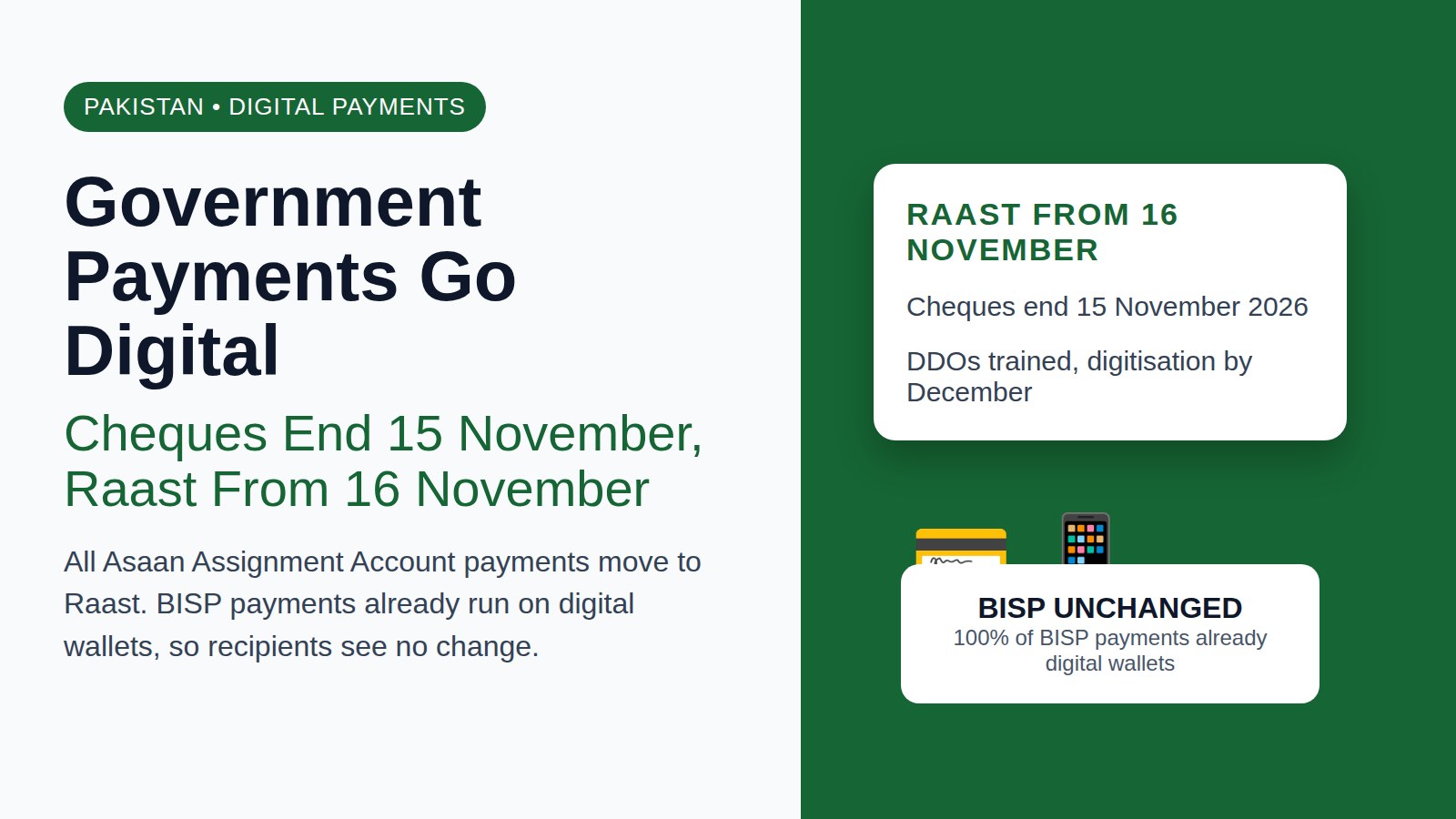
Cheque payments under Asaan Assignment Accounts end on 15 November 2026. From 16 November 2026, all payments through AAA across the country are to be made digitally through the Raast system. The decision was disclosed at a high level meeting on promoting a cashless economy, chaired by Prime Minister Shehbaz Sharif on Friday 6 November 2026.
The change is nationwide and it covers all AAA payments, not a pilot in one province or one department. Officials told the meeting that Drawing and Disbursing Officers have already been trained to operate the new system. That training point matters, because the officers who release the money are the people who must use Raast instead of writing cheques. A change of channel only works if the people who operate it are ready, and the meeting was told they are.
The meeting also reviewed wider progress on digital payments. Officials said digitisation of payments was progressing across federal and provincial government departments, and most federal and provincial government institutions are expected to complete digitisation of their payments by December 2026. That December date is a target for most institutions, not a second cut off for AAA cheques. The AAA cut off is 16 November 2026.
Dated Timeline of the Shift
| Date | What happens |
|---|---|
| 6 November 2026 | Prime Minister Shehbaz Sharif chairs a high level meeting on promoting a cashless economy and the AAA to Raast decision is disclosed. |
| 15 November 2026 | Last day for cheque payments under Asaan Assignment Accounts. |
| 16 November 2026 | All payments through AAA across the country move to Raast. |
| December 2026 | Most federal and provincial government institutions are expected to complete digitisation of their payments. |
| No date announced as of 8 November 2026 | The Prime Minister's roadmap for a fully digital payments system has no published release date yet. |
What Does the Shift Mean for BISP Beneficiaries?
For BISP beneficiaries, the short answer is that it should mean no change. Officials told the 6 November 2026 meeting that 100 percent of payments under the Benazir Income Support Programme (BISP) are already made through digital wallets. BISP payments therefore do not move to Raast as part of this change, because they already travel through a digital channel.
This is the point that most social media posts about the announcement get wrong. A headline that says government payments move to Raast can sound as if every government payment, including BISP, changes on 16 November 2026. That is not what the meeting was told. BISP is a government to person transfer programme, and its payments already run through digital wallets. The AAA change covers government assignment accounts, which are a different channel used for official departmental payments.
BISP beneficiaries should therefore keep using the payment route they already use, and keep checking their payment status through the official 8171 channels. If a payment is late, the cause is far more likely to be a normal release phase or a verification issue than this AAA change. The AAA change does not alter who is eligible for BISP or when a quarterly cycle is released.
What Stays the Same for BISP Beneficiaries
| Item | Status after 16 November 2026 |
|---|---|
| BISP payment channel | Unchanged. Payments already go through digital wallets. |
| Need to register for Raast | None. There is no citizen registration step in this change. |
| BISP eligibility | Unchanged. The AAA decision does not change who qualifies. |
| How to check a payment | Unchanged. Use the official 8171 SMS service and portal. |
| What a vendor or department must do | Changes. Departments and suppliers paid through AAA must use Raast from 16 November 2026. |
BISP Chairperson Senator Rubina Khalid said at a press conference on 8 June 2026 that all BISP payments would be made through digital wallets from July 2026. She also said more than 8 million free Benazir SIMs had been distributed to women beneficiaries to open digital wallets. That July 2026 wallet shift is the reason the November 2026 AAA change leaves BISP untouched.
What Is the December 2026 Target and the 100 Percent Digital Payments Roadmap?
The Prime Minister directed the relevant authorities to prepare a clear roadmap, with specific timelines and targets, for establishing a fully digital payments system across the country. As of 8 November 2026, no release date for that roadmap has been announced in the reports of the meeting. Readers should treat the roadmap as a direction that has been ordered, not as a document they can read yet.
The December 2026 target is separate from the roadmap. Most federal and provincial government institutions are expected to complete digitisation of their payments by December 2026. That is an expectation reported from the meeting, not a law that has been published with penalties or a named list of institutions. The honest way to read it is that the government expects most departments to be digital by the end of 2026, and the AAA move on 16 November 2026 is the first hard deadline inside that wider plan.
The Ministry of Finance briefed the meeting on progress, and the Prime Minister appreciated its efforts to promote digital payments. The Prime Minister also instructed all federal ministries and government institutions to ensure complete implementation of the government's cashless economy plan. The meeting was attended by federal ministers, the State Bank Governor Jameel Ahmad, provincial chief secretaries and senior officials.
What About Raast QR Code Payments, Utility Bills and Areas Without Internet?
The meeting also reviewed Raast QR code payments between consumers and merchants. The Prime Minister directed that the government backed initiative promoting digital payments through the Raast QR code system should continue. He also directed a public awareness campaign to encourage electricity and gas consumers to pay their utility bills through QR codes printed on the bills.
For ordinary shoppers, this is the part of the cashless push they are most likely to meet in daily life. A Raast QR code lets a customer scan and pay a merchant straight from a bank account or wallet, without cash and without a card machine. The campaign on utility bills is meant to make that habit normal for a routine household payment. None of this creates a duty for BISP beneficiaries to pay by QR code. It is a nudge toward digital payment for people who already have a bank account or wallet and a phone that can scan a code.
The meeting also heard that work is under way on a payment mechanism for areas without internet connectivity. No design, launch date or coverage list for that mechanism was announced in the reports of the meeting. The Prime Minister also directed officials to address, without delay, the problems consumers face in using digital payment services, and he stressed that reliable internet connectivity and wider access to technology are essential for the transition.
What Should Government Vendors and Departments Do Now?
Vendors, suppliers and contractors who are paid through Asaan Assignment Accounts should expect Raast from 16 November 2026. Cheques under AAA stop on 15 November 2026, so a vendor who waits for a cheque after that date will be waiting for a payment method that no longer applies to those accounts. The practical step is to confirm with the paying department that the vendor's bank account details are correct and Raast enabled, and to ask the department's Drawing and Disbursing Officer which Raast channel the payment will use.
Departments should already be past the preparation stage, because the officers who operate the accounts have been trained. Vendors should keep their invoices and payment advice slips so any query can be traced.
Ordinary citizens who are not vendors, suppliers or departmental payees have no action to take. There is no form to fill, no office to visit and no deadline for the public in this change. Anyone who receives a message that says you must register for Raast before 16 November 2026 or your BISP payment will stop should treat that message as false. BISP payments already run through digital wallets, and no registration step for citizens was announced.
What to Watch Out For: Scams and Wrong Messages
A firm date and a well known programme name are exactly the raw material that scam messages use. Expect messages that claim BISP payments will stop on 16 November 2026 unless you register, pay a fee, share a code or click a link. None of that follows from the announcement. The AAA change has no citizen registration step, and BISP has not announced a change to its payment channel.
Do not share your CNIC number, wallet PIN, bank OTP or any code from an SMS with a caller or a WhatsApp contact who claims to be from BISP, the State Bank or a bank. BISP's official payment status channel is 8171, and the official portal is 8171.bisp.gov.pk. If a message asks for money to release a payment, it is a scam. BISP payments are free to receive, and no official asks a beneficiary to pay to unlock an instalment.
If you are unsure about a message, check your payment status only through the official 8171 route, or visit a BISP office with your original CNIC. The dates in this article apply to AAA accounts, not to BISP wallets.
Frequently asked questions
Will BISP payments move to Raast on 16 November 2026?
No. Officials told the 6 November 2026 meeting that 100 percent of BISP payments are already made through digital wallets, so BISP payments do not move to Raast in this change. The 16 November 2026 switch covers Asaan Assignment Accounts only.
What is the last date for cheque payments under Asaan Assignment Accounts?
Cheque payments under Asaan Assignment Accounts end on 15 November 2026. From 16 November 2026, all payments through those accounts across the country are to be made digitally through Raast.
Do BISP beneficiaries need to register for Raast?
No. There is no citizen registration step in this change, and BISP beneficiaries do not need to register for Raast to keep receiving their payments. Their payments already run through digital wallets.
What are Asaan Assignment Accounts?
Asaan Assignment Accounts are government assignment accounts used for official government payments, such as payments to departments, vendors and suppliers, and salaries routed through assignment accounts. They are not citizen benefit accounts, and they are separate from BISP wallets.
Who operates Asaan Assignment Accounts?
Drawing and Disbursing Officers, known as DDOs, authorise and release money from these accounts. Officials told the 6 November 2026 meeting that DDOs have already been trained to operate the new Raast system.
What is Raast?
Raast is Pakistan's national instant payment system, run by the State Bank of Pakistan through its subsidiary Raast Payments Pakistan (Private) Limited. It enables end to end digital payments in real time between individuals, businesses and government entities.
What happens to government payments by December 2026?
Most federal and provincial government institutions are expected to complete digitisation of their payments by December 2026, according to officials at the 6 November 2026 meeting. That is a target for most institutions, not a second cut off date for AAA cheques.
Has the government published the roadmap for fully digital payments?
Not as of 8 November 2026. The Prime Minister directed authorities to prepare a clear roadmap with specific timelines and targets for a fully digital payments system, but no release date for the roadmap has been announced in the reports of the meeting.
Will Raast QR code payments affect BISP beneficiaries?
No, not directly. The government is promoting Raast QR code payments between consumers and merchants, and it plans a campaign for utility bill payments by QR code. BISP beneficiaries are not required to pay by QR code, and their payment channel stays the same.
Where can I check my BISP payment status?
Check it only through the official 8171 channels, by sending your CNIC details through the 8171 SMS service or by visiting the official portal at 8171.bisp.gov.pk. Do not share your CNIC, PIN or OTP with callers or contacts who claim they can release your payment.
Sources and official links
Check the destination address before entering personal information.
Related guides
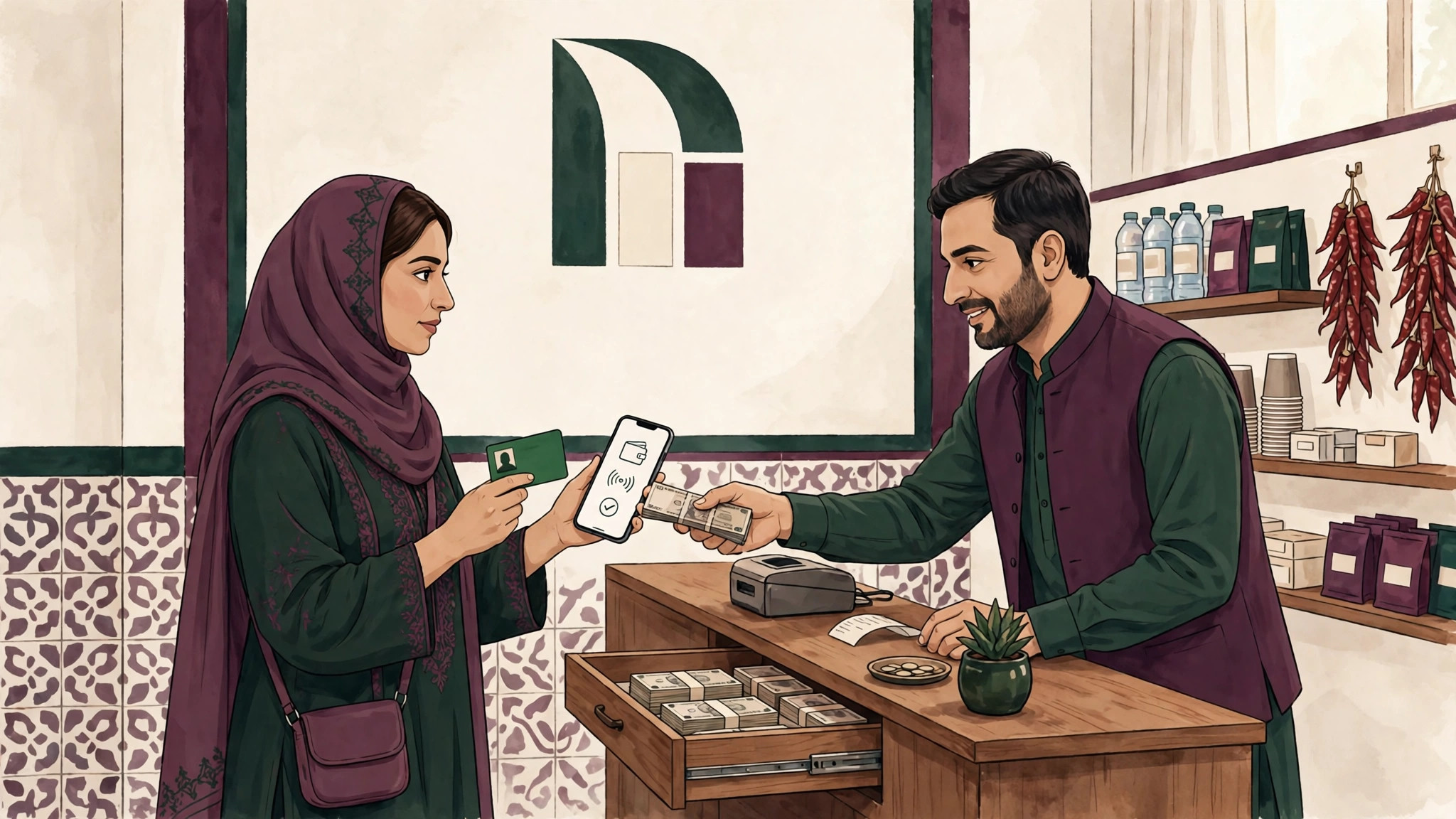
BISP Social Protection Wallet in November 2026: Withdraw From Any Partner Bank, the Rs 280 Cash Charge, and the 31 December Deadline
Yes. As of November 2026, a BISP Social Protection Wallet payment can be withdrawn from an authorised retailer of a partner bank in any city, not only from the bank or district that issued it. Cash withdrawal from the wallet carries a fixed Rs 280 service charge, while online and RAAST transfers are reported free.
Read guide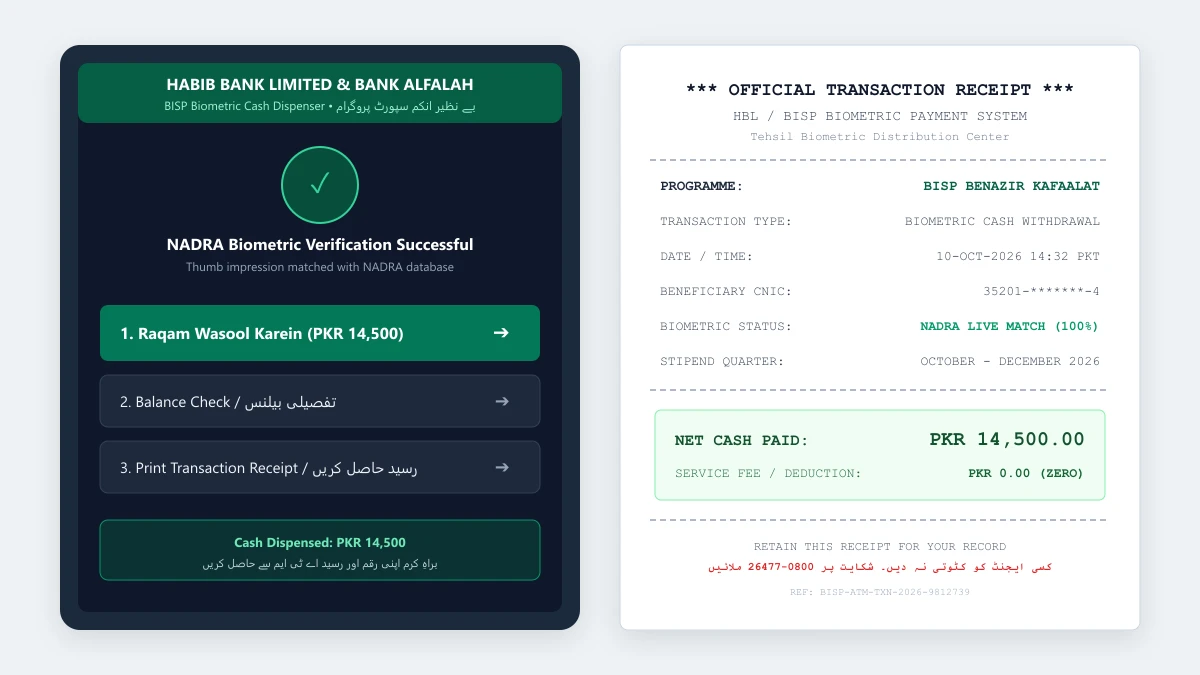
BISP Payment Method 2026: Complete Safe Guide
BISP now pays out through several channels — bank agents, digital wallets, and cash camps. Here's how each one works and how to collect safely.
Read guide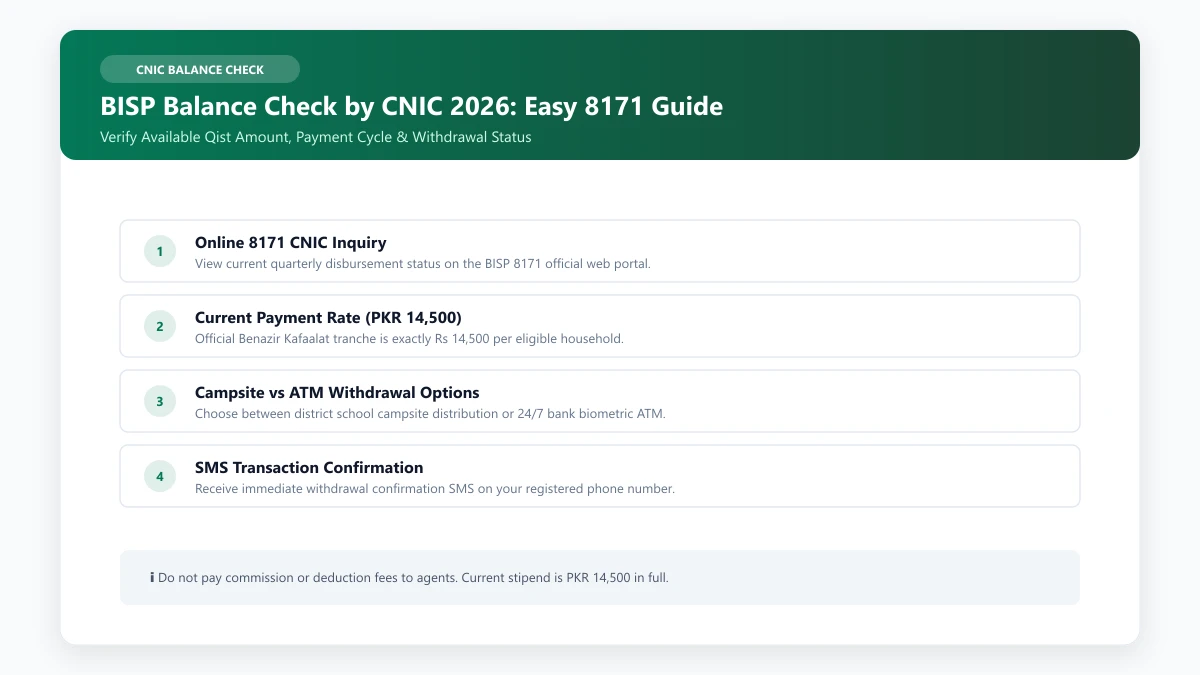
BISP Payment Check 2026: Balance, Payment Date and Withdrawal
To check your BISP payment and balance online, visit the official 8171 web portal (8171.bisp.gov.pk), enter your 13-digit CNIC, and submit the security captcha. Beneficiaries receive quarterly cash installments of Rs. 14,500 via biometric ATMs or authorized HBL and Bank Alfalah payment centers.
Read guide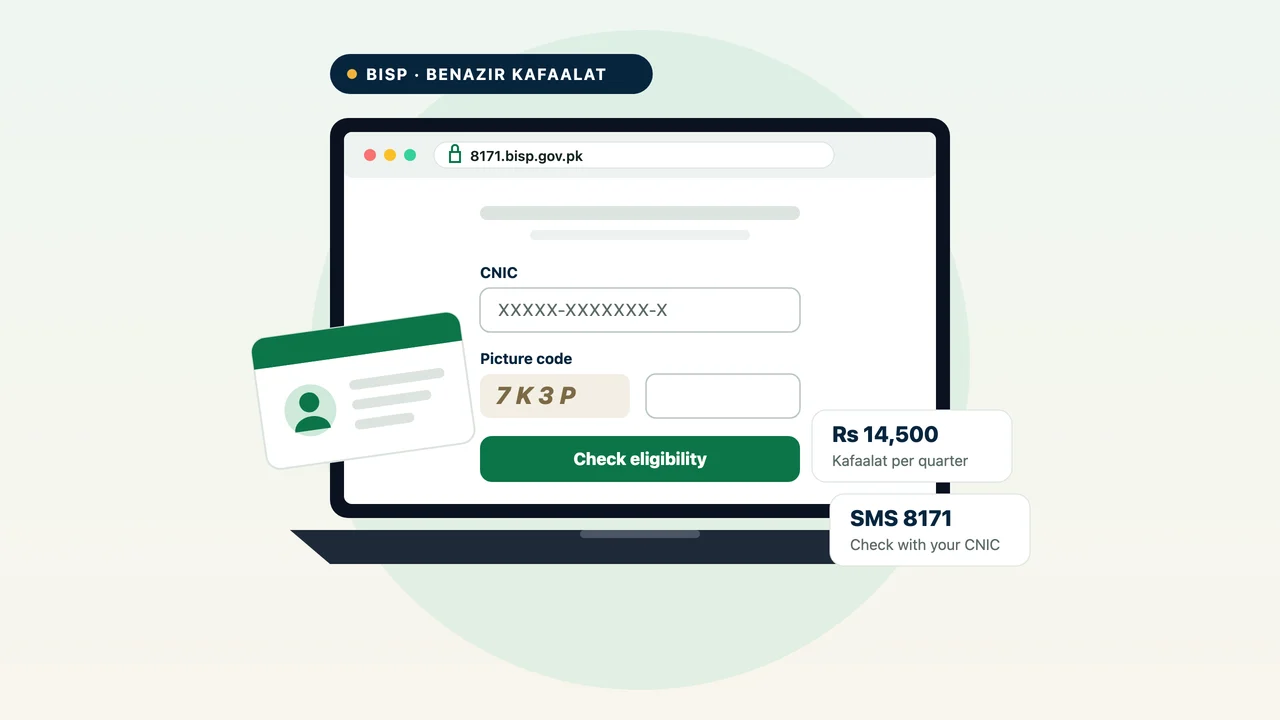
Benazir Income Support Program Online Check 2026
Check the Benazir Income Support Programme online by sending your 13-digit CNIC to 8171 or entering it at 8171.bisp.gov.pk. The reply shows whether your household is eligible for Benazir Kafaalat, which has paid Rs 14,500 a quarter since 10 March 2026. It is an eligibility status, not your PMT score.
Read guide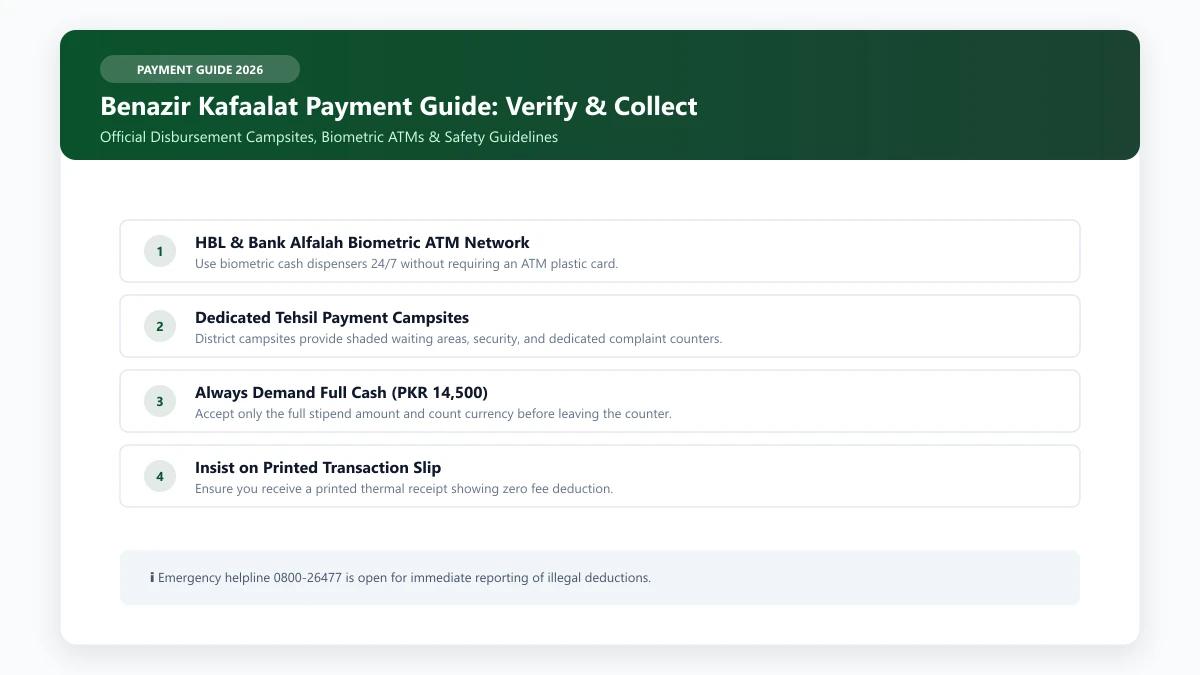
Benazir Kafaalat Payment Guide: Verify, Collect, and Stay Safe
What beneficiaries should check before collecting a payment, plus safe complaint steps.
Read guide