This article explains public information. It does not determine eligibility or replace an official notice.
What is the CM Punjab Minority Card?
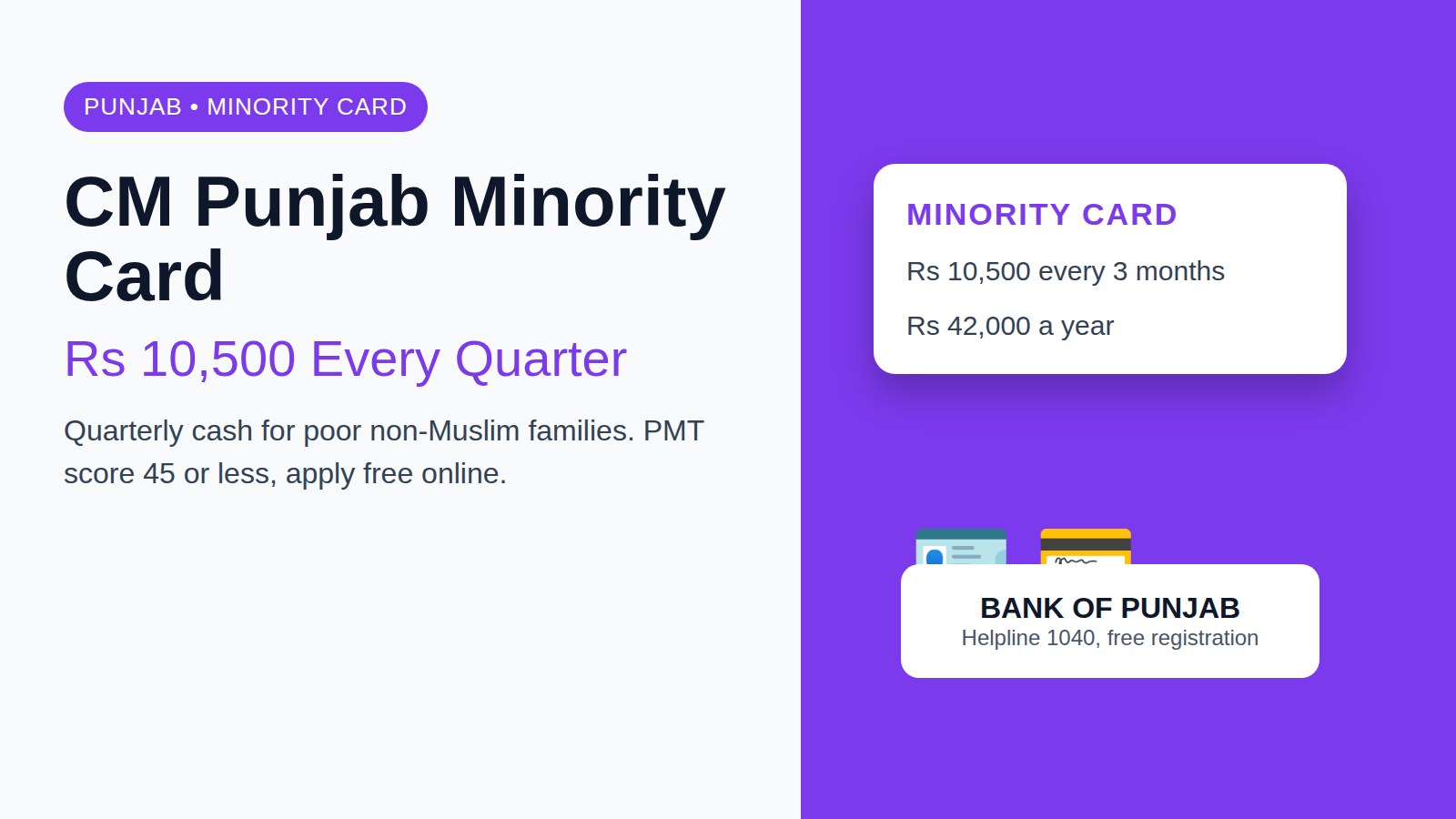
The CM Punjab Minority Card is a Punjab government cash card for poor non-Muslim families. It gives each approved family a fixed payment every three months through the Bank of Punjab. The Human Rights and Minorities Affairs Department of the Government of the Punjab runs the programme.
Chief Minister Maryam Nawaz launched the card in Lahore on 22 January 2025. The department calls it a flagship programme that gives financial help and social protection to minority communities across Punjab. It covers Christian, Hindu, Sikh and other non-Muslim families who live in the province.
| When | Families covered |
|---|---|
| Launch, January 2025 | 50,000 |
| Expansion during 2025 | 75,000 |
| From early 2026 | 100,000 |
The card works as a bank card. Approved families get a physical card and use it to withdraw their payment. The system uses biometric verification through NADRA, payment through the Bank of Punjab, and a central data system built by the Punjab Information Technology Board (PITB).
How much money does the Minority Card pay?
Each approved family receives Rs 10,500 every three months. Four payments a year add up to Rs 42,000 per year. That is the amount as of 2026, and the Chief Minister repeated the figure in August 2026.
The Punjab budget for 2026-27, presented in June 2026, set aside Rs 3 billion for the CM Minority Card. That budget line is a strong sign the programme will keep paying in the current year. But amounts are set by the government and can change, so treat Rs 10,500 as accurate as of 2026 and confirm the current amount on 1040 before you plan around it.
The payment is the same for every approved family. It does not change with family size or district. If someone tells you a different amount for a fee, do not trust them.
Who can apply for the CM Punjab Minority Card?
You can apply if all of these rules are true for you. The official rules are short, and each one matters.
First, you must belong to a minority religion and live in Punjab. That means you are a Christian, Hindu, Sikh or a follower of another minority religion, and Punjab is your home province. The sign-up form asks for your religion and states that Muslims are not eligible for this programme.
Second, you must be the head of the family. The application is made in the head's name, and only one person per household can hold the card.
Third, you must hold a valid CNIC and an active mobile number. Your CNIC must not be expired, and the mobile number should be registered in your own name so you can receive messages about your application and payment.
Fourth, your household PMT score must be 45 or less. The PMT score is the poverty score that decides whether your household counts as poor enough for the programme. A lower score means a poorer household.
Fifth, you must not already get financial help from another programme such as BISP or a PSPA programme. If your family already receives Benazir Kafaalat, call 1040 before you apply. The department checks this rule against official records, so do not apply if you already get that help.
Sort out your PMT score first
The PMT (Proxy Means Test) score comes from the national NSER household survey. It is not a number you type in yourself. If you do not have a PMT score yet, the department asks you to visit your nearest BISP/NSER service centre. The Minority Card portal lists these centres by district.
Some guides mention Punjab's PSER registry in the same breath as the Minority Card. The official rules mention the NSER score, not PSER. PSER is still worth joining, because some other Punjab programmes use it, but it is not the score that decides Minority Card eligibility.
How do I apply for the CM Punjab Minority Card online?
Registration is online and free. Follow these steps, which come from the official Punjab portal and the Minority Card portal.
- Open mcard.punjab.gov.pk and tap Sign up.
- Enter your full name, CNIC number, mobile network, mobile number and religion, then choose a password. Type your name in English letters only, because the form does not accept Urdu script or numbers. Email is optional.
- Log in with your CNIC number as the username and your password.
- Fill in the application form. Enter every detail correctly and check it before you move on.
- Submit the form and note your tracking reference, then come back later to check your application status on the same portal.
If you get stuck, call 1040 during office hours for registration help. Do not pay anyone to fill the form for you. The form is simple, and the helpline can guide you through it.
What you need before you start
Keep your valid CNIC ready, with the 13-digit number clear. Keep the mobile phone that is registered in your name switched on, because the portal and the bank use it to reach you. Know your PMT score, or know which BISP/NSER centre can give it to you. Have your family details and home address ready before you open the form. A short preparation step like this stops most mistakes that delay applications.
Is registration open right now?
This is the one question with no firm yes or no answer on 6 November 2026. Registration happens in phases, and the department opens a window, then closes it. The last window the department announced ran from 26 January to 15 February 2026.
As of September 2026 the sign-up page was online, but that does not prove new applications are being accepted right now. You must confirm on the portal or call 1040 before you apply. Do not trust a random website that claims registration is open today.
One point is clear. The 75,000 families from the first and second phases did not need to apply again. If you already hold the card, do not submit a fresh application. If you applied in an earlier phase and got no card, check your status on the portal first, then call 1040 if the status is unclear.
What happens after you apply?
Your details are checked with NADRA and other records, then approved applicants are issued a card. The money is sent through secure banking channels.
In the second phase, the data went to the Punjab Social Protection Authority (PSPA), which checked it with NADRA and other agencies before passing lists to Deputy Commissioners. Cards are handed out locally. In Gujranwala, for example, assistant commissioners were tasked with distributing them in each tehsil.
How do you receive the money?
Payments go through the Bank of Punjab. The card works as a bank card that you can use at an ATM. The department has also said payments are made only against the Minority Card itself, so keep your card safe.
To keep your payment running, follow four simple rules. Keep your CNIC valid and not expired. Keep the mobile number you registered with active. Never hand your card to an agent or shopkeeper to withdraw money for you. Call 1040 if a payment does not arrive.
If a payment is late, check first whether your CNIC or mobile number changed. Then call 1040. Do not share your card PIN with anyone who calls you about a delayed payment, even if they claim to be from the department or the bank.
How is the Minority Card different from BISP and the Rehmat Card?
These three programmes are often confused, but they serve different people. The table below shows the difference at a glance.
| Minority Card | Benazir Kafaalat | Rehmat Card | |
|---|---|---|---|
| Run by | Punjab Human Rights and Minorities Affairs | BISP (federal) | Punjab Zakat and Ushr |
| For | Poor non-Muslim families | Low-income women in the NSER | Muslim widows and orphans eligible for Zakat |
| Payment | Rs 10,500 per quarter | Quarterly stipend | One-time grant |
| Portal | mcard.punjab.gov.pk | 8171.bisp.gov.pk | rahmatcard.punjab.gov.pk |
| Helpline | 1040 | 0800-26477 | 1077 |
The Minority Card rules say you should not already get help from BISP. If your family receives Benazir Kafaalat, call 1040 before applying. The Rehmat Card is run under Zakat rules, and its official criteria cover needy Muslim widows and orphans who can receive Zakat, so it is not designed for non-Muslim families. The Minority Card is the Punjab cash programme built for minority communities.
What changed in 2026?
Three things changed in 2026, and each one matters for applicants. First, coverage grew to 100,000 families from early 2026, up from 75,000 in 2025 and 50,000 at launch. Second, the Punjab budget for 2026-27 set aside Rs 3 billion for the card, which funds the current year of payments. Third, the Chief Minister repeated the Rs 10,500 figure in August 2026, which confirms the amount held steady through the year.
Some unofficial guides call the 2026 expansion "phase 3" of the programme. The official source we checked describes the same growth in coverage without using that label, so this guide uses the coverage numbers instead. The last announced registration window ran from 26 January to 15 February 2026.
How do you stay safe from agents and scams?
Nobody can charge you for the Minority Card. Registration is free, the card is free, and no agent can add your name to the list or speed up your card. If someone asks for money, that is a scam.
Never share an OTP or your card PIN, even with someone who says they are from the department or a bank. The only official portal is mcard.punjab.gov.pk. Many websites copy the programme's name, so check the web address carefully before you type your CNIC into any form.
If someone demands money, report it through the Pakistan Citizen's Portal, or call 1040. Keep a note of the phone number or the name they used. A quick report helps the department warn other families too.
Frequently asked questions
What is the CM Punjab Minority Card?
The CM Punjab Minority Card is a Punjab government cash support programme for poor non-Muslim families, including Christians, Hindus and Sikhs. It is run by the Human Rights and Minorities Affairs Department and was launched in January 2025. Approved families receive a card and a fixed payment every three months through the Bank of Punjab.
How much money does the Minority Card pay?
The Minority Card pays Rs 10,500 every three months, which means one payment each quarter. That adds up to Rs 42,000 over a full year. This was the official amount as of 2026, and the Chief Minister repeated it in August 2026. Amounts are set by the government and can change, so confirm the current figure on the 1040 helpline before you plan around it.
Who is eligible for the CM Punjab Minority Card?
You are eligible if you are a Christian, Hindu, Sikh or other non-Muslim resident of Punjab, the head of your family, and you hold a valid CNIC and a mobile number. Your household PMT score must be 45 or less, and you should not already receive financial help from BISP or a PSPA programme. The sign-up form asks for your religion and states that Muslims are not eligible for this programme.
How do I apply for the Minority Card online?
You register online at mcard.punjab.gov.pk. Create an account with your CNIC, mobile number and a password, then log in, fill in the form with correct details and submit it. You can track your status on the same portal. Registration is free, and the last announced window ran from 26 January to 15 February 2026, so confirm on the portal or 1040 that new applications are being accepted before you apply.
Is registration open right now?
That is not confirmed as of 6 November 2026. Registration happens in phases, and the last announced window ran from 26 January to 15 February 2026. The sign-up page was online as of September 2026, but that does not prove new applications are being accepted. Check the portal or call 1040 before you apply.
What is a PMT score and how do I get one?
A PMT (Proxy Means Test) score is a poverty score that comes from the national NSER household survey. A lower score means a poorer household, and you need a score of 45 or less to qualify. If you do not have a score yet, visit your nearest BISP/NSER service centre. You cannot choose your score, and nobody can change it for money.
Can I apply if I already get BISP or PSPA help?
No, you should not apply if you already receive financial help from BISP or a PSPA programme. The Minority Card rules exclude families who already get that help. If your family receives Benazir Kafaalat, call 1040 before you apply so you do not waste a trip or risk your existing payment.
How do I check my Minority Card application status?
You check your status on the same portal where you applied, mcard.punjab.gov.pk. Log in with your CNIC number as the username and your password, then look for the status of your application. If the portal shows nothing or the status is unclear, call 1040 during office hours.
Is there a fee for the Minority Card?
No, registration is completely free. Nobody can add your name to the list or speed up your card in exchange for money. Never share your OTP or card PIN with anyone, even a caller who says they are an official. If someone asks you for payment, report it through the Pakistan Citizen's Portal or call 1040.
Does the card pay a festival grant?
That is not confirmed by the official source we checked. Some unofficial guides mention a Rs 15,000 grant on religious festivals such as Christmas, Holi or Diwali, but the official source we checked on 6 November 2026 did not confirm it. Do not plan around a festival grant. Ask on 1040 if you want the current position.
Sources and official links
Check the destination address before entering personal information.
Related guides
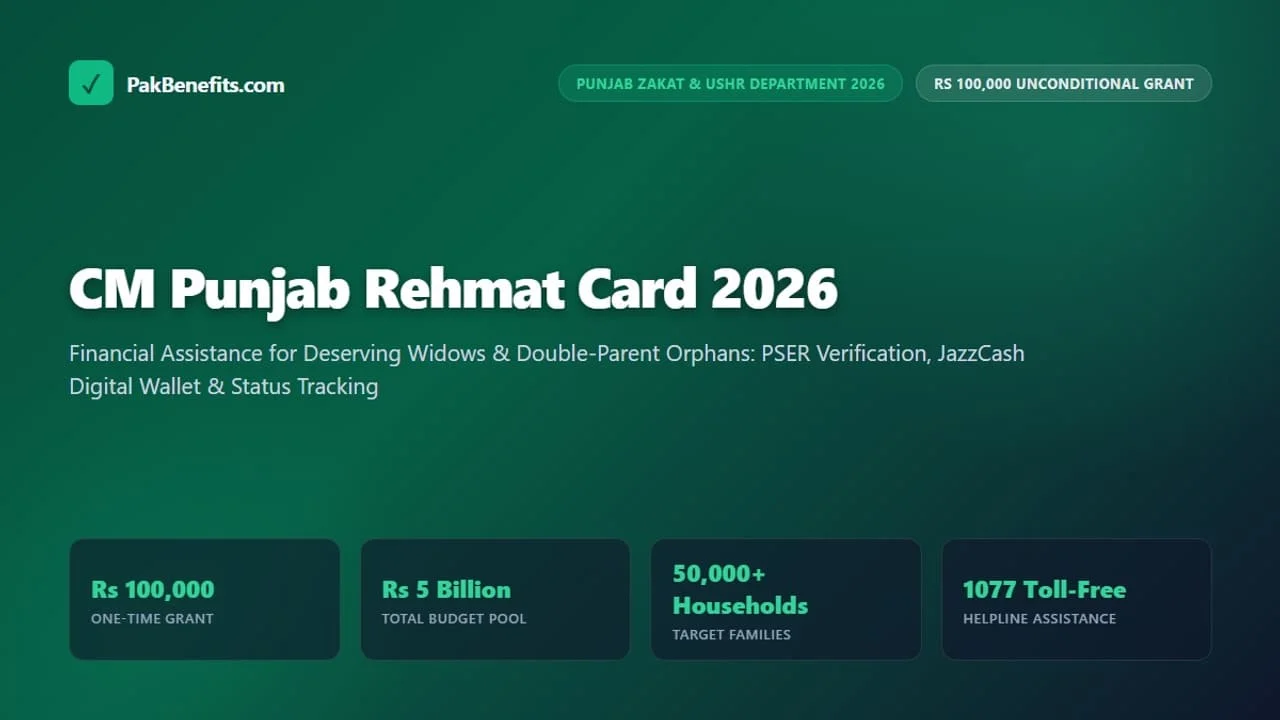
CM Punjab Rehmat Card 2026: Online Registration, Eligibility & Status Check
The CM Punjab Rehmat Card 2026 provides Rs. 100,000 financial aid to eligible widows and parentless orphans across Punjab. Learn eligibility criteria, required documents, online application steps at rahmatcard.punjab.gov.pk, and status tracking via CNIC or 1077 helpline.
Read guide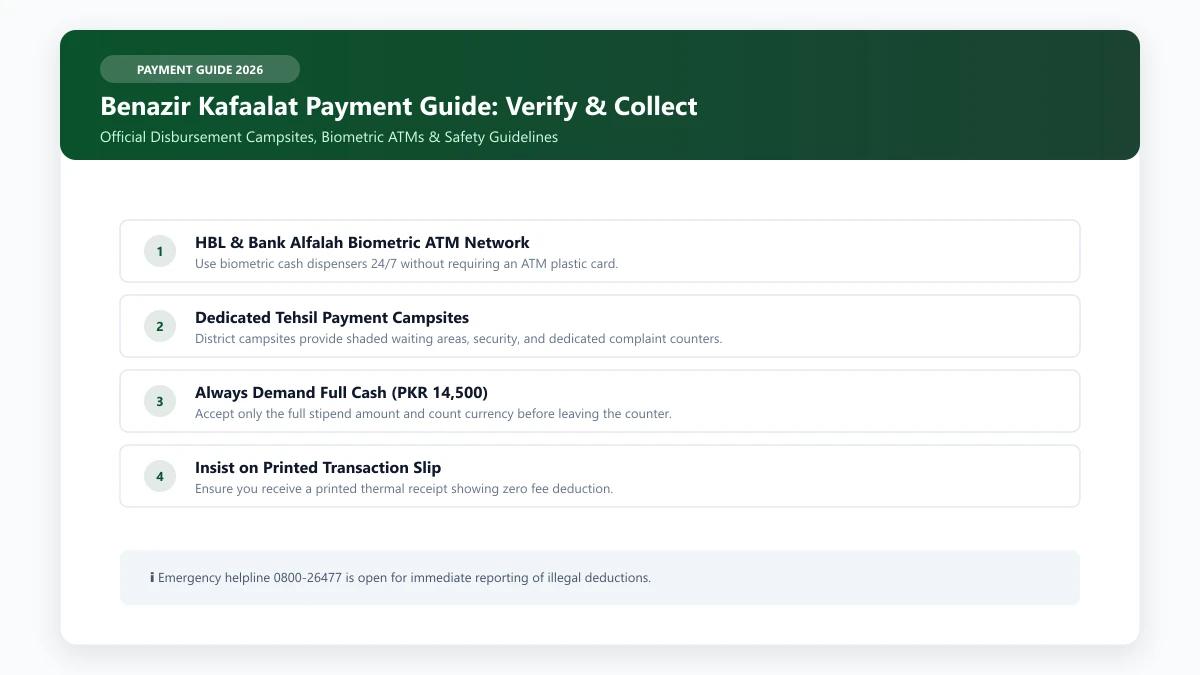
Benazir Kafaalat Payment Guide: Verify, Collect, and Stay Safe
What beneficiaries should check before collecting a payment, plus safe complaint steps.
Read guide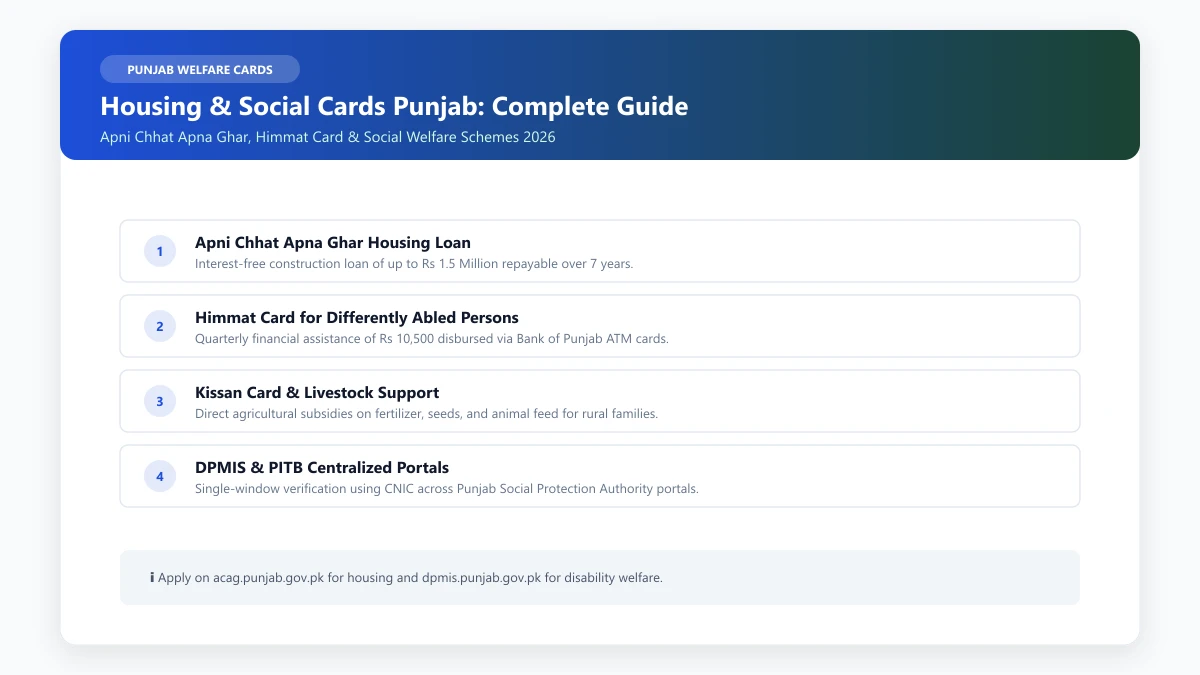
Housing & Social Cards (Punjab) 2026: Complete List, Eligibility & Online Apply Guide
Complete guide to Punjab Housing & Social Cards 2026 (Apni Chhat Apna Ghar, Himmat Card, Kisan Card, Mazdoor Card). Learn eligibility, PSER status check & online apply steps.
Read guide
Punjab Zakat Rashan Card Monthly Grant Explained
The Punjab Zakat Rashan Card monthly grant is Rs 2,000 per month, as listed by the Punjab Zakat and Ushr Department. It supports the chronic poor and is decided by your Local Zakat Committee. Payment comes through branchless banking after biometric verification. The viral Rs 3,000 claim is unverified, so wait for an official notification.
Read guide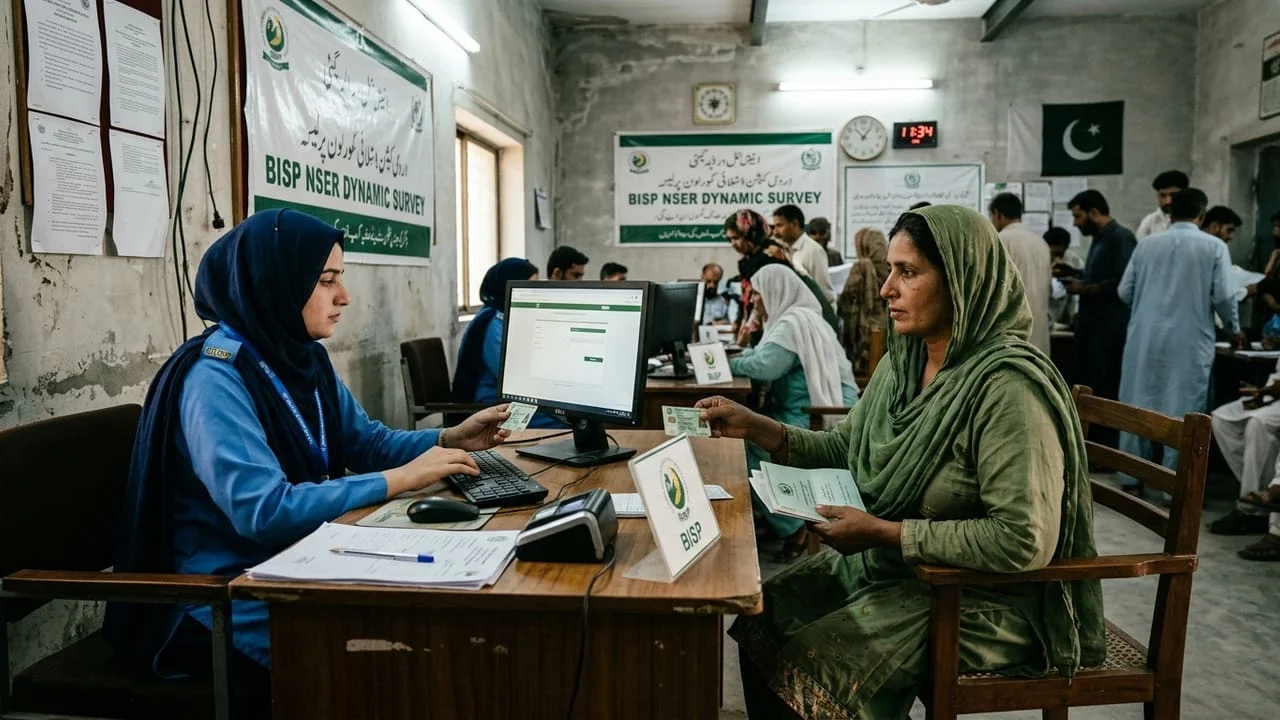
BISP and Ehsaas Difference Explained: History, 8171 Portal, Program Mapping & Current Status (2026)
The primary difference between BISP and Ehsaas is that BISP is a permanent, statutory social safety net established under the BISP Act 2010, whereas Ehsaas was an umbrella policy framework introduced in 2019 that temporarily integrated and rebranded BISP initiatives. Following administrative restructuring, all federal cash transfers, educational stipends, and nutritional grants operate under the official BISP brand and use the unified 8171 portal.
Read guide