This article explains public information. It does not determine eligibility or replace an official notice.
What Is the Punjab Zakat Rashan Card?
A monthly grant for the chronic poor
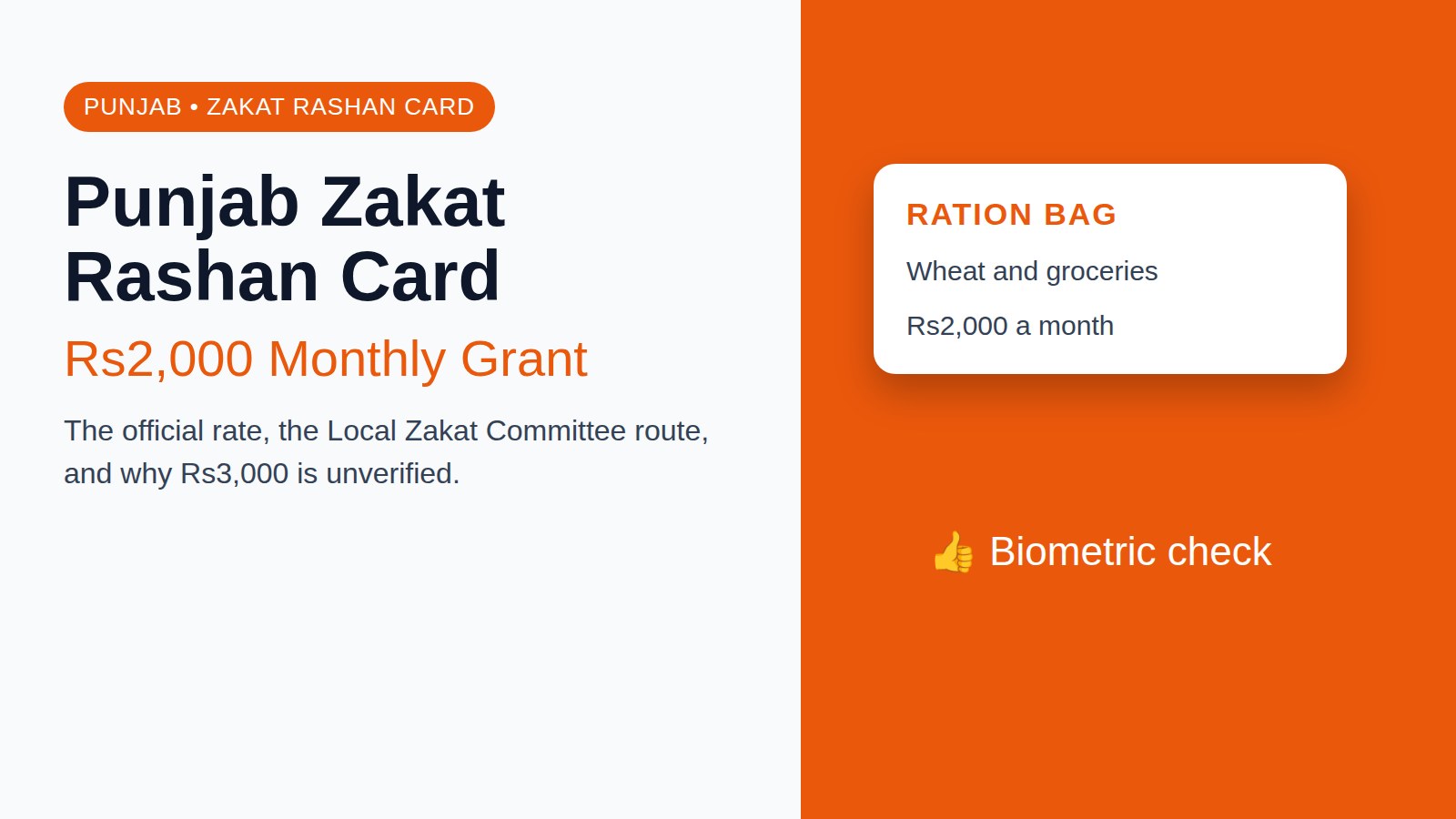
The Zakat Rashan Card is a monthly grant meant for the chronic poor. The Punjab Zakat and Ushr Department says it aims to safeguard them from hunger, which it describes as both a cause and a result of extreme poverty. It is not a food parcel scheme and it is not a grocery discount at a shop.
Who runs the programme
The programme is run by the Punjab Zakat and Ushr Department, using Zakat funds collected under the Punjab Zakat and Ushr Act 2018. The department sets the rules, but it does not decide each case from Lahore.
Your Local Zakat Committee looks at your financial condition and decides your istehqaq, which means your entitlement to receive Zakat. The committee can determine or reject a case, so a form alone does not guarantee approval.
Is the Monthly Grant Rs 2,000 or Rs 3,000?
The current official rate is Rs 2,000
As of 5 November 2026, the official Punjab Zakat and Ushr Department page lists the Zakat Rashan Card monthly grant at Rs 2,000 per month. The same page says istehqaq is determined by the Administrator or Local Zakat Committee of the area where the deserving person lives. That is the rate you should plan around until the department updates its own page.
The department also notes that payment moved to branchless banking in October 2014. If your committee quotes a different figure, ask it to show you the notification it relies on.
Why the Rs 3,000 claim is unverified
A viral image claims a new Rs 3,000 installment is coming soon, and it shows families receiving ration through a Rashan Store. No official notification confirming an increase to Rs 3,000 for the Zakat Rashan Card was found as of 5 November 2026. Treat the claim as unverified, not as the current rate.
Do not change your budget on a social media image, and do not pay anyone who promises to unlock the higher amount. If the rate rises, the change should appear in an official notification or on the department page first.
Where the Rs 3,000 figure does belong
The Rs 3,000 figure is real, but it belongs to a different programme. The CM Punjab Ration Card, also called the CM Punjab Rashan Card, is a separate Punjab initiative that gives Rs 3,000 a month to eligible low income households, largely through PSER registration and a digital card for grocery purchases. Mixing its rate into the Zakat Rashan Card is the main source of confusion online.
If someone quotes Rs 3,000 to you, ask which programme they mean.
How Is the Zakat Rashan Card Different From Ehsaas Rashan and the CM Punjab Ration Card?
Zakat Rashan Card versus Ehsaas Rashan
The old Ehsaas Rashan programme is separate from the Zakat Rashan Card. In October 2022, Punjab announced Ehsaas Rashan Riayat registration by sending a CNIC number to 8123, using a web portal, or visiting an e-Khidmat Center. That scheme gave subsidised prices on items such as flour, edible oil or ghee, and pulses.
The Zakat Rashan Card does not work that way. It is a Zakat funded cash grant, decided by a Local Zakat Committee, and paid through branchless banking. You cannot apply for it by sending your CNIC to 8123. For the older scheme, see Ehsaas Rashan Program 2026 and Ehsaas Rashan Program Guide.
Zakat Rashan Card versus CM Punjab Ration Card
The CM Punjab Ration Card is also separate, even though its name sounds almost identical. It targets low income families, uses PSER registration as a key route, and gives Rs 3,000 a month for essential groceries through a digital card. The Zakat Rashan Card targets people entitled to Zakat under Shariah, uses a Local Zakat Committee decision, and pays Rs 2,000 a month through branchless banking.
The two programmes also differ in who decides your case. A PSER record may matter for the CM Punjab card, but it does not replace the Local Zakat Committee decision for the Zakat grant. Applying for one does not mean you have applied for the other.
Three programmes at a glance
| Programme | Monthly amount | Who decides | How it is paid |
|---|---|---|---|
| Punjab Zakat Rashan Card | Rs 2,000 | Local Zakat Committee | Branchless banking after biometric verification |
| Ehsaas Rashan Riayat (2022 phase) | Subsidised grocery prices, not a fixed cash grant | Punjab system announced in October 2022 | Subsidy at participating outlets in that phase |
| CM Punjab Ration Card | Rs 3,000 | PSER based eligibility route | Digital card for grocery purchases |
Read the table by programme name, not by the word ration alone.
Who Can Get the Zakat Rashan Card?
Core eligibility rules
The department lists clear core rules. The applicant must be an adult Muslim living below the poverty line and eligible to receive Zakat under Shariah. The applicant must be unemployed, must not be a habitual beggar, must not be a government servant, must not be a pensioner, and must not be a Sahib-e-Nisab, which means a person who owns wealth above the level that makes Zakat due on them.
These rules are checked by the Local Zakat Committee, not by an online form. The committee looks at your financial condition in your own area, so documents alone do not settle a case if you do not meet the Zakat criteria.
Who gets preference
Preference goes to the poorest of the poor, and to orphans, widows, divorced people, handicapped and disabled people, and people in old age. Extra preference goes to widows and divorced women who have small children. That preference does not remove the core rules, but it shapes which deserving cases the committee prioritises when funds are limited.
Who is not eligible
Several groups are expressly not eligible, and this is where many applications fail. Widows already receiving a family pension after their husband's death are not eligible, and widows, divorced or unmarried women already receiving a family pension after their father's death are not eligible either. People already receiving financial assistance from Punjab Bait-ul-Mal, Pakistan Bait-ul-Mal, the Punjab Social Protection Authority (PSPA), BISP, or any other public institution are also not eligible.
That last rule means you cannot stack the Zakat grant on top of another public grant. If you already receive BISP support, check the BISP and Ehsaas Difference Guide and the Benazir Kafaalat Payment Guide before you decide which programme fits your case.
How to Apply Through Your Local Zakat Committee
Step by step application
There is no online application for the Zakat Rashan Card on the department page. You apply in writing to the Chairman or Administrator of the Local Zakat Committee for the area where you live, and the committee decides your istehqaq from your financial condition. Follow these steps in order.
- Find your Local Zakat Committee through your union council, mosque, or District Zakat Office.
- Get the prescribed Zakat Rashan Card form from the department website, in Urdu or English.
- Fill in the form and attach a copy of your valid CNIC.
- Give a mobile number registered against your own CNIC.
- Submit the form to the Chairman or Administrator of your Local Zakat Committee.
- Ask that your case be entered in the committee's Istehqaq Register (LZ-19) and its Resolution Register, and keep a copy of what you submitted.
Keep your receipt and any reference the committee gives you. The Ehsaas Registration Center Locator Guide covers a separate route, not this grant.
Documents you need
The department lists the prescribed form and a valid CNIC as the core documents. It also lists the committee's own records, namely a copy of the Resolution Register and a copy of the Istehqaq Register (LZ-19), plus a mobile number registered against the applicant's CNIC. Bring the original CNIC as well as a copy, so the committee can check both.
How Payment Works
Branchless banking and biometric verification
Payment is made through branchless banking after Biometric Verification System (BVS) checks. The department says this method, in place since October 2014, is faster, more convenient, and more transparent than older cash handling.
One grant per household
Not more than one mustahiq can be selected from one and the same household for the Zakat Rashan Card. That rule stops a single household from collecting multiple monthly grants under different names. If two people in your home both seem deserving, the committee will select at most one of them for this grant.
Plan around one Rs 2,000 grant, not two.
Scale of the Programme in 2025-26
More than 123,000 people benefited
The Punjab Zakat and Ushr Department reports that in financial year 2025-26, more than 123,000 poor people benefited from the Zakat Rashan Card programme. The same department page says Rs 1.773 billion was allocated to all districts of the province for this scheme in that year. Those figures show a large, province wide programme.
District wise detail is maintained by the department, so totals vary by district. The figures do not prove the Rs 3,000 claim, and approval still depends on istehqaq and the exclusion rules.
Problems, Scams and What to Check Before You Act
Do not pay an agent or share your CNIC carelessly
No one can sell you a Zakat Rashan Card approval, and no official process asks you to pay a fee to release a payment. Be wary of WhatsApp messages, social media posts, and agents who ask for money, your CNIC copy, your PIN, or your banking details in exchange for registration or a higher installment. The official process runs through your Local Zakat Committee, not through a paid middleman.
A claim that Rs 3,000 is ready on payment of a fee is a scam warning sign. Check the department page, contact your committee, and do not share personal details until you have verified who you are dealing with.
What to do if your committee does not respond
If your committee does not respond, go back in person with your copy of the submitted form and ask for the status of your istehqaq decision. Ask whether your name was entered in the Istehqaq Register and the Resolution Register, and what further proof, if any, the committee needs.
A Note on This Guide
Independent guide, not a government service
PakBenefits is an independent guide, not the Punjab government, and it does not collect CNICs, run registrations, or approve Zakat grants. Only your Local Zakat Committee can decide your istehqaq. Always confirm the current rate and your own status with the committee or the department before you act on any figure in this guide.
Frequently asked questions
What is the Punjab Zakat Rashan Card monthly grant?
The Punjab Zakat Rashan Card monthly grant is Rs 2,000 per month, as listed by the Punjab Zakat and Ushr Department. It is a monthly grant for the chronic poor. Eligibility is decided by the Local Zakat Committee where you live.
Is the Zakat Rashan Card payment now Rs 3,000?
No, the current official rate is Rs 2,000 per month, not Rs 3,000. A viral image claims a new Rs 3,000 installment, but no official notification confirming that increase was found as of 5 November 2026. Wait for an official notification first.
Is the Zakat Rashan Card the same as the CM Punjab Ration Card?
No, they are two separate Punjab programmes with different rates and decision routes. The Zakat Rashan Card pays Rs 2,000 a month through a Local Zakat Committee decision and branchless banking. The CM Punjab Ration Card pays Rs 3,000 a month for groceries, largely through PSER registration and a digital card.
Is the Zakat Rashan Card the same as Ehsaas Rashan?
No, the Zakat Rashan Card is separate from the old Ehsaas Rashan programme. Ehsaas Rashan Riayat registration in Punjab in October 2022 used 8123, a web portal, or an e-Khidmat Center, and gave subsidised grocery prices. The Zakat grant is a cash grant decided by a Local Zakat Committee, and you cannot apply for it by sending your CNIC to 8123.
Who can apply for the Zakat Rashan Card?
An adult Muslim living below the poverty line who is eligible to receive Zakat under Shariah can apply. The applicant must be unemployed, must not be a government servant, a pensioner, a habitual beggar, or a Sahib-e-Nisab. Preference goes to orphans, widows, divorced people, disabled people, and elderly people, and to the poorest of the poor.
How do I apply for the Zakat Rashan Card?
You apply in writing to the Chairman or Administrator of the Local Zakat Committee for the area where you live. Get the prescribed form, attach a copy of your valid CNIC, and give a mobile number registered against your CNIC. The committee then determines or rejects your istehqaq based on your financial condition.
Can I get the Zakat Rashan Card if I already receive BISP?
No, people already receiving financial assistance from BISP, Punjab Bait-ul-Mal, Pakistan Bait-ul-Mal, PSPA, or any other public institution are not eligible. That rule blocks stacking this grant on top of another public grant. If you already receive BISP, ask your committee which single programme fits your case best.
How is the Zakat Rashan Card payment made?
Payment is made through branchless banking after biometric verification. The department has used this method since October 2014, and it describes the method as faster, more convenient, and more transparent. Keep your mobile number registered in your own name, because payment and verification depend on it.
Can two people in one household get the Zakat Rashan Card?
No, not more than one mustahiq can be selected from one household for this grant. The committee will select at most one deserving person per household. Plan around a single Rs 2,000 monthly grant for your household, even if more than one member seems deserving.
How many people benefited from the Zakat Rashan Card in 2025-26?
More than 123,000 poor people benefited in financial year 2025-26, according to the Punjab Zakat and Ushr Department. The department says Rs 1.773 billion was allocated across Punjab districts for the scheme in that year. Those figures show the scale of the programme, but they do not guarantee approval for any single applicant.
Sources and official links
Check the destination address before entering personal information.
Related guides
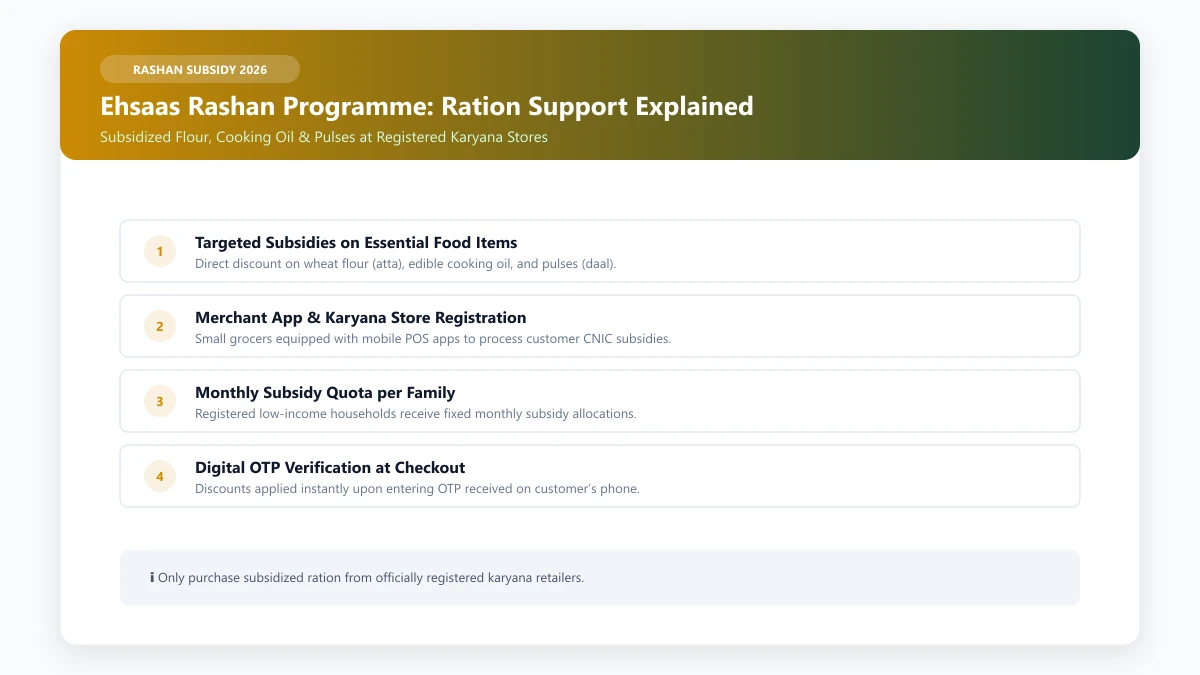
Ehsaas Rashan Program 2026: Eligibility, Registration and CNIC Check
Ehsaas Rashan Program - eligibility, registration, how to check online by CNIC, payment dates and common problems. Updated 2026 guide from PakBenefits.
Read guide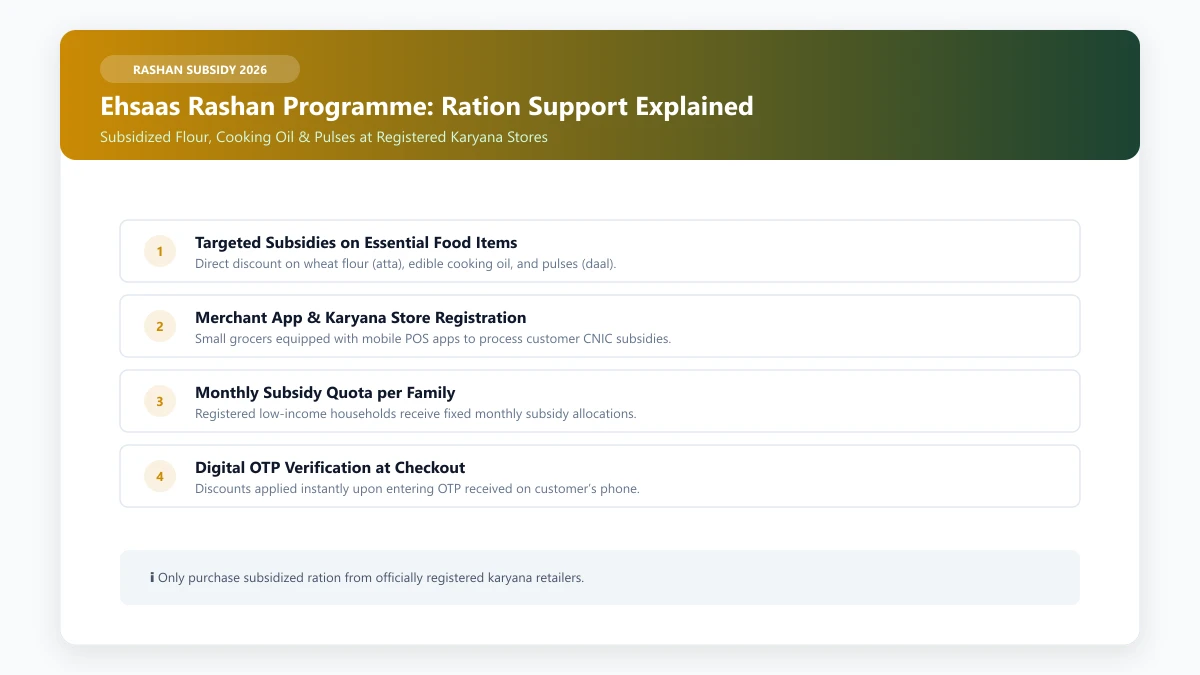
Ehsaas Rashan Programme: Ration Support Explained
How ration-support disbursements are organized, who they typically target, and how to verify a round is genuine.
Read guide
BISP and Ehsaas Difference Explained: History, 8171 Portal, Program Mapping & Current Status (2026)
The primary difference between BISP and Ehsaas is that BISP is a permanent, statutory social safety net established under the BISP Act 2010, whereas Ehsaas was an umbrella policy framework introduced in 2019 that temporarily integrated and rebranded BISP initiatives. Following administrative restructuring, all federal cash transfers, educational stipends, and nutritional grants operate under the official BISP brand and use the unified 8171 portal.
Read guide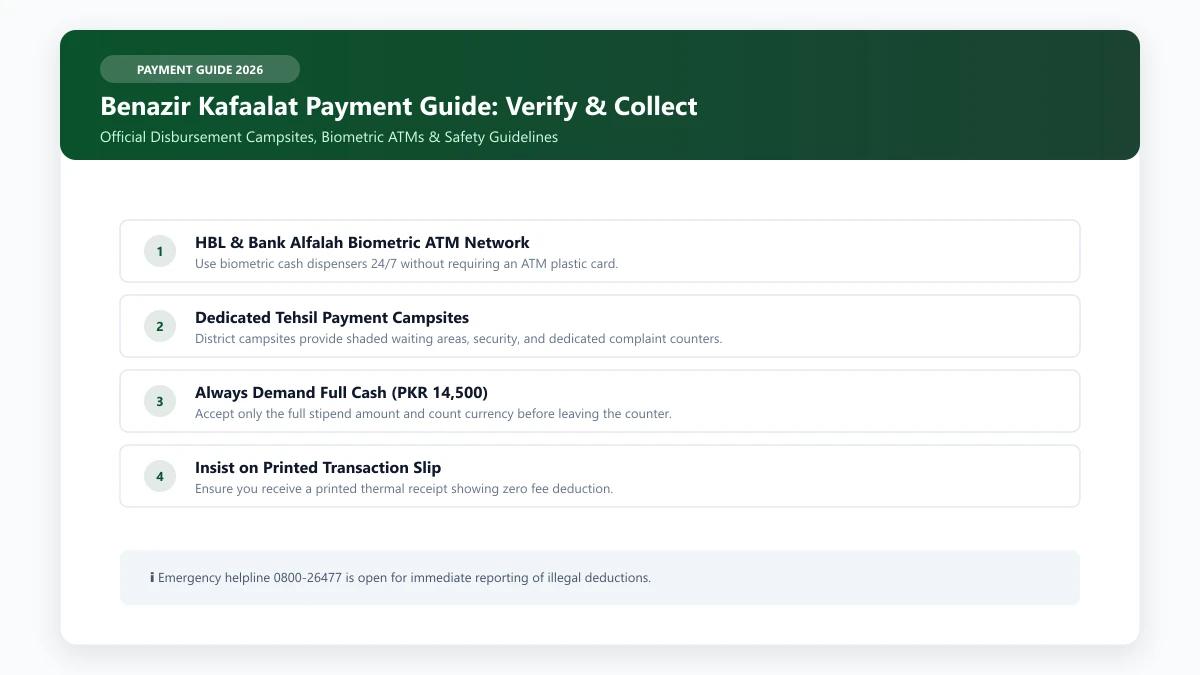
Benazir Kafaalat Payment Guide: Verify, Collect, and Stay Safe
What beneficiaries should check before collecting a payment, plus safe complaint steps.
Read guide
Ehsaas Registration Centers: How to Find and Prepare for Your Visit
What a registration center actually handles, how to find an authorized one, and what to bring.
Read guide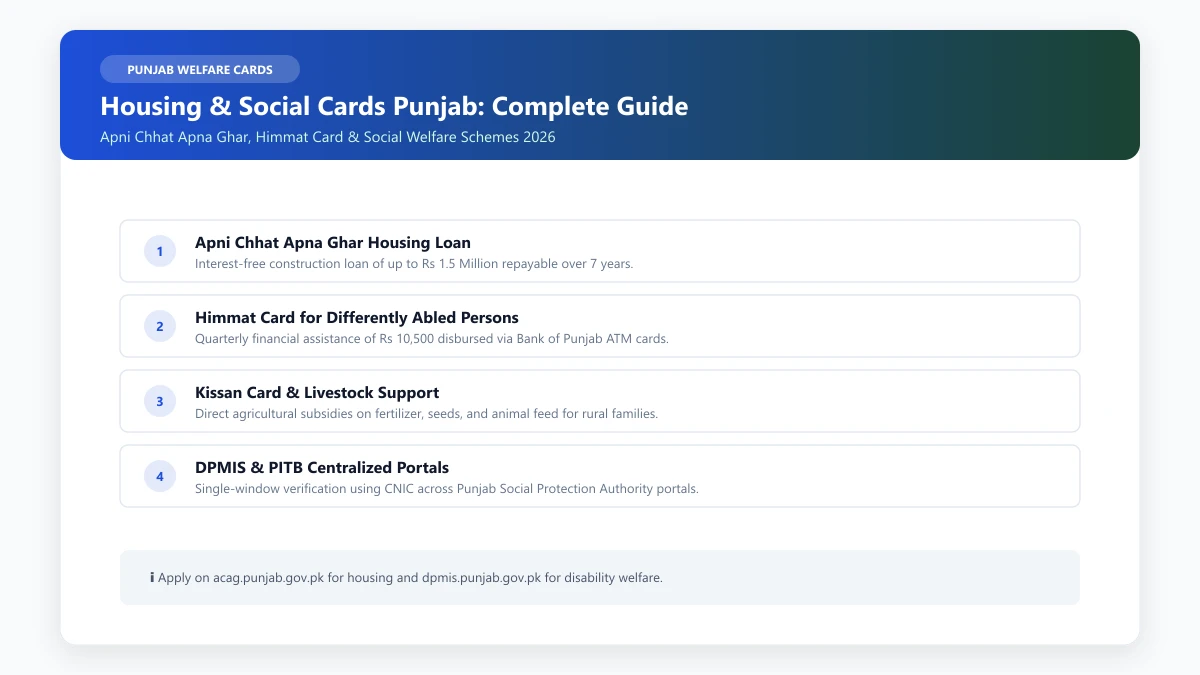
Housing & Social Cards (Punjab) 2026: Complete List, Eligibility & Online Apply Guide
Complete guide to Punjab Housing & Social Cards 2026 (Apni Chhat Apna Ghar, Himmat Card, Kisan Card, Mazdoor Card). Learn eligibility, PSER status check & online apply steps.
Read guide