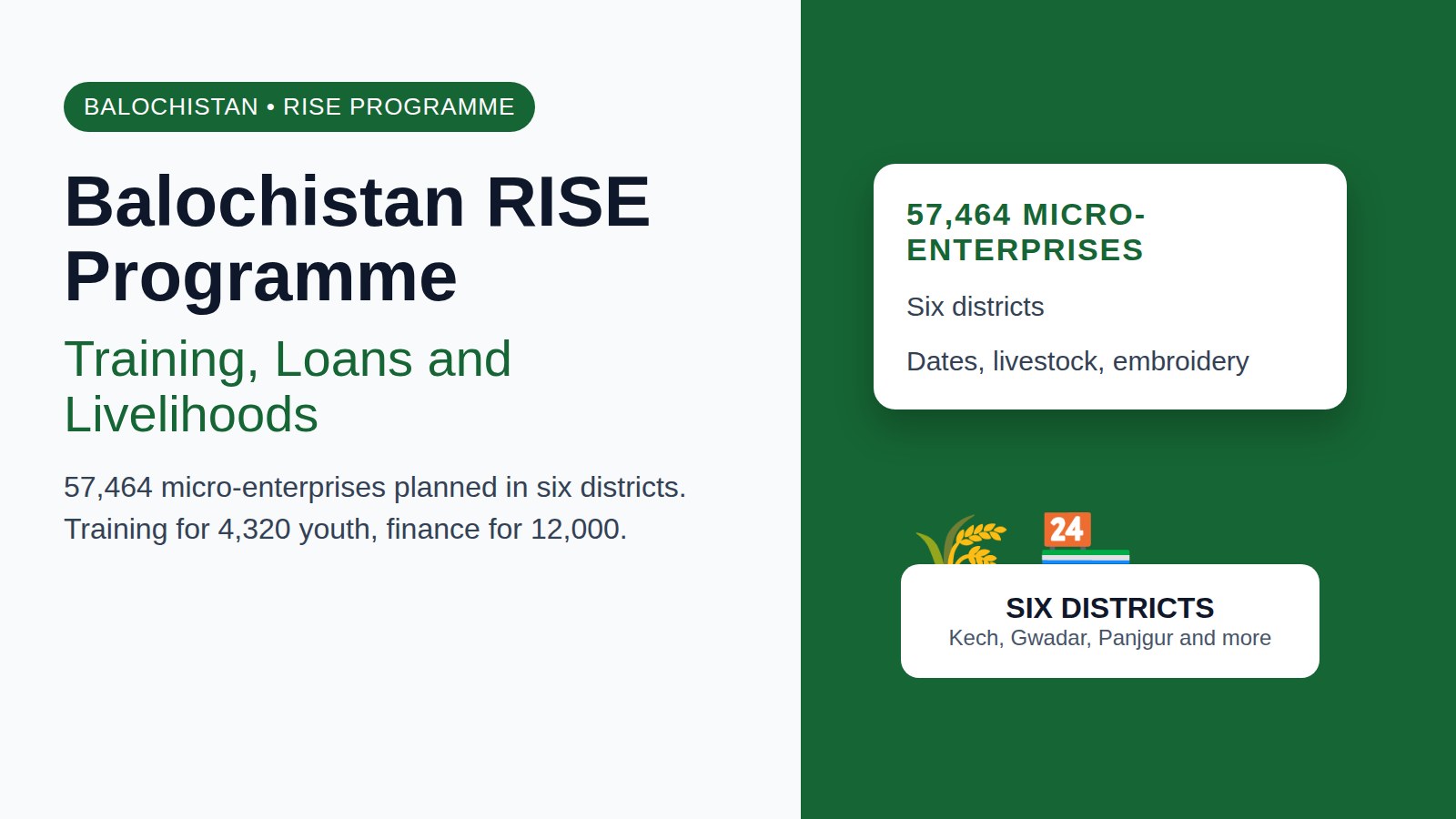
This article explains public information. It does not determine eligibility or replace an official notice.
What is the Balochistan RISE programme?
RISE stands for Resilience, Integration and Socio-Economic Empowerment. It is a flagship programme of the Industries and Commerce Department of the Government of Balochistan. The Balochistan Rural Support Programme, known as BRSP, implements it on the ground.
The programme tackles four problems at once: multi-dimensional poverty, unemployment, economic exclusion and climate vulnerability. Its goal is to help young people and marginalised communities earn an income, create wealth and become productive members of a peaceful and resilient society.
RISE is not a cash grant scheme and it is not a jobs quota. It works through three linked parts: skills training, enterprise creation and access to finance. A young person can train in a market-based trade, get help to start a small business, and then get access to a loan or a grant to run it. The programme also works on the social side, by strengthening local organisations and training young people as community leaders.
The programme was launched in October 2025, with an inauguration ceremony held on 6 October 2025. It came back into the news in early November 2026, when Chief Secretary Shakil Qadir Khan chaired a briefing meeting on its progress and its next steps.
Which districts does the RISE programme cover?
RISE covers six districts in Balochistan: Panjgur, Kharan, Washuk, Gwadar, Awaran and Kech. These are the only districts in the programme. No other district has been added, and no expansion to other districts has been announced as of 12 November 2026.
The six districts sit in the south and west of the province. They share long borders, dry farmland, coastal and fishing areas, and limited formal job markets. That is why the programme focuses on self-employment and small business, not only on salaried jobs.
Some readers have asked online why Pashtun-majority districts such as Quetta, Zhob and Lasbela are not included. The programme's own material does not answer that question. It states the six districts and gives no reason for leaving others out.
What are the RISE programme targets?
The programme has published clear numbers. These are targets, not results so far. The distinction matters, because most of the targets run over several years and no final completion figures have been published yet.
| Target | Number |
|---|---|
| Micro-enterprises to be established | 57,464 |
| Young people to get technical and vocational training and job links | 4,320 |
| Young people to be trained as social change agents | 900 |
| Youth and entrepreneurs to get access to financial services and affordable loans | 12,000 |
| Climate-resilient infrastructure projects | 1,620 |
| Local organisations to be strengthened | 180 |
| Households to benefit from enterprise support | About 80,000 |
| Households whose livelihoods will be protected from climate risks | About 16,500 |
| Households to gain work through strengthened small and medium enterprises | 1,800 |
The biggest number is the 57,464 micro-enterprises. These are small, household-level businesses, such as a food processing unit, a tailoring or embroidery setup, a small livestock unit or a retail shop.
The 4,320 training places are smaller in number but central to the programme. Each trainee is meant to finish training and then be linked with a job or with self-employment. The 900 social change agents are a separate group, trained to lead youth and community work in their own areas.
What training does RISE offer young people?
RISE offers technical and vocational education and training, known as TVET. The training is built around modern, market-based skills. That phrase comes from the briefing given to the Chief Secretary, and it means the trades are picked because employers and buyers want them, not because they are traditional choices.
Training has already started in some trades. In July 2026, young people from Kharan, Washuk, Kech and Gwadar began training in Karachi. Young women trained in baking and cookery at the College of Tourism and Hotel Management, known as COTHM, in Karachi. Young men trained in IT and coding at Saylani Welfare International Trust in Karachi. BRSP picks the trainees using skills mapping, coordinates the training with the institutes, and mentors graduates as they move into work or self-employment.
One example shows how the training works in practice. Fifty young women travelled to Karachi for a three-month professional Baking and Cookery course at COTHM. The course taught practical, market-oriented cooking skills. It also came with a plan for Income Generating Grants for graduates, so they could buy equipment and start a home bakery or a small food business. Two of the trainees, Zareen Taj from Panjgur and Saadia Rameez from Gwadar, spoke publicly about the course in August 2026. They said it gave them skills they could turn into income at home.
Two new training partnerships were reported at the November 2026 briefing. In collaboration with South Air, young people will be given flight crew training, so they can seek work with airlines and learn professional skills linked to modern air travel. Work with Tech Valley will also start soon, to expand opportunities for young people in technology and skills development. Neither partnership has published a start date, a seat count or an application route yet, so treat both as announced plans, not open admissions.
What trades and sectors does RISE support?
RISE supports the trades that already exist in the six districts, and it adds new ones where the market is growing. The briefing named the main sectors and trades for Kharan, Panjgur and Washuk: dates, cotton, wheat, cumin, livestock, handmade Balochi embroidery and food processing. These are the trades the programme is built around in those three districts.
The wider programme also works in agriculture, livestock, fisheries, eco-tourism, climate-smart work and the blue economy. The blue economy means income from the sea and the coast, such as fishing, fish processing and coastal trade. Gwadar and Kech have the strongest coastal link, while the inland districts lean more on farming, dates and livestock.
Business incubators are part of the plan. They help young entrepreneurs shape a business idea, build a model that can earn money, and then join a value chain. A value chain is the full path from production to sale. For dates, it runs from the farm to drying, packing and selling. For embroidery, it runs from the maker to the buyer in a city market or online.
How does RISE help with loans and finance?
Money is the hardest part of starting a business, and RISE tries to solve it in two ways: interest-free loans and grants. The Chief Minister, Mir Sarfaraz Ahmed Bugti, has said the government will give interest-free loans, business development support and skills training so young people can become self-reliant.
The main finance target is 12,000 youth and entrepreneurs who will get access to financial services and affordable loans. Partnerships with financial institutions, including Akhuwat, will provide interest-free loans to 12,000 young entrepreneurs. Akhuwat is a well-known provider of interest-free microfinance in Pakistan, and its role is to handle the lending side.
Grants work differently from loans. Income Generating Grants are planned for training graduates. They help a graduate buy equipment, set up a small business and turn a new skill into income. The grants are meant to remove the first barrier a new entrepreneur faces, which is start-up capital. BRSP has already handed out such grants in the districts. In October 2026, for example, income-generating grants were given to 250 young people and residents in Kech district at a ceremony in Turbat.
A separate grant window opened in November 2026. The RISE Matching Grant Program invites micro, small and medium enterprises in Kech, Awaran and Gwadar to apply. It covers sectors such as agriculture, livestock and dairy, marine fisheries, retail and wholesale, embroidery and women's enterprise, food processing, solar energy services, construction materials, and repair and maintenance. The flyer published by BRSP on 11 November 2026 lists three grant bands: micro grants of Rs 0.5 million to Rs 1 million with a 10 percent applicant share, small grants of Rs 1 million to Rs 5 million with a 20 percent share, and medium grants of Rs 5 million to Rs 10 million with a 25 percent share. The flyer gives a registration deadline of 18 November 2026 and an application deadline of 15 December 2026, with contact email [email protected]. This is a business grant window for existing enterprises, not the youth training intake, so do not mix the two up.
What is new in RISE in November 2026?
Three things changed or were confirmed in November 2026. First, the Chief Secretary chaired a briefing meeting in early November 2026 and was told about the programme's projects, its progress so far and the steps being taken to create new livelihoods. He said the government was taking comprehensive steps to give people dignified work, develop the potential of youth and equip them with modern technical and vocational skills.
Second, the South Air flight crew training and the Tech Valley technology work were reported at that briefing. Both are new directions. They move RISE beyond its farming and craft base and into aviation and technology, which are new job markets for young people in these districts.
Third, the Matching Grant Program flyer for Kech, Awaran and Gwadar was published on 11 November 2026, with the deadlines given above. That is the most concrete new item for business owners, because it has a date and a contact point.
One caution applies to the November briefing date. The same target figures were also reported in social media posts dated 4 September 2026, which described a similar meeting. It is possible the November briefing was a follow-up meeting, not the first one. The figures are the same in both reports, so the targets have not changed. Only the meeting date is uncertain, and this guide states the November briefing as reported by the Daily Balochistan Express, whose report was published in early November 2026.
Who runs RISE and how is it funded?
The Government of Balochistan funds RISE through its Industries and Commerce Department. BRSP implements it. BRSP is a not-for-profit organisation that has worked in rural Balochistan since 1991.
Funding is reported as Rs 16.79 billion on the BRSP website. The News reported Rs 16 billion in January 2026, including Rs 3.5 billion for the current year at that time. The two figures differ, and the BRSP figure is used here because it comes from the implementing organisation's own page. The programme is a multi-year, phased effort, not a one-year spend.
The Chief Minister, Mir Sarfaraz Ahmed Bugti, leads the programme politically. The Chief Secretary, Shakil Qadir Khan, chairs the review meetings. The Secretary Industries, Khalid Sarprah, attends the briefings. BRSP's chief executive, Dr Tahir Rasheed, runs the implementation and has called RISE a landmark initiative. He has said it goes beyond normal livelihood work by focusing on wealth creation and youth entrepreneurship, so young people can create jobs for others, not only find one for themselves.
What has RISE not announced yet?
This section matters, because several websites already carry wrong or invented application steps for RISE. Here is what is not yet published, as of 12 November 2026.
There is no single central RISE application portal for youth training or loans in the official sources checked for this guide. No general eligibility rules, no age limit for the whole programme and no start date for individual applicants have been published by the Government of Balochistan or by BRSP. Do not trust a website that lists a fixed RISE application form, a fee or a guaranteed selection step. Those details have not been announced.
The honest position is this: if you want to join RISE, watch BRSP's official pages and the Government of Balochistan's announcements for the next intake in your district. BRSP district offices are the local contact point, and the programme works through community organisations in each district. Do not pay anyone who claims to sell a RISE application or a guaranteed place. No such paid route has been announced.
How does RISE compare with other Balochistan youth schemes?
RISE is not the only youth scheme in Balochistan. The Balochistan Youth Employment Programme aims to create 25,000 jobs, while RISE is built around training, micro-enterprises and finance. The Balochistan Enterprise Development Programme Gwadar expansion is a related enterprise story focused on Gwadar that mentions RISE in passing, while RISE itself covers six districts and adds training and social work. The Balochistan e-bike scheme stage 2 gives transport help through a National Bank of Pakistan loan, and the Ehsaas Naujawan Programme in Khyber Pakhtunkhwa offers interest-free loans in another province. RISE stands out because it combines training, grants, loans and community work in one programme.
Frequently asked questions
What is the Balochistan RISE programme?
RISE stands for Resilience, Integration and Socio-Economic Empowerment. It is a Government of Balochistan programme, run by BRSP, that gives young people skills training, business support and access to finance in six districts. Its aim is youth employment and stronger rural livelihoods.
Which districts are covered by the RISE programme?
The six districts are Panjgur, Kharan, Washuk, Gwadar, Awaran and Kech. No other district is covered at present, and no expansion has been announced as of 12 November 2026.
How many micro-enterprises will RISE establish?
RISE aims to establish 57,464 micro-enterprises. These are small household businesses, such as food processing units, embroidery setups, livestock units and retail shops. The figure is a target, not a completed count.
How many young people will RISE train?
RISE plans technical and vocational training for 4,320 young people, and it will link them with jobs or self-employment. It will also train 900 young people as social change agents, who will lead youth and community work in their districts.
Does RISE give interest-free loans?
Yes, interest-free loans are part of the plan. Partnerships with financial institutions, including Akhuwat, will provide interest-free loans to 12,000 young entrepreneurs. The programme also plans Income Generating Grants for training graduates, so they can buy equipment and start a business.
What trades does RISE support?
The main trades named for Kharan, Panjgur and Washuk are dates, cotton, wheat, cumin, livestock, handmade Balochi embroidery and food processing. The wider programme also covers agriculture, livestock, fisheries, eco-tourism, climate-smart work and the blue economy. Newer plans add flight crew training with South Air and technology work with Tech Valley.
How can I apply for the RISE programme?
There is no single central application portal or general eligibility list published yet for youth training or loans. Separate intakes are advertised on their own, and one TVET intake closed on 5 November 2026. Watch BRSP's official pages and your district office for the next intake, and do not pay anyone who claims to sell a place.
What is the RISE Matching Grant Program?
It is a grant window for micro, small and medium enterprises in Kech, Awaran and Gwadar, advertised by BRSP on 11 November 2026. Grants run from Rs 0.5 million to Rs 10 million, with an applicant share of 10 to 25 percent by band. Registration closes 18 November 2026 and applications close 15 December 2026.
Who runs the RISE programme?
The Government of Balochistan funds it through the Industries and Commerce Department, and the Balochistan Rural Support Programme implements it. The Chief Minister is Mir Sarfaraz Ahmed Bugti, the Chief Secretary is Shakil Qadir Khan, and the BRSP chief executive is Dr Tahir Rasheed.
How much funding does RISE have?
BRSP states funding of Rs 16.79 billion. The News reported Rs 16 billion in January 2026. The BRSP figure is used in this guide because it comes from the implementing organisation. The programme is phased over several years, not spent in one year.
Sources and official links
Check the destination address before entering personal information.
Related guides
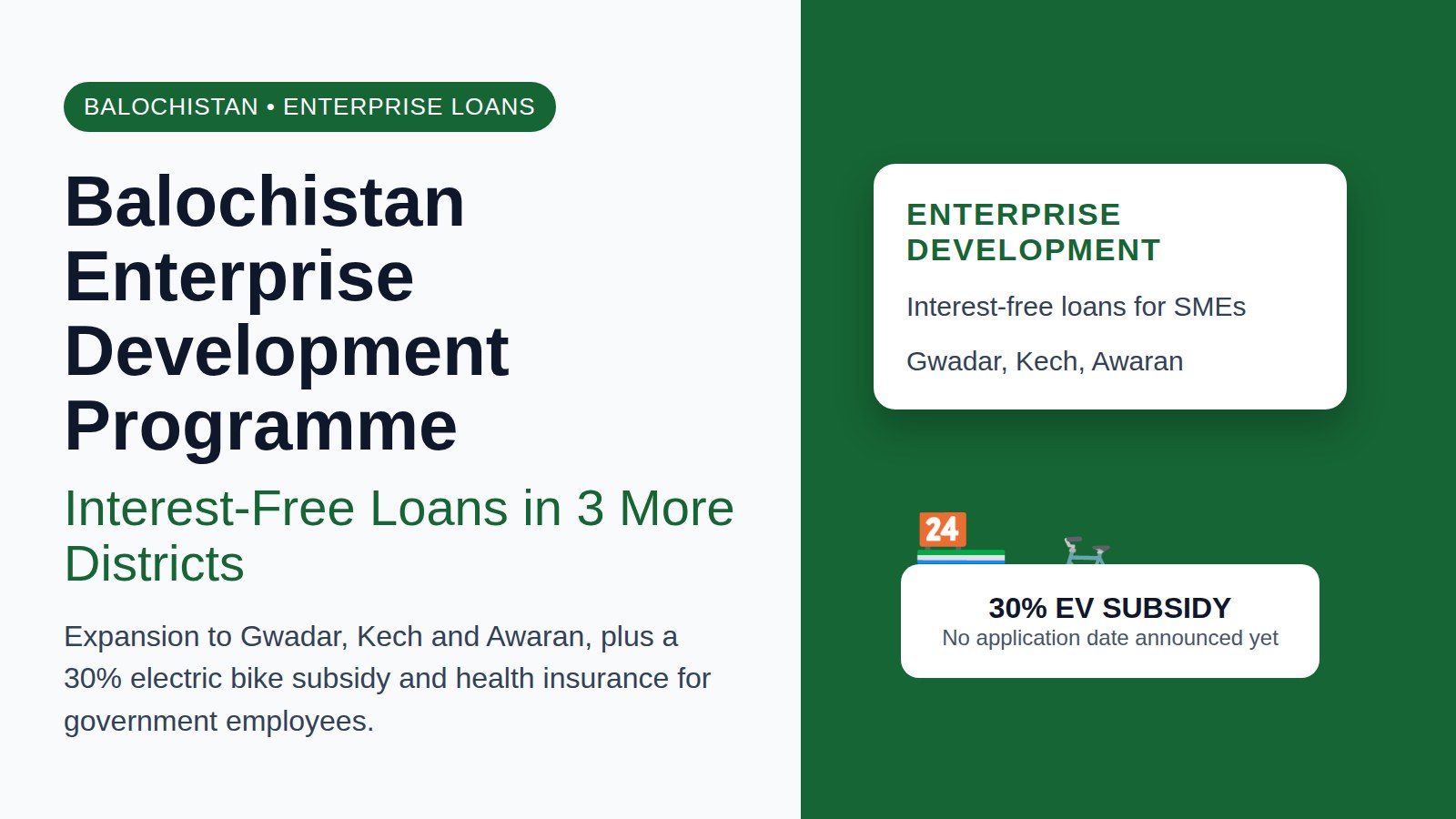
Balochistan Enterprise Development Programme Expands to Gwadar, Kech and Awaran
The Balochistan government has approved the extension of its Enterprise Development Programme to Gwadar, Kech and Awaran, where it will offer interest-free loans to small and medium enterprises and start-ups. The same cabinet meeting also approved a 30 percent subsidy on electric bikes and a health insurance programme for provincial government employees.
Read guide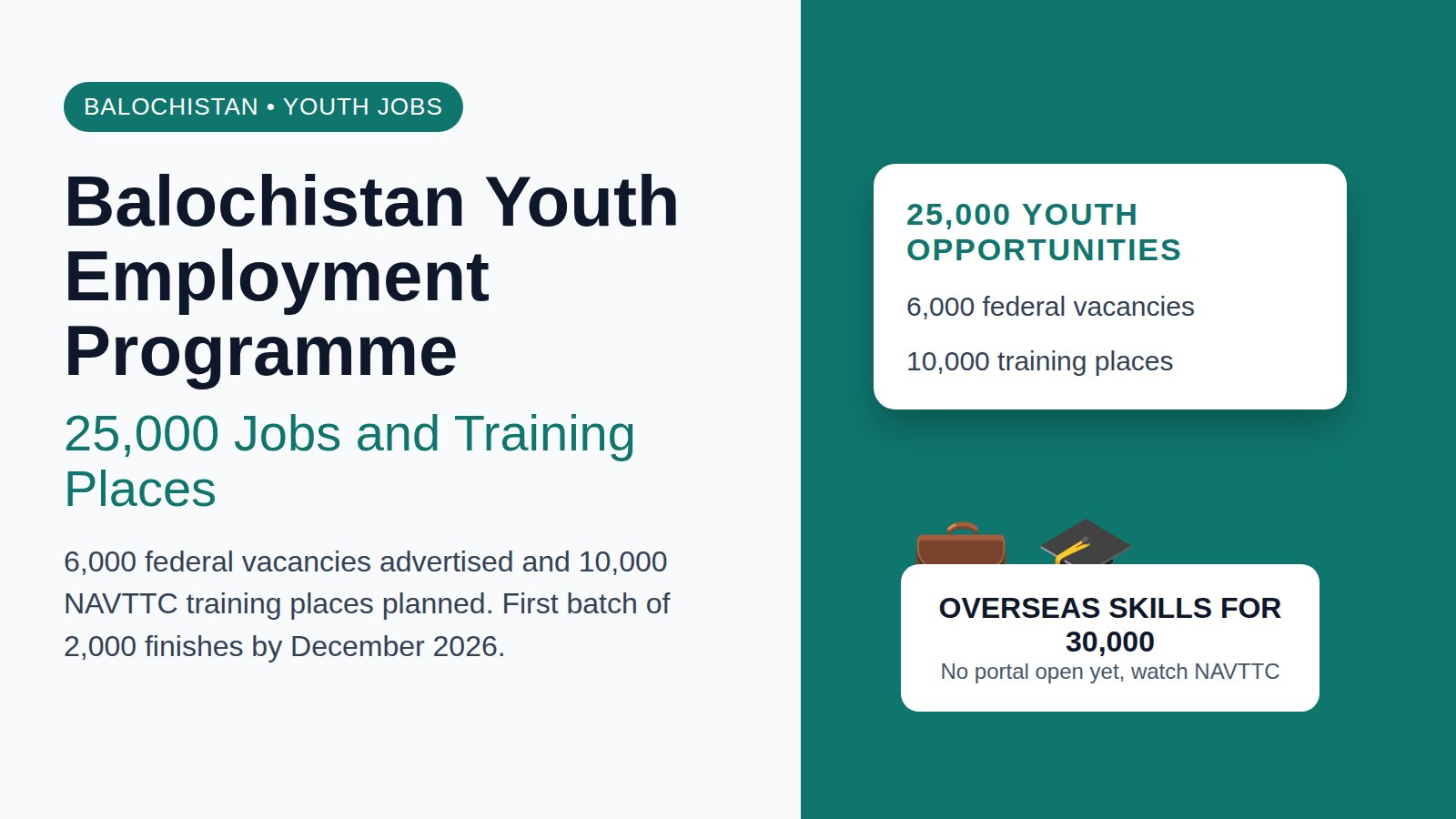
Balochistan Youth Employment Programme: 25,000 Jobs, Training and Overseas Skills
The Balochistan Youth Employment Programme aims to create opportunities for 25,000 young people through 6,000 advertised federal vacancies and technical training for 10,000 more. As of 9 November 2026, no application portal, deadline or eligibility list has been published yet, so watch NAVTTC and B-TEVTA announcements and ignore agents who promise a place.
Read guide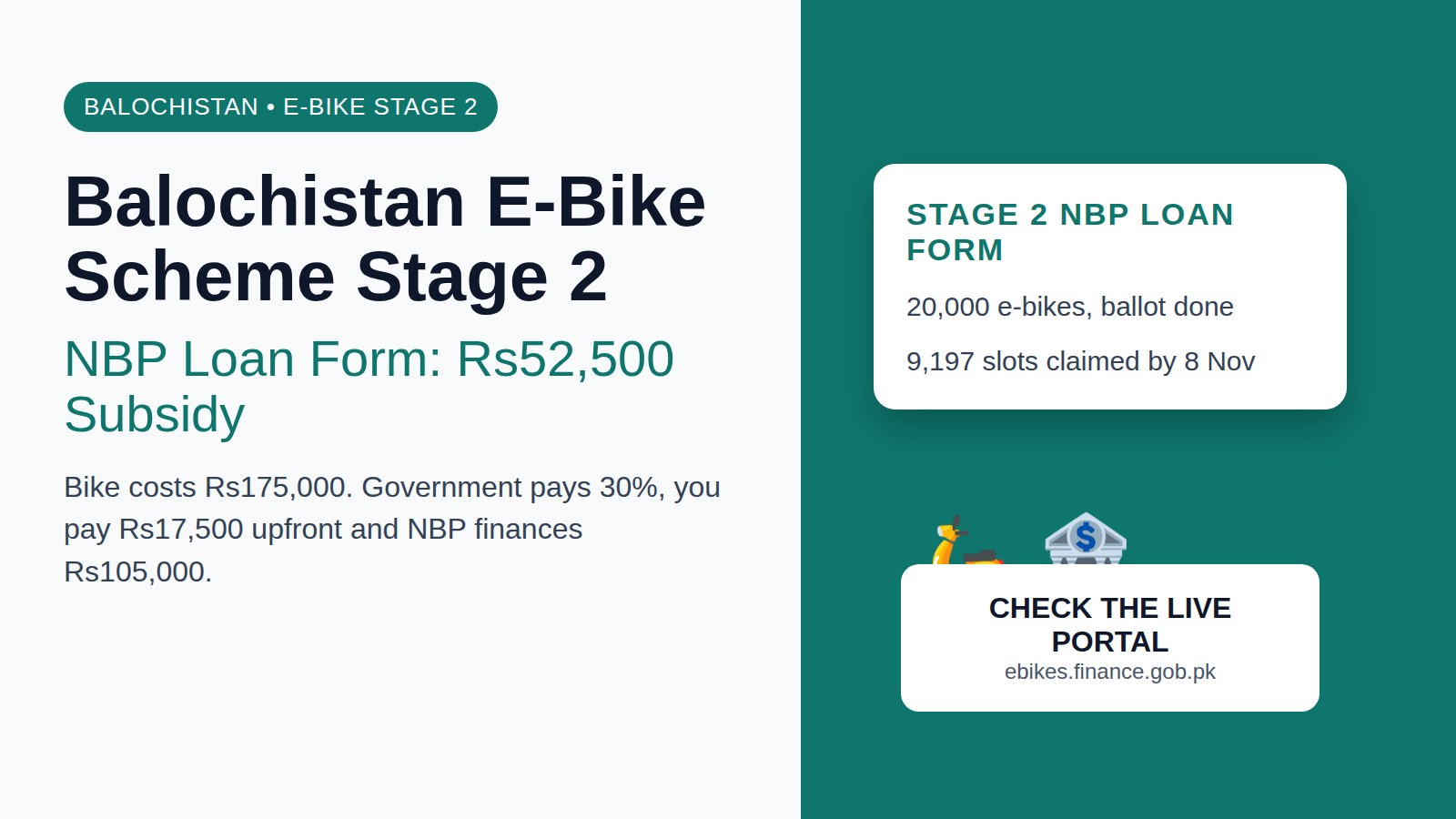
Balochistan E-Bike Scheme Stage 2: NBP Loan Form, Cost and Guarantor Rules
Stage 2 of the Balochistan E-Bike Scheme is the National Bank of Pakistan loan form that ballot winners must finish to claim one of 20,000 electric bikes. The bike costs Rs175,000. The government pays Rs52,500, you pay Rs17,500 upfront, and NBP lends Rs105,000. You also need a permanent Government of Balochistan employee as guarantor.
Read guide
Ehsaas Naujawan Programme: Interest-Free Youth Business Loans in KP
The Ehsaas Naujawan Programme gives interest-free business loans to young people in Khyber Pakhtunkhwa. The Bank of Khyber lends Rs 1 million to Rs 5 million to a registered firm of 3 to 5 partners aged 18 to 35, with no mark-up and up to 8 years to repay.
Read guide