This article explains public information. It does not determine eligibility or replace an official notice.
What is the Balochistan Youth Employment Programme?
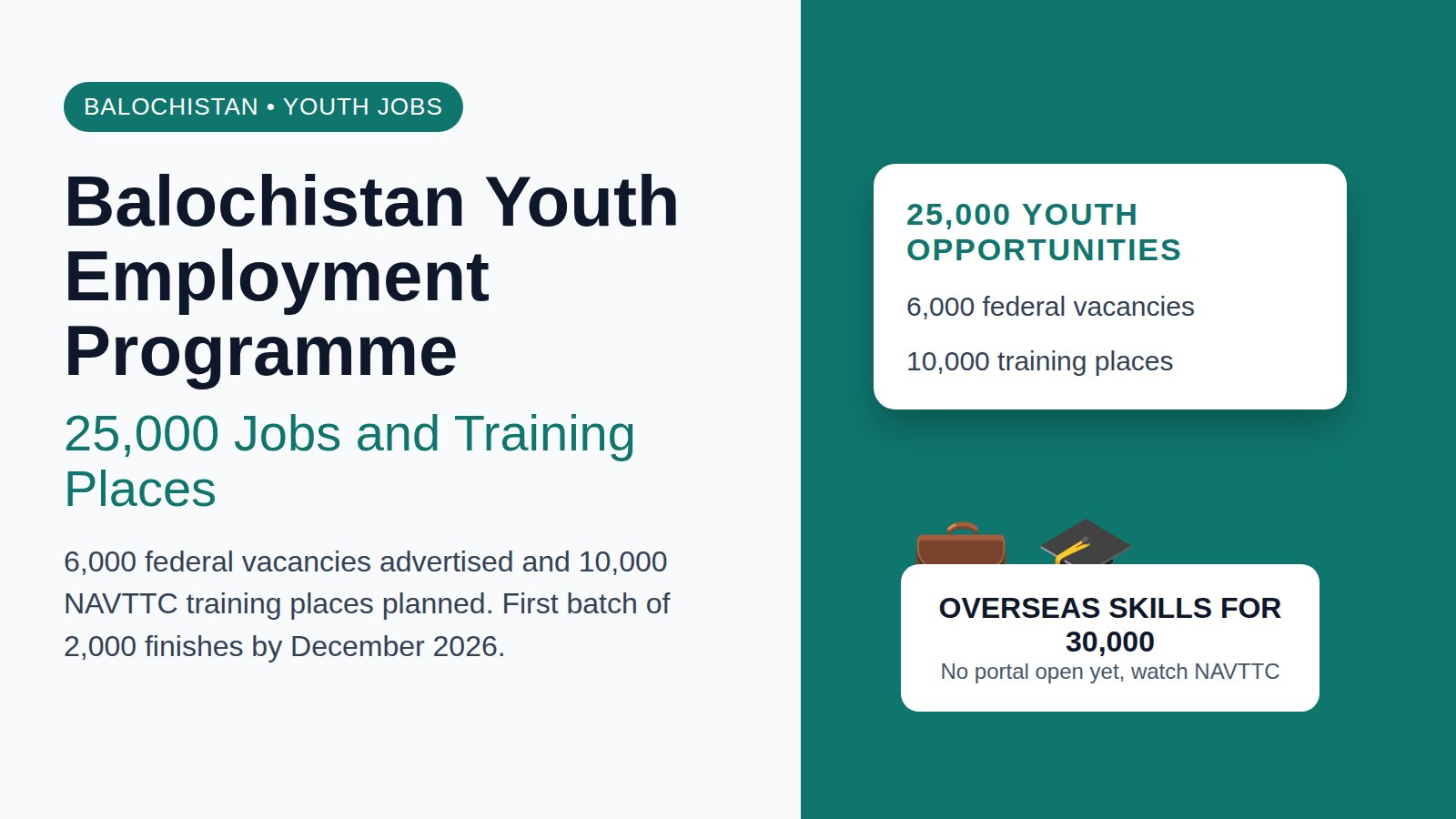
The Balochistan Youth Employment Programme is the provincial government's plan to create work for 25,000 young people across Balochistan. Chief Minister Mir Sarfraz Bugti set out the plan on 4 November 2026, in a meeting with the National Vocational and Technical Training Commission (NAVTTC). The plan has two tracks. One track is direct recruitment into federal government departments. The other track is technical training that should lead to a job in Pakistan or abroad.
This is an independent guide. It is not an official government page, and it is not run by the Government of Balochistan, NAVTTC or the Balochistan Technical Education and Vocational Training Authority (B-TEVTA). The numbers in this guide come from the announcements named in each section, and every date is stamped so you can see how fresh each fact is.
The programme matters because Balochistan has few formal jobs for its young people, and most of the province sits far from the large employers in Karachi, Lahore and Islamabad. A plan that mixes federal vacancies with skills training speaks to both problems at once. The vacancies give an immediate route into work, while the training should give young people a skill they can sell even if they miss out on a government post.
Why southern Balochistan comes first
The briefing to the Chief Minister put the focus on selected districts of southern Balochistan. That focus is deliberate. The south of the province has fewer training institutes, fewer employers and weaker transport links than Quetta and the north, so young people there have fewer options. The Chief Minister also stressed that the benefits should reach deserving young people in underserved areas, not only those who live near a training centre.
No district list has been published yet for this programme, so do not trust a list you see on a jobs site unless it links to an official announcement. A separate federal launch, Skills for Jobs in Balochistan, refers to 12 identified districts, but it does not name them either. As of 9 November 2026, the honest position is that the south is the priority and the district names are still unpublished.
How do the 25,000 jobs break down?
The 25,000 figure breaks into two confirmed parts and one part that has not been explained yet. The first confirmed part is 6,000 federal government vacancies that had already been advertised by 4 November 2026. The second confirmed part is technical training for 10,000 young people, to be delivered jointly by NAVTTC and B-TEVTA. Those two parts add up to 16,000, not 25,000, so 9,000 places in the headline target have no published breakdown yet.
That gap is worth stating plainly. It does not mean the 25,000 figure is wrong. It means the published reports describe a target, not a complete seat plan. More federal vacancies will be advertised in phases, according to the briefing, and later announcements may fill in the rest. Until they do, treat 25,000 as the stated goal and 6,000 plus 10,000 as the confirmed detail inside it.
| Part of the target | Number | Status as of 9 November 2026 |
|---|---|---|
| Federal government vacancies already advertised | 6,000 | Advertised, with more to follow in phases |
| Technical training places with NAVTTC and B-TEVTA | 10,000 | Planned, first batch of 2,000 due to finish by December 2026 |
| Rest of the 25,000 target | 9,000 | No published breakdown yet |
| Total target | 25,000 | Announced by the Chief Minister on 4 November 2026 |
The first batch of trainees gives the plan its first real deadline. A total of 2,000 trainees are expected to complete their training by December 2026, which is only weeks after the announcement. That is a fast turnaround, and it means the first batch must already be in training or about to start. After that batch finishes, the plan is to connect those trainees with overseas employment, though no employer list or country list has been published for them yet.
The phased advertising of federal vacancies matters for applicants too. A vacancy advertised in phases means you cannot apply for every post at once, and a post that is not advertised yet may still appear later. Check the federal jobs portal and official notices regularly, and do not pay anyone who claims to hold a vacancy for you.
What training will NAVTTC and B-TEVTA provide?
NAVTTC and B-TEVTA will jointly provide vocational and technical training to 10,000 young people under this plan. NAVTTC is the federal commission for technical and vocational training, and B-TEVTA is the provincial authority that runs technical and vocational education in Balochistan. Working together lets the federal side bring national standards and funding, while the provincial side brings the training centres and local knowledge.
The meeting that set out the plan brought both sides together. NAVTTC Chairman Engineer Qamar-ul-Islam Raja and Executive Director Nadia Karim briefed the Chief Minister, and B-TEVTA chief Major (Retd.) Abdul Kabir Zarkoon attended with NAVTTC Balochistan Director General Hussain Bakhsh Magsi and Balochistan Secretary Labour and Manpower Saleh Muhammad Nasir. That attendance list matters, because it shows the plan is a joint federal and provincial effort rather than a single department's announcement.
Training will take place at institutions inside Balochistan and at advanced centres in Punjab, Islamabad and elsewhere. That split is practical. Balochistan's own centres can teach many trades, but some advanced or specialised courses need facilities the province does not have yet. Sending trainees outside the province for those courses widens the range of skills on offer, though it also means some trainees will need to live away from home during their course.
B-TEVTA already runs a network of Technical Training Centres (TTCs) and Vocational Training Centres (VTCs) across the province, so the training does not start from zero. The authority is also the apex provincial institution for Technical and Vocational Education and Training (TVET), which means it sets standards and regulates training in the province. Its recent reforms have brought polytechnics, colleges of technology, social welfare vocational centres and small industries training centres under one framework, so a trainee's certificate should carry the same weight wherever in the province it was earned.
Which sectors have the most openings?
The five sectors with the most openings come from a labour market survey that NAVTTC carried out for the related Skills for Jobs in Balochistan launch. Those sectors are construction, industry and mining, agriculture, hospitality, and information technology. The survey identified them as the areas with high employment potential, so training places should concentrate there rather than spread thinly across every trade.
That list fits Balochistan's economy. Construction needs workers for roads, housing and public projects. Industry and mining covers the province's mineral wealth and its processing plants. Agriculture covers farming and livestock, which still employ a large share of the province. Hospitality covers hotels, tourism and services, and information technology covers digital work that a young person can do from anywhere with a connection. If you are choosing a trade, pick one from this list that matches your interest and your district's employers, because those are the trades the survey says employers actually need.
A separate report on the Chief Minister's Youth Skill Development and Overseas Employment Programme names information technology, healthcare, hospitality and electrical work as its focus trades. That report is a single secondary source, so treat its trade list as unconfirmed for this programme. The five sectors above are the ones with a named survey behind them, and they are the safer guide.
Who pays for training, food and travel?
The federal government will cover participants' accommodation, meals, travel and other essential expenses. NAVTTC Chairman Engineer Qamar-ul-Islam Raja gave that assurance on 2 November 2026, two days before the Chief Minister's meeting. That means a trainee from a poor household should not have to pay for a hostel bed, food or the bus fare to a training centre outside their district.
That funding promise is important, because cost is often what stops a young person from taking up training. A free course still costs money if you must pay for a room, eat away from home and travel to another city. Covering those costs removes the largest barrier, at least on paper. What the announcement does not say is how the money will reach trainees, whether as a direct payment, a hostel place or a travel allowance, so watch for that detail in the next announcement.
The related Skills for Jobs in Balochistan launch adds a further detail. Trainees there get a six-month placement in a company after training, and that placement works as a probationary period. The company can then hire the trainee on merit if the placement goes well. That model turns training into a job interview that lasts six months, which is a stronger route into work than a certificate alone.
Who can apply, and has registration opened?
As of 9 November 2026, registration has not opened for the Balochistan Youth Employment Programme, and no application portal, deadline or eligibility list has been published for it. That is the single most important fact in this guide, because most searches for this programme are really asking how to apply. The answer today is that you cannot apply yet, because there is nothing to apply through.
No age limit, education requirement, domicile rule or document list has been confirmed for this programme in the sources checked for this guide. Do not trust a site that gives you an age limit or a list of required documents for this programme unless it links to an official announcement. The only published facts about who the programme is for are that it targets young people in Balochistan, with a focus on selected districts of southern Balochistan, and that selection should be transparent and merit based.
That last point is worth repeating. The Chief Minister directed officials to run transparent selection procedures with merit-based access and regular monitoring of training outcomes and employment placements. That is a promise about how selection should work, not a published rule you can check yourself against yet. When the rules do appear, compare them with that promise, and raise it through official channels if the two do not match.
What to watch for next
Watch three places for the application announcement. First, watch NAVTTC, at navttc.gov.pk, because it is the federal delivery body and it runs the national training announcements. Second, watch B-TEVTA, at btevta.gob.pk, because it is the provincial authority that will run the training centres. Third, watch the Prime Minister's Youth Programme, because its Skills for Jobs in Balochistan launch is the closest related programme and its announcements may carry the same training places.
The related Skills for Jobs launch gives a useful sense of scale for what to expect. It screened 25,000 young people as potential trainees and will select 10,000 in its first phase. Its split is 8,000 placements within 12 identified districts of Balochistan, 1,000 overseas placements through Government-to-Government agreements, and 1,000 seats in federal training institutions. Those numbers describe that launch, and this guide does not present them as the rules of the Chief Minister's programme, but the overlap in the 10,000 figure suggests the two announcements describe the same training cohort from two angles.
How to spot a fake application link
Fake application links appear within days of any popular government announcement, and this programme will be no exception. A fake link usually arrives by WhatsApp, Facebook or SMS, promises a guaranteed place, and asks for a fee, a one-time password or a bank detail. No official announcement for this programme has asked for any of those things, because no official application route exists yet.
Do not pay anyone for a form, a registration or a place on this programme. Do not share your CNIC number, your one-time password or your bank details with an agent who contacts you first. Do not use a link that does not sit on an official government domain. If a link claims to be the application portal, check it against navttc.gov.pk and btevta.gob.pk first, and treat any mismatch as a warning sign.
What are the overseas job plans?
The overseas plan is the most ambitious part of the programme, and also the part with the least settled detail. The provincial government aims to equip 30,000 young people with skills for overseas jobs. That target comes from the B-TEVTA board meeting of 13 October 2026, and it was repeated in the planning minister's announcement of 6 November 2026. It is a separate target from the 25,000 employment target, so do not add the two together into 55,000 places.
The timeline for the 30,000 target is not settled in the sources. October reporting says the 30,000 should be prepared by next year, while the official Balochistan public relations feature on B-TEVTA says the target is to prepare and provide overseas employment to 30,000 skilled youth in the next five years. Those two timelines cannot both be right, so this guide reports both and flags the conflict. Until an official statement settles it, treat "by next year" as the faster claim and "in five years" as the slower one.
The related Skills for Jobs launch gives the only concrete overseas number so far. It plans 1,000 overseas placements in its first phase, arranged through Government-to-Government agreements. That is a small share of the 30,000 target, which fits a phased plan, but it also shows how far the overseas work still has to go. No destination country list has been confirmed for the new cohort, and no employer list has been published either.
There is already some proof that the overseas route works. Under the Chief Minister's Youth Skill Development and Overseas Employment Programme, dozens of trained young professionals from Balochistan have secured jobs in Saudi Arabia and Qatar through B-TEVTA-facilitated placements. That is a small number against a 30,000 target, but it shows the placement channel exists and has already moved people. B-TEVTA's partners in this work include NAVTTC, the British Council, GIZ Pakistan, the University of Balochistan and BUITEMS, which help with curriculum, standards and capacity building.
What is the Rs16 billion youth development programme?
Planning and Development Minister Mir Zahoor Ahmed Buledi said on 6 November 2026 that the provincial government has launched a Rs16 billion youth development programme. The programme covers employment, entrepreneurship and technical training, and it includes plans to equip 30,000 young people with skills for overseas jobs. Buledi announced it at the Gand-o-Nand programme organised by the Turbat Press Club, alongside a wider set of education, healthcare, agriculture and infrastructure initiatives.
The Rs16 billion figure is the envelope for that youth development programme. Do not repeat it as the budget of the 25,000 jobs programme or of the Skills for Jobs launch, because no source gives it that role. The 25,000 jobs announcement of 4 November 2026 carries no budget figure at all, and the two announcements should be kept apart even though they share the 30,000 overseas skills target.
The same speech also reported that 14,500 teachers have been recruited. That figure belongs to the education side of the announcement, not to the youth programme, so do not count it as a youth employment number. It is included here only because it appeared in the same announcement and readers may otherwise mix the two figures together. The enterprise and business loan detail in that same announcement belongs to a separate same-day post on the Balochistan enterprise development programme, and this guide does not cover it.
How is this different from the CM Balochistan Youth Skills Scheme?
This programme is not the same as the CM Balochistan Youth Skills Scheme 2026. That earlier scheme has its own online-apply guide on this site, and you can read it at /cm-balochistan-youth-skills-scheme-2026-online-apply/. It dates from September 2026 and it describes a different application route from the one this guide covers. If you followed that guide, do not assume its steps, dates or portal apply to the November programme.
The two schemes also sit at different stages. The September scheme already had an online application route to write about, while the November programme has announced targets and a first training batch but no published application route yet. That is why this guide spends more space on what is confirmed and what is still missing, instead of giving steps for a form that does not exist.
One confusion to avoid is the Institute Registration Portal. The Chief Minister inaugurated it at the B-TEVTA board meeting of 13 October 2026, and some reports describe it as a registration portal without saying who it is for. It is a portal for technical training institutes to register with B-TEVTA, so the authority can monitor their performance. It is not a portal where a young person registers for training or a job. If you are a candidate, that portal is not your application route.
The Skills for Jobs in Balochistan launch is also a separate announcement, though it is closely related. It was unveiled on 25 October 2026 by Rana Mashood Ahmad Khan, Chairman of the Prime Minister's Youth Programme, and it is executed by NAVTTC in coordination with the Prime Minister's Office. Its partners include the Trade Development Authority of Pakistan, the Pakistan Poverty Alleviation Fund and the Benazir Income Support Programme. For the BISP payment side of that partnership, see our BISP 8171 guide at /benazir-income-support-programme-bisp-8171-guide/.
What has been announced so far?
The announcements below are in date order. They show how the 25,000 and 30,000 targets grew out of the B-TEVTA board meeting in October and into the Chief Minister's announcement in November. Read them as a timeline, not as separate programmes, because the same targets recur in more than one announcement.
| Date | Announcement | What it said |
|---|---|---|
| 13 October 2026 | 11th B-TEVTA board meeting, chaired by Chief Minister Mir Sarfraz Bugti | Plan to train 25,000 youth by next year; programme to upskill 30,000 youth for overseas work to be accelerated; Institute Registration Portal inaugurated; slow progress in the Chief Minister's Youth Skills Development Programme reviewed |
| 25 October 2026 | Skills for Jobs in Balochistan launched by Rana Mashood Ahmad Khan | 10,000 youth to be trained and placed; 25,000 screened; split of 8,000 in 12 districts, 1,000 overseas through Government-to-Government agreements, 1,000 in federal institutions; five sectors named |
| 2 November 2026 | NAVTTC Chairman Engineer Qamar-ul-Islam Raja | Federal government will cover accommodation, meals, travel and other essential expenses for Balochistan trainees |
| 4 November 2026 | Chief Minister Mir Sarfraz Bugti meets NAVTTC leadership | Employment for 25,000 youth; 6,000 federal vacancies already advertised; training for 10,000 youth with NAVTTC and B-TEVTA; first batch of 2,000 to finish by December 2026 |
| 6 November 2026 | Planning Minister Mir Zahoor Ahmed Buledi at Turbat Press Club | Rs16 billion youth development programme launched; 30,000 youth to receive skills for overseas jobs; 14,500 teachers recruited |
The table below separates what the sources have actually confirmed from what readers most want to know but no source has published yet. Use it as a quick check before you act on anything you read elsewhere about this programme.
| Question | Status as of 9 November 2026 |
|---|---|
| How many young people are targeted? | Confirmed: 25,000 for employment, plus a 30,000 overseas skills target |
| How many federal vacancies are advertised? | Confirmed: 6,000, with more in phases |
| How many training places are planned? | Confirmed: 10,000 with NAVTTC and B-TEVTA |
| When does the first batch finish? | Confirmed: first batch of 2,000 by December 2026 |
| Who pays for training costs? | Confirmed: federal government covers accommodation, meals, travel and other essential expenses |
| Which sectors have openings? | Confirmed: construction, industry and mining, agriculture, hospitality, information technology |
| Which districts are covered? | Not announced: 12 districts named as a count only, names not published |
| What is the age limit? | Not announced yet |
| What education is required? | Not announced yet |
| Where do I apply? | Not announced: no portal or form published for this programme |
| What is the last date? | Not announced yet |
| Which countries will trainees go to? | Not announced for the new cohort; Saudi Arabia and Qatar named only for earlier placements |
What should you do now?
If you want a place on this programme, the honest work today is preparation and watching, not applying. No form exists yet, so anyone who offers you one is either mistaken or trying to take your money. The five steps below are the full extent of what a reader can usefully do as of 9 November 2026.
- Check navttc.gov.pk once a week for a Balochistan training announcement, and look for the programme name, not just a general NAVTTC batch.
- Check btevta.gob.pk once a week for the same announcement, because B-TEVTA runs the training centres in the province.
- Keep your CNIC and your Balochistan domicile certificate ready, because a domicile rule is the most likely first requirement when applications open, even though it has not been confirmed yet.
- Pick one sector from the five named in the labour market survey, and learn its basic terms now, so you can choose fast when the trade list appears.
- Ignore any agent, WhatsApp message or Facebook post that asks for a fee, a one-time password or bank details for this programme, and report it through official channels if you can.
Frequently asked questions
What is the Balochistan Youth Employment Programme?
It is the Government of Balochistan's plan to create opportunities for 25,000 young people through federal government vacancies and technical training. Chief Minister Mir Sarfraz Bugti set it out on 4 November 2026, and it is delivered with NAVTTC and B-TEVTA.
How many jobs does the programme offer?
The target is 25,000 opportunities for young people across the province. Of that total, 6,000 federal government vacancies had already been advertised by 4 November 2026, and technical training is planned for 10,000 more, so 9,000 places have no published breakdown yet.
How do I apply for the Balochistan Youth Employment Programme?
You cannot apply yet. As of 9 November 2026, no application portal, form or deadline has been published for this programme, so watch navttc.gov.pk and btevta.gob.pk for the announcement and do not pay any agent who offers you a place.
Who can apply for the programme?
No eligibility list has been published yet, so no age limit, education rule or domicile rule has been confirmed for this programme. The programme targets young people in Balochistan, with a focus on selected districts of southern Balochistan, and selection is meant to be transparent and merit based.
When will the first trainees finish their training?
The first batch of 2,000 trainees is expected to complete training by December 2026. After that batch finishes, efforts will be made to connect those trainees with overseas employment, though no employer or country list has been published for them yet.
Which trades or sectors are covered?
The five sectors named from NAVTTC's labour market survey are construction, industry and mining, agriculture, hospitality, and information technology. Those are the sectors the survey found to have high employment potential, so training places should concentrate there.
Will the government pay for training, food and travel?
Yes, according to NAVTTC Chairman Engineer Qamar-ul-Islam Raja, the federal government will cover participants' accommodation, meals, travel and other essential expenses. How that money will reach trainees has not been published yet, so watch for that detail in the next announcement.
How many young people will get overseas jobs?
The target is to equip 30,000 young people with skills for overseas jobs, but the timeline is unsettled, with October reporting saying by next year and an official feature saying in the next five years. The only concrete overseas number so far is 1,000 placements through Government-to-Government agreements in the first phase of the related Skills for Jobs launch.
What is the Rs16 billion youth development programme?
It is a separate youth development programme announced by Planning Minister Mir Zahoor Ahmed Buledi on 6 November 2026, with an envelope of Rs16 billion for employment, entrepreneurship and technical training. Do not treat it as the budget of the 25,000 jobs programme, which carries no published budget figure.
Is this the same as the CM Balochistan Youth Skills Scheme?
No, it is a different scheme. The CM Balochistan Youth Skills Scheme 2026 is an earlier scheme with its own online-apply guide on this site, while this November programme has announced targets and a first training batch but no published application route yet.
Sources and official links
Check the destination address before entering personal information.
Related guides
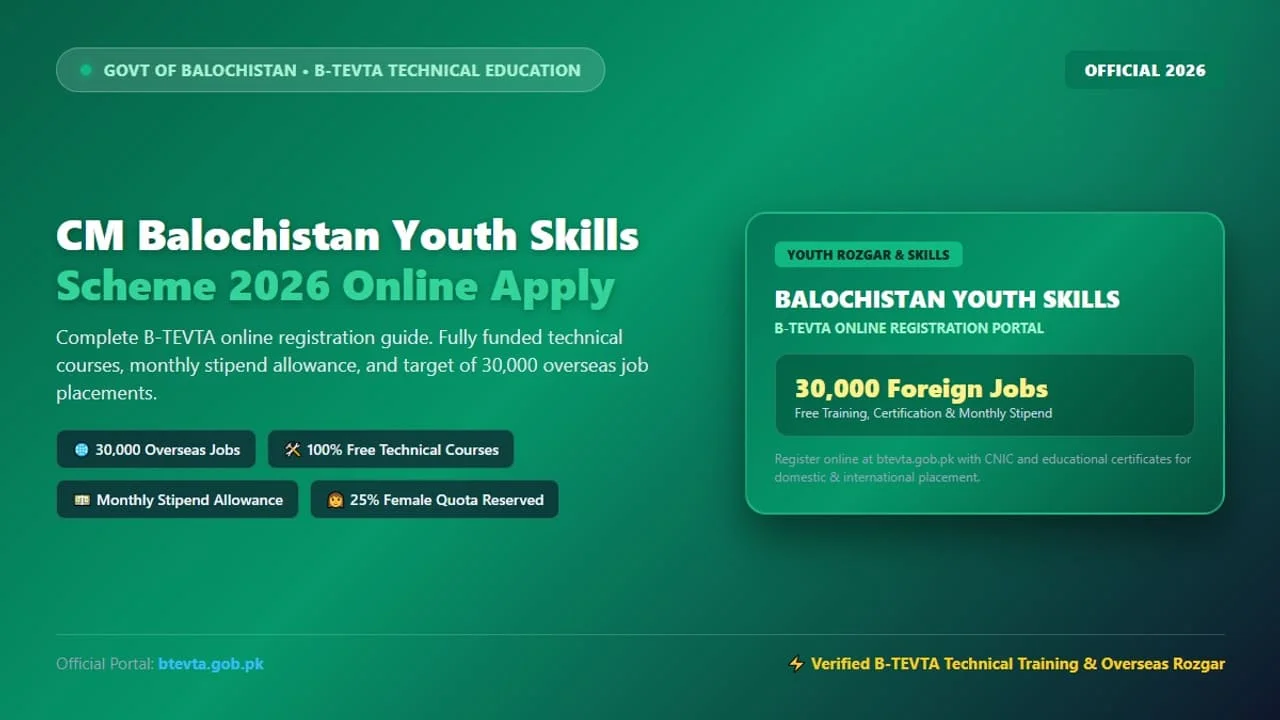
CM Balochistan Youth Skills Scheme 2026 Online Apply & Registration Guide
Apply online for CM Balochistan Youth Skills Scheme 2026. Complete guide to B-TEVTA online registration, courses, monthly stipends, and 30,000 overseas jobs.
Read guide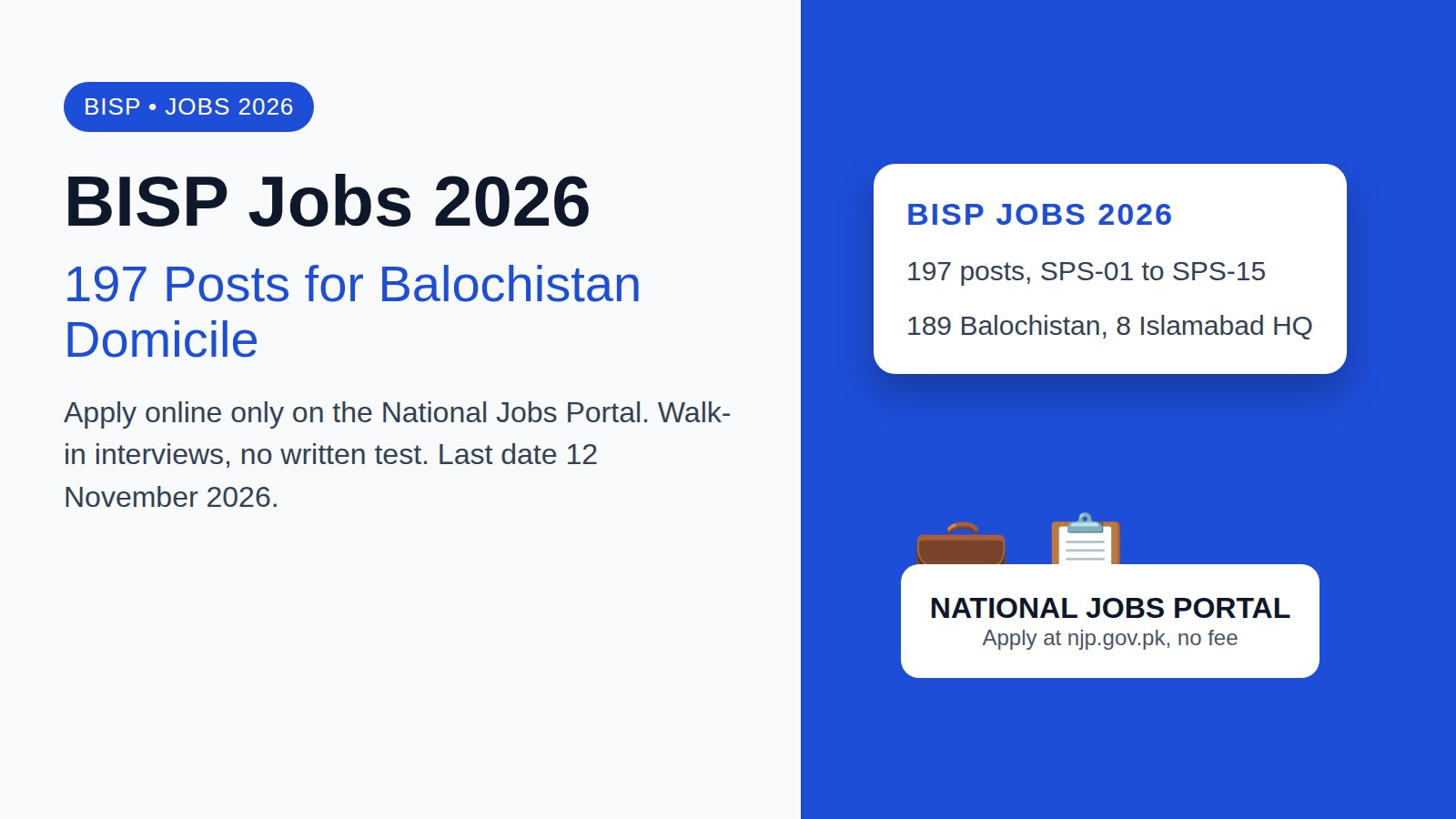
BISP Jobs 2026: 197 Posts for Balochistan Domicile Holders
BISP has announced 197 jobs for Balochistan domicile holders under the Balochistan Employment Initiative, with 189 posts in the Balochistan region and 8 at BISP Headquarters in Islamabad. Apply online only through the National Jobs Portal at njp.gov.pk. The listings show 12 November 2026 as the last date, so confirm it live before you apply.
Read guide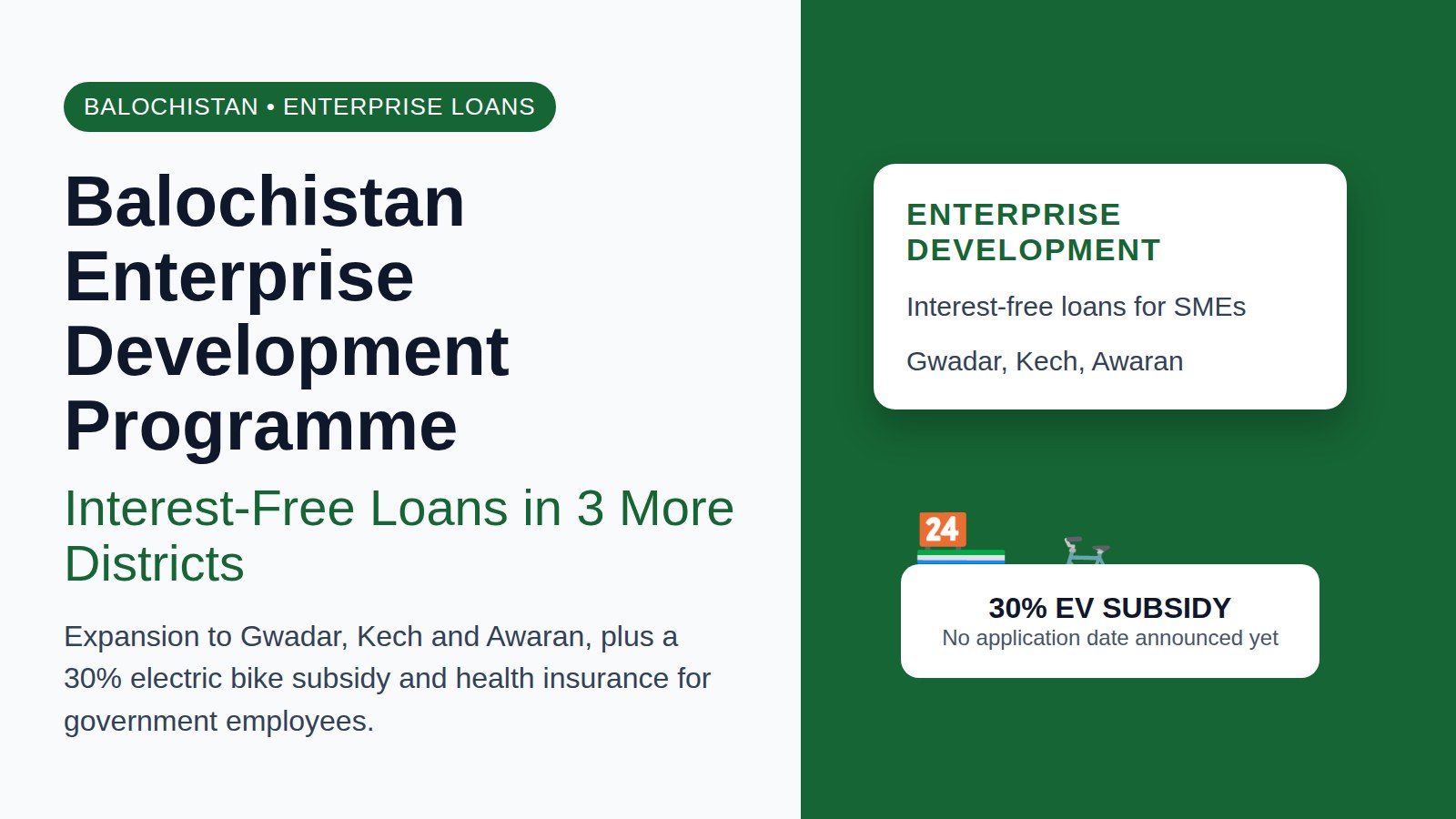
Balochistan Enterprise Development Programme Expands to Gwadar, Kech and Awaran
The Balochistan government has approved the extension of its Enterprise Development Programme to Gwadar, Kech and Awaran, where it will offer interest-free loans to small and medium enterprises and start-ups. The same cabinet meeting also approved a 30 percent subsidy on electric bikes and a health insurance programme for provincial government employees.
Read guide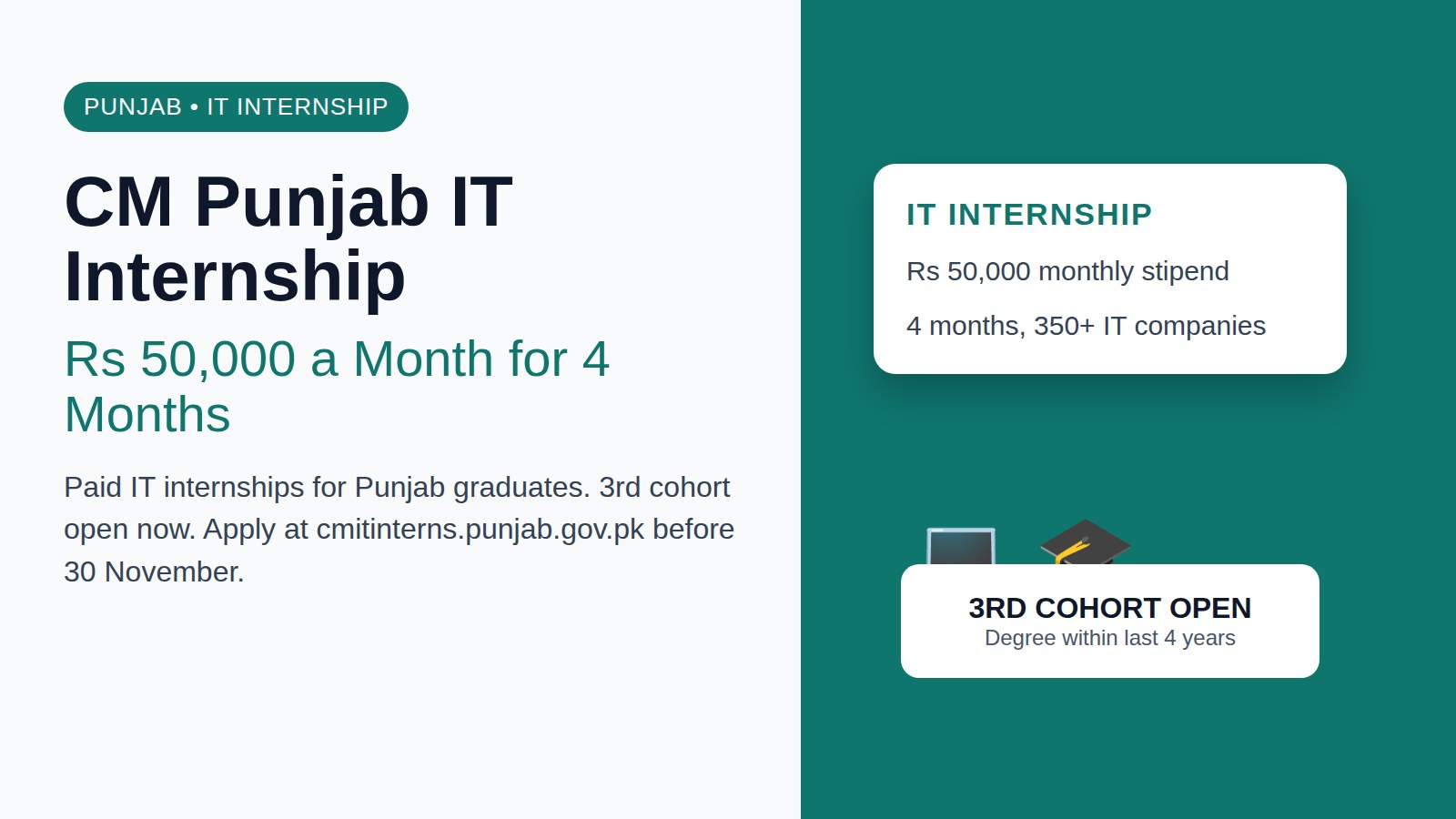
CM Punjab IT Internship Program 2026: Paid Placements for Punjab Graduates
The CM Punjab IT Internship Program 2026 is a paid placement run by the Government of Punjab through PITB. It pays selected Punjab graduates Rs 50,000 a month for 4 months in a host IT company. Registration for the 3rd cohort is open now on cmitinterns.punjab.gov.pk, and you should apply before 30 November 2026.
Read guide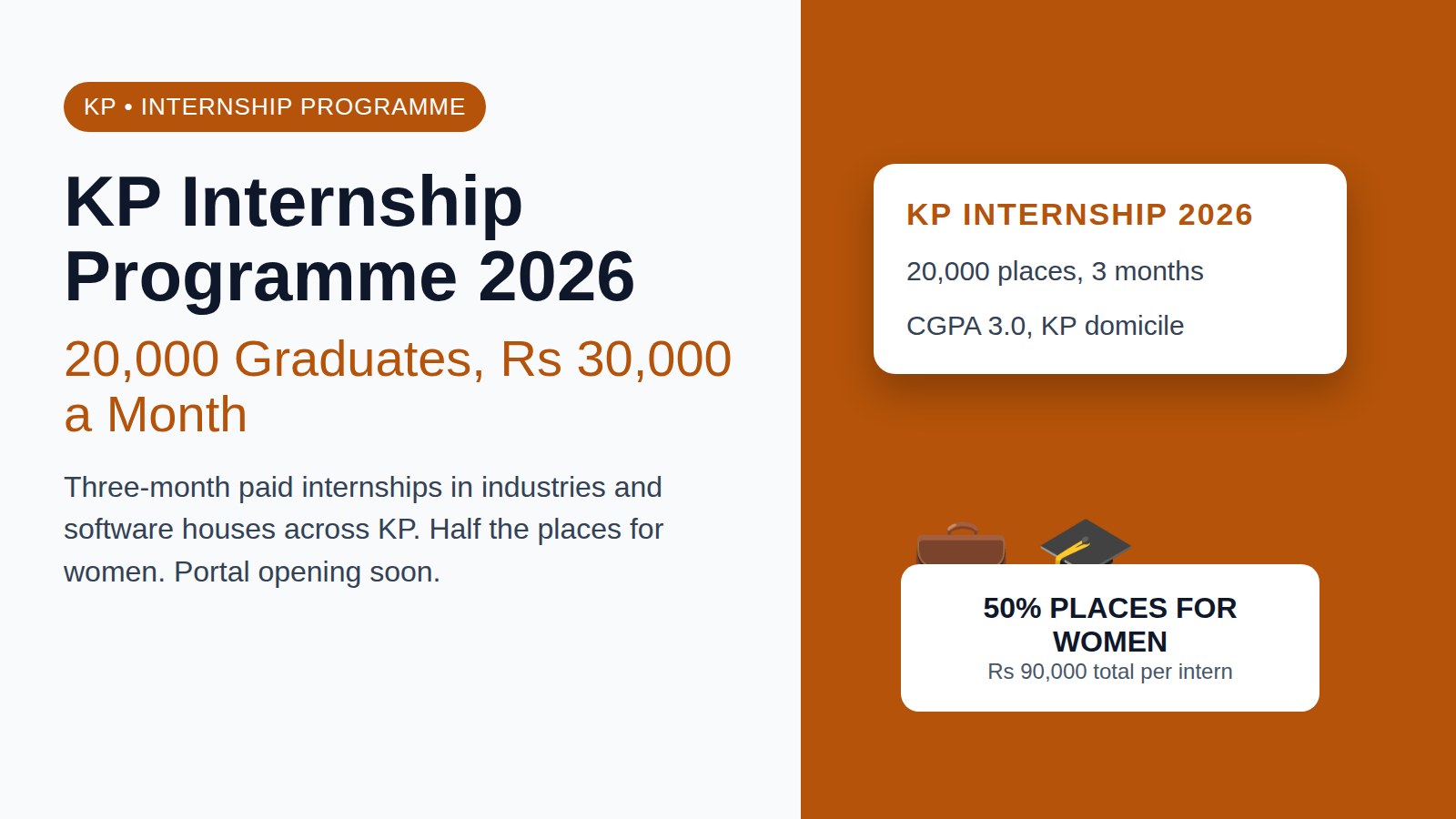
KP Internship Programme 2026 for 20,000 Graduates: Rs 30,000 Monthly Stipend
The KP Internship Programme 2026 will offer paid, three month internships to 20,000 graduates across Khyber Pakhtunkhwa, with a monthly stipend of Rs 30,000 per graduate. As of 8 November 2026, registrations have not started, no application link has been announced, and applicants will need a KP domicile and a minimum CGPA of 3.0.
Read guide