This article explains public information. It does not determine eligibility or replace an official notice.
What did the Sindh cabinet decide on wheat prices?
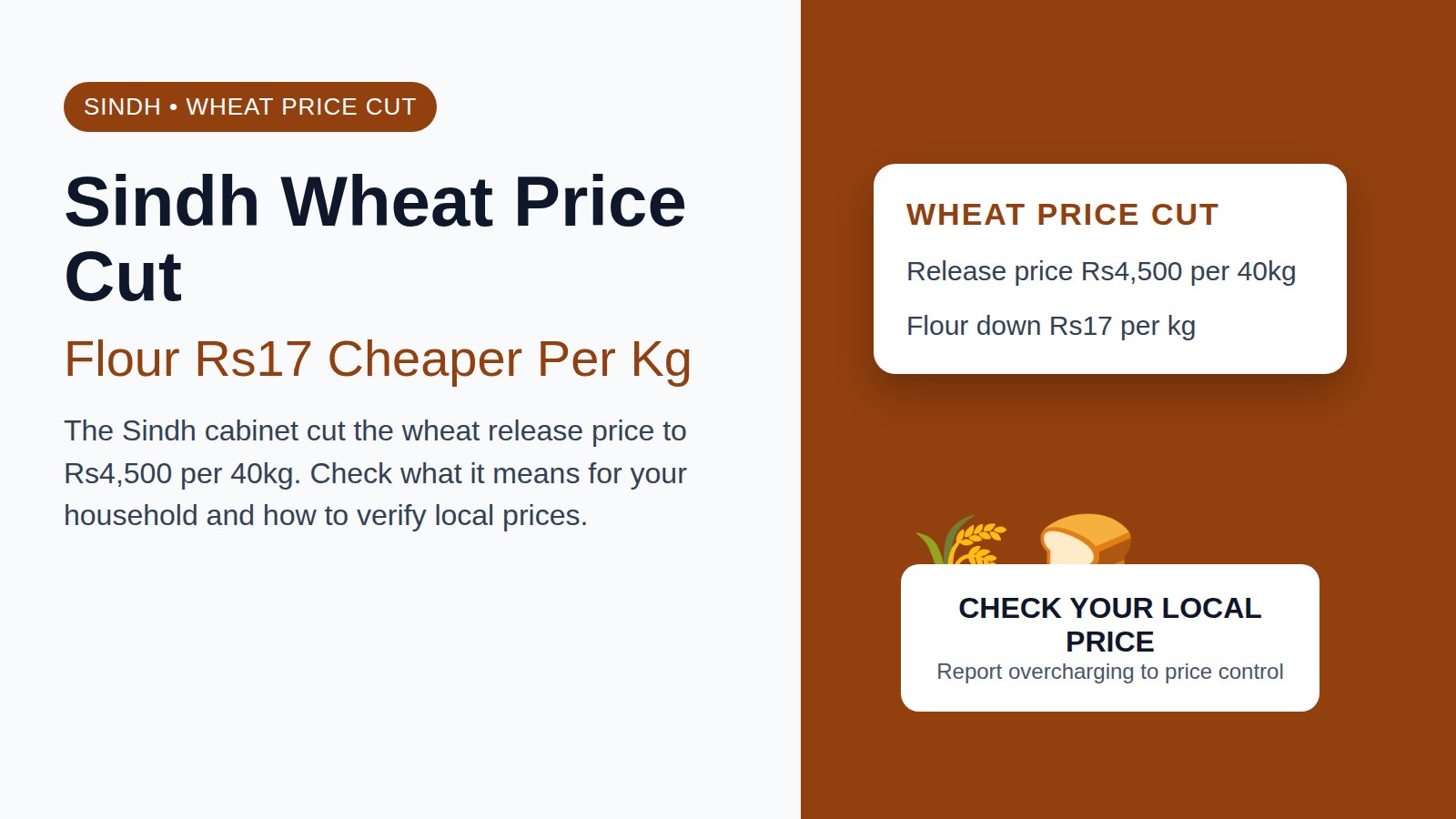
The Sindh cabinet met in Karachi on Tuesday 3 November 2026, chaired by Chief Minister Syed Murad Ali Shah at CM House. The cabinet cut the release price of government wheat by Rs500, from Rs5,000 to Rs4,500 per 40 kilograms. Senior Minister Sharjeel Inam Memon, who holds the information, transport and mass transit portfolios, announced the decision after the meeting.
The cut applies to wheat the government already holds in its stocks, which it sells on to flour mills and atta chakkis. As of 9 November 2026, no official notification has been found on the Sindh government website.
What is the new wheat release price?
The new wheat release price is Rs4,500 per 40 kilograms, down from Rs5,000: a cut of Rs500, or 10 percent. A maund is 40 kilograms, so some reports describe the new price as Rs4,500 per maund.
The release price is what the government charges mills for wheat from its stocks. It is not a shop price. It shapes the flour price only if mills cut their own rates, which is why the minister told mills plainly to pass the benefit on to consumers.
Release price or support price: what is the difference?
Some reports called the new rate a support price, while others called it a release price. The distinction matters. A support price is the price at which the government buys wheat from farmers. A release price is the price at which the government sells wheat from its stocks to flour mills. The 3 November 2026 decision concerns the release price.
For households, cheaper wheat for mills should mean cheaper flour in shops. For farmers, it does not set what they earn.
How much cheaper will flour get in Sindh?
Minister Sharjeel Inam Memon said flour should become cheaper by Rs17 per kilogram, and The Express Tribune reported the cut had already triggered that decline. Most news reports carry the same Rs17 figure, which this guide uses in the headline.
A family buying 40 kilograms a month would save Rs680 if the full cut reaches the shop: Rs340 on a 20 kilogram bag, Rs170 on a 10 kilogram bag. These savings apply only if shops pass on the full cut.
Mill prices in early November 2026 show flour No. 2.5 at about Rs156 per kilogram, down from Rs161 in early October, while maida and fine flour cost more. As of 9 November 2026, no reliable source has published a verified new retail flour price for Sindh after the cut.
What does Rs17 per kg mean for a 10kg and 20kg bag?
A cut of Rs17 per kilogram scales with bag size: a 10 kilogram bag costs Rs170 less, a 20 kilogram bag Rs340 less, and a 40 kilogram bag Rs680 less. This assumes the shop passes on the full cut.
Before the cut, the Pakistan Bureau of Statistics put the average 20 kilogram bag at Rs3,371 in Karachi and about Rs2,951 nationally in the week ending 29 October 2026. Those are old prices, not new ones.
Why do some reports say Rs15 per kg?
One report of the same press briefing quoted the minister as saying flour would become cheaper by Rs15 per kilogram. Most other reports, including coverage based on The Express Tribune and Daily Times, put the figure at Rs17 per kilogram. Readers should treat the flour figure as an expected or reported fall, not as a fixed official retail price.
The minister may have given Rs15 as a careful estimate while other reports put the market fall at Rs17. Or market prices had already eased before the cabinet met, so the total fall from the earlier peak reached Rs17. This guide uses Rs17 because most reports use it, but it flags the Rs15 variant here so readers are not misled.
When will flour prices fall in Sindh?
The cabinet approved the cut on 3 November 2026, and the minister said the fall had already begun. Some buyers may see lower prices at once, while others may wait days, depending on mill purchases and old shop stock.
Flour already on a shelf was milled from wheat bought at the old rate, and a shopkeeper may sell that stock first. In Karachi, transport adds delay, while wheat growing districts may see the new rate faster.
Why the saving may reach shops at different times
Three factors decide the speed. First, mills holding wheat bought at Rs5,000 will mill that first. Second, the mill must cut its flour price and tell distributors. Third, the shop must pass the cut on. A government direction is not a price control at every shop.
Imported wheat also helps. A first shipment of about 51,000 tonnes reached Karachi Port on 28 October 2026, and a second of about 58,132 tonnes was due on 3 November 2026. Imported wheat reaches mills at about Rs112.50 per kilogram, or about Rs115 with delivery. More supply pushes wholesale prices down, which supports the cabinet cut.
How much can a household save each month?
The table below shows what the Rs17 per kilogram cut means at common bag sizes. The "before" column uses an illustrative retail price of Rs170 per kilogram, which matches the retail range of Rs170 to Rs180 per kilogram reported for flour No. 2.5 in Karachi in early November 2026. It is an illustration, not a confirmed new price.
| Bag size | Illustrative price before the cut | Saving at Rs17 per kg | Illustrative price after the cut |
|---|---|---|---|
| 1 kg | Rs170 | Rs17 | Rs153 |
| 5 kg | Rs850 | Rs85 | Rs765 |
| 10 kg | Rs1,700 | Rs170 | Rs1,530 |
| 20 kg | Rs3,400 | Rs340 | Rs3,060 |
| 40 kg | Rs6,800 | Rs680 | Rs6,120 |
Worked example: a household that uses 40 kilograms of flour a month. Assume the household buys 40 kilograms of standard flour each month and the shop passes on the full cut. The saving is 40 multiplied by Rs17, which is Rs680 per month, or Rs8,160 over 12 months. At 20 kilograms a month, it halves to Rs340. If the shop passes on only half the cut, it halves again. The example shows the scale of the relief, not a promise.
Who benefits most from the wheat price cut?
Every household in Sindh that buys flour should benefit if the cut reaches shops, but not equally. Low income families, daily wage earners and large families buy more flour relative to their income, so the Rs17 cut helps them most.
Buyers in Karachi, Hyderabad and Sukkur may feel it most. The Sensitive Price Index for the week ending 29 October 2026 named Karachi and Hyderabad among the most expensive cities for flour.
Low income households and daily wage earners
Low income households spend most of their food budget on staples such as flour, cooking oil and lentils. A fall in the flour price leaves more cash for the rest of the basket. Daily wage earners are paid daily or weekly and buy flour in small lots, so a lower price means the same wage buys more flour on the same day.
Government food support works alongside the price cut, not instead of it. The Ehsaas Rashan Program gives targeted food support to eligible families, and a lower flour price makes that support stretch further.
What about farmers?
Farmers are affected differently. The release price cut does not pay farmers more for their wheat. It sets what mills pay for government stocks. Farmer groups had demanded Rs5,000 per 40 kilograms, while the indicative price announced for farmers in October 2026 was Rs4,500. Rising fuel, fertiliser and transport costs mean a lower official price can squeeze their margins.
That tension is real. A policy that helps flour buyers can hurt wheat growers if the grower price stays low. The next wheat crop in Sindh and Punjab arrives between March and May, so the full effect on farmers will become clear at harvest time. Farmers in Sindh can read our guide to the Sindh Hari Card scheme. In Punjab, support runs through the CM Punjab Kisan Card and the CM Punjab Livestock Card.
How can you check the flour price in your city?
Follow these five steps to check whether the cut has reached your area.
- Ask two or three shops near your home for the price of one kilogram of standard flour, and note the price and date.
- Compare them with the Rs17 cut in mind, and ask whether the new rate has arrived.
- Check the official district rate list if one is published, and compare it with the shop price.
- If the shop price is far above the district rate, note the shop name and price.
- Report clear overcharging to your district price control office, and keep your receipt.
Do not rely on a single shop, as prices vary between shops on the same street. A branded 10 kilogram bag costs more than loose flour from a chakki, so compare the same type. For a 20 kilogram bag, divide the bag price by 20 to get the per kilogram price.
What if your local shop has not cut the price?
First, check whether the shop is still selling old stock. Ask when the flour arrived and when new stock is expected. A shop that bought at the old mill price may need a few days to clear it.
Second, compare with nearby shops. If others have cut the price and yours has not, the problem is with that shop, not with supply. Buy from the cheaper shop if you can.
Third, use the official channel. District price control offices handle overcharging complaints, so keep the receipt and note the shop name, price and date. Karachi wholesalers had already asked the Commissioner to notify new flour prices, as retailers still charged old rates while wholesale prices had dropped.
What else did the Sindh cabinet approve in the same meeting?
The wheat decision was one item on a full cabinet agenda. The same meeting approved a $1 billion urban development programme backed by the Asian Development Bank, to prepare an investment plan for five divisional headquarters in Sindh covering water supply, drainage, sanitation and solid waste management. The approval was granted ex post facto.
The cabinet also approved Rs502.409 million for five schemes in Jamshoro district, including water supply work in Sehwan city and reverse osmosis plants, and about Rs2.993 billion for water supply and drainage in Nawabshah Town, Shaheed Benazirabad district. These will take time.
On Karachi transport, the cabinet announced a Traffic Management Authority, with legislation to follow, and a smart traffic management system. More than 100 electric buses are expected in Sindh by the end of November 2026, and double decker buses are also expected. The cabinet fixed 15 November 2026 as the start of the 2026-27 sugarcane crushing season, and the Ghotki-Kandhkot bridge over the Indus has reached 75 percent completion. A committee was also formed to address katchi abadi issues.
Will the wheat cut lower prices in Punjab and the rest of Pakistan?
The cut applies to Sindh government wheat, so its direct effect is in Sindh. It does not set flour prices in Punjab, Khyber Pakhtunkhwa or Balochistan. But markets are linked across provinces, so cheaper Sindh flour may ease prices in nearby markets as traders move stock.
Punjab has its own wheat and farmer support system, so readers there should check Punjab rates separately. The national picture will become clearer as November 2026 price data is published. As of 9 November 2026, the cut is a Sindh decision with a Sindh effect, and any wider benefit is a market spillover, not a government order.
Frequently asked questions
How much cheaper is flour in Sindh after the wheat price cut?
Flour should become cheaper by Rs17 per kilogram, according to Senior Minister Sharjeel Inam Memon after the cabinet meeting on 3 November 2026. Most reports carry Rs17, though one quoted Rs15.
What is the new wheat release price in Sindh?
The new wheat release price is Rs4,500 per 40 kilograms, down from Rs5,000 per 40 kilograms. The cut is Rs500 per 40 kilograms, which is a 10 percent reduction. The Sindh cabinet approved it on 3 November 2026.
When did the Sindh wheat price cut take effect?
The Sindh cabinet approved the cut on Tuesday 3 November 2026, and the minister said the fall had already begun. Timing at individual shops varies, as mills and shops clear old stock at different speeds.
What is the difference between the wheat release price and the support price?
The release price is what the government charges flour mills for wheat from its stocks, and it is now Rs4,500 per 40 kilograms. The support price is what the government pays farmers for their wheat. The 3 November 2026 decision concerns the release price, not the price paid to farmers.
How much will a 20kg flour bag cost after the cut?
No verified new retail price has been published as of 9 November 2026, so this guide does not state one. What is verified is the saving: a 20 kilogram bag should cost Rs340 less if the full cut reaches the shop. Before the cut, the Pakistan Bureau of Statistics put the average 20 kilogram bag at Rs3,371 in Karachi in the week ending 29 October 2026.
Does the wheat price cut apply in Punjab too?
No. The cut applies to Sindh government wheat, so its direct effect is in Sindh. Punjab has its own wheat and farmer support system and its own prices. Market spillover may ease prices elsewhere, but that is not a government order for Punjab.
Who announced the wheat price cut?
Senior Minister Sharjeel Inam Memon announced it at a press conference in Karachi after the cabinet meeting on 3 November 2026, chaired by Chief Minister Syed Murad Ali Shah. Memon holds the information, transport and mass transit portfolios.
Will roti and chapati prices fall too?
They may fall if tandoors pay less for flour, but that is not guaranteed. In early November 2026, chapati still cost about Rs20 in Karachi even as wheat prices fell, because tandoor owners pointed to high cooking gas costs.
What should I do if my shop has not lowered the flour price?
Check two or three nearby shops first. Ask your shopkeeper when new stock is expected. If nearby shops have cut the price and yours has not, report it to your district price control office, and keep your receipt.
What else did the Sindh cabinet approve on 3 November 2026?
It approved a $1 billion Asian Development Bank backed urban programme for five divisional headquarters, Rs502.409 million for five schemes in Jamshoro, and about Rs2.993 billion for water and drainage in Nawabshah Town. It also announced a Traffic Management Authority for Karachi.
Sources and official links
Check the destination address before entering personal information.
Related guides
Punjab Zakat Rashan Card Monthly Grant Explained
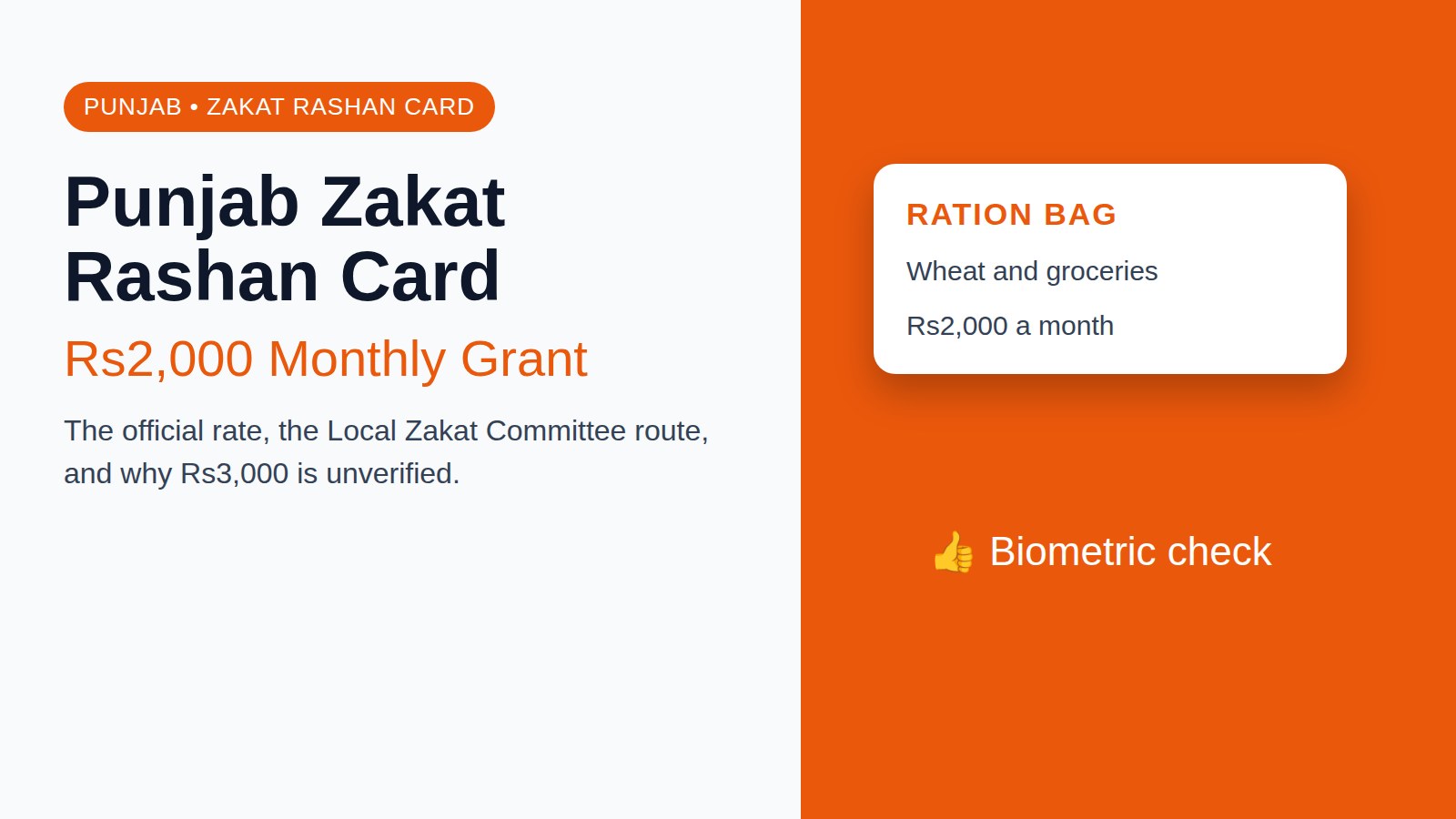
The Punjab Zakat Rashan Card monthly grant is Rs 2,000 per month, as listed by the Punjab Zakat and Ushr Department. It supports the chronic poor and is decided by your Local Zakat Committee. Payment comes through branchless banking after biometric verification. The viral Rs 3,000 claim is unverified, so wait for an official notification.
Read guide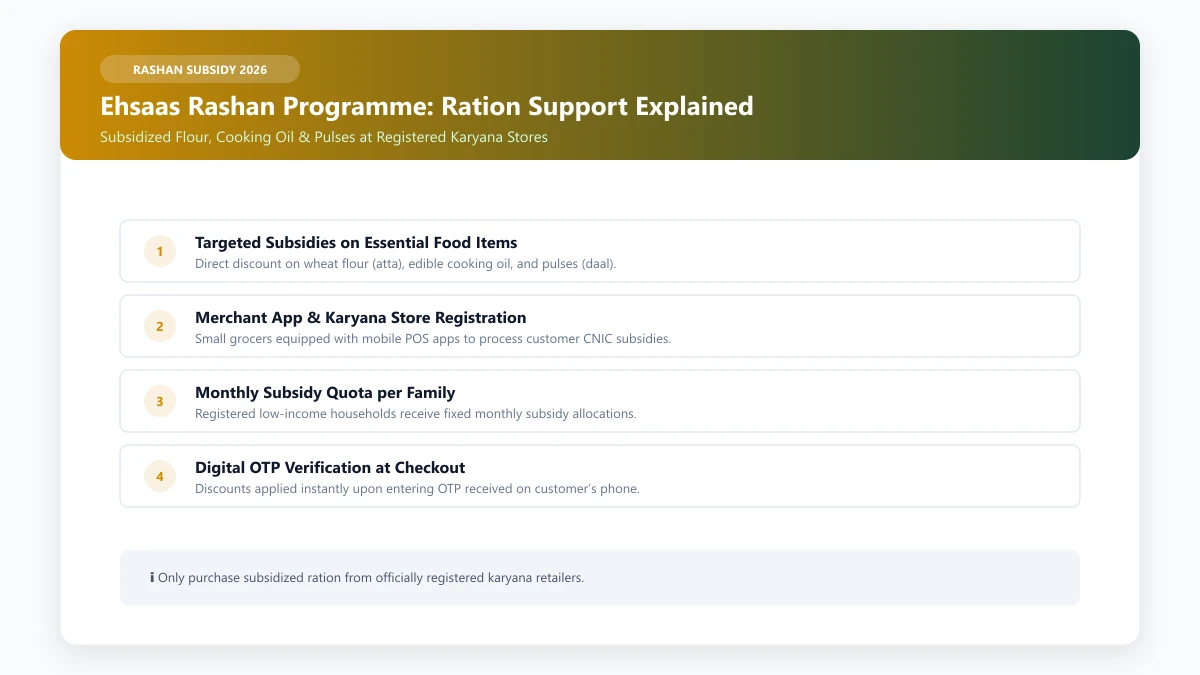
Ehsaas Rashan Program 2026: Eligibility, Registration and CNIC Check
Ehsaas Rashan Program - eligibility, registration, how to check online by CNIC, payment dates and common problems. Updated 2026 guide from PakBenefits.
Read guide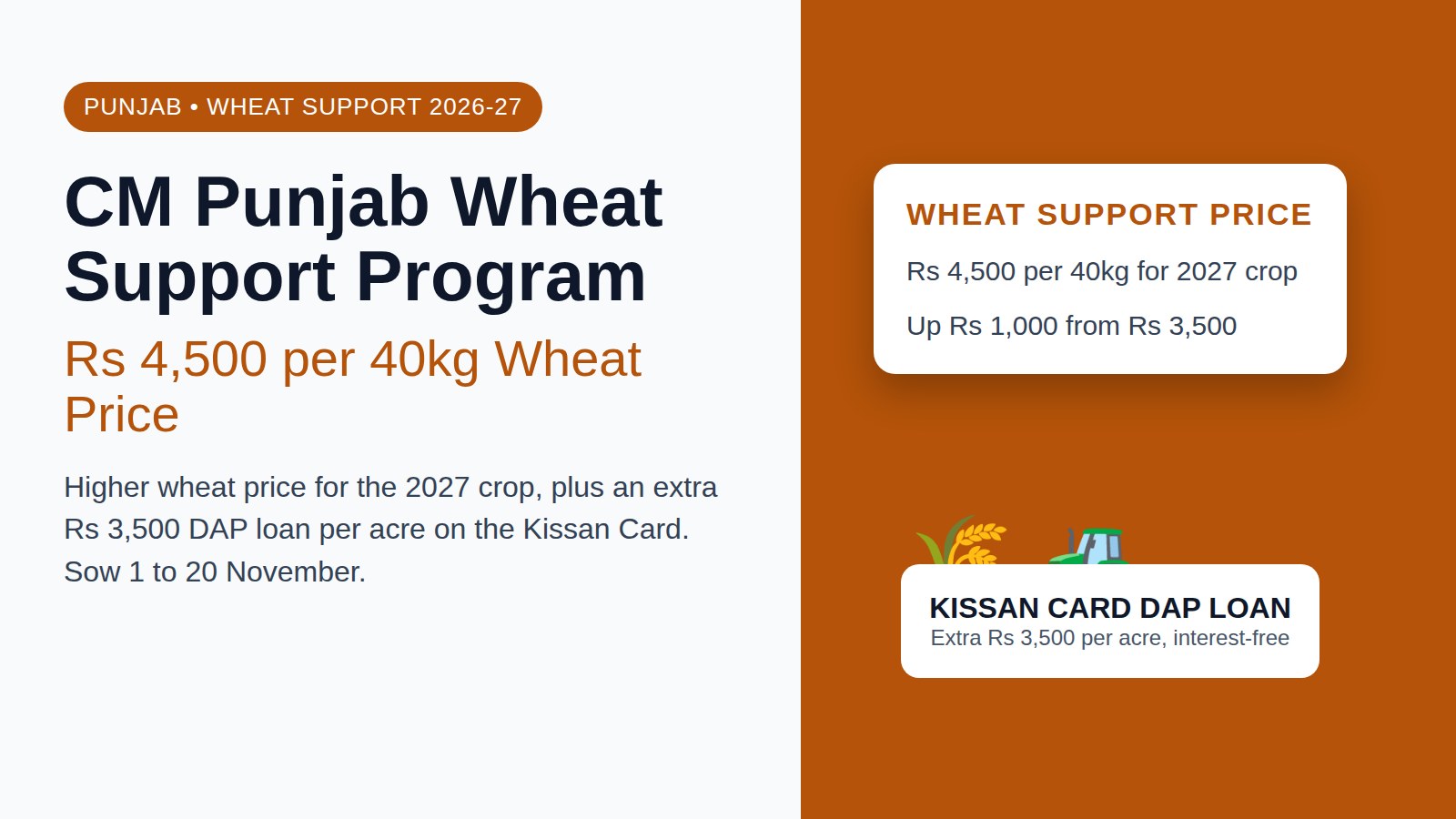
CM Punjab Wheat Support Program 2026-27: Rs 4,500 Support Price and DAP Loan
The CM Punjab Wheat Support Program 2026-27 gives wheat farmers a support price of Rs 4,500 per 40kg for the 2027 crop, an extra Rs 3,500 per acre interest-free DAP loan on the Kissan Card, and certified seed at Rs 7,000 per bag after subsidy. Sow irrigated wheat from 1 to 20 November 2026.
Read guide
CM Punjab Kisan Card Online Apply 2026: 8070 Registration, Eligibility & BOP Card Activation
To register for the CM Punjab Kisan Card online and via SMS in 2026, send an SMS with PKC [Space] your 13-digit CNIC to 8070 using a mobile SIM registered in your own name, or submit an application through the Punjab Agriculture Department portal (agripunjab.gov.pk). Eligible farmers holding between 1 to 12.5 acres of land receive an interest-free agricultural production loan of up to Rs. 150,000 per crop season through Bank of Punjab.
Read guide
Sindh Hari Card Scheme 2026 Online Apply: Registration, Farmer Subsidies & Eligibility Guide
Apply for Sindh Hari Card 2026. Complete guide to registration, land eligibility criteria, Sindh Bank biometric card, fertilizer subsidies, and cash relief.
Read guide