This article explains public information. It does not determine eligibility or replace an official notice.
What is the Sindh Senior Citizen Card?
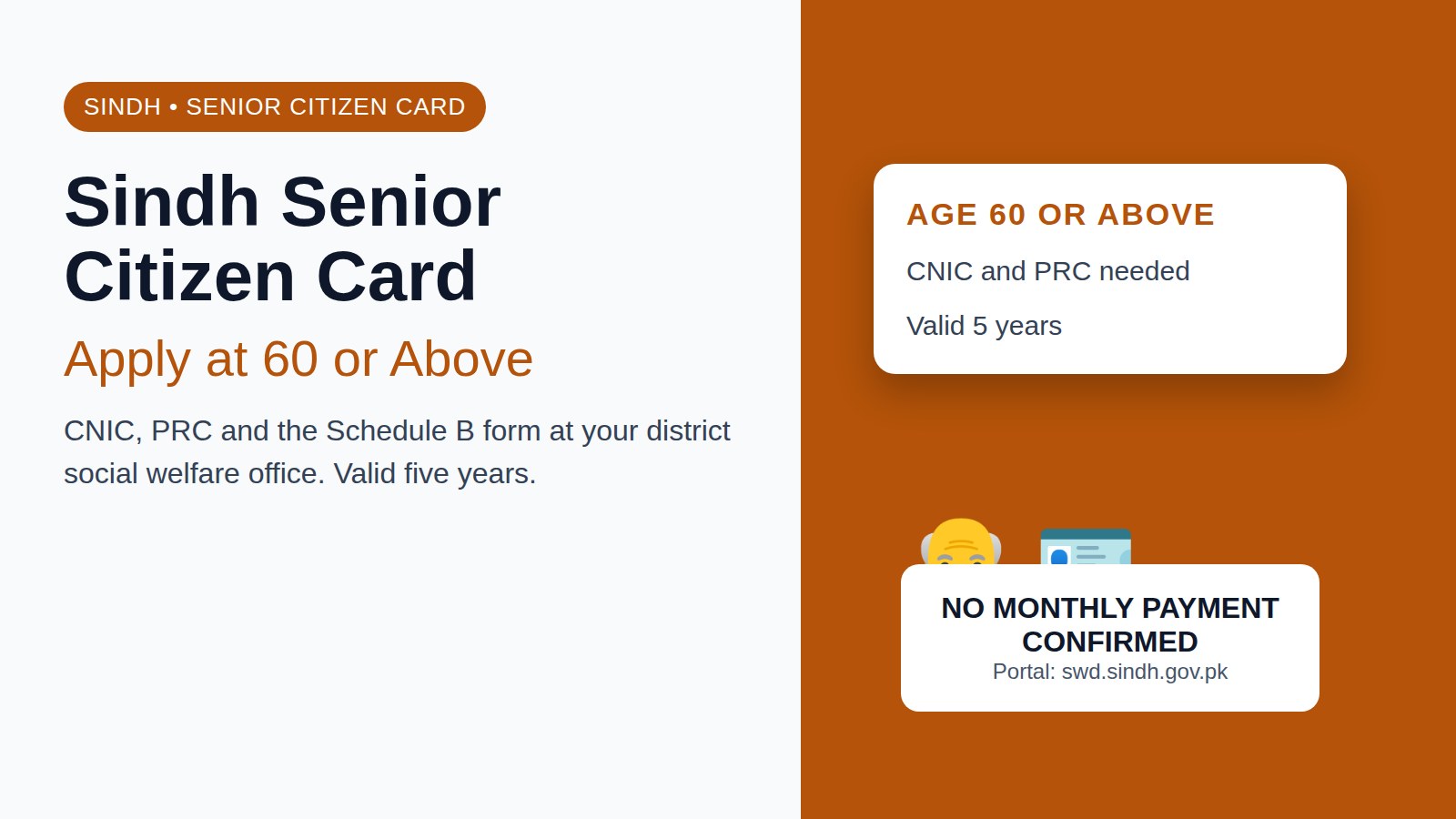
The Sindh Senior Citizen Card is an official identity card for older residents of Sindh, issued by the Sindh Senior Citizens Council under the Sindh Senior Citizens Welfare Act 2014, published as Sindh Act No. XXI of 2016 and amended in 2023. The form states that it aims to promote dignity, respect and reverence for senior citizens.
It does not replace your CNIC, and it is not a pension card. The law created the card in 2016, first as the Azadi Card, and the 2021 Rules set out the form. Yet for years there was no public route to apply. That changed on 19 October 2026, when the department put the Schedule B form on swd.sindh.gov.pk. On 27 September 2026 the same page had only a heading.
The card was once called the Azadi Card
The card was first called the Azadi Card in 2016. The 2023 amendment renamed it the Sindh Senior Citizen Card. If an older poster still calls it the Azadi Card, it refers to the same card.
Who runs the card?
The Sindh Senior Citizens Council issues the card under section 5(2)(b) of the Act as amended in 2023. The Social Welfare Department Sindh publishes the form. The district office checks your papers, and the council, or its committee or an authorised person, approves the card.
Who can apply for the Sindh Senior Citizen Card?
You can apply if you meet two tests from Schedule A. You must be a permanent resident of Sindh, and you must be aged 60 or above. No income test appears on the form, and men and women can both apply.
The age test is 60 or above
You must be 60 or above on the date you apply. Your date of birth must match your CNIC, so check it before you write it. If your CNIC shows a different date, use the CNIC date.
The residence test needs a PRC
You must prove permanent residence with a Permanent Residence Certificate, known as a PRC, issued by the Deputy Commissioner concerned. A CNIC with a Sindh address is not enough on its own. If you do not have a PRC, get one before you apply. You cannot apply if you are under 60, or if you are not a permanent resident of Sindh.
What documents do you need?
You need four items, and the official form lists all four. Do not leave any out, because a missing paper can delay your application.
Document checklist
| Document | What the form asks for |
|---|---|
| Completed form | Schedule B, filled in full, signed, with a thumb impression and one photo pasted on it |
| CNIC | Attested copy of a valid CNIC, front and back |
| Photographs | Three recent passport-size photos with a blue background |
| PRC | Copy of your Permanent Residence Certificate from the Deputy Commissioner |
One photo goes on the form itself. Attach the other two photos, the attested CNIC copy and the PRC copy. Keep a photocopy of the whole set before you hand it in.
What the form asks you to write
The form is one page plus an acknowledgement slip. It asks for your name, your father's or spouse's name, your CNIC number, your age, your CNIC expiry date, your date of birth, your contact number, your gender, your district, your profession if any, your address, and your residence near the respective police station. You sign it, give a thumb impression, and paste one photo on it. An expired CNIC will stall the application.
How to apply for the Sindh Senior Citizen Card?
Apply in person at your taluka or district social welfare office. Schedule A says you may submit the form through an online portal, by mail or in person, but no online portal was found on the department website on 19 October 2026. Some websites mention online or email submission, but that route could not be confirmed, so do not rely on it.
Step 1: Get the Schedule B form
Get the Schedule B form from the senior citizens page on swd.sindh.gov.pk and print it, or ask for it at your nearest social welfare office. Check that you have both parts, the form and the acknowledgement slip.
Step 2: Fill the form in full
Fill every line. Write your name, CNIC number, age, contact details and profession exactly as they appear on your documents, with your CNIC expiry date and date of birth as shown on your CNIC. Sign it, add your thumb impression, and paste one photo on it.
Step 3: Attach your documents
Attach an attested copy of your valid CNIC, front and back, two more blue-background photos, and a copy of your PRC. Make a photocopy of the complete set for your own records.
Step 4: Submit it at the social welfare office
Take the form and documents to the taluka or district social welfare office for your area and hand them in. Ask the official to check the set while you are there. Do not hand your original CNIC or PRC to anyone without a written rule that asks for it.
Step 5: Insist on the acknowledgement slip
Insist on the acknowledgement slip before you leave. It records the inward number, the date, the official's name and the expected date of delivery. It is the only receipt you get, and it is printed as part of the form. Keep it safe with your photocopy.
What happens after you submit the form?
Your application passes through three stages. First, the district assistant director or deputy director verifies it and sends recommendations to the council officer. Next, the council, or its committee or an authorised person, approves it. Last, the card is issued in due course if the details are correct.
No processing time is promised. The slip has a line for the expected delivery date, so ask the official to write a date on it. If that date passes, take your slip back to the same office and ask for an update. The card is valid for five years from the date of issue.
What benefits does the card give now?
This is the part where you should be careful, because the official form does not list benefits. Many guide websites list free or discounted hospital treatment, medicine discounts, reduced transport fares, utility discounts and priority service. Those claims could not be confirmed from an official source. What a card holder gets today is set by council notifications, which the form does not list. Before you apply, ask the department or the service provider which benefits are actually available.
What the law used to promise vs what it promises now
| Benefit | Before the 2023 amendment | After the 2023 amendment, as of 11 November 2026 |
|---|---|---|
| Road transport fare | 50 per cent concession in road fares | Removed. The law now refers only to an admissible concession, with no fixed rate |
| Private hospital treatment | 25 per cent discount at private hospitals and clinics | Removed from the law |
| Medicines and essentials | 25 per cent discount on medicines and essentials | Removed from the law |
| Tax exemption | Exemption from taxes for senior citizens | Removed from the law |
| Government health services | Free services at government facilities, as a duty | The duty was softened to a priority |
| Old-age homes | Homes had to provide geriatric care work and services | That requirement was removed |
| Council duties | Duties the council shall carry out | Many duties became recommendations, as shall changed to may |
The 2023 amendment, Sindh Act No. XXIV of 2023, made these changes. It renamed the Azadi Card and cut the fixed benefits above. That is why a list copied from an old guide can mislead you today.
Is there a fee for the Sindh Senior Citizen Card?
The form prints no fee. Its heading covers validity period and charges, but it states no amount, and no fee could be found on the department website. That does not prove the card is free in every office. It means the fee, if any, is not published. Ask at the office before you pay anything, and get an official receipt for any payment. A claim in one social media post that a fee of Rs 60,000 is required has no support in the form, and you should not pay such an amount.
Is the Rs 10,000 per month payment real?
No. The claim that the card pays Rs 10,000 per month is not verified by any official source. It appears in social media posts, including a post dated 1 November 2026 that shows the card with a benefit of Rs 10,000 monthly. No law, form, council notification or department page found so far supports that payment, and the form does not mention any monthly payment.
Myth vs fact: the Rs 10,000 claim
| Claim | What the evidence shows |
|---|---|
| Myth: The card pays Rs 10,000 every month | No official source states this payment |
| Myth: You only need to apply online to start the payment | No online portal was found on the department website, and the form points to in-person submission |
| Fact: The card is an identity card | The form describes an identity card for permanent residents of Sindh aged 60 or above |
| Fact: The form lists no benefits | The form explains eligibility, documents and validity, but it does not list benefits or payments |
| Fact: The 2023 amendment cut fixed benefits | The amendment removed the fare, hospital, tax and medicine benefits |
If a post or agent promises Rs 10,000 a month, ask for the official notification that states the amount, the paying department and the payment method. If they cannot show it, do not pay them, do not share your CNIC copy, bank details or OTP codes, and report the post.
What changed in November 2026?
The Sindh Senior Citizens Council held its 8th meeting in Karachi on 5 November 2026, chaired by Minister Mir Tariq Ali Talpur. The Social Welfare Department Sindh shared photos on Facebook the same day. The meeting discussed senior citizen cards, budgets, old-age home revamps and healthcare funding. It shows the council is active again, but it does not prove that a new benefits list was approved or that any payment was announced. The province budgeted Rs 150 million for the card in 2023-24, with Rs 50 million for the Welfare Fund, out of Rs 440 million for that head. The page does not say how much was spent or how many cards were issued.
Common mistakes and how to avoid them
Most delays come from small errors. Check that your CNIC is valid and that every spelling matches it, and renew an expired CNIC at a NADRA centre before you apply. Do not apply without a PRC. Use three recent blue-background photos, and paste one on the form. Do not pay an agent, and never share OTP codes, bank details or passwords.
What to do if you need cash help now?
The card is an identity card, and it does not, on the evidence found so far, pay a monthly amount. If you need cash support now, ask the Social Welfare Department, and the zakat and Bait-ul-Mal offices, about their current programmes, because only those offices can confirm what is open today. One option is the Sindh zakat guzara allowance, which prefers the aged and pays Rs 1,000 a month, as reported on 19 October 2026. Confirm that amount at the zakat office. For other card schemes, read the Sindh Youth Card guide, the Sindh Hari Card guide, the Punjab Zakat Rashan Card guide, the Himmat Card guide and the Nigehban Card guide.
Frequently asked questions
What is the Sindh Senior Citizen Card?
It is an identity card issued by the Sindh Senior Citizens Council for permanent residents of Sindh aged 60 or above, under the Act as amended in 2023. It does not replace your CNIC.
Who can apply for the Sindh Senior Citizen Card?
Any permanent resident of Sindh aged 60 or above can apply, if they hold a valid CNIC and a Permanent Residence Certificate from the Deputy Commissioner concerned.
How do I apply for the Sindh Senior Citizen Card?
Get the Schedule B form from the Social Welfare Department website, fill it in full, attach an attested CNIC copy, three blue-background photos and a PRC copy, then submit it in person at your taluka or district office and keep the acknowledgement slip.
Can I apply for the Sindh Senior Citizen Card online?
No confirmed online route exists. Schedule A mentions an online portal, but none was found on the department website on 19 October 2026, so apply in person.
What documents do I need for the Sindh Senior Citizen Card?
You need the completed Schedule B form, an attested copy of a valid CNIC, three recent blue-background photos, and a copy of your PRC from the Deputy Commissioner concerned.
How long is the Sindh Senior Citizen Card valid?
The card is valid for five years once it is issued, as stated in Schedule A. Ask the issuing office well before it expires how to renew it.
Is there a fee for the Sindh Senior Citizen Card?
No fee could be confirmed. The form prints no fee, and no fee was found on the department website, so ask at the office before you pay anything and get a receipt.
What benefits does the Sindh Senior Citizen Card give?
No public benefits list could be found, and the form does not list benefits. The 2023 amendment removed the fixed fare, hospital and medicine discounts, so ask the department or the provider which benefits are available today.
Does the Sindh Senior Citizen Card pay Rs 10,000 per month?
No, that payment is not verified by any official source. Social media posts claim Rs 10,000 a month, but the law, the form and the department pages state no such payment.
How long does it take to get the Sindh Senior Citizen Card?
No processing time is promised in the form. The district office verifies your papers and the council approves the card, so ask for an expected delivery date on your acknowledgement slip.
Sources and official links
Check the destination address before entering personal information.
Related guides
Sindh Youth Card 2026: Launch, Benefits, Eligibility and Registration
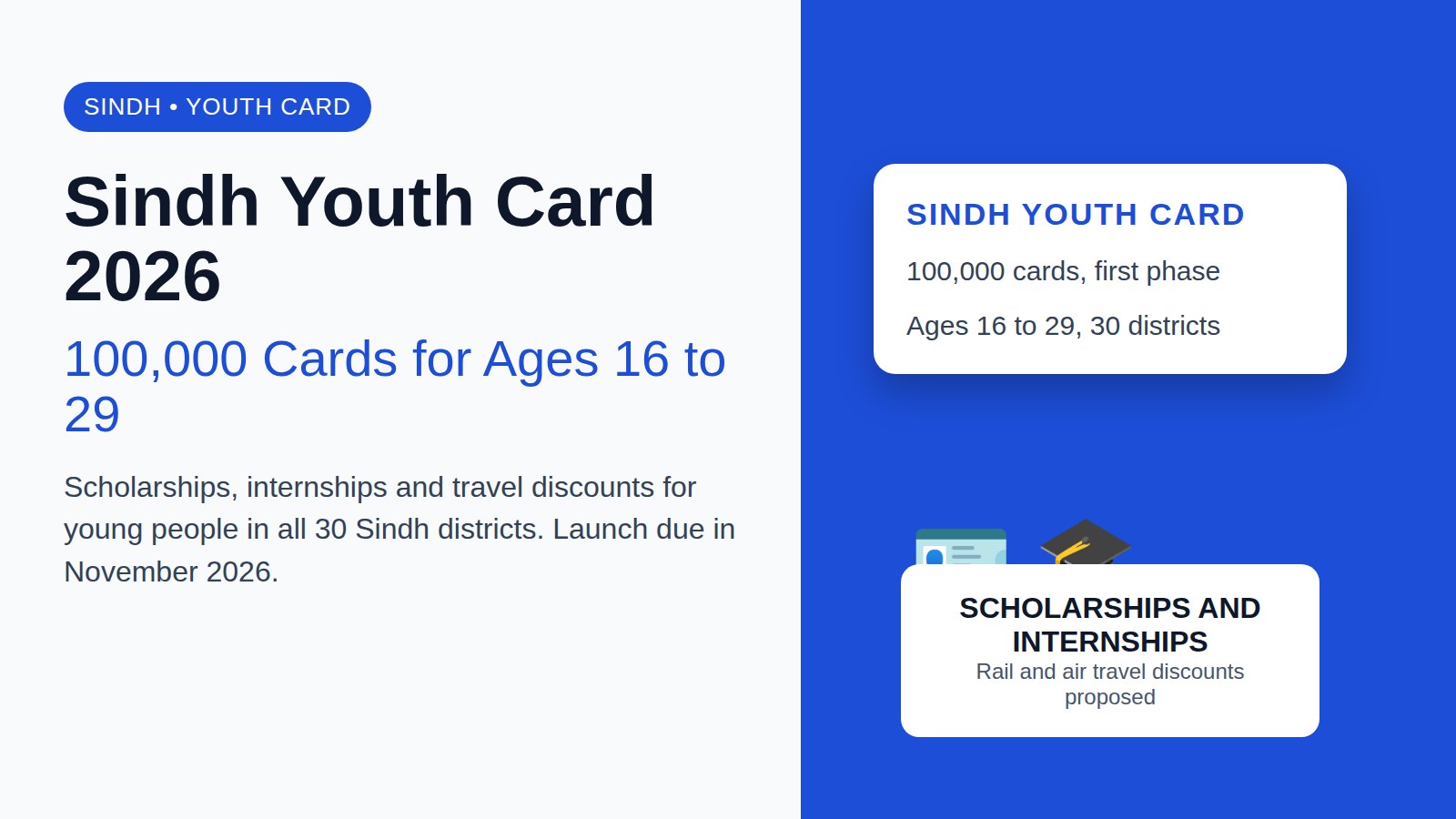
The Sindh Youth Card 2026 is a Sindh scheme for young people aged 16 to 29. It will bring scholarships, internships, skills training and services from 13 departments onto one digital platform. As of 8 November 2026 it has not launched yet, and registration will open after Bilawal Bhutto Zardari inaugurates it this month.
Read guide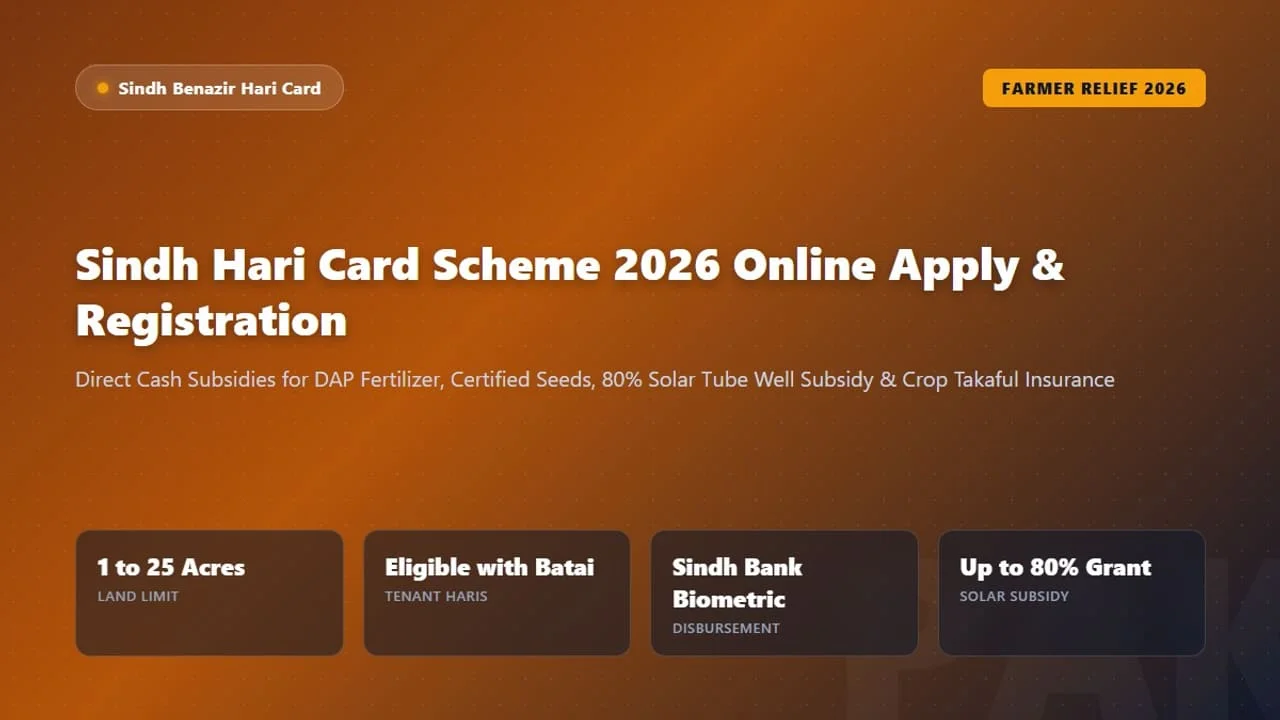
Sindh Hari Card Scheme 2026 Online Apply: Registration, Farmer Subsidies & Eligibility Guide
Apply for Sindh Hari Card 2026. Complete guide to registration, land eligibility criteria, Sindh Bank biometric card, fertilizer subsidies, and cash relief.
Read guide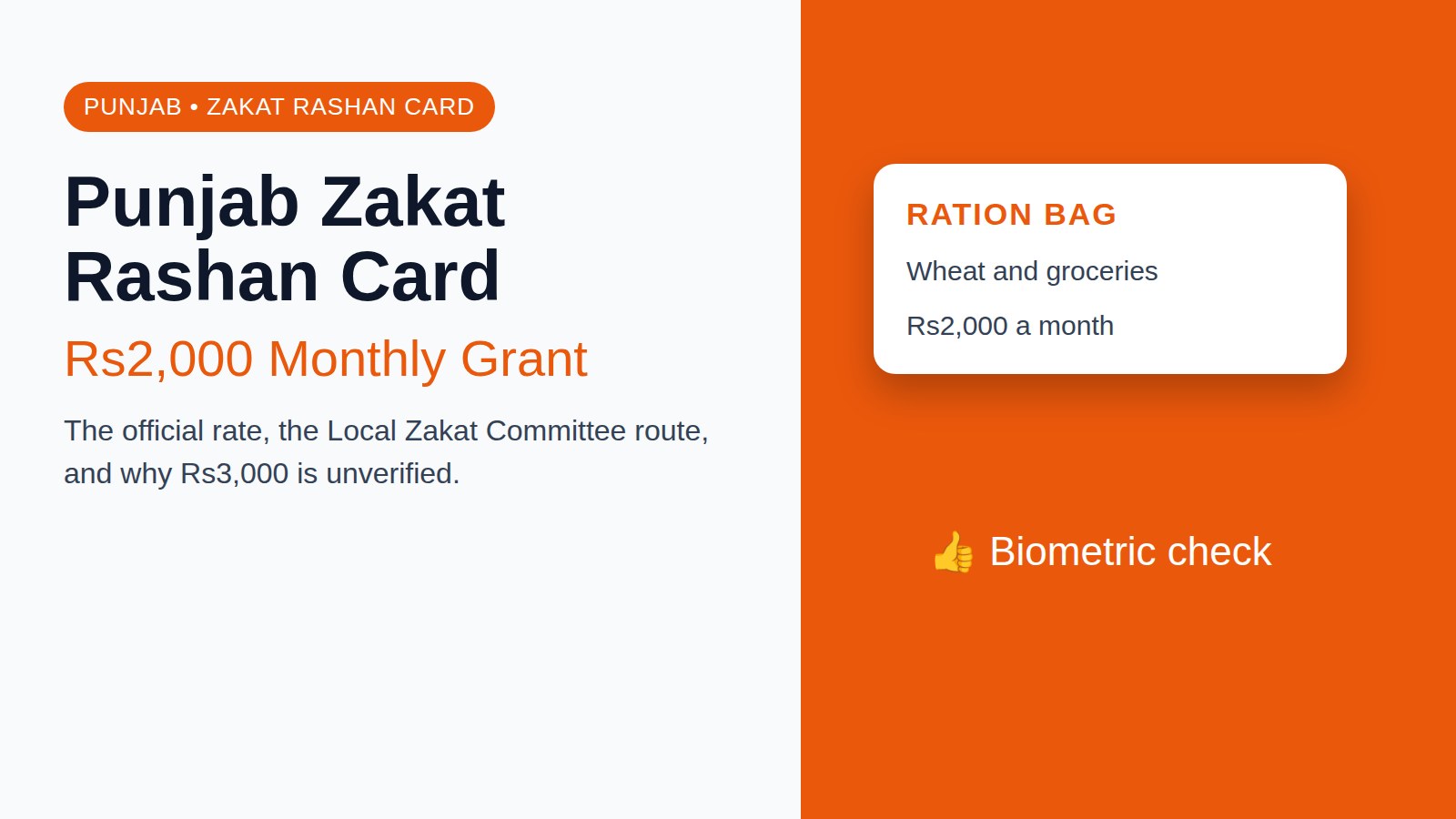
Punjab Zakat Rashan Card Monthly Grant Explained
The Punjab Zakat Rashan Card monthly grant is Rs 2,000 per month, as listed by the Punjab Zakat and Ushr Department. It supports the chronic poor and is decided by your Local Zakat Committee. Payment comes through branchless banking after biometric verification. The viral Rs 3,000 claim is unverified, so wait for an official notification.
Read guide
How to Check Himmat Card Eligibility and Status by CNIC (2026)
Check your Himmat Card status at the official DPMIS verification page by CNIC — no login needed. See eligibility rules, PMT score, payment amount, and how to avoid fake sites.
Read guide
Nigehban Card Check Online by CNIC: How to Check Your Status (2026)
The Nigehban Card is Punjab's own Ramzan relief card, checked via SMS to 8070 or the PSER portal — not BISP's 8171 or the federal Ramzan Package's 9999. See how the check works and how to avoid fake sites.
Read guide