This article explains public information. It does not determine eligibility or replace an official notice.
What is the Punjab Social Security Mobile Health Programme?
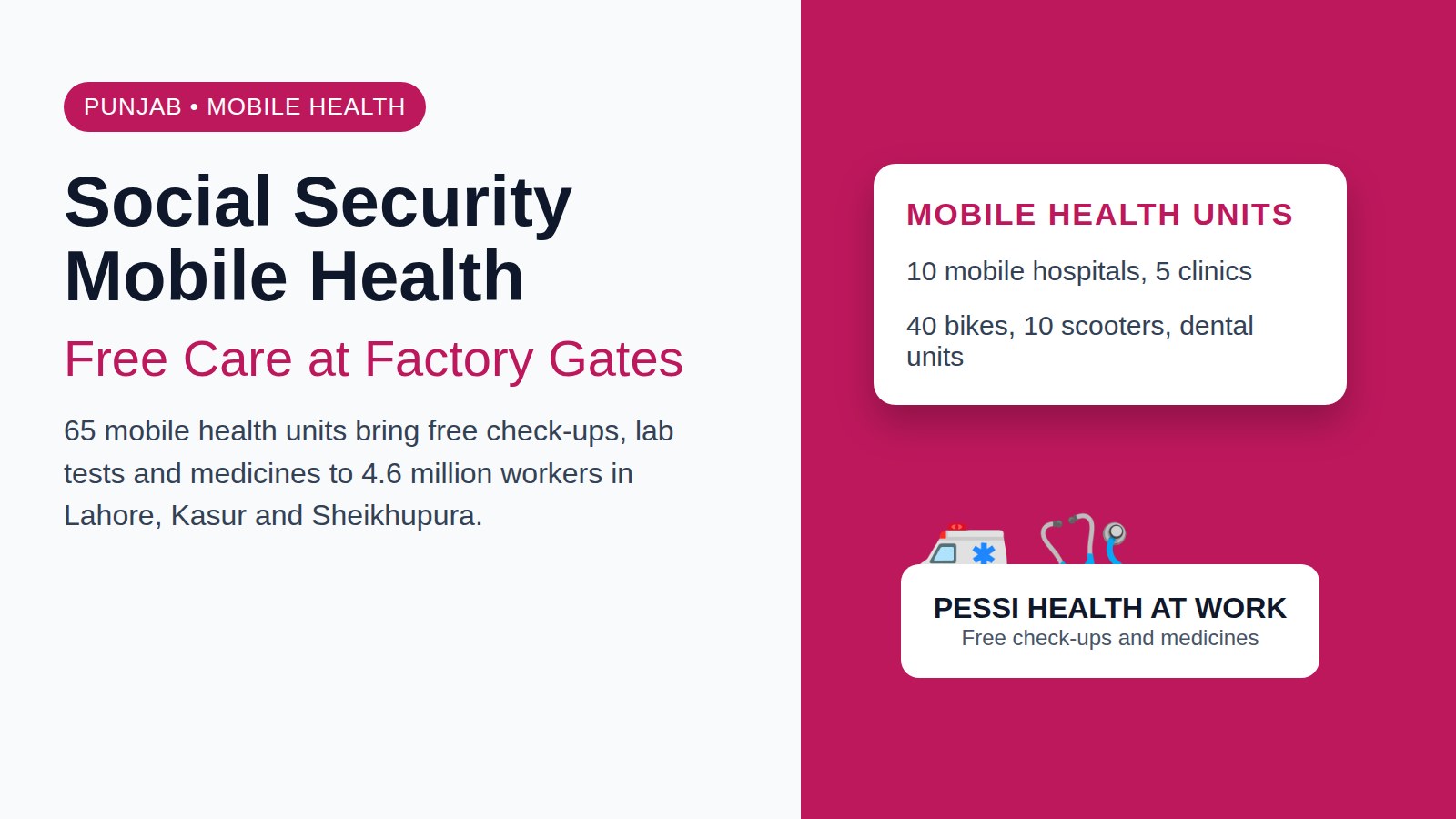
The Punjab Social Security Mobile Health Programme is a Punjab government scheme that takes free healthcare to industrial workers. Mobile health units park at factory gates and visit workers' homes, so a worker can get checked during the working day and a family member can get care at home.
Punjab Chief Minister Maryam Nawaz Sharif inaugurated the programme in mid-October 2026. The Punjab Employees Social Security Institution (PESSI) runs it. Labour Minister Muhammad Manshaullah Butt and Secretary Labour Danish Afzal briefed the Chief Minister on the programme at the launch. PESSI already provides treatment and medicines to industrial workers through social security hospitals and medical outlets across Punjab. This programme adds wheels to that system.
The aim is early diagnosis and treatment. A worker with high blood pressure, diabetes or a heart problem can be found and treated before it turns serious. It also aims to reduce the load on social security hospitals, because many small problems can be handled on the spot.
How it is different from Clinic on Wheels
Do not confuse this programme with Clinic on Wheels. Clinic on Wheels is a separate Punjab health scheme that started in May 2024 and serves the general public in urban slums and rural areas. The Social Security Mobile Health Programme serves only registered industrial workers and their families, and it is run by PESSI. It is also different from the Maryam Nawaz Field Hospitals, large truck-based hospitals launched in May 2024 for rural care.
Who can use the mobile health units?
The programme covers registered industrial workers and their families in Lahore, Kasur and Sheikhupura in the first phase, more than 4.6 million people in total, according to the Chief Minister's Office statement reported at the launch.
You are covered if you are a registered worker with PESSI. Your employer must have registered you and must pay your social security contribution. If you are not sure whether you are registered, ask your employer's HR office or check your PESSI social security card. Workers who hold a Benazir Mazdoor Card are also covered through the same PESSI registration.
Family members get care at home. The units treat workers at their workplaces and visit workers' homes to treat family members who cannot travel. This matters for elderly parents and for women who cannot leave the house during working hours.
What free services do the mobile health units provide?
The units provide free medical consultations, outpatient services, diagnostic tests, medicines, first aid, telemedicine and health awareness sessions. You do not pay for a check-up, a test or the medicines the unit gives you.
Consultations cover common problems such as fever, body pain, skin problems, stomach trouble, high blood pressure and diabetes. Doctors can refer a patient to a social security hospital if the problem needs a specialist or admission. First aid is available for minor injuries at work.
Inside a mobile hospital
A mobile hospital carries doctors, including female doctors, radiologists, nurses, and laboratory and X-ray technicians. It has an outpatient department, radiology facilities and a pathology laboratory. Mobile clinics are smaller units that also offer telemedicine, so a patient can speak to a hospital doctor by video link when the unit's doctor needs a second opinion.
Dental and cardiac care on wheels
The fleet includes specialised dental and cardiac mobile units. Dental units provide treatment with dental surgeons, technicians, dental X-ray facilities and intraoral cameras, plus telemedicine. The cardiac unit provides preliminary heart diagnosis and consultations.
A separate Mobile Rheumatic Heart Disease (RHD) Screening Unit screens workers for early signs of heart disease. It is part of a heart disease screening programme that covers the 29,845 factories, industrial establishments and other institutions on the visit list.
Motorcycles and scooters on fixed routes
Forty motorcycles and 10 scooters carry medical kits, first-aid supplies and essential medicines along designated routes. They reach narrow streets near workers' housing, where a large vehicle cannot enter, and they pass serious cases on to a mobile hospital or clinic.
What is in the 65-unit fleet?
The fleet has 65 mobile health units in total. The breakdown below is taken from the official briefing reported at the launch. The dental and cardiac units sit inside the hospital and clinic figures, because the four named groups already add up to 65, and the briefing gave no separate count for them.
| Unit type | Count | What it does |
|---|---|---|
| Mobile hospitals | 10 | Doctors, X-ray, ultrasound, laboratory tests, outpatient care |
| Mobile clinics | 5 | Consultations, telemedicine, basic diagnostics |
| Dental mobile units | Count not stated separately | Dental treatment, dental X-ray, intraoral camera |
| Cardiac mobile units | Count not stated separately | Preliminary heart diagnosis and consultations |
| Motorcycles | 40 | Medical kits, first aid and medicines on fixed routes |
| Scooters | 10 | Medical kits, first aid and medicines on fixed routes |
| Total fleet | 65 | Free care at workplaces and homes |
Which districts are covered in the first phase?
The first phase covers Lahore, Kasur and Sheikhupura. These three districts hold a large share of Punjab's factories, which is why they came first. More than 4.6 million workers and their families in these districts can use the service.
The units will visit 29,845 factories, industrial establishments and other institutions across the three districts. That figure comes from the official briefing at the launch. No public schedule shows which factory gets a visit on which day, so a worker should ask their factory management when a unit is due.
The fleet reaches Sundar Industrial Estate
In late October 2026, the full fleet reached Sundar Industrial Estate in Lahore. Provincial Labour Minister Muhammad Manshaullah Butt and PESSI Commissioner Zulfiqar Ali Kharal visited the estate to review the service at a private factory. Commissioner Kharal said the service had brought medical treatment to workers' doorsteps.
When will the programme reach your district?
The Punjab government plans to extend the programme to 12 more districts by March 2027. The table below lists every district named in the official statement. No start date has been announced for any single district in the second phase. The March 2027 date is the target for all 12 districts together.
| Phase | Districts | Target date |
|---|---|---|
| Phase 1 (live now) | Lahore, Kasur, Sheikhupura | Launched mid-October 2026 |
| Phase 2 (planned) | Gujranwala, Sialkot, Gujrat, Faisalabad, Sargodha, Sahiwal, Multan, Muzaffargarh, Dera Ghazi Khan, Bahawalpur, Rahim Yar Khan, Rawalpindi | By March 2027 |
If your district is in Phase 2, there is nothing to apply for yet. The units will come to your district's factories once the expansion starts. Until then, PESSI hospitals and medical outlets remain the route for free treatment.
How do workers use the service? There is no form to fill in
There is no separate application form for this programme. You do not register for it, and you do not need a new card. Coverage comes from your existing PESSI registration through your employer. When a unit visits your factory, walk up and get checked. When it visits your home area, your family can get checked there.
Some websites publish fake registration links for Punjab schemes and charge a fee. This programme has no such link. If a website or a WhatsApp message asks you to pay to register for mobile health units, it is not genuine.
What to do if your factory has not been visited yet
Ask your factory management or HR office whether a visit is scheduled. The units work from a visit list of 29,845 factories and institutions, so visits are planned, not random. If you need care now, go to the nearest social security hospital or PESSI medical outlet. Keep your PESSI card and CNIC with you when you visit a unit, so staff can confirm your registration.
How the digital hub tracks the units
All mobile units connect to a digital hub at the PESSI head office in Lahore. The hub monitors the units' movements, field operations and service delivery in real time. No public version of this dashboard has been released, so workers cannot track a unit's live location.
Heart disease screening for workers and schoolchildren
Heart disease is a major part of this programme. The Mobile Rheumatic Heart Disease (RHD) Screening Unit screens workers for early signs of rheumatic heart disease, which can be treated if caught early and can cause serious damage if missed.
The screening programme covers the 29,845 factories and institutions on the visit list. Mobile teams will also screen around 54,000 children in workers' welfare schools across Punjab, not only in the three first-phase districts.
If a screening finds a problem, the patient is referred for further tests and treatment. The cardiac mobile hospital provides the first diagnosis and consultation, and a social security hospital handles follow-up care.
How does this fit PESSI's existing hospitals and outlets?
PESSI already provides treatment and medicines to more than 10 million industrial workers and their families through 24 social security hospitals and 250 medical outlets across Punjab. The mobile health units sit on top of that network. They do not replace the hospitals. They take the first step of care, a check-up, a test or a medicine, to the worker, and they send serious cases to the hospitals.
At the launch, the Chief Minister also visited the outpatient department of Nawaz Sharif Social Security Hospital and the Rehmatul-lil-Alameen Cardiac Centre, where she spoke to patients in the cardiology ward. The units find patients, and the hospitals treat the ones who need more care.
PESSI is also planning a School of Nursing at Manga Social Security Hospital. Commissioner Zulfiqar Ali Kharal said steps were under way to set up the school. It is a plan, not an open institution yet, so do not apply for admission until PESSI announces it.
Workers who need wider health cover should also know about other schemes. The Sehat Sahulat Card is a different system for Khyber Pakhtunkhwa, not a PESSI benefit. Pregnant women in workers' families may also qualify for the Punjab Aaghosh Programme. Workers with disabilities can check the Himmat Card for separate support.
What is still missing or unclear?
First, the exact launch date is unclear. Some outlets report the inauguration as Monday 12 October 2026, while others date their reports to 13 October 2026. This guide uses mid-October 2026 until an official Punjab government release confirms the day.
Second, the fleet arithmetic needs care. The briefing lists 10 mobile hospitals, 5 mobile clinics, 40 motorcycles and 10 scooters, which already add up to 65. The dental and cardiac units have no separate count, so they must sit inside those figures. Any guide that adds them on top of 65 is wrong.
Third, no visit schedule has been published. Workers cannot look up when a unit will reach their factory or their street. No patient numbers have been published either, so it is not yet possible to say how many workers have been treated since the launch.
Fourth, no programme-specific portal or helpline was announced. PESSI has its own general offices and a head office in Lahore, but the launch reports name no phone number or website for this programme. Workers should ask their employer or visit their nearest PESSI directorate.
How do you stay safe from scams?
This programme is free, and no agent can register you for it.
- Never pay anyone for registration, a visit or a medicine from a mobile health unit.
- Never share your CNIC number, PESSI card details or bank details with a person who contacts you about this programme on WhatsApp or by phone.
- Do not click on registration links for this programme. There is no official registration link, so any link that claims to be one is fake.
- If someone claims your factory visit depends on a payment, report it to your factory management and to PESSI.
- Check facts only against PESSI and the Punjab government. A social media post is not proof that a new district has joined.
Frequently asked questions
What is the Punjab Social Security Mobile Health Programme?
It is a Punjab government programme run by PESSI that sends free healthcare to registered industrial workers and their families. Mobile health units visit factories and workers' homes in Lahore, Kasur and Sheikhupura, and the service will reach 12 more districts by March 2027.
Who is eligible for the Punjab Social Security Mobile Health Programme?
Registered industrial workers and their families are eligible. Your employer must have registered you with PESSI and must pay your social security contribution. There is no separate eligibility test for this programme.
Is treatment under the programme really free?
Yes. Check-ups, laboratory tests and medicines from the mobile health units are free for covered workers and their families.
How do I apply for the Punjab Social Security Mobile Health Programme?
You do not apply. There is no application form, portal or registration step for this programme. You are covered through your employer's PESSI registration.
Which districts does the programme cover now?
It covers Lahore, Kasur and Sheikhupura in the first phase. More than 4.6 million workers and their families in these three districts can use the service, and the units will visit 29,845 factories and other institutions there.
When will the programme reach Faisalabad, Multan or Rawalpindi?
The government plans to extend it to 12 more districts by March 2027, including Faisalabad, Multan and Rawalpindi, plus Gujranwala, Sialkot, Gujrat, Sargodha, Sahiwal, Muzaffargarh, Dera Ghazi Khan, Bahawalpur and Rahim Yar Khan. No start date for any single district has been announced.
What services do the mobile health units provide?
They provide free check-ups, laboratory tests, medicines, first aid, telemedicine and health awareness sessions. Mobile hospitals offer X-rays, ultrasound scans and outpatient care, while dental and cardiac units provide specialist care.
Can my family get treatment at home?
Yes. Workers get care at their workplaces, and their family members get healthcare services at home when a unit visits their area. This covers elderly relatives and women who cannot travel to a factory or hospital during working hours.
How is this different from Clinic on Wheels?
Clinic on Wheels is a separate Punjab scheme from May 2024 that serves the general public in slums and rural areas. The Social Security Mobile Health Programme serves only registered industrial workers and their families, and it is run by PESSI.
Is there a helpline or website for the programme?
No programme-specific helpline or website was announced at the launch. Do not trust a phone number or link that claims to be the programme's own contact. For questions, ask your employer or visit your nearest PESSI directorate.
Sources and official links
Check the destination address before entering personal information.
Related guides
Benazir Mazdoor Card Registration Online 2026: Sindh SESSI Apply & Benefits
Complete guide to Benazir Mazdoor Card registration online 2026 in Sindh. Learn SESSI worker registration, free healthcare, education grants, and biometric verification.
Read guide
KPK Sehat Sahulat Card Check Online 2026: 8500 SMS, 10 Lakh Treatment Coverage & Empaneled Hospital List
Check KPK Sehat Card Plus eligibility and balance online by CNIC or 8500 SMS. Learn how to access Rs 10 Lakh free inpatient treatment, view the 2026 empaneled panel hospitals list, and follow the hospital counter admission process.
Read guide
Aaghosh Programme Punjab: Up to Rs 38,000 for Pregnant Women and Young Mothers
The Aaghosh Programme Punjab pays pregnant women, breastfeeding mothers, and mothers of children under two up to Rs 38,000 in seven stages. The Punjab Social Protection Authority runs it with the Health and Population Department in 13 districts only. You register free at a Basic Health Unit or Rural Health Centre.
Read guide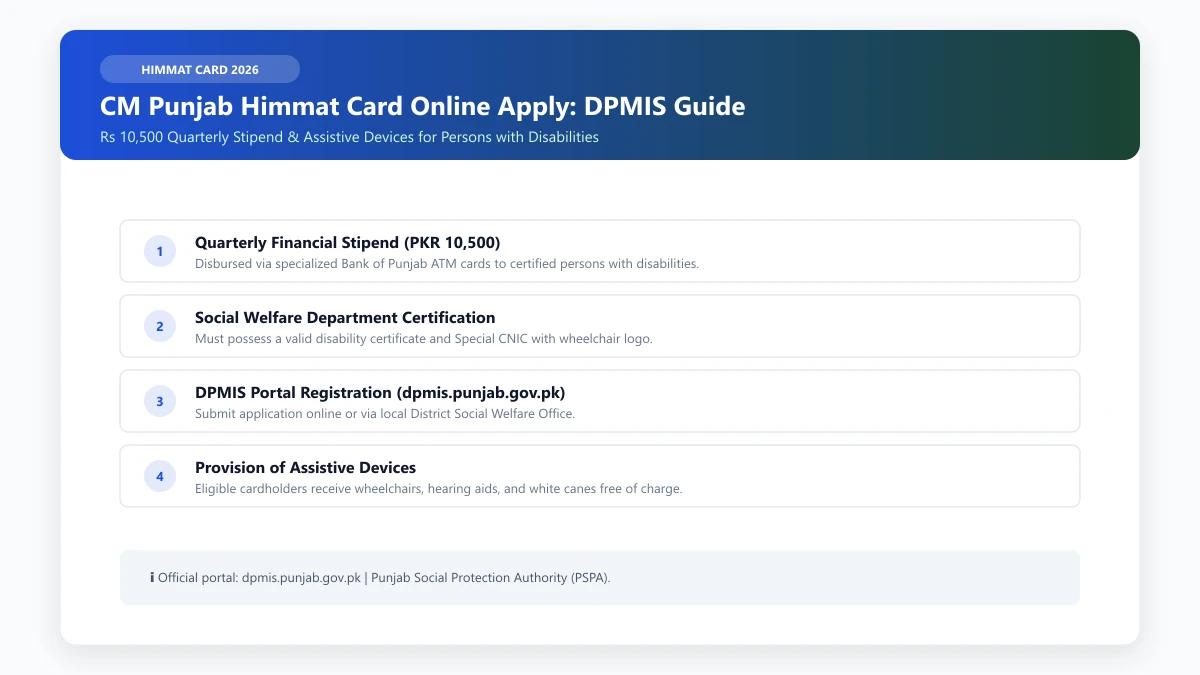
CM Punjab Himmat Card Online Apply 2026: DPMIS Registration, Eligibility & Rs 10,500 Stipend Guide
To apply online for the CM Punjab Himmat Card, visit the official portal at dpmis.punjab.gov.pk, register your account using your 13-digit CNIC, and upload your official Social Welfare Disability Certificate. Eligible certified persons with disabilities receive a quarterly financial stipend of Rs. 10,500 via an ATM-enabled Bank of Punjab card.
Read guide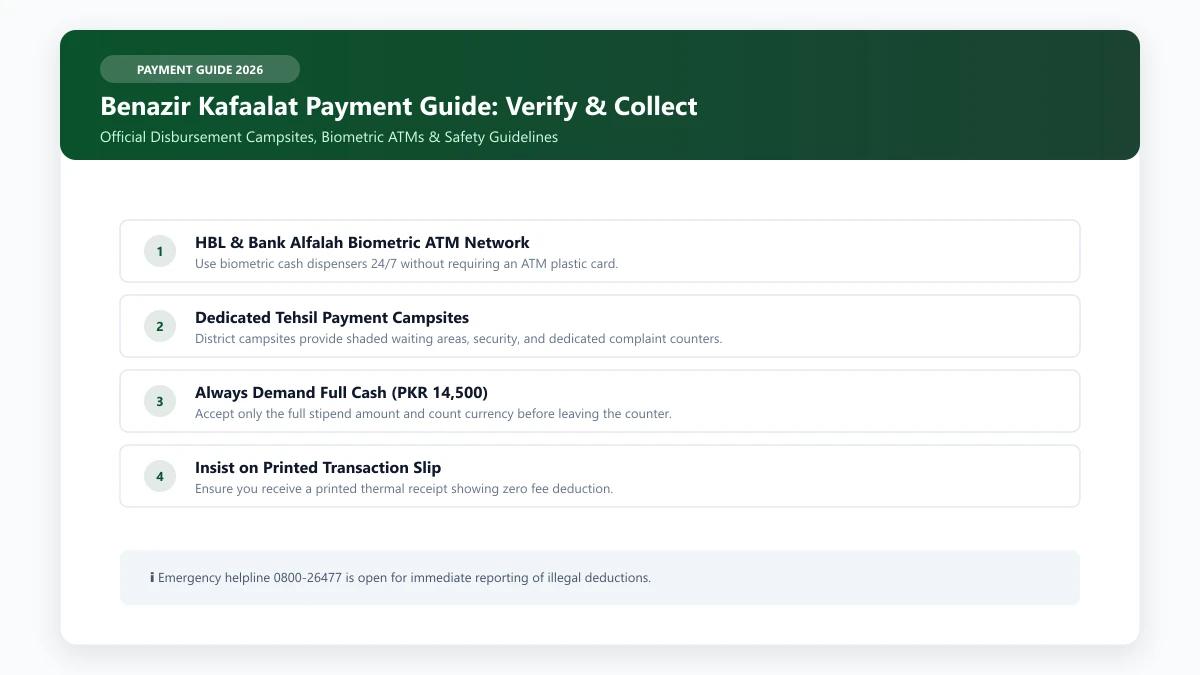
Benazir Kafaalat Payment Guide: Verify, Collect, and Stay Safe
What beneficiaries should check before collecting a payment, plus safe complaint steps.
Read guide