This article explains public information. It does not determine eligibility or replace an official notice.
What is the KP HPV vaccination campaign 2026?
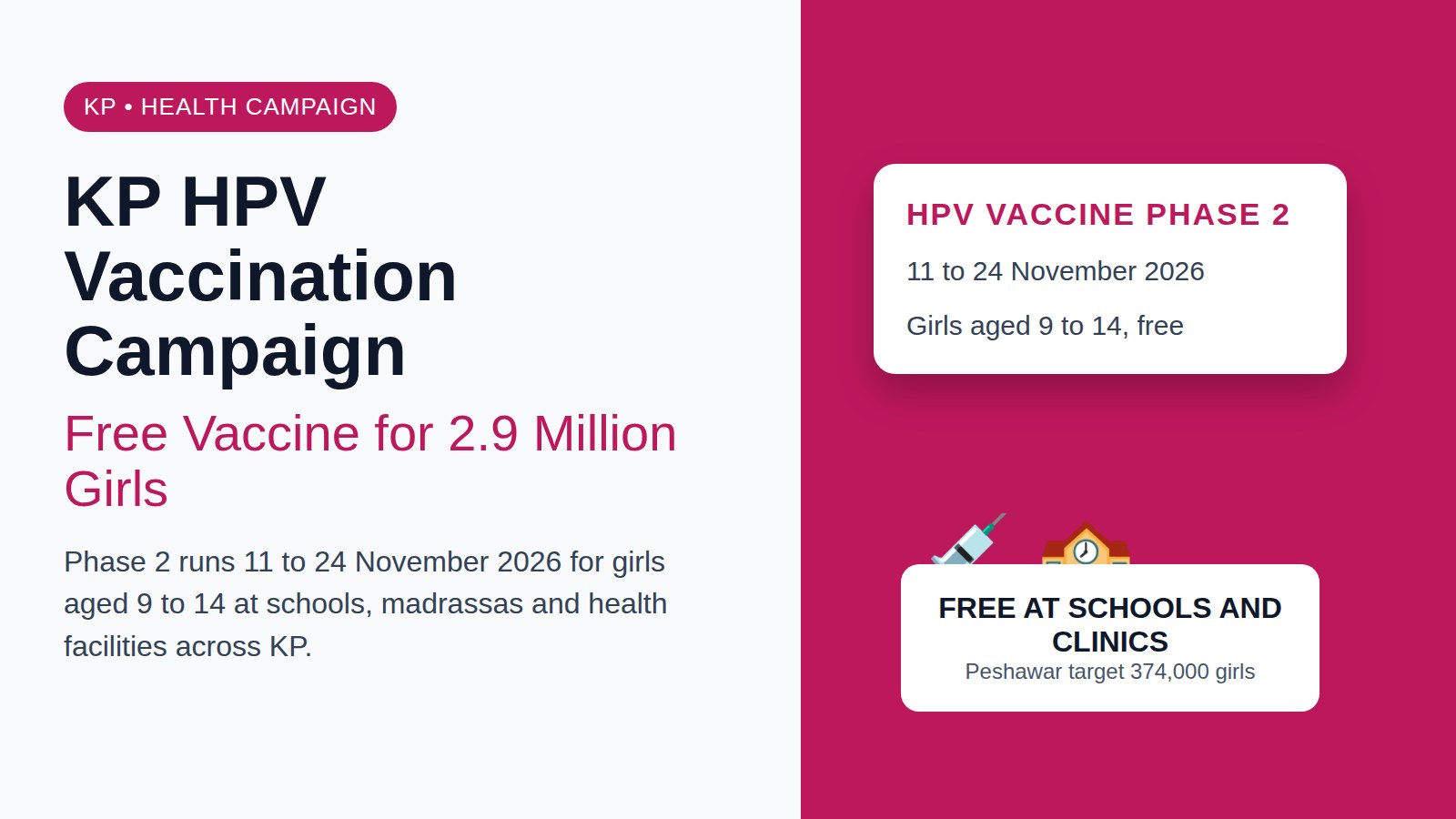
The KP HPV vaccination campaign 2026 is the second phase of the Cervical Cancer Prevention Campaign in Khyber Pakhtunkhwa. As of 8 November 2026, it is scheduled to run from 11 to 24 November 2026, and it follows the first phase of the national programme in September 2025.
The Khyber Pakhtunkhwa Health Department runs the campaign with support from the Medical Emergency Resilience Foundation (MERF) and Gavi, the Vaccine Alliance. The Expanded Programme on Immunization (EPI) in Khyber Pakhtunkhwa leads the vaccination work. The World Health Organization (WHO) supports the wider national programme. The vaccine is free for every eligible girl.
How is Phase 2 different from Phase 1?
Phase 1 ran from 15 to 27 September 2025 in Punjab, Sindh, Islamabad Capital Territory and Azad Jammu and Kashmir, and it aimed to reach 13 million girls. WHO reported in January 2026 that more than 9.6 million girls had been protected. Phase 2 brings the same programme, led nationally by the Federal Directorate of Immunization (FDI), to Khyber Pakhtunkhwa, with Balochistan and Gilgit-Baltistan listed for 2027.
Why does HPV vaccination matter for girls aged 9 to 14?
Human papillomavirus (HPV) is a common virus, and persistent infection with high risk types of HPV is the main cause of cervical cancer. Cervical cancer develops in the cervix, the lower part of the uterus, and it can take many years to develop after infection. Vaccination works best before a girl is exposed to the virus, which is why the programme targets girls aged 9 to 14.
Cervical cancer causes more than 5,000 new cases and more than 3,000 deaths each year in Pakistan, according to the KP Health Department and WHO. WHO reported in September 2025 that Pakistan loses 8 women every day to cervical cancer. Globally, it caused about 660,000 new cases and 348,000 deaths in 2022. The vaccine prevents infection with the virus types that cause most cervical cancers, so it lowers the risk of cancer in later life. It does not treat an infection that is already present.
Why vaccinate before age 15?
The immune response is strong in young adolescents, and vaccination at ages 9 to 14 gives protection before exposure. No KP source for Phase 2 states the number of doses, so parents should confirm the dose with the vaccination team on the day. WHO aims to eliminate cervical cancer as a public health problem by 2030, with a target to vaccinate 90 percent of girls by age 15.
Who can get the free HPV vaccine in KP?
Every girl aged 9 to 14 in Khyber Pakhtunkhwa is in the target group, as of 8 November 2026, including school-going, madrassa-going and out-of-school girls. No KP source states a district by district list, so this article does not list districts beyond Peshawar and Khyber district.
Of the 2.9 million target girls, about 1.6 million are school-going and about 1.3 million are out of school, according to the KP Health Department handout reported in July 2026. In District Peshawar, the target is 374,000 eligible girls. Parents should confirm the date and venue locally.
Who is not in this campaign?
Boys are not in the target group, and women above age 14 are not in it either. The programme targets girls because cervical cancer is the most common HPV linked cancer and the one this programme aims to prevent. Adults who have symptoms should seek medical care at a health facility, and they should not wait for a vaccination campaign.
| Group | Can get the free vaccine? | Where to go |
|---|---|---|
| Girls aged 9 to 14 in school | Yes | School vaccination session |
| Girls aged 9 to 14 in a madrassa | Yes | Madrassa vaccination session |
| Out-of-school girls aged 9 to 14 | Yes | Community location, mobile team or government health facility |
| Girls below 9 or above 14 | No | Ask a health facility about routine immunisation |
| Boys | No | No vaccination under this campaign |
Where and when can girls get vaccinated in KP?
The campaign runs from 11 to 24 November 2026 across Khyber Pakhtunkhwa, including Khyber tribal district. As of 8 November 2026, those are the dates stated by UrduPoint, The News and FATA Voice. One other report gave different dates, and that conflict is flagged in the notes at the end of this article, so parents should confirm the dates locally.
Vaccination is free of cost at schools, madrassas, designated community locations and government health facilities. School-going girls will receive it at public and private educational institutions. Out-of-school girls will be reached through community outreach, mobile teams for hard to reach areas and fixed centres at public health facilities. Parents should confirm venue and timing with their daughter's school or the nearest government health facility. Citizens seeking information can also contact the 1322 helpline, according to FATA Voice on 20 October 2026.
What is the plan for Peshawar and Khyber district?
A media orientation workshop was held on 4 November 2026 at the ERU Hall, DHO Office Peshawar, organised by the KP Health Department with support from MERF and Gavi. Technical sessions were led by Dr Muhammad Arif, EPI Coordinator Peshawar, Dr Qazi Taimor of WHO, Dr Saad and Muhammad Shoaib of MERF. In Khyber district, a journalists session was held at the Deputy Commissioner House in Peshawar, with Rescue 1122 and other departments coordinating preparations.
How does the campaign work in schools, madrassas and communities?
The campaign uses two delivery strategies, both free for eligible girls. The first covers girls in education through planned sessions. The second covers girls outside school through outreach and fixed centres.
A Provincial Steering Committee headed by the Secretary Health provides oversight, and a Technical Committee chaired by the Director General Health Services supervises planning and coordination. Provincial and district focal persons have been nominated, and officials from the education, Auqaf, social welfare, local government and information departments have assigned roles. The Society of Obstetricians and Gynaecologists of Pakistan (SOGP) and the Pakistan Paediatric Association (PPA) provide technical support. The Director General Health Services, Dr Shaheen Afridi, has urged parents, teachers, community leaders and religious scholars to support the campaign.
What happens on vaccination day?
- Confirm the date, time and venue with your daughter's school or madrassa, or with the nearest government health facility.
- Take your daughter to the session on the stated date, and ask the team about the number of doses and the record you will receive.
- Stay for the short observation period the team advises after the injection, if the team asks you to do so.
- Keep any vaccination record you are given, and ask where to go if you have a question after the session.
What is HPV and how does the vaccine prevent cervical cancer?
Human papillomavirus (HPV) is a group of viruses, and some high risk types can cause cervical cancer after a long lasting infection. Most infections clear on their own, but a persistent infection can lead to changes in cervical cells over many years. The vaccine trains the immune system to block infection with the virus types it covers.
The HPV vaccine used in the national programme is WHO prequalified, which means WHO has assessed its quality, safety and efficacy. WHO states that it is safe, science based and effective, and it has been used in more than 150 countries, including Muslim countries. The exact brand for KP Phase 2 is not stated in the KP sources used for this article, so this article does not name one for KP. The national programme in 2025 used Cecolin, a bivalent vaccine against HPV types 16 and 18, according to The Lancet, but that is not a confirmed KP Phase 2 fact. The vaccine contains no live virus and no viral DNA, so it cannot cause HPV infection or cancer.
Is the HPV vaccine safe, and what side effects should parents expect?
The HPV vaccine has a long safety record in more than 150 countries. WHO, Gavi, the Vaccine Alliance, UNICEF and the Government of Pakistan describe it as safe and effective. In Pakistan, more than 9.6 million girls were protected in the first phase in 2025.
Some girls may have mild and short lived side effects. Health officials at the Khyber district session said some recipients might have mild pain or redness at the injection site, a slight fever, temporary fatigue or dizziness. These effects usually settle on their own, and parents should contact a health facility if they are worried or if symptoms do not settle. Misinformation is a real challenge, and Dr Mohibullah told the Khyber district session that a lack of public awareness remained a major challenge. Parents should rely on the KP Health Department, WHO, Gavi and UNICEF for facts. There is no evidence that the HPV vaccine affects fertility, according to safety monitoring cited by health sources.
What should parents do before 11 November?
Parents should act now. Confirm your daughter is aged 9 to 14, and ask her school or madrassa for the vaccination date, time and venue. If she does not attend school, ask the nearest government health facility about the nearest community session or mobile team. Note the 1322 helpline, talk with your daughter about the visit in simple terms, and plan who will take her. Keep any vaccination record you receive. If she misses her school session, ask about a catch up session or a fixed centre during the campaign window.
Families who need wider health cover in Khyber Pakhtunkhwa can also read about the Sehat Sahulat Card, the Punjab Aaghosh Programme and the Punjab Social Security Mobile Health Programme. These are separate programmes, and they do not replace the HPV campaign.
What has changed since Phase 1 in 2025?
Phase 1 proved that a large HPV campaign can run in Pakistan, and Phase 2 extends that work to a new province. In Phase 1, more than 49,000 health workers trained by WHO were mobilised, and the campaign targeted 13 million girls. WHO reported in January 2026 that more than 9.6 million girls had been protected, about 66 percent coverage.
Phase 2 in KP targets 2.9 million girls, including 1.6 million school-going girls and 1.3 million out-of-school girls. The KP plan adds madrassas as a stated venue, and community outreach and mobile teams for hard to reach areas. The national plan is to integrate the vaccine into routine immunisation for 9 year old girls in later years, and to extend the programme to Balochistan and Gilgit-Baltistan in 2027. As of 8 November 2026, the KP campaign has not yet started, so no coverage figure exists for Phase 2.
What should families do if they miss the campaign dates?
If a girl misses her school or madrassa session, parents should ask the school or the nearest government health facility whether a catch up session is planned, or whether a fixed centre can vaccinate her before 24 November 2026. Out-of-school girls can also use community locations and government health facilities during the window.
If the window has passed, parents should ask the nearest government health facility or the district EPI office what the next option is. No KP source confirms a routine date or a catch up date after 24 November 2026, so parents should not assume a later date exists.
Frequently asked questions
Is the KP HPV vaccine free?
Yes, it is free of cost for eligible girls at schools, madrassas, designated community locations and government health facilities.
When does the KP HPV vaccination campaign 2026 run?
The campaign runs from 11 to 24 November 2026, as of 8 November 2026. Parents should confirm the exact date and time locally, because session dates can differ within that window.
Who can get the HPV vaccine in Khyber Pakhtunkhwa?
Girls aged 9 to 14 can get it, including school-going, madrassa-going and out-of-school girls. The target is 2.9 million girls, including 374,000 in District Peshawar.
Where can my daughter get the HPV vaccine?
She can get it at her school or madrassa, at a designated community location, or at a government health facility. Out-of-school girls can use community outreach sessions, mobile teams and fixed centres.
How many doses will my daughter need in the KP campaign?
This is not confirmed for KP Phase 2 in the KP sources used for this article, so parents should ask the vaccination team on the day. The national programme in 2025 planned a single dose, but that does not confirm the KP dose.
Which vaccine brand is used in the KP campaign?
The brand is not stated in the KP Phase 2 sources used for this article, so this article does not name one for KP. The national programme in 2025 used Cecolin, a bivalent vaccine against HPV types 16 and 18, according to The Lancet, but that is not a confirmed KP fact.
Is the HPV vaccine safe?
Yes, the WHO prequalified vaccine is described by WHO, Gavi and UNICEF as safe, science based and effective. It has been used in more than 150 countries, and more than 9.6 million girls were protected in Pakistan in 2025.
What side effects can the HPV vaccine cause?
Some girls may have mild pain or redness at the injection site, a slight fever, temporary fatigue or dizziness. These effects usually settle on their own, and parents should contact a health facility if they are worried.
Do parents need to give consent for the HPV vaccine?
No KP Phase 2 source used for this article states the consent rules, so parents should confirm them with their daughter's school or the nearest government health facility. Parents should ask what form, if any, the school needs.
What should I do if my daughter misses her school vaccination session?
Ask the school or the nearest government health facility about a catch up session or a fixed centre before 24 November 2026. If the window has passed, ask the health facility or district EPI office what the next option is.
Sources and official links
Check the destination address before entering personal information.
Related guides
KPK Sehat Sahulat Card Check Online 2026: 8500 SMS, 10 Lakh Treatment Coverage & Empaneled Hospital List
Check KPK Sehat Card Plus eligibility and balance online by CNIC or 8500 SMS. Learn how to access Rs 10 Lakh free inpatient treatment, view the 2026 empaneled panel hospitals list, and follow the hospital counter admission process.
Read guide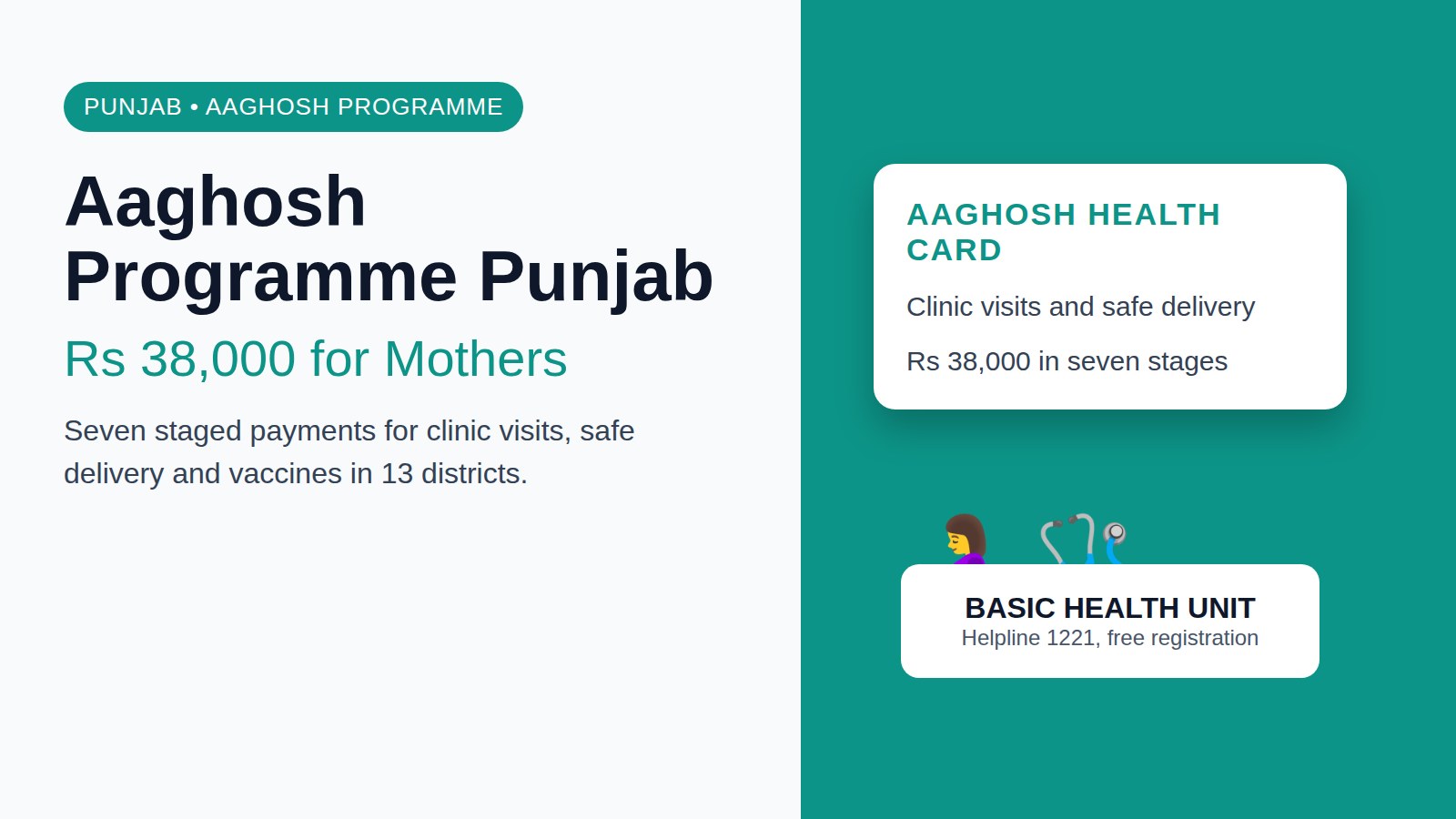
Aaghosh Programme Punjab: Up to Rs 38,000 for Pregnant Women and Young Mothers
The Aaghosh Programme Punjab pays pregnant women, breastfeeding mothers, and mothers of children under two up to Rs 38,000 in seven stages. The Punjab Social Protection Authority runs it with the Health and Population Department in 13 districts only. You register free at a Basic Health Unit or Rural Health Centre.
Read guide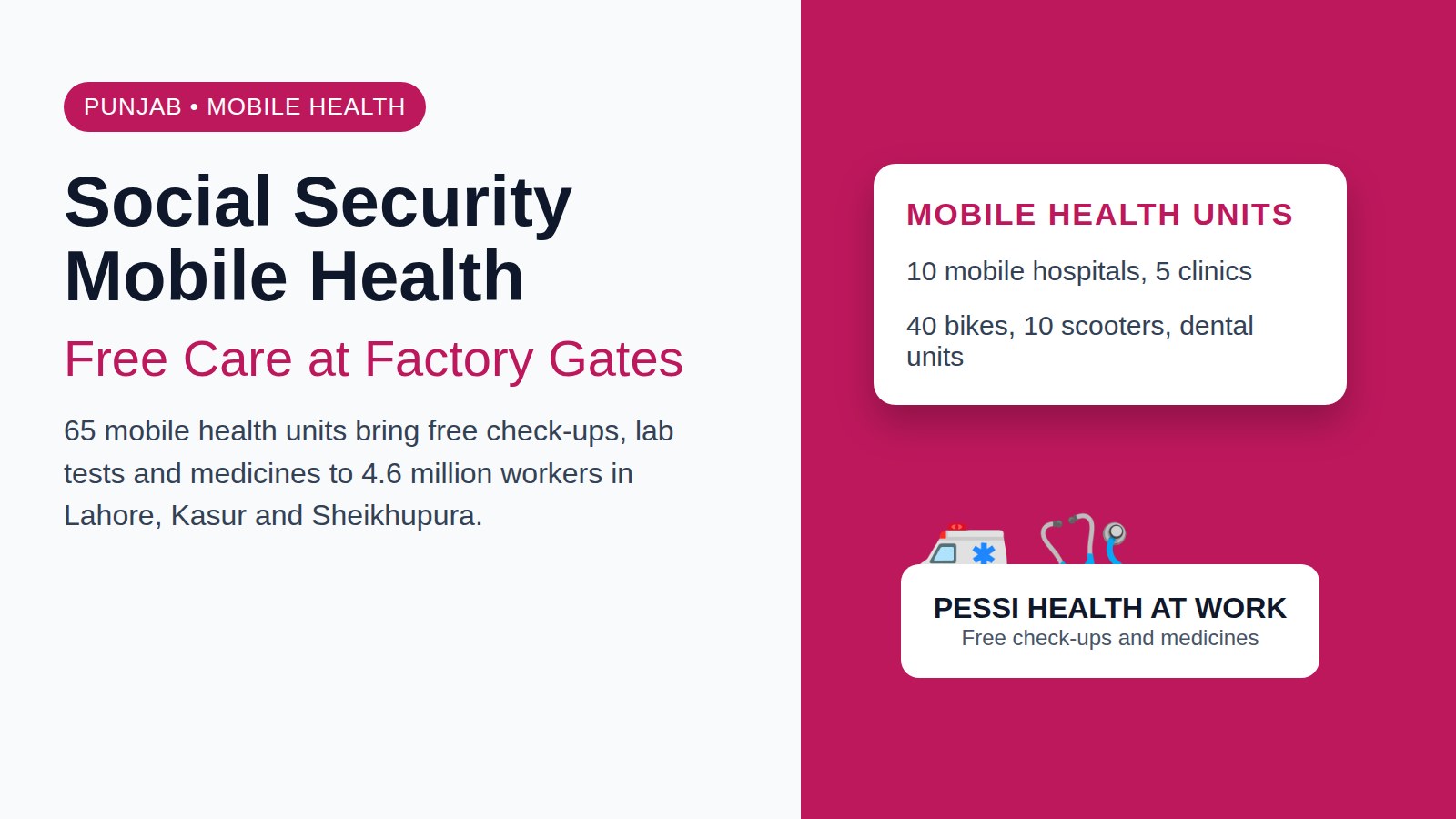
Punjab Social Security Mobile Health Programme: Free Healthcare for Workers 2026
The Punjab Social Security Mobile Health Programme sends free healthcare to registered industrial workers in Punjab. 65 mobile health units visit factories in Lahore, Kasur and Sheikhupura, and treat workers' families at home. Check-ups, laboratory tests and medicines are free. The programme launched in mid-October 2026 and will reach 12 more districts by March 2027.
Read guide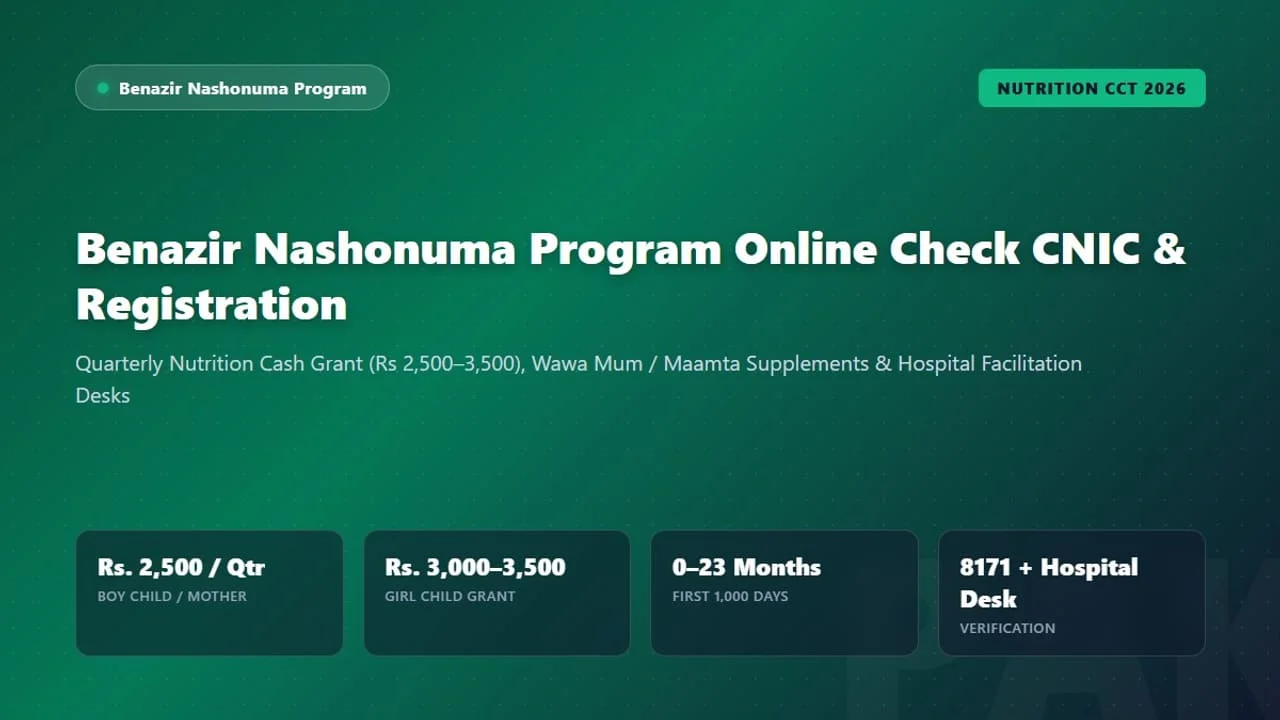
Benazir Nashonuma Program Online Check 2026: 8171 CNIC Status, Rs 3,000 Nutrition Cash & Registration Guide
Check Benazir Nashonuma Program eligibility by CNIC via 8171 portal. Complete guide to Rs 2,500-3,000 cash grant, Wawa Mum nutrition, and center registration.
Read guide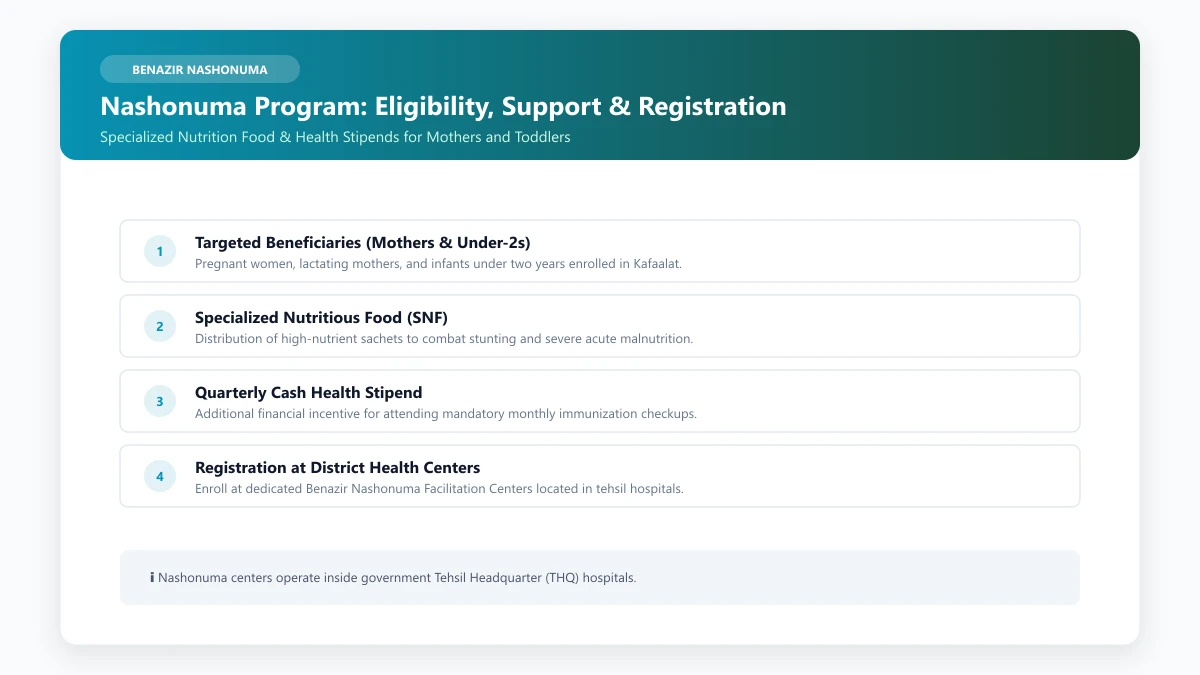
Nashonuma Program: Eligibility, Support & Registration
Understand Benazir Nashonuma support for eligible mothers and young children, the facilitation-centre route and how it differs from Punjab Aghosh.
Read guide