This article explains public information. It does not determine eligibility or replace an official notice.
What is the Dalda Foundation Scholarship 2026-27?
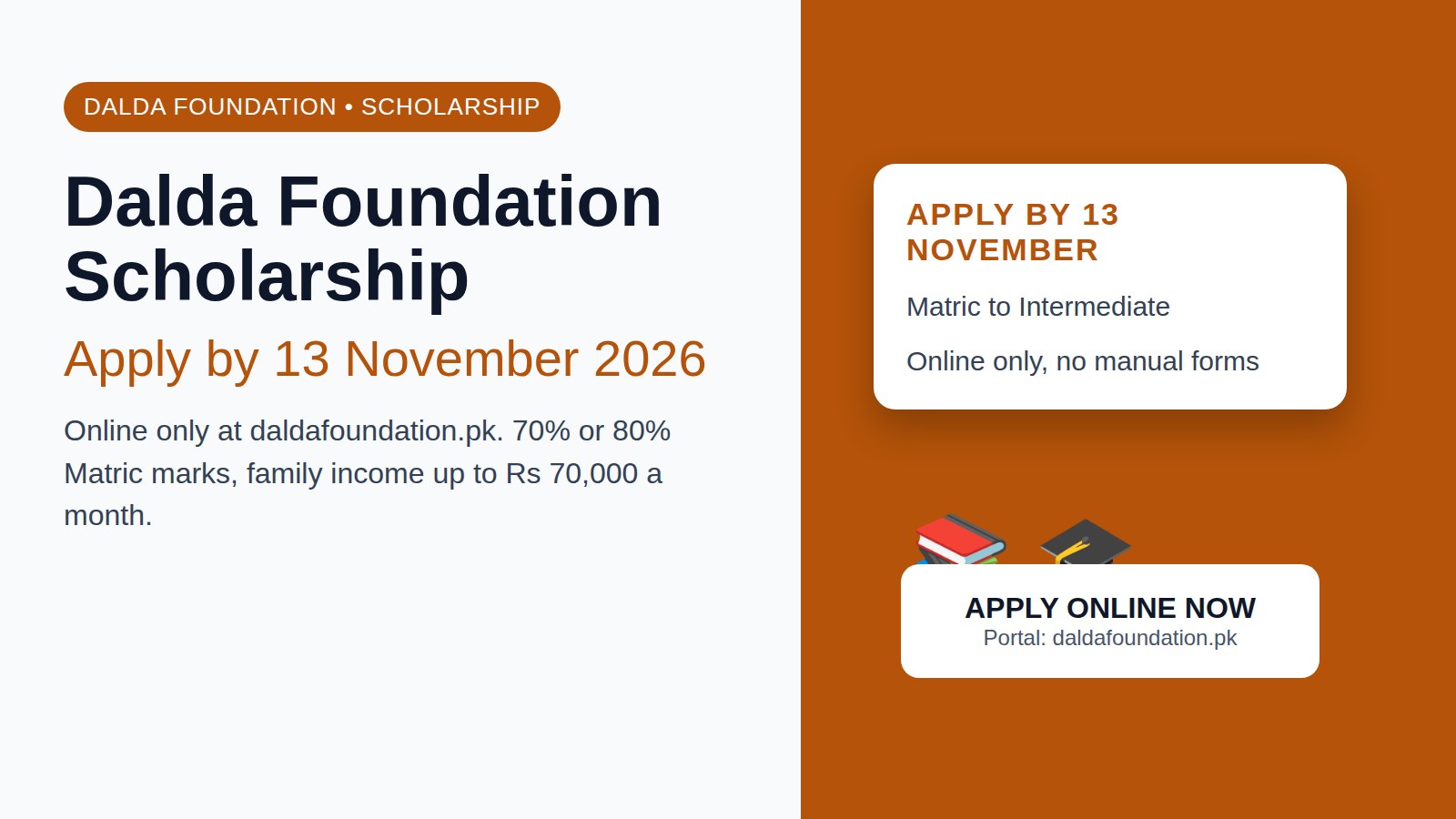
The Dalda Foundation Scholarship 2026-27 is the Dalda Foundation Trust Scholarship and Student Development Programme for the 2026-27 cycle. The Dalda Foundation Trust, known as DFT, opened online applications on 12 October 2026 and will close them on 13 November 2026. It supports talented students from low-income families across all provinces of Pakistan, including Azad Jammu and Kashmir and Gilgit-Baltistan.
DFT says it has worked since 2010 to support talented youth through education and skills. The 2026-27 notice reports more than 6,500 scholarships awarded so far, more than 2,200 students graduated, and more than 1,100 scholars who completed training in 2025-26. Treat these as the notice's own figures, because the DFT homepage currently shows a lower figure of 5,571+ scholarships awarded.
The two paths: professional education and vocational training
The programme offers two paths with one shared purpose. Professional education supports students from Intermediate through university, so a first-year Intermediate student can stay in the programme up to graduation. Vocational education and training supports practical skills courses that lead to work. Pick the path that matches what you are studying.
Professional education covers FSc Pre-Medical, FSc Pre-Engineering, ICS, FA and Arts, Home Economics and General Science. Vocational education and training covers Digital and Future Skills, Technical Trades, Retail and Services, Hospitality, Health and Allied fields, and Agriculture and Livestock. Both paths use the same online form at daldafoundation.pk.
What selected scholars get beyond money
Selected scholars get more than fee support. DFT describes its support through five pillars: financial support, counselling and mentoring, skills and training, earning capacity, and values and character. The idea is a six-year student development plan that follows a professional education student from Intermediate through university. The notice also mentions an international scholarship directory that DFT has created for students, but no detail is given about how scholars use it, so treat it as a bonus, not a reason to apply.
Who can apply for the Dalda Foundation Scholarship?
Any Pakistani citizen can apply if they meet the rules for their category, including residents of Azad Jammu and Kashmir and Gilgit-Baltistan. The notice splits applicants into external general applicants and internal applicants from third-party worker families. Each group has its own marks bar and income cap, so read your own group carefully. Meeting the rules does not guarantee a scholarship, because every applicant must also clear the written assessment and verification stages.
External general applicants for professional education
General applicants for professional education must be under 19 years of age and enrolled in the first year of Intermediate at an eligible public-sector institution. They must have passed Matric. Their Matric marks decide which stream they qualify for. Students in ICS, Arts, Home Economics and General Science need at least 70% marks in Matric, while students in Medical and Engineering streams need at least 80% marks in Matric.
The family income rule is strict. The monthly income of the parent or guardian must not exceed Rs 70,000. Families in an urban area must also meet a house size limit of 120 square yards. If your income is above Rs 70,000 a month, or your urban house is larger than 120 square yards, the general category will not accept you. Check both figures before you spend time on the form.
External applicants for vocational and technical training
Vocational applicants need at least 50% marks in Matric and admission to an eligible government or government-approved training programme. The course should last between 6 months and 2 years, and DFT gives preference to employment-focused courses that lead to a job. No under-19 age bar and no first-year Intermediate rule is stated for this route, because it is for skills training, not a degree track.
The income rule matches the general professional route: the monthly income of the parent or guardian must not exceed Rs 70,000, and the 120 square yard limit applies to the family house in an urban area. If you are enrolled in a short skills course, or you have admission to one, this route fits you better than professional education.
Internal applicants: third-party workers and their families
DFT runs a separate category for the families of its third-party workers. Students in this internal category who are admitted to eligible public-sector institutions can apply for professional education from Grade 8 onwards. They need at least 50% marks in Matric, and their parent or guardian income must not exceed Rs 90,000 a month.
The same internal category covers vocational and technical training, with the same 50% Matric bar, a course of 6 months to 2 years, and the same Rs 90,000 income cap. If you belong to a third-party worker family, apply under this category, not the general one, because the marks bar is lower and the income cap is higher.
Do I meet the marks and income limits?
Use this table to check yourself in two minutes. Find your applicant type and compare your Matric percentage and family monthly income with the row. If any one figure fails, check the other rows before you give up.
| Applicant type | Matric marks needed | Family income cap | Other key rule |
|---|---|---|---|
| General, professional education, ICS, Arts, Home Economics or General Science | At least 70% | Rs 70,000 a month | Under 19, first-year Intermediate, public-sector institution |
| General, professional education, Medical or Engineering | At least 80% | Rs 70,000 a month | Under 19, first-year Intermediate, public-sector institution |
| General, vocational and technical training | At least 50% | Rs 70,000 a month | 6 months to 2 years, government or approved programme |
| Internal, third-party worker family, professional education | At least 50% | Rs 90,000 a month | Can apply from Grade 8 onwards |
| Internal, third-party worker family, vocational training | At least 50% | Rs 90,000 a month | 6 months to 2 years, government or approved programme |
One warning sits inside this table. Some reports place General Science at 80% instead of 70%, while others place it at 70% with ICS, Arts and Home Economics. This guide follows the 70% grouping. If you are a General Science student with marks between 70% and 79%, check the notice on daldafoundation.pk before you decide, because only the notice settles it.
How do I apply online at daldafoundation.pk?
You apply online only. The notice is clear that manual applications will not be accepted for this round, and there is no paper form to download. Follow these steps before 13 November 2026.
- Go to the official website at daldafoundation.pk.
- Open the student registration or scholarship application section.
- Create an account with an email address you check regularly, because DFT contacts candidates only by email.
- Pick the category that matches your situation: external or internal, professional or vocational.
- Fill in the form with your personal, educational and family financial details.
- Upload the required documents, including your Principal-approved documents.
- Review every entry, submit the form, and keep your application details for future reference.
Apply well before the last date. Portals slow down near a deadline, and a late or half-filled form will not be accepted after 13 November 2026. If a step on the live portal looks different from this list, follow the live portal, because it is the official source.
How are scholars selected?
Selection runs in six stages, and eligibility alone does not win the award. First, you submit the online application before the deadline. Second, DFT screens it against your category rules. Third, shortlisted applicants appear in the DFT written assessment. Fourth, DFT completes academic and financial verification. Fifth, shortlisted candidates are invited for orientation. Sixth, candidates who qualify get final selection and the award.
The notice gives no test date, no syllabus and no result date for the written assessment. One report describes standard test papers set by foundation examiners, but no paper pattern has been published. Revise your Matric and Intermediate basics, keep checking the email you used on the form, and do not pay anyone who claims to sell the test paper.
What documents do I need?
Every applicant must provide Principal-approved documents with the form. Your institution's principal must approve the papers you submit, so get this done early. The notice does not publish an exact document list, so confirm the list below on the official portal before you submit.
Keep these ready: your Matric result card or certificate, your B-Form or CNIC, copies of your parent or guardian CNIC, a recent photograph, proof of family income, and your college admission or enrolment information. DFT may also ask for other documents that fit your category. Scan each paper clearly, and check that names and dates match across your documents, because mismatched papers are a common cause of delays at verification.
What does the scholarship cover, and what does it not say?
The scholarship covers financial support for educational expenses, plus academic counselling and guidance, mentoring, skills development and career guidance. For professional education students, support can run from Intermediate through university under the six-year student development plan, if they keep meeting the programme rules. Vocational students get support for their training course of 6 months to 2 years.
What the notice does not state matters just as much. The latest announcement does not specify a fixed scholarship amount or a monthly stipend, so do not plan your budget around a figure you saw on another site. It does not state the number of awards, it does not publish the exact document list beyond Principal-approved papers, and it does not give a written assessment date. The notice also states that DFT may cancel or withdraw any facility at its discretion without explanation. Rely only on the official website for updates.
What should I check before the 13 November deadline?
Check three things that the sources disagree on. First, the dates. The 2026-27 notice and every competitor guide say applications opened on 12 October 2026 and close on 13 November 2026. The DFT homepage still describes its yearly window as 15 July to 30 October, which is general site text, not the 2026-27 notice. Use the notice dates, and confirm them on daldafoundation.pk.
Second, the General Science marks bar. Reports split on whether General Science needs 70% or 80% in Matric. If your marks fall between 70% and 79% and you study General Science, this one check decides whether you qualify. Third, the contact details. DFT lists WhatsApp 03311200897 and landline (021) 35850942, extension 385. Office hours differ across reports, with closing times of 4:00pm, 4:30pm and 5:00pm all reported, so confirm the hours on the notice before you call. Watch your inbox after you submit, including the spam folder, because DFT contacts candidates only by email.
Other scholarships to check if you miss this deadline
If you miss 13 November 2026, or if you do not meet the Dalda rules, other scholarships are still open. The KP Education Endowment Fund Scholarship 2026-27 supports students in Khyber Pakhtunkhwa. The HEC Balochistan and ex-FATA Scholarships Phase 2 offers 5,000 awards for students from Balochistan and the former FATA region. The Scotland Pakistan Scholarships for Young Women and Girls support female students in Pakistan.
Two more options: the CM Punjab Honhaar Scholarship Program 2026 supports students in Punjab, and the HEC MBBS and BDS admissions for Balochistan and FATA 2026-27 cover medical and dental admissions for students from Balochistan and FATA. Check each one's own last date and rules, because they differ from Dalda.
Frequently asked questions
What is the last date to apply for the Dalda Foundation Scholarship 2026-27?
The last date to apply is 13 November 2026. Applications opened on 12 October 2026, and late forms will not be accepted. Apply well before the last date, because the portal can slow down near the deadline.
How do I apply for the Dalda Foundation Scholarship?
Apply online only at daldafoundation.pk. Create an account, pick your category, fill in the form, upload your Principal-approved documents, and submit before 13 November 2026. Manual applications are not accepted for this round, and there is no form to download.
Who can apply for the Dalda Foundation Scholarship 2026-27?
Pakistani citizens can apply, including residents of Azad Jammu and Kashmir and Gilgit-Baltistan. General professional applicants must be under 19 and in the first year of Intermediate at an eligible public-sector institution. Vocational applicants need at least 50% in Matric, and third-party worker families can apply from Grade 8 onwards. Second-year Intermediate students should check with DFT, because the general category is built for first-year students.
What Matric percentage do I need for the Dalda scholarship?
It depends on your stream and category. General professional applicants need at least 70% in Matric for ICS, Arts, Home Economics and General Science, or at least 80% for Medical and Engineering. Vocational applicants and internal third-party worker applicants need at least 50% in Matric. Some reports place General Science at 80%, so check the notice if your marks fall between 70% and 79%.
What is the family income limit for the Dalda scholarship?
The monthly income of the parent or guardian must not exceed Rs 70,000 for general applicants, and Rs 90,000 a month for internal applicants from third-party worker families. Families in urban areas must also meet the house size limit of 120 square yards.
How much money does the Dalda Foundation Scholarship pay?
The 2026-27 announcement does not state a fixed scholarship amount or a monthly stipend. The programme offers financial support plus counselling, mentoring, skills training and career guidance, but no figure is published. Do not trust any site that quotes a fixed amount for this cycle.
Can students from Azad Jammu and Kashmir and Gilgit-Baltistan apply?
Yes, if they meet the rules for their category. Residence in Pakistan, including Azad Jammu and Kashmir and Gilgit-Baltistan, is a stated condition for general applicants.
Do I need to be under 19 to apply?
The under-19 rule applies to general applicants for professional education. The reports we checked do not state the same age bar for vocational applicants or for internal third-party worker applicants, who can apply from Grade 8 onwards. If your age is close to the limit, check your category rules on daldafoundation.pk.
What happens after I submit my application?
DFT screens your form, then shortlisted candidates appear in a written assessment. After that comes academic and financial verification, then orientation, then final selection and the award. DFT contacts candidates only by email, so check your inbox regularly. No test date has been announced yet.
Is there an application fee for the Dalda scholarship?
The announcement does not state an application fee, and no fee is mentioned in the notice or in the competitor guides we checked. If any person or site asks you to pay a fee to apply, do not pay, and confirm the position on daldafoundation.pk first.
Sources and official links
Check the destination address before entering personal information.
Related guides
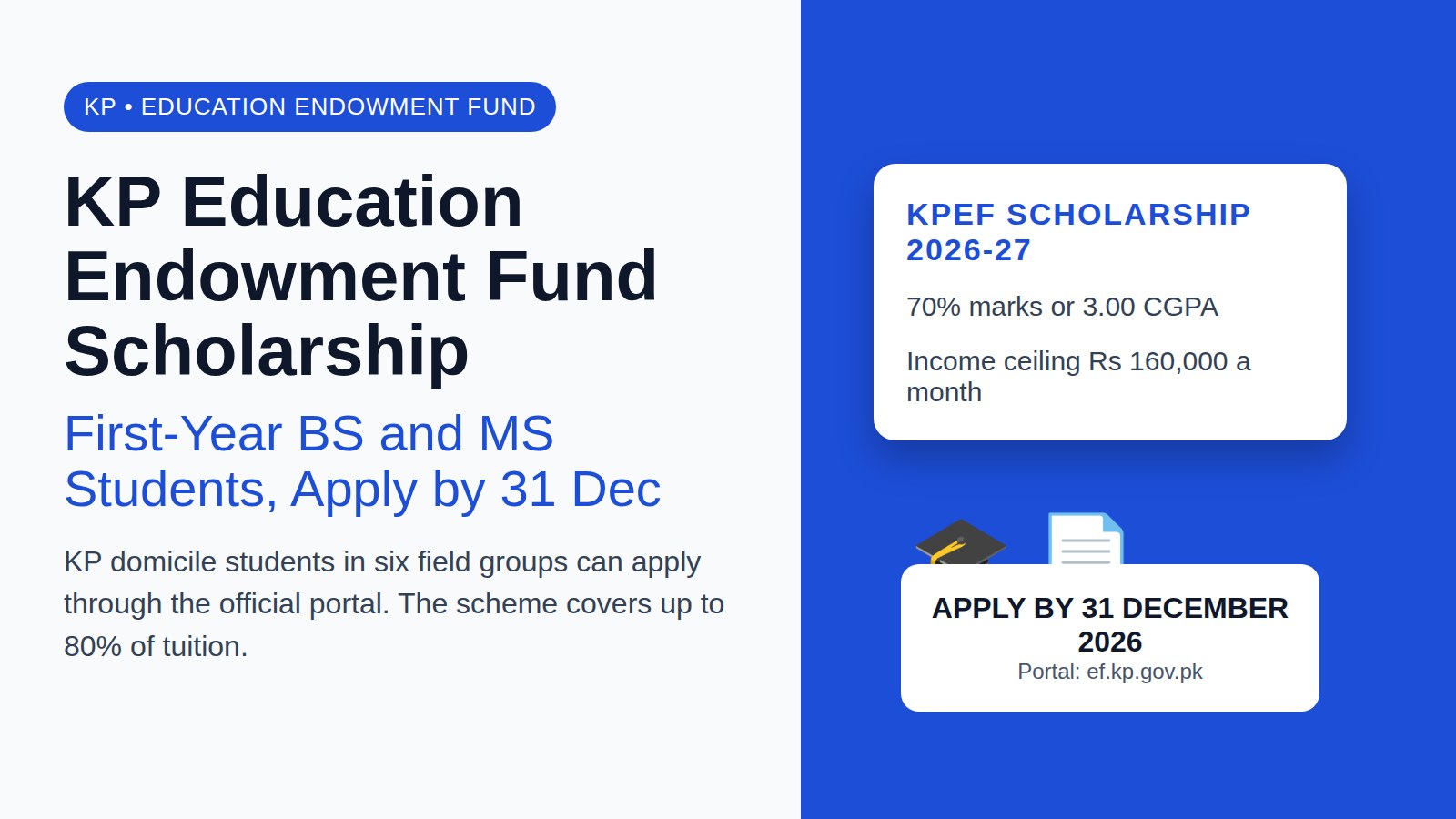
KP Education Endowment Fund Scholarship 2026-27: First-Year BS and MS Students Can Apply by 31 December
The KP Education Endowment Fund Scholarship 2026-27 supports first-year BS and MS students from Khyber Pakhtunkhwa with at least 70% marks or a 3.00 CGPA and family income of Rs 160,000 a month or less. It covers up to 80% of tuition fees. Apply only through the official KPEF online portal before 31 December 2026.
Read guide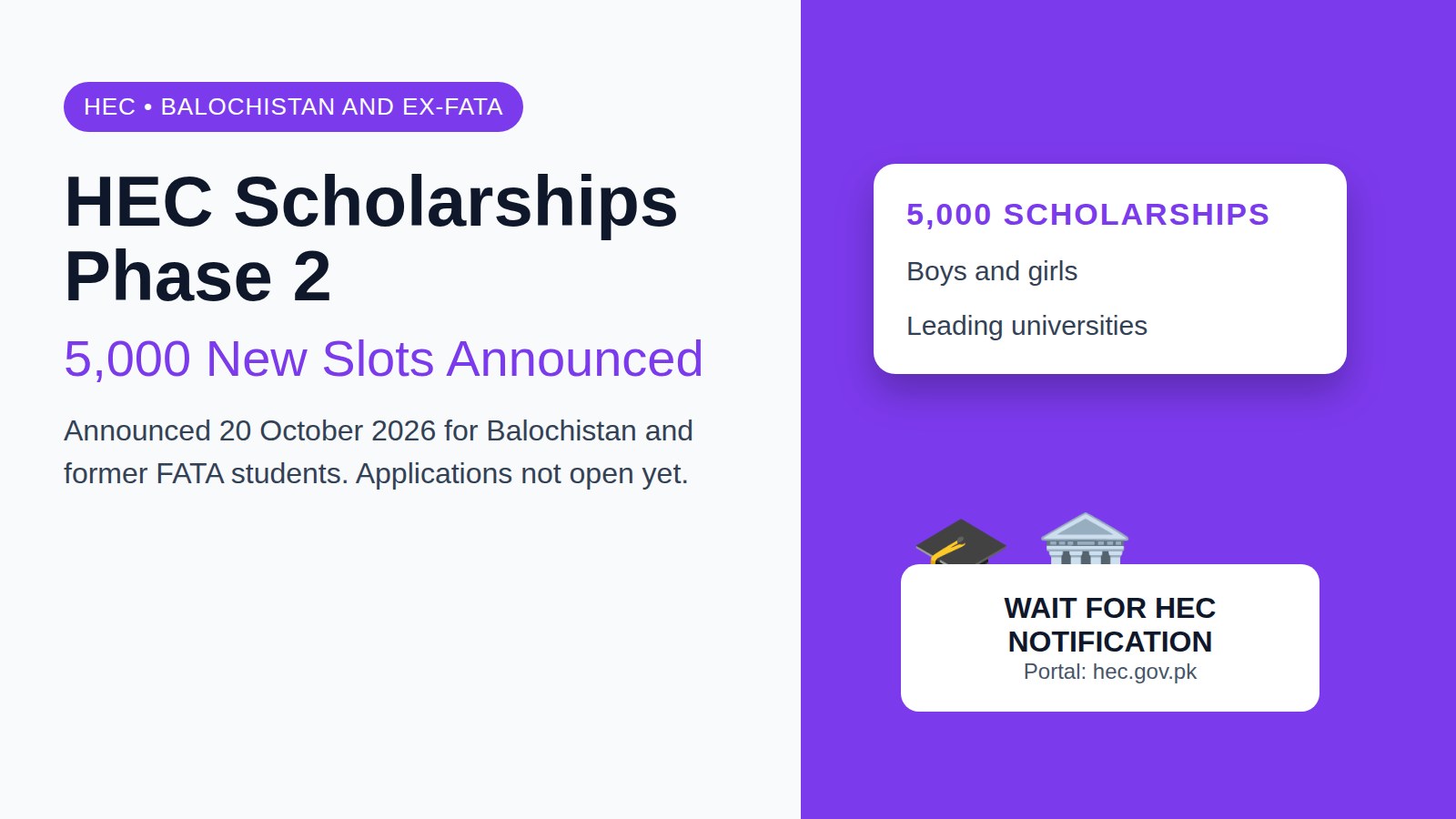
HEC Balochistan and ex-FATA Scholarships Phase 2: 5,000 New Slots
Planning Minister Ahsan Iqbal announced 5,000 HEC Balochistan ex-FATA scholarships Phase 2 in the National Assembly on 20 October 2026. The awards are for boys and girls from Balochistan and the former tribal districts to study at universities across Pakistan. Applications are not open yet. HEC has not announced eligibility, a deadline, or a portal.
Read guide
Scotland Pakistan Scholarships for Young Women and Girls: Complete Eligibility, Benefits, and Application Guide
The Scotland Pakistan Scholarships for Young Women and Girls is a fully funded financial aid program funded by the Scottish Government and administered by the British Council Pakistan. It covers university tuition, hostel accommodation, and travel for eligible female Pakistani students pursuing undergraduate or master's degrees at HEC-recognized universities inside Pakistan.
Read guide
CM Punjab Honhaar Merit Scholarship Program 2026: Online Apply, Eligibility & 100% Tuition Fee Guide
To apply online for the CM Punjab Honhaar Merit Scholarship Program in 2026, register on the official portal at honhaarscholarship.punjabhec.gov.pk using your CNIC/B-Form and academic registration details. The Government of Punjab provides 100% full tuition fee coverage for 30,000 undergraduate students enrolled in 68 priority disciplines across 50 public universities and medical colleges.
Read guide
HEC MBBS BDS Admissions Balochistan FATA 2026-27: What Changed and How to Apply
For session 2026-27, admitting universities handle MBBS and BDS admissions for Balochistan and erstwhile FATA students under the HEC Phase-III project, using PMDC approved seat allocations and their own admission rules. HEC funds only candidates it selects through its merit based scholarship process. It does not admit students, allocate seats, or place them in colleges.
Read guide