This article explains public information. It does not determine eligibility or replace an official notice.
What are the HEC Balochistan ex-FATA scholarships Phase 2?
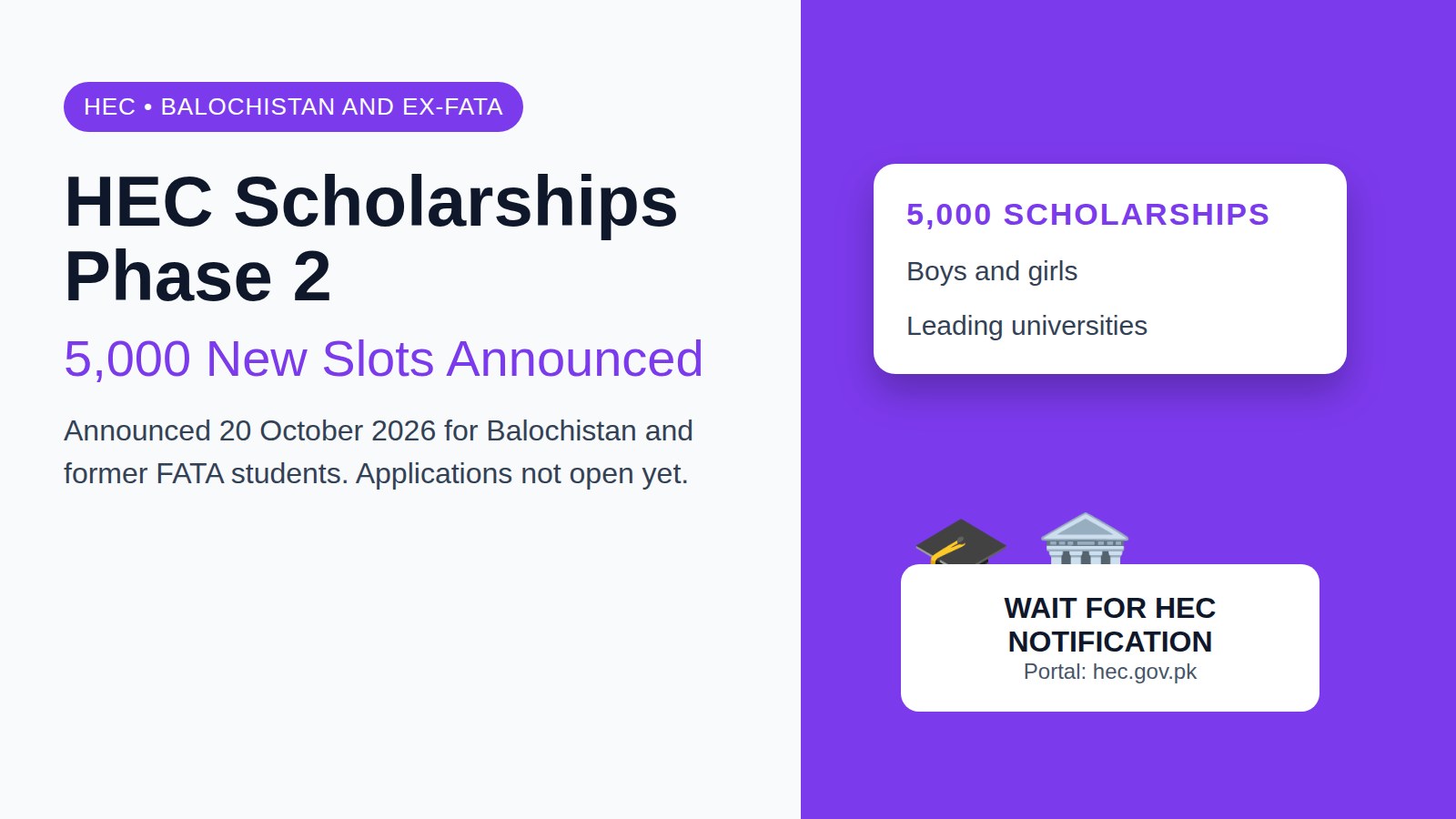
The HEC Balochistan ex-FATA scholarships Phase 2 are 5,000 additional scholarships for students from Balochistan and the former Federally Administered Tribal Areas (FATA) to pursue higher education at leading universities across Pakistan. Federal Minister for Planning Ahsan Iqbal announced the second phase in the National Assembly on Tuesday 20 October 2026. He said the programme would help talented students from the two regions reach universities that many families cannot afford on their own.
The announcement is a policy decision, not an application launch. It confirms the number of new slots, the two regions, and the administering body. It does not open applications, and it does not set the rules for who can apply. That distinction matters, because a student who treats the announcement as an open advertisement may pay an agent, share documents, or miss the real deadline when it appears.
The Higher Education Commission (HEC) will administer the scholarships. HEC is the federal body that runs higher education scholarships in Pakistan, and it has run earlier scholarship batches for Balochistan and erstwhile FATA students. The minister said education is the most effective way to overcome backwardness and promote development in underdeveloped areas.
Who announced the 5,000 scholarships and when?
Planning Minister Ahsan Iqbal announced the 5,000 scholarships while addressing the National Assembly on Tuesday 20 October 2026. He said the second phase of the scholarship programme had been launched, and that 5,000 additional scholarships would go to boys and girls from Balochistan and the former FATA. The announcement was reported by the Express Tribune on 21 October 2026 and by Radio Pakistan, as carried by The Asian Mirror on 22 October 2026.
The minister spoke in response to concerns raised by members of the House about development in Balochistan. In the same address, he said the government had earmarked Rs 200 billion in the development budget for projects in Balochistan, and he described that allocation as the largest for any province. The scholarship announcement sat within that wider development message, alongside plans for a solarisation initiative in the tribal districts and a programme to equip local youth with digital skills.
The wording of the announcement also matters. The minister said the programme had been introduced by the previous government, and that its second phase had now been launched. That history explains why reports call the new awards Phase 2, even though HEC already uses phase numbers for its own project. The two numbering systems do not match, and this guide explains that clash in the comparison section below.
Who are the scholarships for?
The scholarships are for boys and girls from Balochistan and the former FATA, now the merged tribal districts of Khyber Pakhtunkhwa. The announcement covers both regions and both genders, and it aims at students who want to study at leading universities across Pakistan. No district list or age limit was stated.
The target group is defined by place, not by subject. The minister did not name specific degrees, universities, or fields of study. Reports describe the awards as fully funded places at leading universities, but the announcement itself did not publish a coverage list, so readers should treat the phrase fully funded as a report description, not as a confirmed package. Tuition, stipend, books, hostel, and travel support will only be certain when HEC publishes the notification.
The regional focus is the point of the programme. Students in remote districts face costs that go beyond tuition, because the leading universities are often far from home. Accommodation, transport, and living costs can block a talented student even when the fee itself is covered. The programme is meant to close that gap for young people from the two most underserved regions in Pakistan's higher education landscape.
What is announced and what is still missing?
This is the most important section in this guide, because the gap between the announcement and the application is where confusion and scams grow. The table below is dated 11 November 2026. It separates what the minister confirmed on 20 October 2026 from what HEC has still to publish. Check it again when the official notification appears, because any row marked as missing can change in a single advertisement.
| Item | Status as of 11 November 2026 |
|---|---|
| Number of new slots | Announced: 5,000 additional scholarships |
| Regions covered | Announced: Balochistan and former FATA |
| Boys and girls included | Announced: both included |
| Announced by | Announced: Planning Minister Ahsan Iqbal, National Assembly, 20 October 2026 |
| Administered by | Announced: Higher Education Commission (HEC) |
| Study level and place | Announced in outline: higher education at leading universities across Pakistan; no university list published |
| Funding description | Reported as fully funded in news reports; no coverage list published by HEC |
| Split of the 5,000 slots between the two regions | Not announced |
| Eligibility criteria | Not announced |
| Domicile rules | Not announced for Phase 2 |
| Academic requirements | Not announced |
| Application portal | Not announced |
| Application deadline | Not announced |
| Test or selection process | Not announced |
| Scholarship coverage, tuition, stipend, books, hostel, travel | Not announced |
The pattern is clear. The announcement fixed the scale and the audience, and it left the process open. That is normal for a National Assembly statement, which sets policy while the administering body writes the rules. It also means no one can apply yet, and no one can confirm whether they qualify. A social media post that names a deadline, a portal link, or an eligibility rule for these 5,000 slots is guessing, unless it quotes the official HEC notification.
How does Phase 2 compare with earlier phases?
The comparison below uses HEC's own published history for its Balochistan and erstwhile FATA scholarship project, and it keeps that history separate from the new announcement. The minister called the October 2026 announcement the second phase of a programme introduced by the previous government. HEC, however, already numbers its own project in phases, and those numbers tell a different story.
| HEC project phase | Launch and approval | Scholarships planned or awarded |
|---|---|---|
| Phase I | Approved in October 2007, launched to provide 2,000 scholarships | Completed; 2,002 scholarships awarded in HEC reporting |
| Phase II | Approved by the Central Development Working Party in October 2015 | Aimed at 3,500 scholarships, 2,500 undergraduate and 1,000 postgraduate; 3,341 awarded |
| Phase III | Approved in January 2023 | Aims at 5,000 undergraduate scholarships; 3,000 awarded in Batches I to III by March 2026, with further batches to follow |
| October 2026 announcement | Announced 20 October 2026 by Ahsan Iqbal as a second phase | 5,000 additional scholarships announced; eligibility, deadline, portal, and coverage not yet announced |
HEC reported on 6 March 2026 that it had awarded 8,343 scholarships to Balochistan and erstwhile FATA students under the project to date. It also said the selection of 1,000 undergraduate scholarships for session 2025-26 was in its final stage, and that another 1,000 undergraduate scholarships would be awarded for academic session 2026-27. Those figures describe the earlier project, not the 5,000 slots announced in October 2026. Do not add them together.
The earlier phases also show what a full HEC advertisement normally contains. Past batches under the project offered undergraduate scholarships at HEC recognised public and private sector universities and degree awarding institutions across Pakistan, for students who held a valid domicile or local certificate from Balochistan or erstwhile FATA. Those past rules are useful background, but they are not the rules for the new 5,000 slots. Students should not assume that a past deadline, age limit, or marks threshold will apply again until HEC says so in the new notification.
What should students prepare while they wait?
Preparation is the right response to an announcement with no deadline yet. The steps below do not submit an application, because no application is open. They put a student in a position to apply quickly and correctly when HEC publishes the notification.
- Confirm your domicile or local certificate is valid and matches your region. Past HEC batches for Balochistan and erstwhile FATA required a valid domicile or local certificate from one of the two areas, and the certificate had to be signed by the district administration. The new notification may set a different rule, but a valid certificate is the most likely first check, so renew or correct it now if it has an error.
- Keep your CNIC or B-Form ready, and make sure the name and date of birth match your academic records. A mismatch between identity documents and certificates is a common cause of delay, and it is easier to fix at NADRA now than under a deadline.
- Gather your academic transcripts and certificates, from Matriculation through Intermediate or an equivalent qualification. Keep clear scanned copies as well as the originals, because HEC applications in past batches were online only, and hard copies were not accepted.
- Secure admission, or at least shortlist HEC recognised universities that offer your chosen subject. Past batches required study at a recognised institution, and admission and scholarship funding were separate decisions.
- Keep a record of your academic results and any test scores, and note the dates on which each result was issued. Past HEC guidance said result awaiting students were not eligible for earlier batches, but that rule may not apply to the new slots, so keep the facts ready and wait for the notification.
- Watch the official HEC website and the Ministry of Planning, Development and Special Initiatives for the formal advertisement, and read it in full before you submit anything.
- Do not pay anyone who claims to register you, reserve a slot, or speed up your application. Government scholarships do not charge for registration through agents, and a fee paid to a stranger cannot be recovered. If you need help, call the HEC helpline for scholarship queries on 051-111-119-432, as listed on official HEC guidance.
How is this different from the HEC MBBS and BDS admissions change?
This announcement is separate from the HEC MBBS and BDS admissions change for Balochistan and FATA students for session 2026-27, which is covered in a separate live post. That change, announced on 5 November 2026, split medical admission from scholarship funding. Admitting universities now handle MBBS and BDS admissions directly, using seat allocations approved by the Pakistan Medical and Dental Council, while HEC funds only the candidates it selects through its merit based scholarship process. It applies to medical and dental seats under the Phase-III project, and it has its own dates, portals, and merit rules.
The 5,000 scholarships announced on 20 October 2026 are a wider higher education announcement, not a medical admission rule. They cover leading universities across Pakistan, and they do not name MBBS or BDS, a medical college, or a seat allocation. A student who wants medicine should read the HEC MBBS BDS admissions Balochistan FATA 2026-27 guide for the medical track, and treat this Phase 2 announcement as a separate funding opportunity. Do not mix the two sets of dates, because the medical admission windows close on university timetables, while the Phase 2 application window has not even opened yet.
The two announcements also show why the source matters. The MBBS and BDS change came with a dated HEC announcement and university notices that named portals and deadlines. The Phase 2 announcement came as a National Assembly statement, with no portal and no deadline. That difference reflects two different kinds of decision, one an administrative change with immediate effect, and the other a policy launch that still needs a formal advertisement.
What mistakes and scams should applicants avoid?
The most costly mistake is to act on a deadline or portal link that HEC has not published. Unofficial pages already carry claims about the split of the 5,000 slots, the coverage package, and the eligibility rules. One site claims the slots are evenly distributed between male and female applicants, and another claims full tuition, living stipends, and book allowances throughout the degree. Neither claim appears in the reports of the minister's announcement, and the Asian Mirror report states plainly that the announcement did not specify how the slots would be distributed between the two regions. Treat those claims as unverified until HEC confirms them.
A second mistake is to pay an agent or a page that promises a guaranteed slot. No agent can reserve a government scholarship, and no payment can move an application ahead of merit. Government scholarships do not charge for registration through agents, and a student who pays loses the money and still has no application. Keep your CNIC, domicile, login details, and academic documents private, and do not share them with a stranger who contacts you first.
A third mistake is to copy the rules from an earlier HEC batch and assume they apply now. Past batches had their own deadlines, age limits, marks thresholds, test fees, and coverage amounts, and those details change with each advertisement. The safest habit is to read the new notification in full, note its closing date and its document list, and apply only through the portal it names.
How does this compare with other Pakistani scholarships?
The HEC Balochistan ex-FATA scholarships Phase 2 are defined by region, while most other scholarships are defined by need, merit, province, or gender. That difference helps a student decide which programmes to watch alongside this one. The Ehsaas Undergraduate Scholarship is a need based programme for undergraduate students across Pakistan, so it covers a wider group but does not reserve places for Balochistan and ex-FATA students. The CM Punjab Honhaar Scholarship Program 2026 is a Punjab merit scholarship, so it does not cover Balochistan or FATA students.
The Scotland Pakistan Scholarships for Young Women and Girls support women and girls in specific fields, so they suit a narrower group than the Phase 2 announcement, which covers boys and girls. Students from Balochistan should also look at the Balochistan Youth Employment Programme and the CM Balochistan Youth Skills Scheme 2026, which support jobs and skills rather than university funding. The KP Education Endowment Fund Scholarship 2026-27 and the KP EEF Scholarships 2026 1,000 Students are provincial options for students in Khyber Pakhtunkhwa, and they run on their own timetables and rules. None of these programmes replaces the Phase 2 announcement, and none of them opens its application for it.
Frequently asked questions
What are the HEC Balochistan ex-FATA scholarships Phase 2?
They are 5,000 additional scholarships announced on 20 October 2026 for boys and girls from Balochistan and the former FATA to study at leading universities across Pakistan. Planning Minister Ahsan Iqbal announced the second phase in the National Assembly, and HEC will administer the programme.
Are applications open for the 5,000 HEC Balochistan ex-FATA scholarships?
No. Applications are not open yet. HEC has not published an application portal, a deadline, or eligibility criteria for these 5,000 slots, and students should wait for the official HEC notification before they apply.
Who is eligible for the HEC Balochistan ex-FATA scholarships Phase 2?
The announcement targets students from Balochistan and the former FATA, including both boys and girls. Detailed eligibility criteria, domicile rules, and academic requirements have not been announced yet, so no student can confirm eligibility until HEC publishes the notification.
What is the last date to apply for the Phase 2 scholarships?
No deadline has been announced. The 20 October 2026 announcement launched Phase 2 as a policy decision, and the application window will be set in the official HEC notification that follows.
How do I apply for the HEC Balochistan ex-FATA scholarships Phase 2?
No application process has been announced yet. When HEC publishes the advertisement, it is expected to name the portal and the steps, and students should apply only through that official channel. Do not pay anyone who claims to register you now.
What will the Phase 2 scholarships cover?
Coverage details have not been announced. News reports describe the awards as fully funded, but HEC has not published a list covering tuition, stipend, books, hostel, or travel. The exact package will be confirmed only in the official notification.
How will the 5,000 slots be split between Balochistan and ex-FATA?
The split has not been announced. The minister's announcement did not specify how the additional scholarships would be distributed between the two regions, and any figure seen on an unofficial page is unverified until HEC confirms it.
Is this the same as the HEC MBBS and BDS admissions change for Balochistan and FATA?
No. The MBBS and BDS change, announced on 5 November 2026, is a separate medical admission rule for session 2026-27. The Phase 2 announcement of 20 October 2026 is a wider higher education scholarship launch, and it does not name MBBS or BDS seats.
What documents should I prepare while I wait?
Keep your domicile or local certificate, CNIC or B-Form, academic transcripts, and admission record ready, and make sure the names and dates match across them. These are the documents past HEC batches asked for, but the new notification may set a different list, so treat this as preparation, not as a confirmed requirement.
Where should I check for official updates on the Phase 2 scholarships?
Check the official HEC website and the Ministry of Planning, Development and Special Initiatives for the formal advertisement. You can also call the HEC helpline for scholarship queries on 051-111-119-432. Do not rely on social media forwards or agents for dates, portals, or merit lists.
Sources and official links
Check the destination address before entering personal information.
Related guides
HEC MBBS BDS Admissions Balochistan FATA 2026-27: What Changed and How to Apply
For session 2026-27, admitting universities handle MBBS and BDS admissions for Balochistan and erstwhile FATA students under the HEC Phase-III project, using PMDC approved seat allocations and their own admission rules. HEC funds only candidates it selects through its merit based scholarship process. It does not admit students, allocate seats, or place them in colleges.
Read guide
Ehsaas Undergraduate Scholarship 2026 Online Apply: HEC Portal Check, 100% Tuition Fee & Rs 4,000 Stipend Guide
Apply online for HEC Ehsaas Undergraduate Scholarship 2026 on ehsaas.hec.gov.pk. Learn how to secure 100% full tuition fee coverage, Rs 4,000 monthly stipend, prepare university FAO documents, and clear the ISAC interview.
Read guide
CM Punjab Honhaar Merit Scholarship Program 2026: Online Apply, Eligibility & 100% Tuition Fee Guide
To apply online for the CM Punjab Honhaar Merit Scholarship Program in 2026, register on the official portal at honhaarscholarship.punjabhec.gov.pk using your CNIC/B-Form and academic registration details. The Government of Punjab provides 100% full tuition fee coverage for 30,000 undergraduate students enrolled in 68 priority disciplines across 50 public universities and medical colleges.
Read guide
Scotland Pakistan Scholarships for Young Women and Girls: Complete Eligibility, Benefits, and Application Guide
The Scotland Pakistan Scholarships for Young Women and Girls is a fully funded financial aid program funded by the Scottish Government and administered by the British Council Pakistan. It covers university tuition, hostel accommodation, and travel for eligible female Pakistani students pursuing undergraduate or master's degrees at HEC-recognized universities inside Pakistan.
Read guide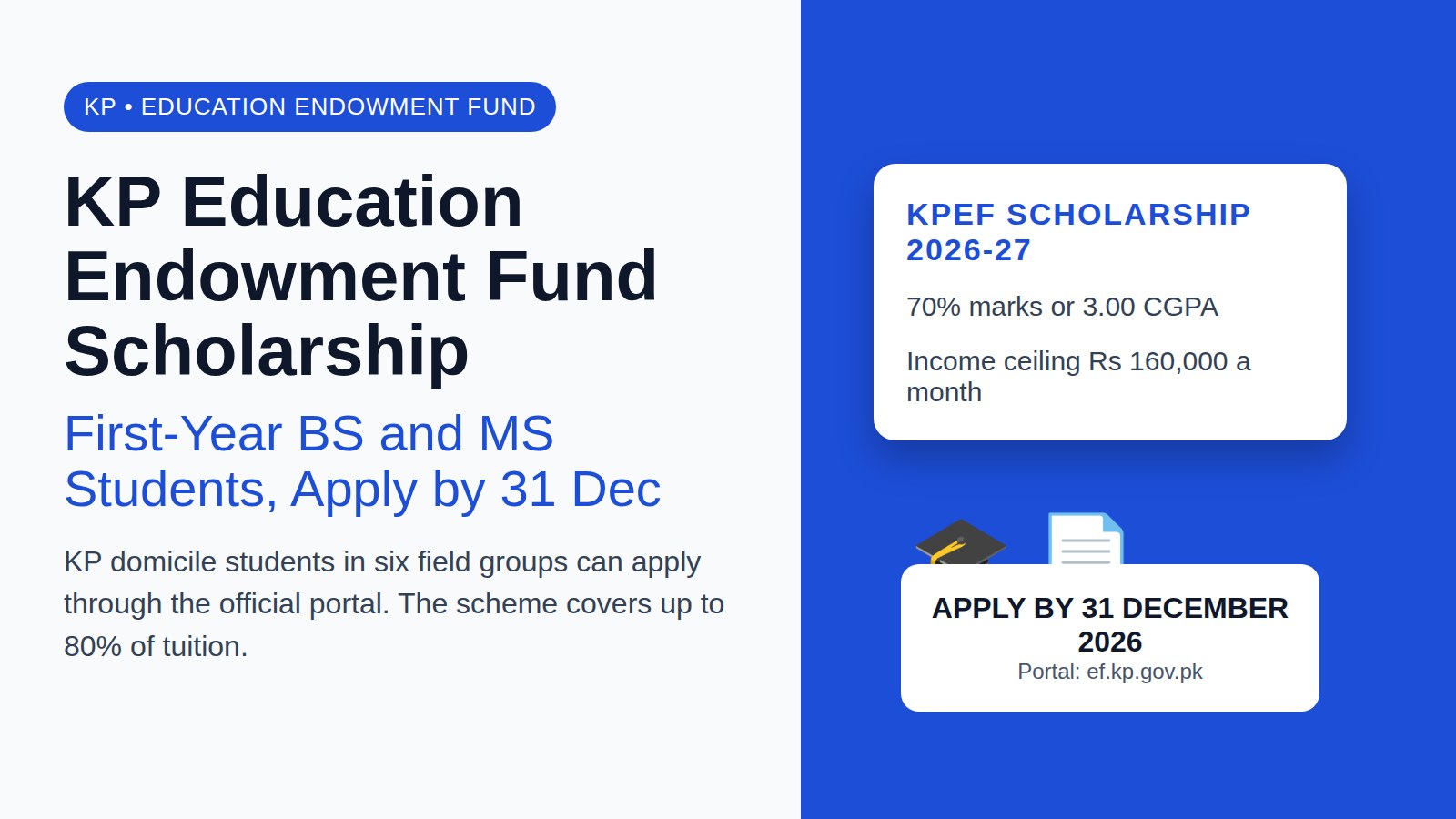
KP Education Endowment Fund Scholarship 2026-27: First-Year BS and MS Students Can Apply by 31 December
The KP Education Endowment Fund Scholarship 2026-27 supports first-year BS and MS students from Khyber Pakhtunkhwa with at least 70% marks or a 3.00 CGPA and family income of Rs 160,000 a month or less. It covers up to 80% of tuition fees. Apply only through the official KPEF online portal before 31 December 2026.
Read guide