This article explains public information. It does not determine eligibility or replace an official notice.
What is the new procedure for HEC MBBS BDS admissions Balochistan FATA 2026-27?
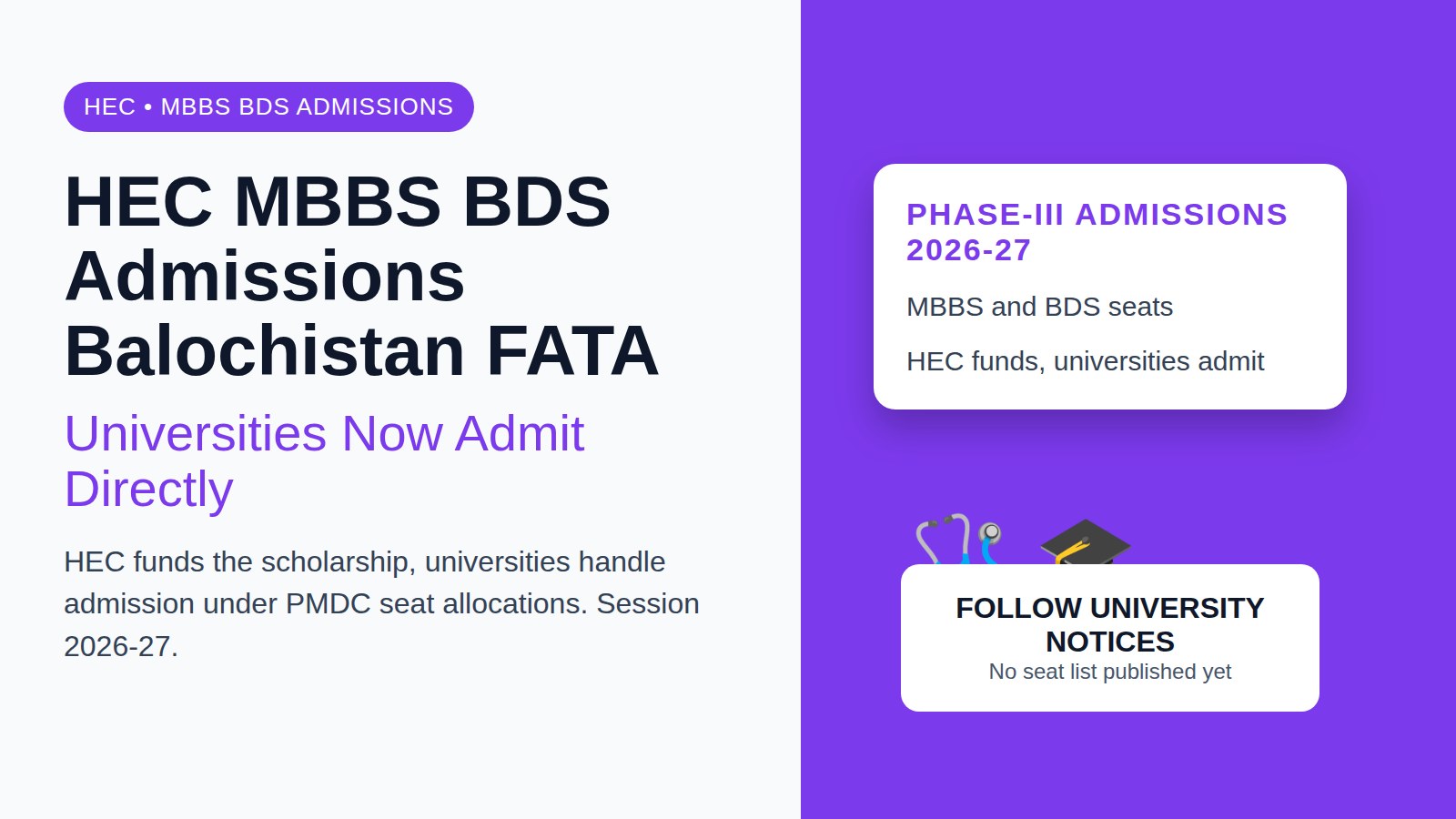
The new procedure splits one journey into two separate tracks. The admitting university decides admission, and HEC decides scholarship funding. A student must succeed on both tracks to study medicine or dentistry with HEC support. The Higher Education Commission (HEC) announced the change on 5 November 2026 for the project called Provision of Higher Education Opportunities for the Students of Balochistan and Erstwhile FATA (Phase-III), for academic session 2026-27. The change also applies to later sessions, not only to 2026-27.
What exactly changed on 5 November 2026?
From session 2026-27, admissions to MBBS and BDS under the Phase-III project are undertaken directly by the respective admitting universities. That is the core change, as reported by Islamabad Post on 5 November 2026 from the DNA news agency. Each university must follow the seat allocations approved by the Pakistan Medical and Dental Council (PMDC) and the applicable admission rules. HEC will provide scholarship funding to candidates it selects through its prescribed merit based process, and it will not be responsible for admission, seat allocation, or placement in medical colleges and universities.
What stayed the same?
The project itself has not changed. Phase-III still supports undergraduate study for students from Balochistan and erstwhile FATA, and MBBS and BDS remain within its scope. The HEC scholarship still runs on merit, and the general Phase-III rules still require a valid domicile or local certificate, 12 years of education, and an HEC test. The medical admission rules still come from PMDC and from each admitting university, so the MDCAT, FSc Pre-Medical marks, and domicile checks still decide who gets a seat. What changed is the route, not the goal.
Who does what now: HEC, the admitting university, and PMDC
Three bodies share the work, and each one controls a different part. Confusing their roles is the most common mistake in this process.
| Body | What it controls | What it does not control |
|---|---|---|
| Higher Education Commission (HEC) | Scholarship funding for candidates it selects through its merit based process | Admission, seat allocation, or placement in any medical college |
| Admitting university | Admission, merit lists, seat allocation within its approved seats, deadlines, and document checks | HEC scholarship selection or funding |
| Pakistan Medical and Dental Council (PMDC) | Approved seat allocations and the admission regulations that universities must follow | Individual admissions, merit lists, or scholarship awards |
HEC runs Phase-III and funds the students it selects. The admitting university runs its own portal, checks eligibility, builds the merit list, and offers the seat. PMDC sets the framework, including the Medical and Dental (Admissions, Curriculum and Conduct) Policy and Regulations 2026, which apply to session 2026-27 and later. The HEC frequently asked questions page states the same split: HEC offers the scholarship only and does not guarantee admission or placement on a reserved seat.
Who can apply for HEC MBBS BDS admissions Balochistan FATA 2026-27?
The scheme is for students from Balochistan and erstwhile FATA, which means the former Federally Administered Tribal Areas, now the tribal districts of Khyber Pakhtunkhwa. Two different sets of eligibility rules apply, and both must be met. The HEC scholarship has its own rules, and the admitting university has its own admission rules. Meeting one set does not satisfy the other.
Which domicile and region rules apply?
For the HEC scholarship, the applicant must hold a valid domicile or local certificate from Balochistan or erstwhile FATA, and the father or guardian must hold one too. The certificate must be signed by the district administration, and applicants with a domicile from outside those two areas cannot apply. For the university admission, the applicant must provide verified proof of domicile or permanent residence that matches the quota they claim. A Balochistan applicant normally submits a local or domicile certificate issued by the competent district authority. For erstwhile FATA, universities have asked for domicile verification from the Deputy Commissioner or Assistant Commissioner.
Which academic and MDCAT rules apply?
For the general HEC Phase-III scholarship, the applicant must have completed 12 years of education with at least 60 percent marks, and must be aged 22 years or less on the closing date of the advertisement. Students awaiting results cannot apply, and students already receiving another HEC or government scholarship cannot apply. Those are HEC scholarship rules, not medical admission rules. For MBBS and BDS admission itself, the PMDC Regulations 2026 set the thresholds: at least 60 percent marks in HSSC or an IBCC recognised equivalent qualification, with Biology and Chemistry plus Physics or Mathematics, and at least 55 percent in MDCAT for MBBS and 50 percent for BDS. The University of Health Sciences (UHS) Lahore applies the same thresholds for its quota seats, and accepts a valid MDCAT result from 2024, 2025, or 2026. Its merit formula is 50 percent MDCAT, 40 percent HSSC Pre-Medical, and 10 percent Matriculation. Confirm the exact thresholds on the portal of the university you choose.
How to apply for HEC MBBS BDS admissions Balochistan FATA 2026-27
Apply on two tracks, and keep a separate record for each one. Track A is the university admission, and Track B is the HEC scholarship. Neither track replaces the other, and neither one guarantees the other.
Track A: secure admission at the admitting university
- Open the official admission portal of each university you want. Do not use a link from a social media post or a WhatsApp forward.
- Read that university's admission notice and prospectus for session 2026-27, and note its eligibility rules, quota categories, fee, and deadline.
- Create an account with your name, email, mobile number, and CNIC or Juvenile Card number.
- Enter your personal, domicile, Matriculation, FSc Pre-Medical, and MDCAT details, and select the correct quota category.
- Upload scanned copies of your photograph, domicile or local certificate, academic transcripts, and MDCAT scorecard.
- Pay the application fee through the method the university names, and keep the receipt.
- Submit before that university's deadline, save the acknowledgement, and check the portal for the merit lists and selection lists.
Track B: apply for HEC scholarship funding separately
- Watch the HEC website and the Phase-III page at hec.gov.pk/site/bf3 for the scholarship advertisement and its closing date.
- Submit the HEC scholarship application online only, through the HEC portal. HEC does not accept applications by courier or by hand.
- Upload attested copies of your CNIC or Juvenile Card, your own and your father or guardian's domicile or local certificate, and your educational documents.
- Pay the non-refundable test fee through the 1Link 1Bill Invoice service, then verify the payment and submit. Payment alone does not count as submission, so confirm you receive the acknowledgement email.
- Appear for the HEC aptitude test run by HEC or its Education Testing Council (ETC). Other entry tests do not replace it. You need at least 50 percent marks in that test to qualify.
- If provisionally selected, sign the prescribed legal bond and submit the acceptance form within one month of the offer, or the offer lapses.
The HEC merit score for the general scholarship is 50 percent academic record and 50 percent HEC or ETC aptitude test score, with 20 percent weight for SSC and 30 percent for HSSC. That is a different formula from the university merit formula for MBBS and BDS admission, which is 50 percent MDCAT, 40 percent HSSC, and 10 percent Matriculation. Do not mix the two formulas.
Which dates apply, and what has already closed?
The HEC announcement of 5 November 2026 does not publish a single application date, and there is no common closing date for every university. Each admitting university sets its own dates, so follow the notice of the university you choose. A student who waits for one national deadline will miss the real ones. The University of Health Sciences (UHS) Lahore opened MBBS quota applications on 26 October 2026 at 9:00 am, and closed them on 9 November 2026 at 5:00 pm. As of 10 November 2026, that MBBS quota window has closed. The same UHS notice puts BDS quota applications from 14 December 2026 at 9:00 am to 28 December 2026 at 5:00 pm, on a separate portal. The UHS provisional MBBS merit list is dated 13 November 2026, the final merit list 17 November 2026, and MBBS classes start on 1 February 2027. Those dates come from the UHS notice as reported by Ilm Ki Dunya, and they cover Punjab public medical and dental colleges only. They are not HEC dates, and they do not apply to other admitting universities.
How many MBBS and BDS seats are there for Balochistan and FATA students?
The HEC announcement of 5 November 2026 does not publish seat numbers. No national total for Balochistan and erstwhile FATA MBBS and BDS seats can be stated from that announcement, and this guide does not invent one. Seat numbers exist only at the level of each admitting university, inside the seat allocations approved by PMDC. The UHS Punjab quota is the clearest published example. UHS announced 252 reserved MBBS and BDS seats in Punjab public medical and dental colleges for 2026-27, with 214 for MBBS and 38 for BDS. Within that total, Balochistan holds 48 MBBS and 10 BDS seats, and former FATA holds 49 MBBS and 16 BDS seats. For Balochistan, the split is 20 goodwill MBBS seats plus 28 MBBS and 10 BDS seats under the HEC scholarship scheme. For former FATA, the split is 21 MBBS and 6 BDS general seats plus 28 MBBS and 10 BDS seats under the HEC scholarship scheme. These are UHS Punjab numbers only, not a national total, and they do not cover other admitting universities such as the National University of Medical Sciences (NUMS) or Shaheed Zulfiqar Ali Bhutto Medical University (SZABMU), which publish their own seat tables. The general Phase-III scholarship, across all undergraduate subjects, offers 1,000 scholarships in every batch, split 50:50 between Balochistan and erstwhile FATA. HEC reported on 6 March 2026 that it had awarded 8,343 scholarships under the project to date, and that another 1,000 would be advertised for session 2026-27. Those are programme totals, not MBBS and BDS seat counts.
What does the HEC scholarship pay for MBBS and BDS students?
HEC funds the candidates it selects, but the 5 November 2026 announcement does not state an amount for MBBS and BDS students. The amounts below come from the general Phase-III rules in the HEC frequently asked questions page, and they apply to the programme as a whole, not only to medicine. Confirm the exact support for a medical student with HEC. The general support is tuition and hostel charges up to Rs 200,000 per year, a living allowance of Rs 12,000 per month, a book allowance of Rs 10,000 per year, a travelling allowance of Rs 10,000 per year, and an initial settlement allowance of Rs 20,000 payable once. The scholarship is first awarded for one year or one semester, and it may extend for up to four or five years depending on the degree, subject to satisfactory academic performance. Medical and dental degrees run longer than four or five years in practice, so ask HEC how the duration rule applies to an MBBS or BDS student.
What changed in November 2026: the two track checklist
Use this checklist to test whether you have covered both tracks. A yes on one track and a no on the other means the application is not complete.
| Check | Track A: university admission | Track B: HEC scholarship |
|---|---|---|
| Who decides? | The admitting university | HEC, through its merit based process |
| Where do you apply? | The university admission portal | The HEC Phase-III portal |
| What proves eligibility? | MDCAT, FSc Pre-Medical, domicile, and the university rules | Domicile, 12 years of education, age, and the HEC test |
| What is the result? | A seat, shown on a merit or selection list | Funding, shown on an HEC selection or offer |
| Does one guarantee the other? | No | No |
Before 5 November 2026, many students and parents treated HEC selection as a route into a medical college. After the announcement, that reading is wrong. Secure the seat through the university first, or at least in parallel, and treat the HEC scholarship as funding for a seat you have already won. Keep copies of both applications, both receipts, and both acknowledgement emails, because the two tracks use different portals, different fees, and different lists.
What mistakes and scams should Balochistan and FATA applicants avoid?
The most costly mistake is to apply for the scholarship and skip the university portal. A second mistake is to apply to one university and assume its deadline covers every other university. A third mistake is to trust a single date, seat number, or merit list seen on an unofficial page. HEC urged candidates to follow official university announcements and to avoid unauthorised sources, because agents and fake pages target medical aspirants every year. Do not pay any agent who promises a seat or a scholarship, do not share your CNIC, domicile, or login details with a stranger, and do not pay a fee outside the payment method the university or HEC names. False information or forged documents can cancel an application or a scholarship at any stage, so check every detail before you submit, because the HEC form cannot be edited after submission.
How does this scheme compare with other Pakistani scholarships?
The HEC Phase-III scheme is different from most scholarships because it is tied to where you come from, not only to your marks. The Ehsaas Undergraduate Scholarship is a need based programme for undergraduate students across Pakistan. The CM Punjab Honhaar Scholarship Program 2026 is a Punjab merit scholarship, so it does not cover Balochistan or FATA students. The Scotland Pakistan Scholarships for Young Women and Girls support women and girls in specific fields. Students from Balochistan should also look at the Balochistan Youth Employment Programme and the CM Balochistan Youth Skills Scheme 2026, which support jobs and skills rather than medical admission. The KP Workers Welfare Fund Scholarship 2026 is for children of registered workers in Khyber Pakhtunkhwa, so it fits a different group.
Frequently asked questions
What is the new HEC procedure for MBBS and BDS admissions for Balochistan and FATA students in 2026-27?
From session 2026-27, admitting universities handle MBBS and BDS admissions directly, using PMDC approved seat allocations and their own admission rules. HEC provides scholarship funding only to candidates it selects through its merit based process.
Does HEC allocate MBBS and BDS seats or place students in medical colleges?
No. HEC states that it is not responsible for admission, seat allocation, or placement in medical colleges and universities. The admitting university allocates the seat, and HEC funds the candidates it selects.
Does HEC scholarship selection guarantee admission to MBBS or BDS?
No. Scholarship selection does not guarantee admission to any medical or dental programme. You must meet the admitting university's eligibility rules and secure a seat through its own process.
Who can apply under the HEC Phase-III project for MBBS and BDS?
Students with a valid domicile or local certificate from Balochistan or erstwhile FATA can apply, provided they meet the HEC scholarship rules and the admitting university's admission rules. The father or guardian must also hold a valid domicile or local certificate from the same area.
What MDCAT score do I need for MBBS and BDS admission in 2026-27?
Under the PMDC framework, you need at least 55 percent in MDCAT for MBBS and at least 50 percent for BDS. You also need at least 60 percent marks in HSSC Pre-Medical or an equivalent qualification, with Biology and Chemistry plus Physics or Mathematics.
How do I apply for MBBS and BDS admission under this procedure?
Apply directly through the admission portal of the university you want to join, and complete its eligibility checks, document uploads, fee payment, and submission before its deadline. Then follow the HEC Phase-III scholarship process separately for funding.
What is the last date to apply for HEC MBBS BDS admissions Balochistan FATA 2026-27?
There is no single last date in the HEC announcement of 5 November 2026. Each admitting university sets its own deadline. For example, the UHS MBBS quota window closed on 9 November 2026, while its BDS quota window runs from 14 December to 28 December 2026.
How many MBBS and BDS seats are available for Balochistan and FATA students?
The HEC announcement does not publish seat numbers. Each admitting university publishes its own seat table within the PMDC approved allocation. For example, UHS Punjab lists 48 MBBS and 10 BDS seats for Balochistan and 49 MBBS and 16 BDS seats for former FATA.
What does the HEC Phase-III scholarship pay?
Under the general Phase-III rules, support includes tuition and hostel charges up to Rs 200,000 per year, a living allowance of Rs 12,000 per month, a book allowance of Rs 10,000 per year, a travelling allowance of Rs 10,000 per year, and a one time settlement allowance of Rs 20,000. Confirm the exact support for a medical student with HEC.
Where should I check for official updates on HEC MBBS BDS admissions?
Check the HEC website and the Phase-III page at hec.gov.pk/site/bf3, and check the official admission portal of each admitting university you apply to. Do not rely on unauthorised sources, agents, or social media forwards for dates, seats, or merit lists.
Sources and official links
Check the destination address before entering personal information.
Related guides

Scotland Pakistan Scholarships for Young Women and Girls: Complete Eligibility, Benefits, and Application Guide
The Scotland Pakistan Scholarships for Young Women and Girls is a fully funded financial aid program funded by the Scottish Government and administered by the British Council Pakistan. It covers university tuition, hostel accommodation, and travel for eligible female Pakistani students pursuing undergraduate or master's degrees at HEC-recognized universities inside Pakistan.
Read guide
Ehsaas Undergraduate Scholarship 2026 Online Apply: HEC Portal Check, 100% Tuition Fee & Rs 4,000 Stipend Guide
Apply online for HEC Ehsaas Undergraduate Scholarship 2026 on ehsaas.hec.gov.pk. Learn how to secure 100% full tuition fee coverage, Rs 4,000 monthly stipend, prepare university FAO documents, and clear the ISAC interview.
Read guide
CM Punjab Honhaar Merit Scholarship Program 2026: Online Apply, Eligibility & 100% Tuition Fee Guide
To apply online for the CM Punjab Honhaar Merit Scholarship Program in 2026, register on the official portal at honhaarscholarship.punjabhec.gov.pk using your CNIC/B-Form and academic registration details. The Government of Punjab provides 100% full tuition fee coverage for 30,000 undergraduate students enrolled in 68 priority disciplines across 50 public universities and medical colleges.
Read guide
Balochistan Youth Employment Programme: 25,000 Jobs, Training and Overseas Skills
The Balochistan Youth Employment Programme aims to create opportunities for 25,000 young people through 6,000 advertised federal vacancies and technical training for 10,000 more. As of 9 November 2026, no application portal, deadline or eligibility list has been published yet, so watch NAVTTC and B-TEVTA announcements and ignore agents who promise a place.
Read guide
CM Balochistan Youth Skills Scheme 2026 Online Apply & Registration Guide
Apply online for CM Balochistan Youth Skills Scheme 2026. Complete guide to B-TEVTA online registration, courses, monthly stipends, and 30,000 overseas jobs.
Read guide