This article explains public information. It does not determine eligibility or replace an official notice.
What is the CM Punjab School Meal Program 2026?
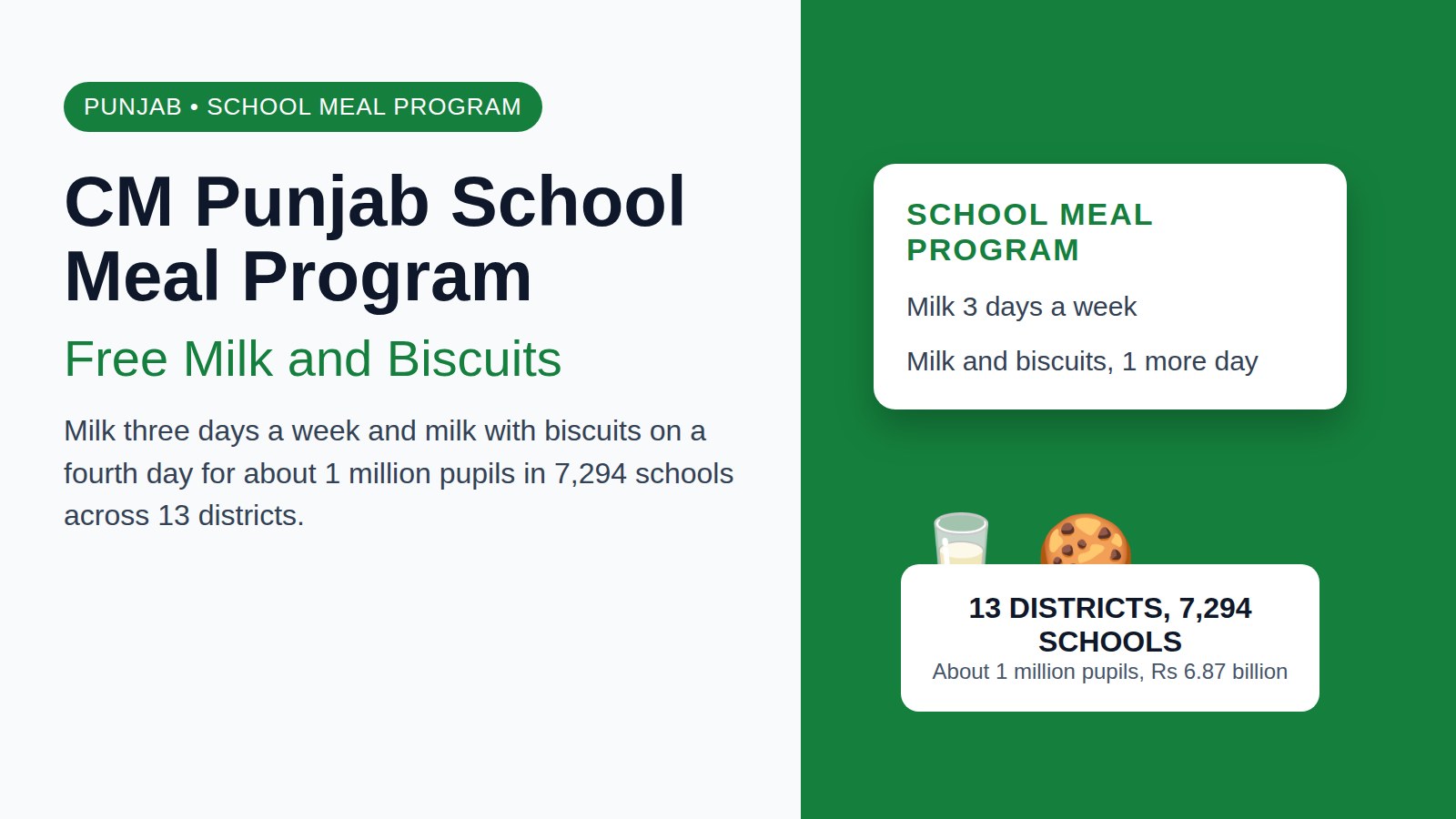
The CM Punjab School Meal Program 2026 is a Punjab government scheme that gives free milk and biscuits to children in government schools. It targets districts where poverty and poor nutrition affect attendance and learning. The aim is simple. A hungry child cannot focus in class, so the program feeds children during school hours.
The Punjab School Education Department of the Government of Punjab runs the program. The Punjab Food Authority has a role in menu design and monitoring. The Chief Minister of Punjab, Maryam Nawaz Sharif, approved the current phase.
How the program helps children learn
Poor nutrition affects growth, energy and focus. Children who miss breakfast or eat too little often struggle to sit through lessons. A milk pack during school hours gives them energy and a reason to attend each day. Parents in low income areas also gain a reason to keep children enrolled.
The program links food with schooling in a direct way. It does not pay cash to families. It gives food to children at school, so a child must be at school to receive the meal.
Which 13 districts are covered?
The current phase covers 13 districts in Punjab. The full list is Bahawalnagar, Bhakkar, Chiniot, Dera Ghazi Khan, Kot Addu, Layyah, Lodhran, Mianwali, Muzaffargarh, Rahim Yar Khan, Rajanpur, Taunsa and Vehari. These are largely southern and western Punjab districts, where need is reported to be highest.
Coverage is limited to specific government schools inside these districts. A district being on the list does not mean every school in that district is covered. The approved phase covers 7,294 schools in total across the 13 districts. No official per district school list was found at the time of writing, so parents should check with their child's school directly.
| District | In the pilot phase? | In the current 13 district phase? |
|---|---|---|
| Bahawalnagar | Yes | Yes |
| Bhakkar | Yes | Yes |
| Chiniot | No | Yes |
| Dera Ghazi Khan | Yes | Yes |
| Kot Addu | No | Yes |
| Layyah | Yes | Yes |
| Lodhran | No | Yes |
| Mianwali | Yes | Yes |
| Muzaffargarh | Yes | Yes |
| Rahim Yar Khan | Yes | Yes |
| Rajanpur | Yes | Yes |
| Taunsa | No | Yes |
| Vehari | No | Yes |
The table shows how the program grew. Eight districts were in the pilot phase listed on punjab.gov.pk. Five more districts joined as the program expanded to 13. Those five are Chiniot, Kot Addu, Lodhran, Taunsa and Vehari.
Is your district covered?
If your child's school is in one of the 13 districts above, ask the school head or class teacher whether the school is part of the program. The school can confirm the meal days for its own students. The Punjab School Education Department is the department to contact if the school cannot answer. No helpline number for parents was found in the sources checked for this guide. That gap is flagged in the coverage notes.
What do children get each week?
Children get milk three days a week. On one more day each week, they get milk plus biscuits. That is four serving days a week in total. The milk comes as a packaged milk pack, and the biscuits come as a fortified biscuit pack, according to the official PMIU-PESRP page.
The exact brand, pack size and biscuit type are not stated in the official sources checked. Some guides claim a 175 to 200 millilitre UHT milk pack and a 50 to 75 gram biscuit pack, with calorie and nutrient figures. Those figures were not verified against an official source, so this guide does not repeat them as fact.
What the meal is meant to do
The meal is a supplement, not a full lunch. It adds nutrition during school hours. It is not meant to replace breakfast or the main meal at home. The program targets undernourished children in government primary schools, with a focus on early grades.
How did the program grow from pilot to current phase?
The program started small and grew in steps. Reports differ on the exact early steps, so the timeline below keeps each figure tied to its source and date. The formal launch event took place on 1 February 2026. Chief Minister Maryam Nawaz Sharif launched the School Meal Programme at Government Primary School Kisanwala in Bhakkar. On the same visit, she inaugurated a Daanish School in Mankera, Bhakkar.
| Phase | Districts | Schools | Students | Meal schedule | Source and date |
|---|---|---|---|---|---|
| Early pilot, 2023 to 24 | 3 districts | Not stated | Not stated | Not stated | TechJuice, 28 Aug 2026 |
| Expansion, 2024 to 25 | 13 districts | Not stated | Not stated | Not stated | TechJuice, 28 Aug 2026 |
| Pilot, punjab.gov.pk page | 8 districts | 3,527 | 400,000 plus | Daily milk and biscuits | punjab.gov.pk, pilot page |
| Feb 2026 briefing | 13 districts | 8,319 | Not stated | Nutritious lunches, as briefed | The News, 1 Feb 2026 |
| Current phase, Sep 2026 | 13 districts | 7,294 | About 1.028 million | Milk 3 days, milk plus biscuits 1 day | Approved 28 Aug 2026, reported by Eduvision, Bloom Pakistan and TechJuice |
The table shows why readers see different numbers online. The school counts of 3,527, 8,319 and 7,294 belong to different phases and different dates. They are not the same count updated three times. The 8,319 figure comes from a February 2026 briefing. The 7,294 figure is the approved current phase count from August 2026. This guide uses 7,294 for the current phase and reports 8,319 only as the February 2026 figure.
Why the school count changed
The sources do not explain why the current phase covers 7,294 schools while the February 2026 briefing reported 8,319 schools. No official statement explaining the difference was found. This guide does not guess the reason.
Who gets the meals, and is there an application?
Children enrolled in a covered government school in one of the 13 districts get the meals. The program targets undernourished students in government primary schools. There is no separate test, no income form and no merit list for parents to join. Enrolment in a covered school is the route in.
There is no parent application. Children receive meals through their enrolled government school in a covered district. There is no form, no portal and no registration step. Do not pay anyone who offers to register your child for school meals. Do not share your CNIC or your child's details with any agent who claims to enrol children in this program.
If your child attends a private school, or a government school outside the 13 districts, the program does not cover them in the current phase.
What parents should ask the school
Ask the school head three questions. Is this school part of the School Meal Program. On which days do children receive milk and biscuits. Who should parents contact if a child misses a serving day. The answers vary by school, because delivery days and suppliers can differ. Keep the school's answer as your local source of truth, not a social media post.
What has the program achieved so far?
The News reported in February 2026 that 33.7 million milk packs and 12.2 million biscuit packets had been distributed. The same briefing said enrolment had risen by 28 per cent since launch, with 24,740 extra students enrolled. These figures come from a briefing by Education Minister Rana Sikandar Hayat to the Chief Minister. They are reported government figures, not independently verified counts. The official PMIU-PESRP page gives a different cumulative figure of more than 27,027,074 milk packs delivered. This guide reports both figures with their sources and does not merge them into one total.
Enrolment growth is the most quoted outcome. A 28 per cent rise sounds large, but it is a briefing figure tied to the February 2026 launch event. It does not prove that meals alone caused the rise. Other factors, such as school upgrades announced on the same visit, may also have played a part.
What happens to the empty milk packs?
Empty milk packs are collected and recycled. The News reported in February 2026 that more than 200,000 empty milk packs were being recycled to make furniture, notebooks and pencils. The Chief Minister saw desks made from recycled milk cartons during her visit to Government Primary School Kisanwala. Reports say the recycled furniture can withstand rain and high temperatures and can last for many years.
The official PMIU-PESRP page reports more than 120,000 kilograms of material recycled. The punjab.gov.pk pilot page says funds from recycling are used for the welfare and development of the participating schools. The exact amounts raised and how they were spent were not found in an official source.
How is the program run and checked?
The Punjab School Education Department runs the program. The PMIU-PESRP, the Programme Monitoring and Implementation Unit of the Punjab Education Sector Reform Programme, is listed as the implementing agency on the official PMIU-PESRP page. The Punjab Food Authority has a role in menu design and monitoring, according to competitor guides. That role was not confirmed on an official Punjab Food Authority page in the sources checked, so it is stated as reported.
District education authorities oversee delivery to schools. Suppliers deliver milk packs and biscuit packets to schools, and schools distribute them to children during school hours. The exact supplier names, delivery frequency and quality checks were not published in the sources checked. No public dashboard showing daily delivery by school was found, and no official list of covered schools by district was found.
What does the program cost, and who pays?
The current phase budget is Rs 6.87 billion for the current financial year. The Punjab government pays for the program from public funds. The budget covers procurement, packaging, transport and monitoring, according to competitor guides. The exact split between those costs was not published in the sources checked. An older PMIU-PESRP page lists Rs 6,999.751 million for an earlier approval, not for the August 2026 phase. Do not add the two budgets together.
How is this different from other Punjab school schemes?
Punjab runs several school schemes, and parents often mix them up. The School Meal Program gives food to children at school. It does not pay cash, does not build schools and does not give scholarships. The schemes below work differently, and each has its own rules.
Daanish Schools are residential schools for children from low income families. The Chief Minister inaugurated a Daanish School in Mankera, Bhakkar, on the same day she launched the meal program. Daanish Schools provide schooling and boarding, not just a meal. Read our guide on Daanish Schools construction and admission for the admission rules.
Do not confuse the meal program with a cash scheme
No cash is paid under the School Meal Program. No card is issued. No bank account is needed. If a message promises cash from the School Meal Program, it is false. Cash stipends for school children come through Benazir Taleemi Wazaif and other cash programs, not through this meal program. The Schools of Eminence program upgrades selected government schools, and does not give daily meals. A child can attend a School of Eminence and also receive school meals if that school is covered. Read our guide on Nawaz Sharif Schools of Eminence Punjab. Benazir Taleemi Wazaif pays money to families, while the meal program gives food at school. Read our guide on Benazir Taleemi Wazaif check online by CNIC.
What should parents do if their child's school is not covered?
First, confirm the facts with the school. Ask whether the school is on the program list for the current phase. A school in a covered district may join in a later phase. Do not rely on a neighbour's claim or a social media list.
Second, keep the child enrolled and attending. A child who drops out will miss the meals even if the school later joins.
Third, ask the district education office about future expansion. Some guides claim the program will expand to all 36 districts of Punjab. That claim was not verified against an official announcement, so this guide does not give a date for expansion. The official PMIU-PESRP page mentions a scale up to 14 districts through a revised PC-I, which conflicts with the 13 district current phase.
What to watch out for, scams and wrong claims?
The most common wrong claim is a fake registration form. There is no form for this program, so any form that asks for a fee or CNIC details for school meals is fake. Do not fill it in. Do not pay any agent. The program reaches children through their school, not through an agent or a website.
A second wrong claim is a fake district list. Some social media posts add districts that are not in the approved 13. The approved list is Bahawalnagar, Bhakkar, Chiniot, Dera Ghazi Khan, Kot Addu, Layyah, Lodhran, Mianwali, Muzaffargarh, Rahim Yar Khan, Rajanpur, Taunsa and Vehari. Attock appears on the older PMIU-PESRP page but is not in the August 2026 approved list of 13. Do not trust a list that adds districts without an official source.
A third wrong claim is a fake meal schedule. The current phase gives milk three days a week and milk plus biscuits on one more day. Claims of a full daily lunch, meat meals or cash in place of meals do not match the approved schedule.
Frequently asked questions
What is the CM Punjab School Meal Program 2026?
It is a Punjab government program that gives free milk and biscuits to children in government schools in 13 districts. The Punjab School Education Department runs it, and the current phase was approved on 28 August 2026 with a budget of Rs 6.87 billion.
Which districts are covered by the CM Punjab School Meal Program 2026?
The 13 districts are Bahawalnagar, Bhakkar, Chiniot, Dera Ghazi Khan, Kot Addu, Layyah, Lodhran, Mianwali, Muzaffargarh, Rahim Yar Khan, Rajanpur, Taunsa and Vehari. Only specific government schools inside these districts are covered.
How do I apply for the CM Punjab School Meal Program for my child?
You do not apply. There is no form, no portal and no registration step. Your child receives meals through their enrolled government school if that school is covered in one of the 13 districts.
What food do children get under the program?
Children get milk three days a week, plus milk and biscuits on one more day each week. The milk comes as a packaged milk pack and the biscuits as a fortified biscuit pack, according to the official PMIU-PESRP page.
How many schools and students are covered in the current phase?
The current phase covers 7,294 government schools and about 1.028 million students. An earlier February 2026 briefing reported 8,319 schools, but that figure belongs to that briefing and not to the August 2026 approved phase.
When did the CM Punjab School Meal Program start?
The formal launch event took place on 1 February 2026 at Government Primary School Kisanwala in Bhakkar, where Chief Minister Maryam Nawaz Sharif launched the program. The program had earlier roots in a pilot that reports date to the 2023 to 24 financial year, and the current phase runs from September 2026.
Who runs the CM Punjab School Meal Program?
The Punjab School Education Department runs the program, with PMIU-PESRP listed as the implementing agency. The Punjab Food Authority is reported to have a role in menu design and monitoring, but that role was not confirmed on an official Punjab Food Authority page.
Is the CM Punjab School Meal Program free?
Yes, it is free for children in covered schools. There is no fee, no card and no payment. Anyone who asks for money to enrol a child in the program is running a scam.
Does the program cover private schools?
No. The program covers government schools only, and only specific government schools in the 13 listed districts. Private school children are not covered in the current phase.
Will the program expand to all districts of Punjab?
No official date for expansion to all districts was found. Some guides claim the program will reach all 36 districts, but that claim is not verified. The current approved phase covers the 13 districts listed in this guide.
Sources and official links
Check the destination address before entering personal information.
Related guides
Daanish Schools Construction Admission: What Was Ordered and Who Qualifies
On 31 October 2026, Prime Minister Shehbaz Sharif ordered Daanish Schools construction across Pakistan to run around the clock, with no compromise on quality. Admission stays strictly merit-based for children from the poorest and most deserving families. No new admission dates were published in the reports reviewed, so families should wait for an official announcement.
Read guide
Nawaz Sharif Schools of Eminence Punjab: 300 Modern Public Schools Explained
Nawaz Sharif Schools of Eminence are 300 upgraded public schools being built across Punjab by the Punjab Education Foundation. Each campus has air-conditioned classrooms, AI laboratories and science labs, with classes capped at 30 students. Families earning up to Rs 200,000 a month get free education.
Read guide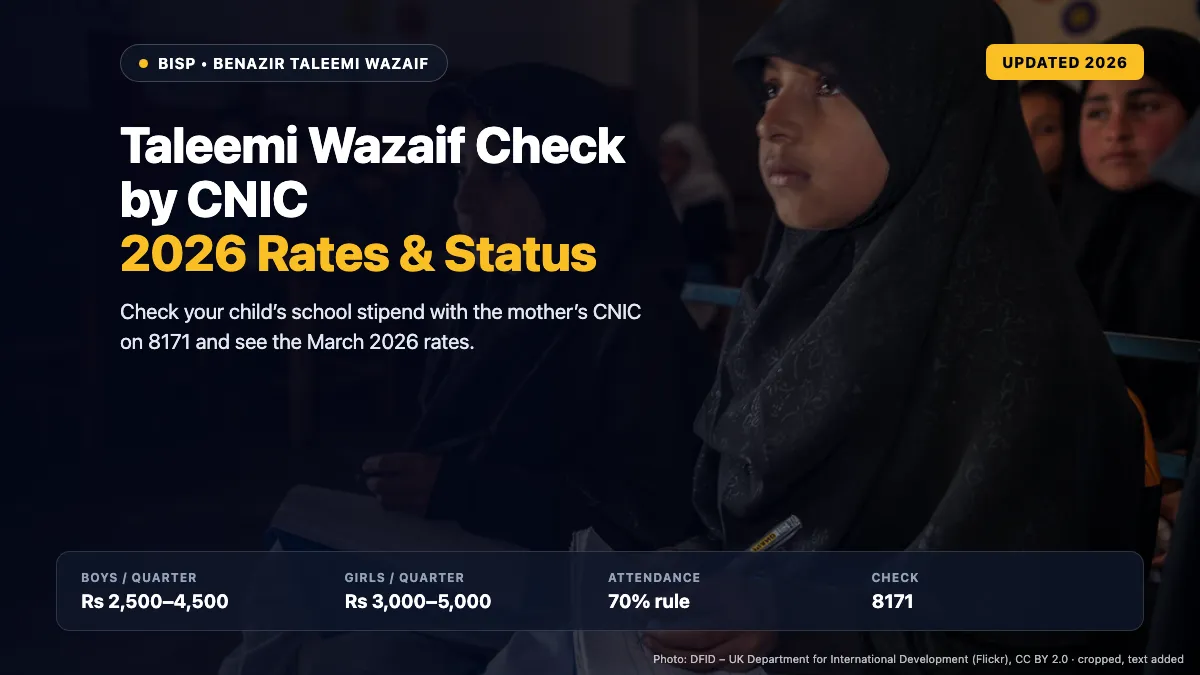
Benazir Taleemi Wazaif Check Online by CNIC 2026
To check Benazir Taleemi Wazaif online by CNIC in 2026, enter the mother's 13-digit CNIC without dashes on 8171.bisp.gov.pk, or SMS it to 8171 for the family's status. Since March 2026, quarterly stipends are Rs 2,500–4,500 for boys and Rs 3,000–5,000 for girls, paid per child.
Read guide
CM Punjab Honhaar Merit Scholarship Program 2026: Online Apply, Eligibility & 100% Tuition Fee Guide
To apply online for the CM Punjab Honhaar Merit Scholarship Program in 2026, register on the official portal at honhaarscholarship.punjabhec.gov.pk using your CNIC/B-Form and academic registration details. The Government of Punjab provides 100% full tuition fee coverage for 30,000 undergraduate students enrolled in 68 priority disciplines across 50 public universities and medical colleges.
Read guide
CM Punjab Free Laptop Scheme 2026 Online Apply: Maryam Nawaz Portal, Eligibility & Merit List Guide
Apply online for CM Maryam Nawaz Free Laptop Scheme 2026 at laptop.punjab.gov.pk. Check eligibility, merit CGPA, documents, and 110,000 laptop distribution.
Read guide