This article explains public information. It does not determine eligibility or replace an official notice.
What the October 2026 Report Actually Says
The headline removal figure
The Ministry of Poverty Alleviation and Social Safety reported the figures to the National Assembly, in reports dated 23 October 2026. The ministry said 2,259,404 ineligible beneficiaries were removed from the Benazir Income Support Programme (BISP) in the fiscal year that ended on 30 June 2026. That covers the full fiscal year, not a single payment cycle.
The same report said payments to more than 800,000 people identified as ineligible were stopped. Removal and a stopped payment are not the same action. A payment can stop while a record is checked, and a removed record is no longer counted as active.
What removal means in practice
Removal means BISP no longer treats the record as eligible. It does not automatically mean the person committed fraud, and it does not by itself settle whether money must be repaid. Each case depends on why the record was flagged.
That distinction matters. No headline can tell you about your own record. Only a status check through an official channel, or a visit to a BISP office, can do that.
Complaints received in the same year
The ministry also reported 55,579 complaints in that fiscal year about unauthorised deductions, embezzlement and unauthorised disbursement. Those complaints describe problems in how money was handled, not only who was on the list. Keep payment receipts and report a short payment at once.
If an agent deducts money, read how to complain about a BISP agent deduction before you pay anyone to fix it.
Why Two Different Sets of Figures Appear
The ministry report and the Auditor General audit are not the same document
Two different exercises produced the two sets of figures, and mixing them up causes most of the confusion. The first is the ministry report, reported on 23 October 2026, covering removals from 1 July 2025 to 30 June 2026. The second is the Auditor General of Pakistan audit report for fiscal year 2024-25, reported in June 2026, which measures financial exposure in compromised cases.
The ministry report describes a cleanup exercise. The audit looks back at payments already made and at system weaknesses. They answer different questions, so their totals should never be added together.
A side by side comparison
| Exercise | Period covered | Headline finding |
|---|---|---|
| Ministry report to the National Assembly | 1 July 2025 to 30 June 2026 | 2,259,404 ineligible beneficiaries removed; payments to more than 800,000 people stopped |
| Auditor General audit report | Fiscal year 2024-25 | Financial exposure of more than Rs 25 billion across 601,850 compromised cases |
| Fiscal year 2019-20 audit finding cited in the ministry report | Fiscal year 2019-20 | 140,488 government employees and family members identified as availing benefits |
The 2019-20 figure is the oldest of the three. Check the year first.
Who Was Flagged and Why
Government employees and their spouses
A federal cabinet directive dated 24 December 2019 excluded civil servants and their spouses from BISP. Despite that directive, the Auditor General audit found Rs 515.712 million paid in fiscal year 2024-25 to 12,078 government employees, pensioners or spouses under the Unconditional Cash Transfer programme. Most were spouses of employees or pensioners in grades 1 to 16, with smaller numbers in higher grades.
A separate parliamentary reply reported that 229,157 government employees or their spouses had been blocked after identification through audits. That is a different count from the 2,259,404 removals, and it should not be swapped with it. The same reply said 32,971 blocked cases were exempted from recovery because the monthly pension was Rs 29,000 or below.
Data gaps and profiling weaknesses
The audit found material weaknesses in the BISP Management Information System, especially in spouse data profiling. In 5,558 cases, a single spouse Computerised National Identity Card (CNIC) was linked to as many as seven female beneficiaries, involving Rs 239.035 million. Far larger was the missing data finding: 596,252 beneficiaries had no spouse CNIC recorded, involving Rs 25,459.960 million.
Missing data does not prove that every one of those payments went to the wrong person. It proves the record could not be verified as the system required, which is itself a control failure. The audit also found 97,179 instances of multiple Proxy Means Test (PMT) scores against identical heads of household, which led to 18,964 irregular enrolments in fiscal year 2024-25, worth an estimated Rs 533.536 million.
Vehicle owners, duplicate stipends and marital status errors
A test check of 275,000 vehicles registered in Islamabad found 1,719 beneficiaries who owned motor vehicles above the prescribed threshold and still received payments, totalling Rs 69.744 million. The audit warned that Islamabad is only a fraction of national registrations, so the national total could be higher. That is a warning, not a national estimate.
Duplicate records also appeared in Benazir Taleemi Wazaif. A total of 165 fully sponsored schools under Pakistan Bait-ul-Mal were also enrolled under Taleemi Wazaif, which produced duplicate stipends of Rs 17.690 million. In addition, 278 government employees were irregularly enrolled as higher secondary students, drawing Rs 2.546 million, and Rs 104.734 million went to 7,020 women wrongly registered as married since 2017 but later confirmed as unmarried through the 2023-24 Dynamic Survey.
What Recovery Means So Far
How much money has been recovered
The ministry report said more than Rs 712 million was recovered from people who fraudulently received payments. More than Rs 545 million came through the Federal Investigation Agency, and more than Rs 21 million came from BISP employees. The Standard report noted that the ministry did not specify the breakdown of the rest.
A separate report of the same reply gave a fuller breakdown: Rs 545.784 million through the Federal Investigation Agency, Rs 21.550 million from BISP employees, and Rs 145.066 million from other government departments, for a total of Rs 712.4 million. Recovery proceedings were also started against 236 BISP employees.
Why recovered money is far smaller than the flagged totals
Recovered money will almost always look small next to a flagged total, because the two numbers measure different things. A flagged total such as Rs 25 billion is financial exposure across compromised cases, including payments that could not be properly verified. A recovery total counts money actually collected back.
The process is continuing. The parliamentary reply said data updating, profiling, blocking and recovery were still under way, and that the totals could change. Treat every total here as a reported figure at a point in time, not as a final total.
What a Removed or Blocked Person Should Do
Check your status first
Do not guess your status from a news report, and do not trust a message that claims you have been removed. Check through an official route: send your CNIC number by SMS to 8171, or use the 8171 web portal. If the result is unclear, keep a note of the exact message and the date you checked.
See how to check BISP eligibility on 8171 and how to check on the 8171 portal by CNIC. Never share your CNIC with a stranger or an agent that offers to check it for a fee.
Visit a BISP tehsil office
If your payment has stopped, visit your nearest BISP tehsil office with your original CNIC. Staff there can tell you the reason recorded against your case and what is needed next. Take any payment receipt, SMS or letter you received.
If your case was paused rather than removed, the reason may be a verification step, not a final decision. Read why a Benazir Kafaalat case is paused so you can ask the office a precise question.
Ask for a re-survey if you are asked to
BISP may ask a household to complete a fresh survey through the Dynamic Registry so its PMT score can be recalculated. A PMT score is a poverty score built from household data, and a score above the threshold can lead to ineligibility. If asked, attend with the listed documents and check the recorded details.
See what a PMT score above 32 means and how a re-survey works and which documents a dynamic survey needs. If an entry is wrong, raise it at once.
Complain through the right channel
If money was deducted, complain on helpline 0800-26477 or at your tehsil office. Give the date, amount, payment point and agent name if you know it. Keep the complaint reference.
Steps to take if your payment stops
- Check your status by SMS to 8171 or on the 8171 web portal, and note the result and date.
- Visit your nearest BISP tehsil office with your original CNIC and any receipt or message.
- Ask for the recorded reason, and whether a re-survey or document is needed.
- Complete the re-survey if asked, and check the recorded household details.
- Complain on helpline 0800-26477 if money was deducted without your consent, and keep the reference.
What This Does Not Mean
It does not prove fraud by any individual reader
An audit finding describes a system failure, a data gap or a group of flagged records. It does not prove that any one reader committed fraud. Fraud is a finding about a specific case after evidence and process, not a label that follows from a headline total.
The same caution applies in the other direction. A person who was wrongly removed still has to go through the check and complaint process. BISP will not restore a record on the basis of a news article.
Eligible households are still paid, and scams follow this news
BISP continues to pay eligible households, and a cleanup does not cancel the programme. If you are eligible and your record is in order, a news report does not by itself stop your payment. Ignore any message that asks for a fee to keep your payment active.
Scam messages often reuse real news to sound urgent. A message that claims your record is removed and asks for money, a code or your CNIC details is a fraud attempt, not a BISP notice. Read how to check a fake 8171 SMS and report fraud before you reply or click a link in it.
What BISP was told to fix
The Departmental Accounts Committee directed immediate blocking of the flagged government employee beneficiaries and started recovery operations. It also ordered BISP to sign a memorandum of understanding with Pakistan Bait-ul-Mal for API integration, so duplicate payments can be caught across programmes. BISP was further directed to obtain data clarifications from the National Database and Registration Authority (NADRA), to verify spouse relationships independently, and to put 10 percent to 15 percent of high-density married female households through physical field verification.
Those directions are about the system, not one household. They explain why checks may feel stricter next cycle, and why a record with missing data may be paused. PakBenefits is an independent guide, not BISP, and it does not collect CNIC numbers. Always confirm your status through 8171 or a tehsil office.
Frequently asked questions
Was I removed from BISP because of this audit?
No news report can answer that for you, because removal applies to specific records, not to all readers. Check your status by SMS to 8171 or on the 8171 web portal, and visit a BISP tehsil office if the result is unclear.
How can I check my BISP status?
Send your CNIC number by SMS to 8171, or check through the 8171 web portal. Note the exact result and date, because that helps tehsil office staff find your case. Never share your CNIC with an agent or a social media page that offers to check it for a fee.
What does blocked mean compared with removed?
Blocked usually means payments on a record have stopped while the case is flagged for checking or recovery. Removed means the record is no longer counted as active. Both need a status check at a BISP office, because the next step depends on the recorded reason.
Why were government employees and spouses flagged?
A federal cabinet directive dated 24 December 2019 excluded civil servants and their spouses from BISP. The Auditor General audit still found Rs 515.712 million paid in fiscal year 2024-25 to 12,078 government employees, pensioners or spouses. They were flagged because they conflicted with the exclusion rule.
Does a missing spouse CNIC mean my payment stops?
A missing spouse CNIC is a data gap, and the audit recorded 596,252 beneficiaries without one. It does not by itself prove ineligibility, but it can lead to verification or a pause. Visit a tehsil office with your CNIC and ask what document completes your record.
What should I do if my payment stopped but I am eligible?
Check your status first, then visit your nearest BISP tehsil office with your original CNIC and any payment receipt. Ask for the recorded reason and whether a re-survey or document is needed. If money was deducted, complain on helpline 0800-26477 and keep the reference.
Can I ask for a re-survey?
You can complete a re-survey when BISP asks for one through the Dynamic Registry, and it recalculates your PMT score from current data. Attend with the listed documents and check the recorded details. If an entry is wrong, raise it at once.
How do I complain about a deduction or an agent?
Complain on the BISP helpline on 0800-26477, or at your tehsil office, with the date, the amount, the payment point and the agent name if you know it. Keep the complaint reference and follow up with it. Do not pay anyone to file it for you.
Do I have to repay money if BISP says I was ineligible?
Not every flagged record leads to repayment, and the parliamentary reply exempted 32,971 blocked cases from recovery where the monthly pension was Rs 29,000 or below. Recovery depends on the case and the decision recorded against it, so ask the tehsil office what applies to your record. Do not hand money to an agent who claims to settle a demand on the spot.
How can I avoid fake messages about removal?
Treat any message that claims you are removed and asks for money, a code or your CNIC details as a fraud attempt. BISP status checks run through 8171 and official offices, not through a link in a random message. Report it through the official complaint route and do not click links.
Sources and official links
Check the destination address before entering personal information.
Related guides
Why Was My Benazir Kafaalat Case Paused? 6 Common Reasons and Official Solutions
A Benazir Kafaalat case is typically paused or blocked due to an expired CNIC in NADRA records, an overdue 3-year NSER dynamic re-survey, a PMT score crossing 32, repeated biometric scanner failures (Error 93/99), a SIM registered in someone else’s name, or automated flags from FBR tax or passport databases. Beneficiaries must renew their CNIC or complete a free re-survey at their local BISP Tehsil Office to reinstate payments.
Read guide
BISP Agent Deduction Complaint and Retailer Penalty Guide: How to Report Illegal Fee Cuts, File 8171 Grievances & Recover Cash (2026)
Illegal deductions from your Rs. 14,500 BISP Kafaalat payment are strictly prohibited under federal law. If a POS retailer or franchise agent withholds Rs. 500 to Rs. 1,500 as an unauthorized fee, report the terminal immediately via the BISP toll-free helpline at 0800-26477 or visit your local Tehsil Assistant Director to trigger immediate retailer blacklisting and full cash reimbursement.
Read guide
BISP E-Kacheri Live Complaint Guide: How to Raise Your Case in the Live Session
The BISP E-Kacheri is a live phone-in where Chairperson Senator Rubina Khalid takes beneficiary calls on BISP's verified Facebook page and directs officers to fix complaints. Sessions last about an hour, past 2026 sessions took 27 to 37 callers each, and no call-in number is published in advance.
Read guide
BISP Dynamic Registry Centres Mobile Vans: How and Where to Register in 2026
BISP Dynamic Registry Centres Mobile Vans give you two in person routes to the same NSER survey. Go to a Dynamic Registry Centre at your BISP tehsil office, or use a Mobile Registration Van when it visits a remote or underserved area. Both routes are free, and neither route accepts an online registration.
Read guide
BISP Ever-Married Condition Removed: What It Means for Unmarried Women and Your 8171 Check
BISP has reported that the ever-married condition for Benazir Kafaalat is removed, so marital history alone should no longer decide who receives payment. BISP has not yet published the start date, new wording, or update process, so an unmarried woman should confirm her record at a tehsil office before expecting payment.
Read guide
Fake 8171 SMS Check, Complaint & BISP Lottery Fraud Alert Guide
Spot fake 8171 SMS scams and report BISP lottery fraud. Step-by-step guide to reporting scammers on PTA 9000, BISP Helpline 0800-26477, Police 15, and FIA Cybercrime.
Read guide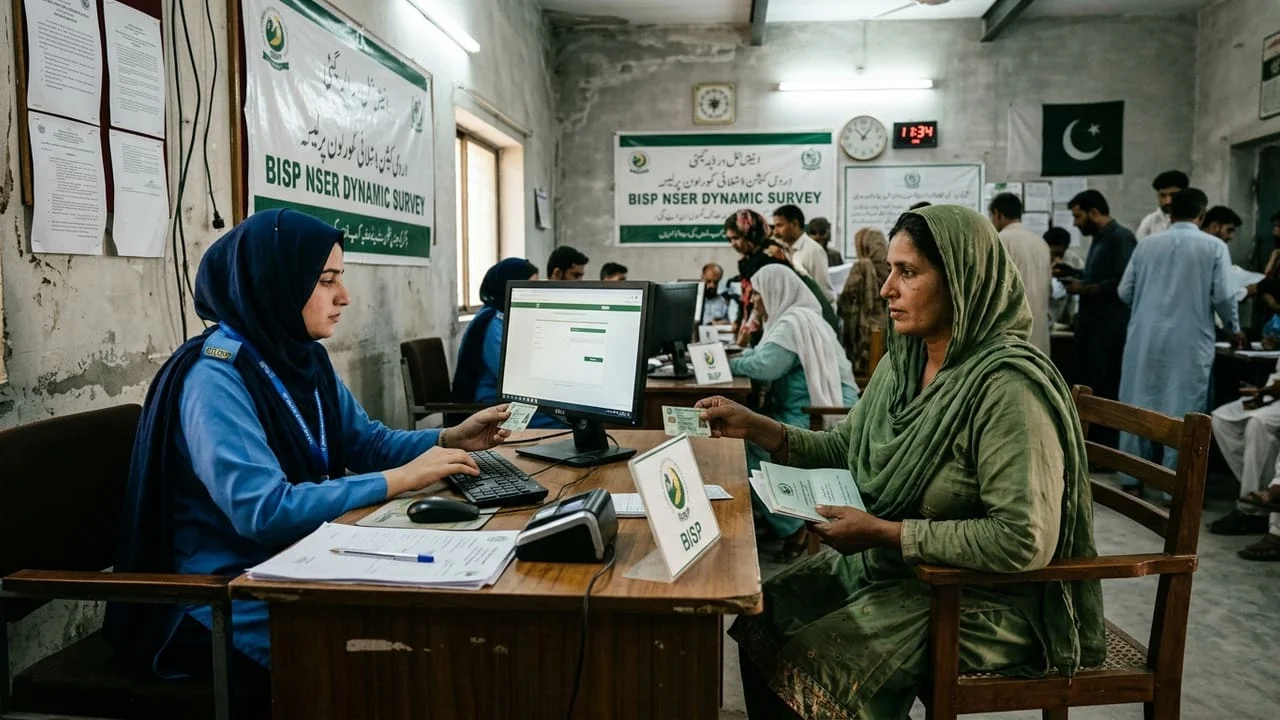
BISP Dynamic Survey Ke Liye Kon Se Documents Chahiye: Tehsil Desk Timing Aur Token System Guide (2026)
BISP Dynamic Survey ke liye asal CNIC, tamam bachon ka NADRA B-Form (CRC), haaliya bijli ya gas ka utility bill, aur registered mobile SIM zaroori hain. Bewa khawateen ke liye shohar ka Death Certificate aur mazoor afraad ke liye Wheelchair CNIC lazmi hai. Tehsil office desk Pir ta Juma subah 8:00 baje se shaam 4:00 baje tak khula hota hai.
Read guide