This article explains public information. It does not determine eligibility or replace an official notice.
What is the KP Workers Welfare Fund Scholarship 2026?
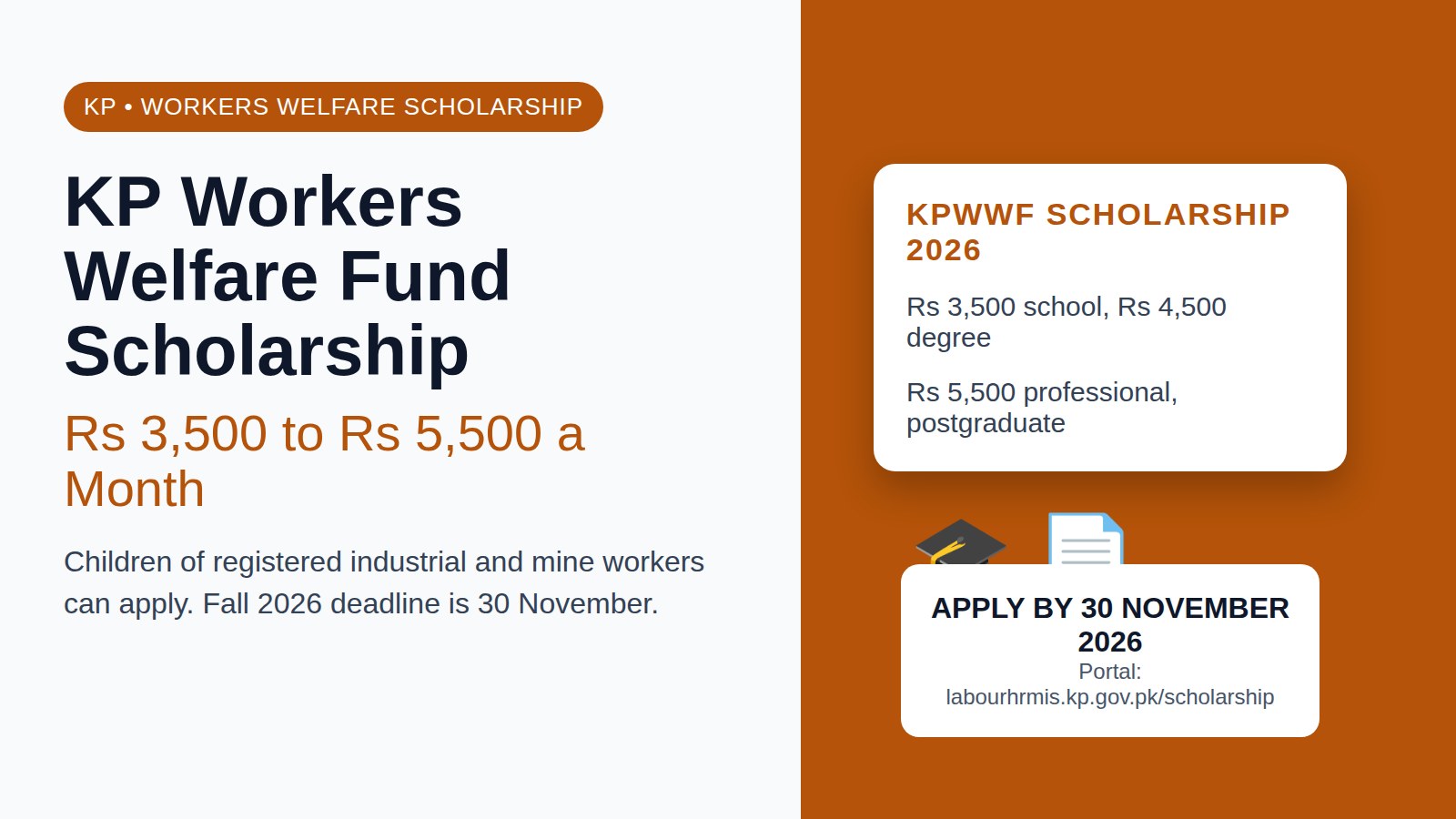
The KP Workers Welfare Fund Scholarship 2026 is an educational assistance programme for the children of registered industrial and mine workers in Khyber Pakhtunkhwa. The Directorate of Education Khyber Pakhtunkhwa launched the 2026 programme, and the Khyber Pakhtunkhwa Workers Welfare Board administers it. The programme pays a monthly stipend and can also cover fee reimbursement. It covers students from matriculation and intermediate level through undergraduate degrees and on to postgraduate, engineering and medical study, as long as the student studies at a recognised institution and the parent worker meets the registration and service rules. The policy began in 1998-99, and it passed to the provincial boards in 2000.
Who runs the scholarship and who pays for it?
The Khyber Pakhtunkhwa Workers Welfare Board runs the scholarship in the province, and its scholarship section handles applications, verification and payment. The Directorate of Education Khyber Pakhtunkhwa launched the 2026 round, which is why some reports name the directorate as the launching body and others name the board as the administering body. Both descriptions are correct, and they refer to different roles. The money comes from the Workers Welfare Fund framework, to which industrial and mine establishments contribute. An establishment must be registered under the relevant law, or contribute under the Workers Welfare Fund Ordinance 1971 at 2 percent, or under the Companies Profit (Workers Participation) Act 1968 at 5 percent.
What does the scholarship pay for?
The scholarship pays a monthly stipend that depends on the student's level of study. It also covers fee reimbursement in the cases the rules allow. In the reimbursement mode, a student pays the fee first, keeps the original receipt, and then claims the amount back. In the panel university mode, the student takes admission at a recognised institute, college or university where a provisional offer letter issued by the scholarship section applies, and the board pays the institution directly. The board's own information also lists admission, tuition, transport, hostel and mess, registration, examination, library and lab fees. Category I students also receive a book allowance, but its exact amount is unconfirmed as of 9 November 2026.
How much is the monthly stipend?
As of 9 November 2026, the monthly stipend is Rs 3,500 for Category I, Rs 4,500 for Category II and Rs 5,500 for Category III. Both result.pk reports agree on those rates.
| Category | Level of study | Monthly stipend |
|---|---|---|
| Category I | Matric, intermediate, equivalent and technical education | Rs 3,500 |
| Category II | Two year and four year graduation and undergraduate degree programmes | Rs 4,500 |
| Category III | Postgraduate, engineering and medical programmes | Rs 5,500 |
Category I covers school and intermediate students, including technical education. Category II covers two year or four year graduation programmes at a public or private university, or an affiliated college recognised by the Higher Education Commission. Category III covers postgraduate, engineering and medical degrees from institutions registered with the Higher Education Commission and the relevant professional council. The stipend is paid only for the period the university prescribes for degree completion, and the fund does not pay for repeated courses or for failures. Over twelve months, the stipend comes to Rs 42,000 in Category I, Rs 54,000 in Category II and Rs 66,000 in Category III, which is our calculation from the confirmed monthly rates.
Who can apply for the KP Workers Welfare Fund Scholarship 2026?
The scholarship is for children of eligible industrial and mine workers, not for the workers themselves. The programme is merit and need based. Four checks decide most applications. First, the parent must be a worker under the legal definition that applies. Second, the parent must be registered with the Employees Old-Age Benefits Institution, known as EOBI, or with an Employees Social Security Institution, known as ESSI, or must provide the prescribed alternative where the rules allow it. Third, the parent must meet the service requirement for the student's level. Fourth, the student must study at a recognised institution and meet the academic requirement.
Does the parent need EOBI or ESSI registration and three years of service?
Yes, in the normal case. The parent must be registered with EOBI or ESSI, and must have a minimum service tenure of three years in a recognised industrial unit or mine. That is the rule stated in the primary 2026 report, and it matches the 2025-26 advertisement. The three year rule is not the same for every level. For education up to intermediate level, the published 2025-26 rules state that no minimum service period applies. For education above intermediate level, the worker normally needs at least three years of cumulative service. The 2025-26 rules describe a notarised affidavit alternative for an unregistered worker, but the primary 2026 report does not repeat it, so confirm whether it still applies. The worker must also fall under the definition of a workman in the Industrial Relations Act 2012, known as IRA 2012.
What must the student show?
The student must be the child of an eligible worker, and must study at a recognised institution. For university level study, the institution must be recognised by the Higher Education Commission, and for engineering or medical study it must also hold the relevant professional recognition. For technical study, the institute must be registered with the relevant technical and vocational authority. The student must also hold an admission or offer letter where the rules require one. The academic requirement is the least firmly confirmed part of this guide. The second result.pk report, drawing on an EduVision listing, states that 60 percent marks are required for FSc and university programmes, and 80 percent marks are required for medical and engineering programmes. The primary 2026 report does not state any marks requirement, and we could not verify the figures against an official board notice. Treat them as reported but unconfirmed.
Can children of deceased or disabled workers apply?
Yes, in the cases the rules describe. Children of deceased workers can qualify where the death grant has been claimed, and children of workers who became disabled during service can qualify where a legal medical board has certified the disability. The facility also extends to children of retired workers, workers laid off because an industry closed, and workers of the Workers Welfare Board or Workers Welfare Fund themselves. Two limits apply to every family. The facility can cover up to three children of one worker, and there is no age limit. A worker cannot apply for their own study under this facility.
Which deadline applies to you?
This is where the sources disagree, and the disagreement matters. As of 9 November 2026, there are two different sets of dates, and they describe different things. The first set comes from the primary 2026 report, and it is tied to the admission session. The Fall 2026 session deadline is 30 November 2026, and the Spring 2027 session window runs from 1 January to 28 February 2027. The second set comes from a second result.pk report that draws on an EduVision listing, and it is tied to the scholarship category. It lists 31 January 2027 for Category I, and 30 April 2027 for Category II and Category III. Do not treat 30 April 2027 as a single universal deadline. Treat 30 November 2026 as the deadline for Fall 2026 admissions, and the January and April dates as the category dates for the 2026-27 reimbursement track. That reading is our reconciliation of the two sources, not a statement from the board, so confirm which date governs your case on the official portal.
| Date | What it covers | Source as of 9 November 2026 |
|---|---|---|
| 30 November 2026 | Fall 2026 session deadline | Primary 2026 report on result.pk |
| 1 January to 28 February 2027 | Spring 2027 session submission window | Primary 2026 report on result.pk |
| 31 January 2027 | Category I, listed for reimbursement cases | Second result.pk report, drawing on an EduVision listing |
| 30 April 2027 | Category II and Category III | Second result.pk report, drawing on an EduVision listing |
The 2025-26 round followed the same session pattern, with a Fall deadline of 30 November 2025 and a Spring window from 1 January to 28 February 2026, and late applications were not accepted. If the two sets of dates point in different directions for your case, follow the earlier date. You have 21 days from 9 November 2026 to the Fall deadline, so start the document collection now rather than in the last week.
How to apply for the KP Workers Welfare Fund Scholarship 2026
Apply through the official portal at labourhrmis.kp.gov.pk/scholarship. The primary 2026 report states that applicants must visit the portal to set up their profile and upload scanned copies of all required credentials. We tried to open the portal on 9 November 2026, and the page returned only a footer line naming the Directorate of Labour in Peshawar, with no usable form, menu or instruction text. We could not confirm the exact screens or steps from the portal itself. Do not pay any agent who claims to have a shortcut, and do not use a link from a social media post or a WhatsApp forward.
- Confirm the parent worker and the student meet the eligibility rules, and identify the student's category.
- Confirm the student's institution is recognised for the programme.
- Obtain the admission or offer letter where the rules require one.
- Collect the worker's CNIC, EOBI or ESSI card, service and salary certificates, and the student's CNIC or Form-B, photographs and academic records.
- Complete the prescribed form and obtain the factory management and CBA attestations where required.
- Create a profile on the official portal and upload scanned copies of the required credentials. This step is confirmed only in the form stated by the primary 2026 report, because the portal itself could not be read on 9 November 2026.
- Submit the application through the prescribed process, and keep copies of everything you submit.
The 2025-26 advertisement also described a physical submission route. Forms for Peshawar and adjoining districts went to the Scholarship Section at the Khyber Pakhtunkhwa Workers Welfare Board main office, Plot No. 2, Sector A-3 near the FIA Building, Phase-5, Hayatabad, Peshawar. Forms for the Haripur and Bannu zones went to their respective zonal offices. The numbers listed were 091-9217146 for the Secretary and 091-9217193 for the Assistant Director (Scholarship). Those details come from the 2025-26 advertisement, not from a 2026 notice, so confirm them before you travel or call. An older portal address also appears as labourris.kp.gov.pk/scholarship, which may be a misprint, so use the labourhrmis.kp.gov.pk/scholarship address.
What documents do you need?
The list below names only the documents the sources actually name. The primary 2026 report names four items, and the 2025-26 rules name a fuller list. Confirm the final list on the official portal. The documents the sources name are the worker's EOBI or ESSI card, a factory management or CBA attested certificate, the student's Form-B or CNIC copy, and previous academic result cards, known as DMCs. The fuller 2025-26 list adds the attested scholarship form, an offer letter, a photograph, the worker's CNIC, original service and salary certificates, establishment registration and contribution proof, a stamp paper undertaking, fee receipts for reimbursement cases, and institution affiliation proof. Documents must be attested by a Gazetted Government Officer of BPS-17 or above, except where the rules specify otherwise.
Check your eligibility in one minute
Use the self check below before you apply. Count yourself as ready only if every confirmed row is a yes. Rows marked as to confirm are points where the sources do not agree, so treat them as a prompt to ask the scholarship section. If you answered yes to every confirmed row, submit before the earlier of the dates that could apply to you. If you answered no to any confirmed row, fix that point first, because the board verifies information physically with the industrial unit.
| Check | Rule as of 9 November 2026 | Your answer |
|---|---|---|
| Is the parent a registered industrial or mine worker? | Yes, required, and the worker must meet the IRA 2012 workman definition | Yes or no |
| Is the parent registered with EOBI or ESSI? | Yes, normally required, or the prescribed affidavit alternative where allowed | Yes or no |
| Has the parent completed three years of service? | Yes, for study above intermediate level. No minimum applies up to intermediate level | Yes, no, or not needed for my level |
| Is the employer registered and contributing to the fund? | Yes, required, at 2 percent under the 1971 Ordinance or 5 percent under the 1968 Act | Yes or no |
| Is the student the child of the worker? | Yes, required. The worker cannot claim it for their own study | Yes or no |
| Is the institution recognised? | Yes, required, by the relevant board, HEC or professional council | Yes or no |
| Do you have an admission or offer letter? | Yes, where the rules require one | Yes or no |
| Are your documents attested? | Yes, by a Gazetted Officer BPS-17 or above where required, plus management and CBA attestation on the form | Yes or no |
| Do you meet the marks rule? | To confirm. 60 percent for FSc and university and 80 percent for medical and engineering are reported but unconfirmed | Ask the scholarship section |
| Which deadline governs your case? | To confirm. Fall 2026 is 30 November 2026, and the category dates run to 31 January and 30 April 2027 | Use the earlier date until confirmed |
What can go wrong with an application?
Most failed applications fail on documents or on dates, not on marks. The common problems are incorrect worker information, invalid EOBI or ESSI documentation, a missing service or salary certificate, study at an unrecognised institution, a missed deadline, an incomplete form, an unsupported reimbursement claim, and false information. The board may verify the information with the industrial establishment. A student must complete the course within the approved timeframe, cannot simply change discipline without permission, and only one postgraduate level course will be financed.
How does this scholarship compare with other Pakistani scholarships?
The KP Workers Welfare Fund Scholarship is different from the general scholarships most students know, because it is tied to the parent's job, not to the student's province alone or to a test score alone. The Ehsaas Undergraduate Scholarship is a need based programme for undergraduate students, and it does not require a parent to be an industrial worker. The CM Punjab Honhaar Scholarship Program 2026 is a Punjab merit scholarship, limited to Punjab. The Scotland Pakistan Scholarships for Young Women and Girls support women and girls in specific fields. Families should also know about the Benazir Mazdoor Card and the Federal Contributory Pension Scheme. Apply to the scheme that matches your facts.
Frequently asked questions
What is the KP Workers Welfare Fund Scholarship 2026?
The KP Workers Welfare Fund Scholarship 2026 is an educational assistance programme for children of registered industrial and mine workers in Khyber Pakhtunkhwa. It pays a monthly stipend of Rs 3,500 to Rs 5,500, depending on the student's level.
Who can apply for the KP Workers Welfare Fund Scholarship 2026?
Children of eligible industrial and mine workers can apply, as long as the parent meets the worker definition in the Industrial Relations Act 2012 and the student studies at a recognised institution. The parent must normally be registered with EOBI or ESSI.
What is the last date to apply for the KP Workers Welfare Fund Scholarship 2026?
As of 9 November 2026, the Fall 2026 session deadline is 30 November 2026. The Spring 2027 window runs from 1 January to 28 February 2027, and a second source lists 31 January 2027 for Category I and 30 April 2027 for Categories II and III.
How much stipend will I receive under the KP Workers Welfare Fund Scholarship 2026?
You will receive Rs 3,500 a month in Category I, Rs 4,500 a month in Category II, or Rs 5,500 a month in Category III. The stipend is paid only for the period the university prescribes for degree completion.
Is EOBI or ESSI registration required for the KP Workers Welfare Fund Scholarship 2026?
Yes, in the normal case the parent must be registered with EOBI or ESSI. The 2025-26 rules describe a notarised affidavit alternative for an unregistered worker, but the primary 2026 report does not repeat it, so confirm whether it still applies.
Is there a three year service requirement for the KP Workers Welfare Fund Scholarship 2026?
Yes, for study above intermediate level the parent normally needs at least three years of cumulative service. For education up to intermediate level, the published 2025-26 rules state that no minimum service period applies.
What marks do I need for the KP Workers Welfare Fund Scholarship 2026?
That point is unconfirmed as of 9 November 2026. A second report drawing on an EduVision listing states 60 percent marks for FSc and university programmes and 80 percent for medical and engineering programmes, but the primary 2026 report states no marks requirement.
What documents are required for the KP Workers Welfare Fund Scholarship 2026?
The sources name the worker's EOBI or ESSI card, a factory management or CBA attested certificate, the student's Form-B or CNIC copy, and previous academic result cards, known as DMCs. The fuller 2025-26 list adds the attested form, an offer letter, photographs, the worker's CNIC, and service and salary certificates.
How do I apply online for the KP Workers Welfare Fund Scholarship 2026?
Apply on the official portal at labourhrmis.kp.gov.pk/scholarship, where the primary 2026 report says applicants create a profile and upload scanned copies of their credentials. We tried to open the portal on 9 November 2026 and it returned only a footer line.
Can more than one child from the same family receive the scholarship?
Yes, the scholarship facility can cover up to three children of one worker, subject to each child meeting the eligibility rules. There is no age limit, and children of deceased or disabled workers can qualify in the cases the rules describe.
Sources and official links
Check the destination address before entering personal information.
Related guides
Ehsaas Undergraduate Scholarship 2026 Online Apply: HEC Portal Check, 100% Tuition Fee & Rs 4,000 Stipend Guide
Apply online for HEC Ehsaas Undergraduate Scholarship 2026 on ehsaas.hec.gov.pk. Learn how to secure 100% full tuition fee coverage, Rs 4,000 monthly stipend, prepare university FAO documents, and clear the ISAC interview.
Read guide
CM Punjab Honhaar Merit Scholarship Program 2026: Online Apply, Eligibility & 100% Tuition Fee Guide
To apply online for the CM Punjab Honhaar Merit Scholarship Program in 2026, register on the official portal at honhaarscholarship.punjabhec.gov.pk using your CNIC/B-Form and academic registration details. The Government of Punjab provides 100% full tuition fee coverage for 30,000 undergraduate students enrolled in 68 priority disciplines across 50 public universities and medical colleges.
Read guide
Scotland Pakistan Scholarships for Young Women and Girls: Complete Eligibility, Benefits, and Application Guide
The Scotland Pakistan Scholarships for Young Women and Girls is a fully funded financial aid program funded by the Scottish Government and administered by the British Council Pakistan. It covers university tuition, hostel accommodation, and travel for eligible female Pakistani students pursuing undergraduate or master's degrees at HEC-recognized universities inside Pakistan.
Read guide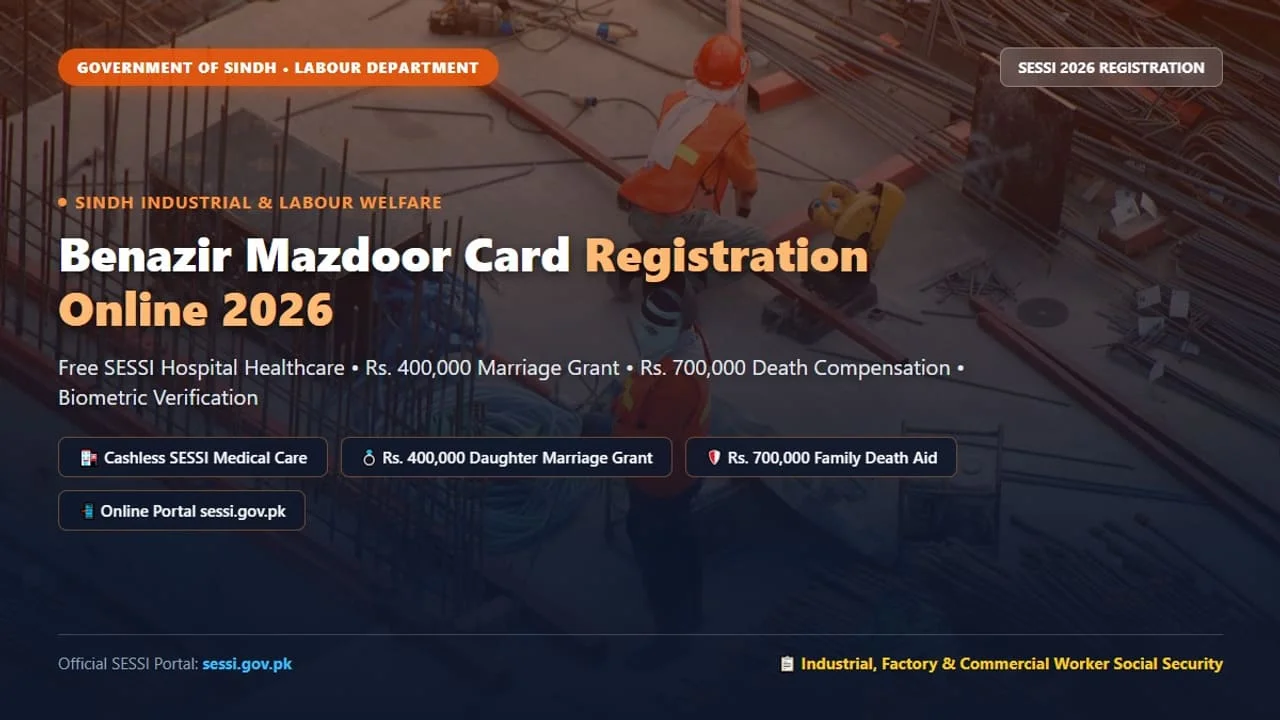
Benazir Mazdoor Card Registration Online 2026: Sindh SESSI Apply & Benefits
Complete guide to Benazir Mazdoor Card registration online 2026 in Sindh. Learn SESSI worker registration, free healthcare, education grants, and biometric verification.
Read guide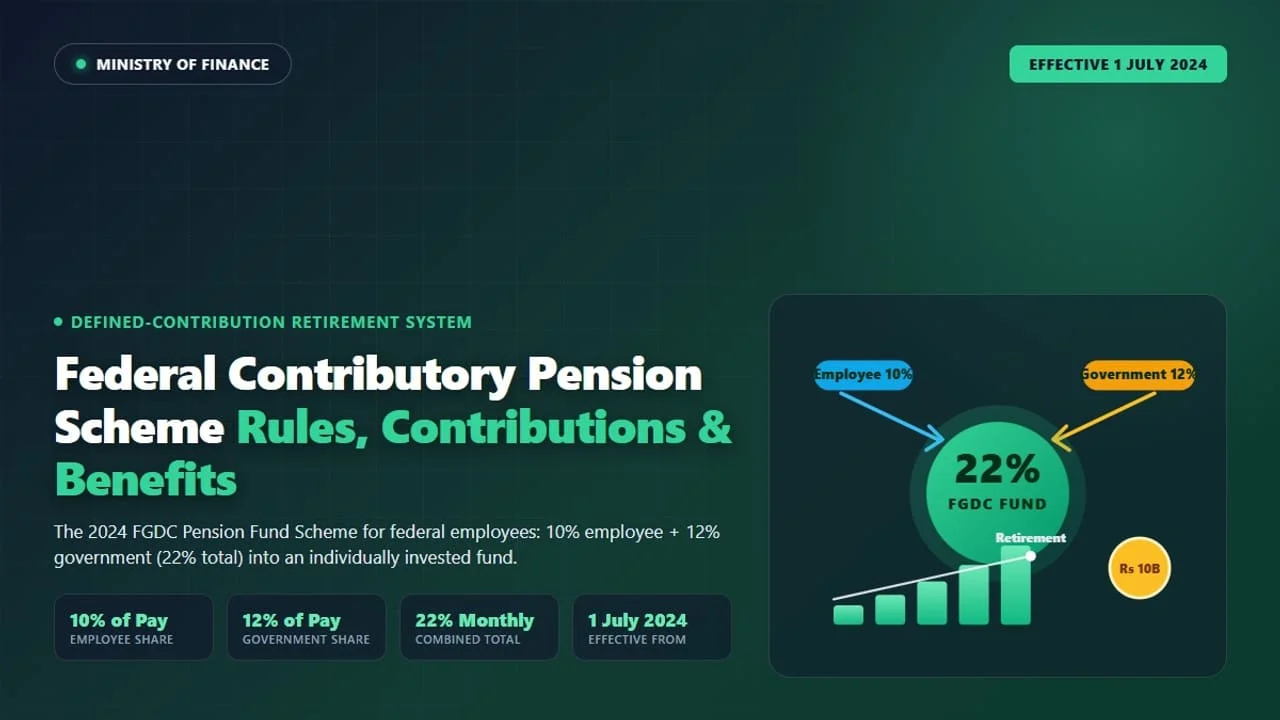
Federal Contributory Pension Scheme: FGDC Rules, Contributions & Benefits
Pakistan's Federal Contributory Pension Scheme (FGDC) covers federal employees hired after 1 July 2024. The employee contributes 10% and the government 12% (22% total) into an individually invested fund managed by licensed pension fund managers.
Read guide