This article explains public information. It does not determine eligibility or replace an official notice.
What Is the Wazir-e-Azam Apna Ghar Program?
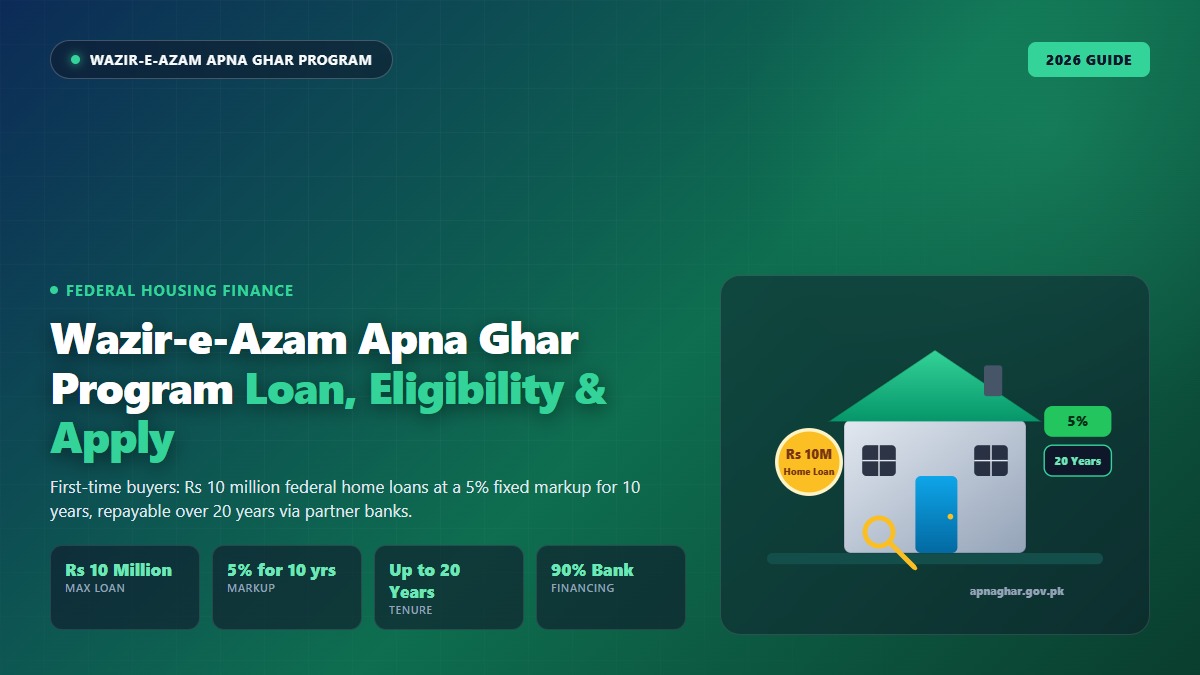
The Wazir-e-Azam Apna Ghar Program, slogan Ghar Ho Tu Apna, is Pakistan's federal housing finance scheme launched by Prime Minister Muhammad Shehbaz Sharif on 30 April 2026 and regulated by the State Bank of Pakistan. It gives first-time buyers a subsidised home loan at a 5% fixed markup for the first decade, instead of the 20%-plus market rates ordinary mortgages carry.
Because it is a markup subsidy and risk-sharing scheme, the government pays the difference between the 5% rate the borrower gets and the bank's commercial rate, and it shares part of the credit risk. That is what lets commercial banks, Islamic banks, the House Building Finance Company and, since July 2026, non-bank finance companies offer a 20-year mortgage at 5% in the first place.
A Federal Markup-Subsidy Housing Scheme
The programme succeeds and rebrands the earlier Mera Pakistan Mera Ghar (MPMG) markup subsidy initiative. It is delivered through partner financial institutions, not directly by the government, and the financing is available in both conventional and Shariah-compliant (Diminishing Musharakah) forms.
Unlike the Punjab-only housing schemes, this is a federal programme covering all four provinces plus Islamabad, Gilgit-Baltistan and Azad Kashmir.
What the Loan Actually Covers
The financing can be used for any one of four purposes: buying a constructed house, buying a flat, buying a residential plot together with construction, or building on a plot you already own. A plot-only purchase with no construction, and pure renovation finance, are not covered.
The property must fall within the size limits: a house of up to 10 marla (2,720 square feet) or a flat of up to 1,500 square feet, with no cap on the property's price.
How Much Can I Borrow, and What Is the Markup?
The maximum financing is Rs 10 million, offered in four standard slabs. The indicative monthly payments below were announced at launch, calculated at the 5% rate over 20 years.
The 5% Markup and the KIBOR Repricing
The customer pays a 5% markup fixed for the first 10 years, subsidised by the government. From year 11 the rate moves to 1-year KIBOR plus 3%, so the monthly installment can change with market conditions.
Banks must disclose this re-pricing schedule before you sign, so read the Key Fact Statement for the exact terms rather than relying on the headline 5%.
The 90:10 Financing Split
The bank finances up to 90% of the property value and you contribute the remaining 10% as equity. On a Rs 10 million home that means you bring roughly Rs 1 million and the bank finances the rest.
There is no processing fee and no prepayment penalty, so you can settle the loan early at no extra cost - a key difference from standard mortgages.
| Loan slab | Typical use | Indicative monthly installment |
|---|---|---|
| Rs 2,500,000 | Smaller home or 3-marla construction | Rs 16,499 |
| Rs 5,000,000 | 5-marla home or ~1,000 sq ft flat | Rs 32,997 |
| Rs 7,500,000 | 7-marla home or larger flat | Rs 49,497 |
| Rs 10,000,000 | Up to 10-marla home or 1,500 sq ft flat | Rs 65,996 |
Who Is Eligible for the Apna Ghar Program?
Eligibility is deliberately broader than the provincial housing schemes because this programme targets the working and middle class, not only the poorest households.
- Resident Pakistani citizen holding a valid CNIC, or a Non-Resident Pakistani (NRP) holding a NICOP or POC
- First-time homeowner - no residential property currently registered in your name anywhere in Pakistan
- Stable, verifiable income from salary, business, or remittance
- Clean credit history with no loan defaults (a clean e-CIB record)
Income, Age and Work History
The minimum income and age rules are set by each participating bank, so they vary slightly. Most banks require a minimum gross income of roughly Rs 25,000 to Rs 50,000 per month, and the applicant must not exceed about 60 years of age (salaried) or 65 years (self-employed) at loan maturity.
Work history matters too: salaried applicants typically need six months to two years of continuous employment, while self-employed applicants usually need two to three years in the same business. Owning agricultural land or a commercial shop does not disqualify you - the first-time-homeowner rule applies only to residential property.
What Documents Do I Need?
Gather clear, complete copies before you start - incomplete files are the most common cause of delay.
- Valid CNIC (and your spouse's CNIC if married) and recent passport-size photographs
- Income proof - salary slips or a salary certificate for salaried applicants, or bank statements and tax/NTN records for the self-employed
- Recent bank statements showing your income and your 10% equity amount
- Property documents - sale agreement or title document, Fard/registry/allotment letter, and an approved building plan for construction
- An affidavit declaring you own no other residential property, plus personal and professional references
How to Apply Online at apnaghar.gov.pk
The application is fully digital through the official portal. Follow these steps inside the current window:
- Step 1: Open the official portal at https://apnaghar.gov.pk - the only official federal application portal, hosted on the .gov.pk domain and linked from the State Bank of Pakistan website.
- Step 2: Register with your 13-digit CNIC, a mobile number in your own name, and an email address, then verify the SMS OTP and email link.
- Step 3: Complete the application form - personal, income, employment and property details - then select your loan slab and preferred bank.
- Step 4: Upload clear scans of your documents as PDF or JPG files, each under 2 MB.
- Step 5: Choose your bank from the participating commercial banks, Islamic banks, HBFC, or eligible NBFCs and microfinance companies.
- Step 6: Submit and save your Tracking ID. The bank contacts you within 3-5 working days for valuation and verification.
- Step 7: Approval and disbursement - banks are mandated to complete approval within 15 working days of a complete application.
Which Banks and NBFCs Offer the Apna Ghar Loan?
The scheme is delivered through a wide network of financial institutions, not a single bank. Confirmed participants include National Bank of Pakistan (NBP), Bank of Punjab (BOP), Meezan Bank, HBL, Allied Bank, UBL, MCB Bank, Bank Alfalah, Bank AL Habib, Faysal Bank, Askari Bank, Mobilink Bank and Standard Chartered, plus the House Building Finance Company (HBFC).
A change many older guides miss: from July 2026 the programme is no longer bank-only. Non-bank housing finance and investment finance companies can now lend up to Rs 10 million, and microfinance companies up to Rs 5 million, widening reach into smaller cities and towns.
Apna Ghar vs Apni Chhat Apna Ghar: What's the Difference?
The names are confusingly similar, but these are different schemes run by different governments. The Wazir-e-Azam Apna Ghar Program is federal; Apni Chhat Apna Ghar (ACAG) is a Punjab-only scheme launched by Chief Minister Maryam Nawaz Sharif.
| Parameter | Wazir-e-Azam Apna Ghar (Federal) | Apni Chhat Apna Ghar (Punjab) |
|---|---|---|
| Government level | Federal | Punjab |
| Coverage | All provinces + Islamabad + GB + AJK | Punjab only |
| Maximum loan | Rs 10 million | Rs 1.5 million |
| Markup | 5% fixed for 10 years, then KIBOR + 3% | 0% (interest-free) |
| Tenure | Up to 20 years | 7-9 years |
| Portal | apnaghar.gov.pk | acag.punjab.gov.pk |
Official Portal, Scam Alerts and Safety
The sole official application portal is apnaghar.gov.pk. Since the April 2026 launch, lookalike websites and Facebook pages have appeared offering paid registration - the real portal ends in .gov.pk, is linked from the State Bank of Pakistan's website, and never charges a fee.
If a bank delays, overcharges, or refuses a legitimate application without reason, register a grievance through the State Bank of Pakistan complaint portal at complaint.sbp.org.pk. This is the official escalation path, not an agent or a facilitation website.
- Registration and application are free - never pay an agent or a website that promises guaranteed approval.
- Never share your CNIC image, OTP, password or bank PIN with anyone.
- Never send money through JazzCash, Easypaisa or any wallet to an unknown person for fast processing.
Frequently asked questions
What is the Wazir-e-Azam Apna Ghar Program?
The Wazir-e-Azam Apna Ghar Program is Pakistan's federal housing finance scheme, a markup subsidy and risk-sharing programme launched by Prime Minister Shehbaz Sharif on 30 April 2026 and regulated by the State Bank of Pakistan. It gives first-time buyers subsidised home loans through partner banks.
What is the maximum loan amount?
The maximum loan is Rs 10 million, offered in slabs of Rs 2.5 million, Rs 5 million, Rs 7.5 million and Rs 10 million. The slab you qualify for depends on your income, equity contribution and the property value being financed.
What is the markup rate?
The markup is 5% fixed for the first 10 years, subsidised by the government. After year 10 it moves to 1-year KIBOR plus 3%, a market-linked rate, so your monthly installment may change.
Is the Apna Ghar Program interest-free?
No. It carries a fixed 5% markup for the first decade, not zero interest. The interest-free scheme is the separate Punjab-only Apni Chhat Apna Ghar programme.
How much down payment do I need?
You contribute 10% of the property value as equity, while the bank finances up to 90%. There is no processing fee and no prepayment penalty.
Who is eligible for the Apna Ghar Program?
Any resident Pakistani holding a valid CNIC - or an NRP with a NICOP or POC - who is a first-time homeowner with a stable, verifiable income and a clean credit history. Both salaried and self-employed applicants can apply.
What kind of property is covered?
A house of up to 10 marla (2,720 sq ft) or a flat of up to 1,500 sq ft, with no cap on price. You can buy a house or flat, buy a plot with construction, or build on a plot you already own.
Which banks and NBFCs offer the loan?
Participating lenders include NBP, Bank of Punjab, Meezan Bank, HBL, Allied Bank, UBL, MCB, Bank Alfalah, Bank AL Habib, Faysal Bank, Askari Bank, Mobilink Bank, Standard Chartered and HBFC. From July 2026, eligible NBFCs and microfinance companies can also lend.
How do I apply online?
Visit apnaghar.gov.pk, register with your CNIC and mobile number, complete the application form, upload your documents, choose a participating bank, and submit. You will receive a Tracking ID to monitor progress.
Is there any application fee?
No. Application is free, with no processing fee and no prepayment penalty. Anyone charging a registration fee is running a fraud.
Sources and official links
Check the destination address before entering personal information.
Muhammad Salman specializes in Pakistani public sector financing, youth entrepreneurship schemes, and government subsidy programmes, cross-referencing all data against official SBP circulars and ministry directives.
Related guides
Apni Chhat Apna Ghar Scheme Online Apply 2026: ACAG Portal Registration, Eligibility & Rs 15 Lakh Loan Guide
To apply online for the CM Punjab Apni Chhat Apna Ghar Scheme in 2026, register on the official government portal at acag.punjab.gov.pk using your 13-digit CNIC and mobile number, upload your land ownership documents (Fard/Registry for up to 5 Marla urban or 10 Marla rural plots), and complete your household socio-economic profile. Eligible citizens receive an interest-free construction loan of up to Rs. 15 Lakh with an installment of ~Rs. 14,000 over 7 years.
Read guide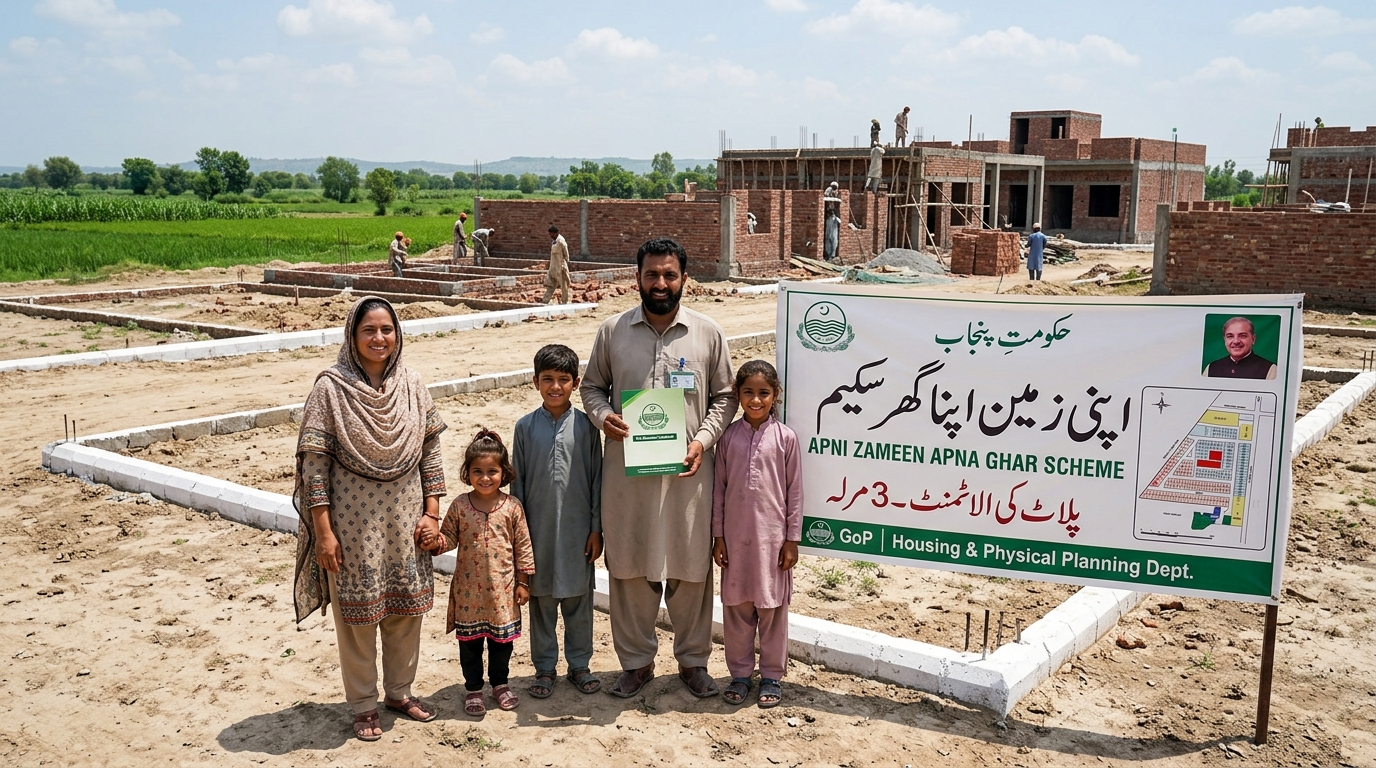
Apni Zameen Apna Ghar Balloting Result 2026: How to Check CNIC Status & Plot Rules
Check the Apni Zameen Apna Ghar balloting result 2026 online by CNIC. Guide on Phase 1 winner status, 3-marla plot allocation, and rules after selection.
Read guide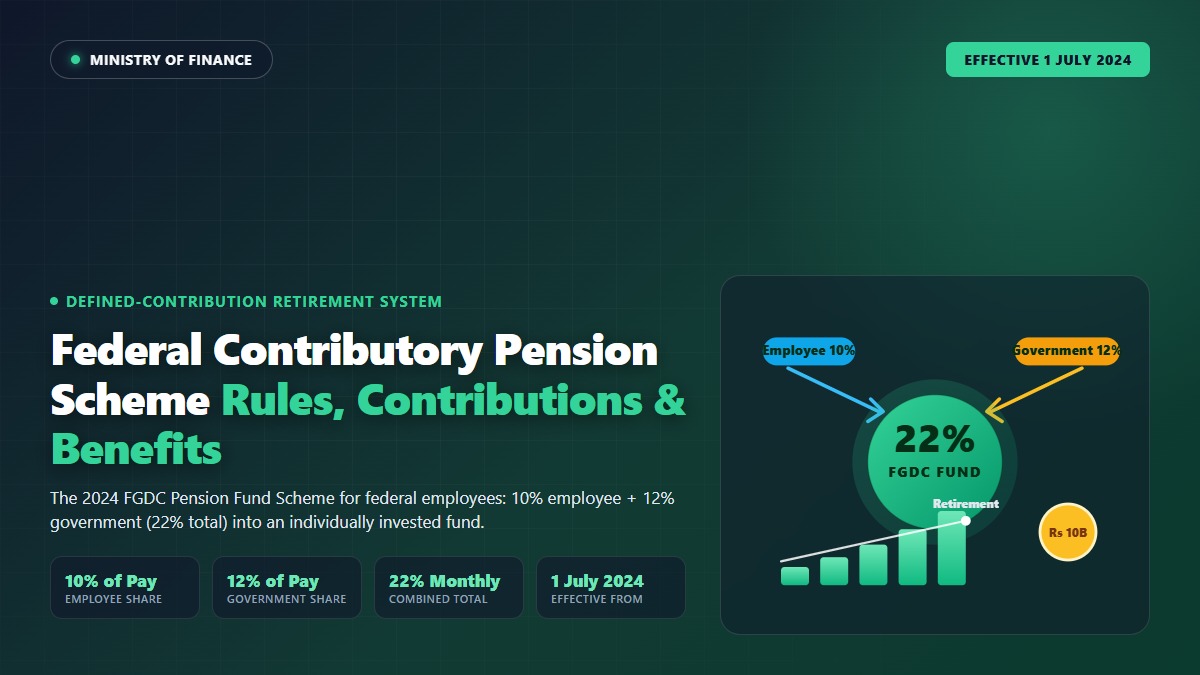
Federal Contributory Pension Scheme: FGDC Rules, Contributions & Benefits
Pakistan's Federal Contributory Pension Scheme (FGDC) covers federal employees hired after 1 July 2024. The employee contributes 10% and the government 12% (22% total) into an individually invested fund managed by licensed pension fund managers.
Read guide
Prime Minister Youth Loan Scheme 2026: Complete Application, Eligibility & Tiers Guide
The Prime Minister Youth Loan Scheme 2026 provides subsidized business financing up to Rs 7.5 million for Pakistani citizens aged 21 to 45 across three tiers (0%, 5%, and 7% markup). Apply online through the official pmyp.gov.pk portal.
Read guide