This article explains public information. It does not determine eligibility or replace an official notice.
There’s No Single “Benazir Form” — Here’s What People Actually Mean
The confusion is understandable — “Benazir” refers broadly to the Benazir Income Support Programme, and BISP runs several distinct programs under that name, each with its own paperwork and eligibility process. Someone searching for “the Benazir form” could mean the general household registration survey, the Kafaalat cash transfer enrollment, the Taleemi Wazaif education stipend application, or the Nashonuma nutrition program form — and each of these serves a different purpose.
The Different BISP-Related Forms, Explained
| Form | Purpose | Who Needs It |
|---|---|---|
| NSER / Dynamic Survey Form | General household registration that creates or updates your record in the National Socio-Economic Registry | Anyone not yet registered, or households needing a resurvey |
| Kafaalat Enrollment Form | Enrollment into the core BISP cash transfer program | Households whose NSER/PMT score meets the eligibility threshold |
| Taleemi Wazaif Form | Education stipend application tied to school-going children | Kafaalat-registered families with children enrolled in school |
| Nashonuma Form | Nutrition support for pregnant/nursing women and young children | Eligible households with a qualifying pregnant woman, nursing mother, or child under two |
Each Form, Explained Simply
NSER/Dynamic Survey form (general registration)
This is the foundational form — it’s what actually gets your household into BISP’s system in the first place. Without this, none of the program-specific forms below apply, since eligibility for all of them is calculated from your NSER/PMT score.
Kafaalat enrollment form
Once your household is registered and your PMT score qualifies, Kafaalat enrollment is what activates the recurring quarterly cash transfer. This isn’t automatic — it’s a distinct step after registration, not a guaranteed follow-on.
Taleemi Wazaif (education stipend) form
This applies specifically to families already receiving Kafaalat who have children of school-going age. It requires proof of school enrollment, and payments are typically tied to maintaining a minimum attendance level.
Nashonuma (nutrition) form, if applicable to the reader
This targets a more specific group — pregnant women, nursing mothers, and children under two — within Kafaalat-eligible households, and is aimed at nutrition support rather than general income support.
Documents You’ll Need
Use this as a starting checklist before visiting a BISP Tehsil Office:
- Original CNIC (yours, and household members’ where relevant)
- Form-B for children without their own CNIC
- Proof of household income or lack thereof, where requested
- Proof of school enrollment (for Taleemi Wazaif specifically)
- Any prior BISP reference number or NSER survey ID, if you’ve been surveyed before
- A working, currently active mobile number for OTP and SMS verification
Where and How to Get and Submit It
All of these forms are handled at your nearest BISP Tehsil Office, or through a household visit from an NSER enumerator during an active dynamic survey round in your area. There’s no need to download or print a form yourself in advance — the office manages the paperwork directly as part of the in-person process, since it involves biometric and CNIC verification that can’t be completed remotely.
Common Mistakes That Get Forms Rejected
- Submitting with an expired or mismatched CNIC that fails NADRA verification
- Applying for a program-specific form (like Taleemi Wazaif) before Kafaalat enrollment is confirmed
- Providing an inactive mobile number, which blocks OTP-based follow-up communication
- Incomplete household information, especially around income sources or family size
- Assuming a status check via 8171 counts as submission of any of these forms — it doesn’t
Frequently asked questions
Is the Benazir form free?
Yes — registration and all program-specific enrollment forms (Kafaalat, Taleemi Wazaif, Nashonuma) are free. You should never be asked to pay a fee to submit, process, or expedite any of these forms.
Where do I get the Benazir form?
You don’t download it yourself — it’s completed in person at a BISP Tehsil Office, or through an NSER enumerator during an active household survey in your area.
What documents go with the form?
At minimum, your original CNIC, and Form-B for any children without their own CNIC. Program-specific forms like Taleemi Wazaif also require proof of school enrollment.
How long does processing take?
Processing time varies by program and current survey activity in your district, but PMT score calculation and enrollment confirmation typically take several weeks rather than being instant — checking your BISP status via 8171 periodically is the best way to track progress.
Sources and official links
Check the destination address before entering personal information.
Saad has covered BISP, Ehsaas, and provincial welfare schemes for Live Govt Schemes & Ehsaas Programs since 2024, cross-checking every guide against the current official portal before publication.
Ayesha reviews programme-eligibility and payment content for accuracy against BISP, NADRA NSER, and provincial notices, and flags any guide that needs an update after an official policy change.
Related guides
8171 Register: Does Texting Your CNIC Actually Sign You Up for BISP?
No — texting your CNIC to 8171 does not register you for BISP. It only checks your existing status. Here’s how registration actually works.
Read guide
BISP Eligibility Criteria: Who Actually Qualifies for Benazir Kafaalat
BISP eligibility runs on a household's PMT score from the NSER survey, not a fixed income figure — the approved cutoff is 32, relaxed to 37 for households with a differently-abled member.
Read guide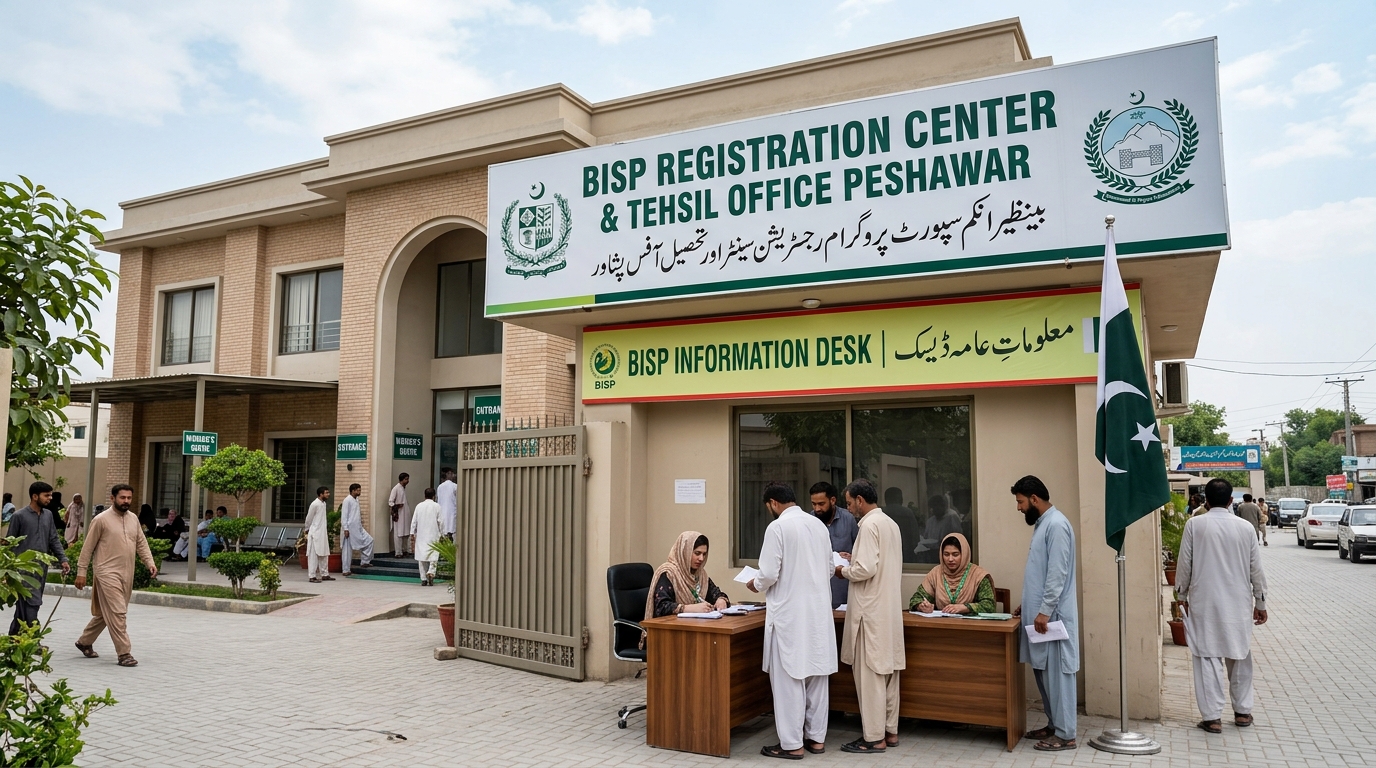
Verified BISP Tehsil Offices KPK & Peshawar List
Peshawar aur KPK ke tamam major districts ke BISP offices ke exact addresses, contact details aur timings ki mukammal master list.
Read guide